5/17/2013
I once bought a quart of high-quality fish emulsion to try on my strawberries. It cost me $16… and was gone faster than cheese doodles at Marley Fest. Other great fertilizers, like blood or kelp meal, require a generous home equity line to buy in quantity.
I recently wrote a “Chemical vs. Organic Fertilizers” post over at The Prepper Project. One thing I didn’t mention there, however, was how darn cheap chemical fertilizers are compared to their organic counterparts.
Before you send me hate mail: I know they’re not cheap in the long run. Chemical fertilizers can damage soil fertility, wreak havoc on a microscopic level, eat up fossil fuels, put toxic levels of salts in the ground, contribute to the pollution of our waterways and make your hands smell really weird. But – let’s face it – if you want to grow a garden and you don’t have much money, 10-10-10 is pretty affordable.
Most of what I’m going to write today may be old-hat to experience organic gardeners; but there’s always a new generation of experimenters and learners coming up behind us. They’re the ones I hope to reach… encourage… and inspire to grow their gardens both frugally and responsibly. Are you a cheapskate… and an organic gardener? Keep reading.
Cheap Option #1: Manure
Poultry, goat, sheep, rabbit, horse, cow… whatever the farm animal, manure is the classic soil amendment. Problem: much of it is contaminated or at risk of contamination by herbicides. That means we organic gardeners are in a real bind. Can you track down every shipment of hay that’s been fed to the animals producing your manure? Are you sure your local dairy farmer didn’t spray “Grazon” on his fields to control pigweed at some point? Manure may be the best… and hurray if you can get safe stuff… but it’s playing Russian Roulette until we get these nasty persistent herbicides BANNED.
Cheap Option #2: Seaweed
No – I’m not talking about buying seaweed fertilizer. That’s great stuff… but it’s expensive! I’m talking about picking up seaweed on the closest beach, rinsing the salt off it, then letting it rot in a bucket. It smells incredibly bad but is a great source of micronutrients. Strain and water away.
Cheap Option #3: Urine
That’s right. Homemade fertilizer! Thin with about 6 parts water to 1 part urine, then water away. Note: you can use urine in higher concentrations on some plants, particularly if you don’t have a high-salt diet. This stuff works like a charm. I saw a garden in South Florida sand that was green, lush, highly productive… and fed only on diluted urine. It’s completely safe since the human kidneys don’t allow bacteria to pass through, making urine sterile (unless you have a urinary tract infection – then all bets are off, and you probably won’t feel like gardening anyhow).
Cheap Option #4: Worm Tea
This is a great way to add microbes to your soil while feeding your plants. I use it as a drench and a foliar spray. If you keep a bin of worms, “worm tea” is the liquid that sits in the bottom. I’ve got a bin to catch the “tea” that drips from the old dishwasher I converted into a worm farm. I take that precious liquid, mix it with a generous amount of water and pour it around my tropical trees and potted plants as a special boost.
Cheap Option #5: Compost or Manure Tea
There are a lot of ways to make this stuff. Some people will tell you to put an air hose from an aquarium pump into the bottom of a barrel of water with a few scoops of compost or manure in it, then let it bubble for a day or two. Other folks simply let a barrel of compost/manure and water sit in the sun for a few weeks. Yet other gardeners will add molasses, Epsom salts, comfrey, yogurt and all kinds of fun stuff to the mix. Whatever way you do it, once you pour that stuff on plants, they are very, very happy. And it allows you to stretch your manure/compost supply a long, long way.
A Special Recipe for Awesome Growth … and Stinkiness
“Dad! Please don’t spray that stuff anymore! PLEASE!”
That’s what I hear when I use Dave’s Amazing Unbelievable Super Fertilizer™ in my heavy-duty 4-gallon backpack pump sprayer. To get a wide range of nutrients and lots of microbial action, I add (roughly):
1/2 cup unsulphured molasses (to feed microbes)
1 gallon of urine (for nitrogen and micronutrients)
1/2 cup of fish emulsion (adds more nitrogen and other nutrients)
1 cup of liquid seaweed (for trace minerals and even more micronutrients)
A bit of homemade liquid soap (to break surface tension)
A tablespoon of Epsom salts (for magnesium)
A few cups of worm tea (for micronutrients and added microbes)
I top that combination up with water and sometimes let it sit for a day or two before application. It smells horrifying but the plants absolutely love it. The smell will go away in a day or so, so apply at least two days before having a barbecue. Unless you want to turn all your guests vegetarian for life.
This tank mix adds microbes to the ground, feeds the soil web, provides micronutrients, foliar feeds the leaves and makes solicitors stay far, far away from your house.
Whatever method you use to feed your plants organically… keep experimenting! This is a journey we’re all on together. Share your thoughts and your recipes with others (so long as they don’t cost $16 a quart). If you do, we’ll all be a little richer… and our gardens will be a lot greener.
5/15/2013
After spending the past twenty years teaching composting, I have come to the conclusion that compost is the answer. Never mind the question-Compost is the answer. This pretty much puts me in the compost geek zone, of course. But through droughts and floods, jump-starting new gardens into big production and even battling cancer twice, I’ve found that the “organic matter family”-compost, vermicompost,
mulches and compost teas are powerful tools for getting food production and great nutrition right.
About five years ago I started experimenting with biochar. I collected charcoal from my wood stove, crushed it in a tough plastic bag with the car and charged it by soaking it in compost tea.
Microscopic picture of bIochar. These tiny pores are the secret of biochar’s power. Imagine each hole as a home for a microbe or a water trove for a fungal hyphae. It’s like putting a high rise condo for microbial life in every cubic inch of your soil.)Photo courtesy of CarbonGold
I’ve had what I believe are great results, Enough so that I’m ready to take it to the next level by building a small scale biochar retort. Fortunately I’m not alone. In the past year I’ve shared ideas with a growing community of Midwest biochar converts and gained more than I gave. Last weekend I completed my first biochar retort and tested it on a cloudy Saturday.
Picture ( A smoky start to a burn with chips that were too wet.)

Picture ( Paint burning off the barrel and insulation paper charring as my second attempt gets really hot.)

I previously spent a cold day in January completing the first of my New Year’s resolutions helping David Yarrow with two test burns. David is a wise man in many of the ways of Earth keeping but he’s for sure a biochar expert. He’s even mentioned in Albert Bates’ The Biochar Solution. Together we built a screener so we could remove the smallest “fines” from a pile of wood chips then filled and lit one of his retorts.
Picture (David Yarrow and a version of his TLUD (top lit-up draft) biochar retort)
Once lit these retorts roar into life with a red-hot, clean burning flame that leaves no smoke. A full barrel of wood chips yields about a third barrel of biochar- about 150 pounds. David and his friends, near Lawrence, Kansas are building retorts, testing designs, and testing biochar on plant growth in a controlled experiment funded by a SARE grant this year. Me, I’ll be making more char and conducting more of my own project/experiments throughout this season.
Stan Slaughter, The Eco-Troubadour can be reached at www.Eco-Troubadour.com
Stay tuned and visit these sites for more information:
http://www.YouTube.com/watch?v=ECQVtLtSSEA
http://www.DYarrow.org/gateway.htm
http://www.NewSociety.com/Books/B/The-Biochar-Solution
5/13/2013
The dirt in our garden is amazing: black, moist, deep. The old 1800s-era Jessaman homesite is nearby – in fact, our garden borders the old cellar hole and wraps around the now-filled-in well hole. We imagine that where we now grow our sustenance, the Jessaman’s, too, raised their crops, or perhaps their animals. It’s the best explanation we have for this extraordinary pocket of fertile soil.

This spring, I’ve expanded the garden by a few additional beds with the goal of growing more potatoes. The chosen area served as the “landing zone” for our cabin construction last year, and has spent recent seasons covered with brambles, wild strawberry, and virgin’s bower. Despite this, the weeding was fairly easy, a testament to the dirt beneath.
I graciously accepted this good fortune. Garden fork in hand, and bucket of weeds by my side, I was pleased to be running my fingers through dirt – and no bugs yet to buzz about my head! With a steady breeze and clouds racing overhead, it was with much contentment that my fingers searched out the roots that my eyes couldn’t see. The weeds seemed to give way willingly to this new growing space. Potatoes will do well here with ample depth to plunge their tubers. I’m hopeful – this will be an important winter crop.
As I go along, I pull out pebbles occasionally, but only one large stone. Time and time again, however, my hands pry free the remnants of bricks. As late afternoon turns to early evening and my work for the day is nearing completion, a collection of the ruddy-colored artifacts is stacked to one side. The sight of them calls up something nostalgic in me, broken bits suggesting a history that is largely lost.
As I methodically weed my way to an additional garden bed, my hands are engaged in the work of the present while my mind flits over designs and dreams for the future. Imagining plans for the season, the year, the decade…my hands grasp another brick, and re-focus my thoughts from the future to the present, and from the present to the past. Which dreams were these bricks a part of? How were they buried in this rich, dark dirt, the legacy of an unknown history from which we now benefit?
The reality of time’s passage is easy to witness with a glance about me – the old cellar beginning to fall in, the overgrown well filled with rocks, the wall of the old saw mill balancing delicately along the river bank, the scars from a logging operation prior to our moving onto the land, the clearing where we once lived in the yurt. As my fingers stumble upon another brick, I see Ryan and I in a chain of history, of dreams, of sweat – and perhaps, of potatoes - unfolding within this nook of a landscape.
For ecological garden design and maintenance, orchard care, or weeds pulled from your garden or landscaped housefront, please contact Beth via b.a.weick@gmail.com.
5/13/2013
Lee Reich describes the weekly goings-on at his farmden (more than a garden, less than a farm) at www.LeeReich.Blogspot.com.
I might be accused of being the Henry the Fourth of horticulture. Visitors here are amazed -- or is itshocked? -- to learn of my apparent ruthlessness.
A case in point: I grow about two dozen varieties of pear, all trees I
made myself by growing rootstocks from pear seeds and grafting onto those rootstocks one or more stems (known as scions) of a variety I want to grow. (Pears on seedling rootstocks grow very large and I’m afraid of heights. So I usually make dwarf trees by grafting scions onto scions of special dwarfing rootstocks that, in turn, get grafted on the seedling rootstocks.) Problem is that I’ve never tasted many of the varieties I’ve grown. I chose them from recommendations or from printed descriptions. Alas, some varieties never live up to their promise, for me at least. And then, it’s off with their heads.
In contrast to Henry, I don’t lop off their heads and that’s the end of them. Instead, after lopping a tree back to a fairly low stub of trunk, I then stick on some new scions. With a full-grown root system beneath them, the scions, once they’ve knit to the rootstocks, really take off, often growing more than 3 feet in one season.
These “top-worked” trees also bear quickly, sometimes within a couple of years. And a couple of years after that, the graft smooths out so that you’d hardly guess at the apparently brutal treatment the tree endured just a few years back. Unless, of course, I’m not pleased with the fruit of the new variety, in which case it’s again, “Off with your head.”.
My favorite graft for these tree makeovers is known as a bark graft and the time to do it is just as leaves are beginning to poke out of recently dormant stems and the bark easily separates from the wood. Which is now, early May, here in New York’s Hudson Valley. Ideally, foot-long scions of one-year-old wood (last years growth) have been gathered a few weeks previous and have been kept dormant with refrigeration.
The nice thing about the bark graft is that it comes with an insurance policy. Onto a stub of a trunk a couple of inches or more in diameter, you can stick 3, 4, 5, or even more scions, depending on just how wide the trunk is. Only one scion needs to grow; the more that are grafted, the greater the chance of success.
The graft itself is simple. I make a long, evenly sloping cut, typically about 2 inches long, near the base of the scion. Then, into the freshly cut stub on which the scions will be grafted, I make two slits about the width of the base of the scion and through the bark and down to the wood. Lifting the bark near where it was cut provides an opening into which I slide the cut scion with this sloping cut facing inward and deep enough to cover its sloping cut. This is repeated with the other scions, all around the stub. One or two staples from a staple gun or a wrapping of electrician’s tape suffices to hold the scions and the flap of bark from the rootstock in place.
Finally, and very important, everything needs to be sealed against moisture loss. A number of specially formulated concoctions will do this; my favorite is Tree-Kote.
Today I lopped the head off some major limbs of a 16-year-old chestnut seedling and grafted the variety Peach (yes, it’s a chestnut variety) on one large stub and the variety Colossal on the other. Tomorrow, I’ll decapitate a Doyenne de Juillet pear that’s only claim to fame, here at least, is that the fruit ripens in July, and stick some Beurre Superfin scions onto the waiting stub.
No harm done.

5/2/2013
Down in South Florida (and Hawaii), gardeners have all the luck. Roughly 1.5 zillion amazing tropical species grow there, including pineapples. I used to cut the tops off and plant them here and there around my landscaping. In North Florida, where I now live, it's not nearly that easy.
You'll do great until the temperatures drop into the 20s, then your pineapple plants melt. The cold is insurmountable here. You may do good for a few years ... then BAM! Dead bromeliads.
Fortunately, they're easy to grow in pots. The picture in this post shows one of the many pineapple plants I inherited from my grandfather when he passed away a couple years back.
Before I go further, I have to tell you about him. His name was Judson Greene and he was a sailor and a brilliant carpenter. When I was a kid, he stood ten foot tall. If you dropped him on a desert island, he could build a sloop from laminated twigs, find a way to varnish it (twice), then sail back to home port before dinner. He had traveled about the tropics in the Navy, done scientific research, and still managed to raise five children, the oldest of whom was my mother.
Grandpa was also an inveterate experimenter, which is perhaps where I get my own exploratory drive. He planted a rubber tree in his back yard, grew a mahogany in the side yard, and was always toying with the idea of converting his whole house to solar power.
When he discovered in his 70s that you could grow pineapple plants from the tops of store-bought pineapples, he hatched an idea. Visiting the local grocery store, he asked the woman behind the food prep counter what she did with the pineapple tops that were removed when they made fruit salads. When he found out they were being thrown away, he asked if she’d save him some. She did – an entire black trash bag full.
Grandpa called my younger sisters and their friends together and made them an offer: for each pineapple top they planted in his back yard, he’d pay them a nickel.
Pineapple plants were soon scattered here and there all through the backyard landscaping. About two years later, the bounty started trickling in, and wow – those pineapples were the most delicious golden fruits. The ones the coons didn’t steal were shared regularly with visitors, who were all amazed to realize they were homegrown. For the next decade, until his death, Grandpa had pineapples … and his army of young planters grew up enjoying the fruit.
Though you may not live in the right climate to grow pineapples unprotected, they’re remarkably easy to grow – even outside the tropics.
When I inherited as many of Grandpa’s as I cared to dig up, I took them up here, potted some and planted others up against the south wall of my house. I now have at least five blooming, both in pots and against the wall ... and the frosts have only claimed a few test starts I put out in the yard.
The key to growing pineapples is two-fold.
- Don’t let them freeze!
- Don’t over water them!
That’s the basic formula. You can plant pineapple tops in cheap potting soil and water them as you remember… and they’ll grow. Pineapples, like all the bromeliads I’ve ever handled, have limited root systems. They feed primarily through their leaves. That said – don’t ever let any fertilizer fall down into the center of the plant. That can burn the poor thing and rot it from the middle out.
It the plant is looking really yellow or the leaves are getting washed out and reddish, it needs a little fertilizer boost. I use heavily diluted urine, compost, a little dissolved Epsom salts and fish emulsion every once in a while … but they probably don’t even need that.
And for those of you that live for ornamentals - why grow other bromeliads when you can grow these? They're attractive and edible. The down side is that they take a couple years to produce from a top or a slip ... but the up side is that you can start them any time you want, put them aside, start more, put them aside... and eventually, you'll have tons of pineapples. Just do it in between taking care of your faster-producing plants and you'll get there.
If you’re further north than me and even the south wall of your house is too cold for growing pineapples, bring the pots in during the cold and place them next to a sunny window. They’ll live. In fact, I’ve even seen small varieties used as novelty houseplants.
Though you may not be able to grow a little plantation like Grandpa did, you can certainly pot up a couple of pineapples for your porch. As tropical plants go, they’re one of the easiest to grow … and the easiest to find locally.
Try it! When you’re sipping a homemade pineapple cocktail, watching your neighbor hoe their oh-so-boring vegetables, you’ll thank me.
For survival plant profiles, ideas on growing tons of food, and madcap gardening inspiration, visit David’s daily blog at www.floridasurvivalgardening.com.
5/2/2013
It’s time. It’s time to separate the wheat from the chaff. It’s time for tomato seedlings to stand up and be measured. Are they fit for the job?
If you start your own seedlings under grow lights or in a window, you might be asking these questions of your tomato plants in the next few weeks. You’ve grown them from seed. You’ve nurtured them, fussed over them, watered them, provided the best lighting you could offer. Even if they’re spindley, you might be a bit attached to your little babies by now. You’ve grown them from a pup, and now its time for them to go out in the world and establish some roots. The main question: Will they do justice to your garden?
Ideal Tomato Plant Measurements
What exactly will it take for these tomato plants to do justice to your garden? Your goal is 5-8 week old plants with pencil thick stems and pencil long height. The height doesn’t matter as much as the stem thickness. This will give the jump start that tomato plants need in a relatively short growing season as we have in the eastern US, at least. With only July and August as hot enough months to produce delicious tomatoes, the plants need a jump start of a couple months of indoor or greenhouse growth. Seed packets say 8 weeks, but I know my greenhouse does the trick in 5 weeks. They would be monsters by 8 weeks. Under grow lights, I bet it’s closer to 8 weeks.
When I meet a new gardener who is also starting tomatoes from seed, I offer some unsolicited advice. It goes like this: If you are blending the two arts — the art of seed-starting with the art of gardening, you should know if you are starting your garden with a jump start or at a deficit.
Seed starting can be tricky, especially under lights. After all, trying to replicate the sun is a lot to expect from a fluorescent light bulb. The sun is a beautiful amazing tool. When I moved from starting seeds under lights to our first greenhouse, the difference was incredible. Seedlings that were stretching for the light under my fluorescents were now growing thick and stocky under nature’s perfect grow light. So if you can, find a way to utilize direct sunlight. Check the Mother Earth News blog for ideas on constructing something really cool. Or, if growing indoors under lights, work on how low you can keep that light, raising it a notch as the plants grow. Otherwise, they reach and reach, all leggy and spindly (same thing).
Tomato Plants a Bit Leggy?
What to expect from tiny tomato plants? Tiny tomato plants, or long but skinny ones, may not survive the transplant. Or they may develop into nice plants and fruit, giving you hope, but they could be too late to catch the ripening season at all. Or maybe it works out fine, just a little late, missing the first month of harvest potential. But now you are well-supplied with information, so if your plants don’t make the grade this year, try 'em anyway, but go in knowing the possibilities. Maybe also buy ideal sized plants to go alongside them. It can be a year to experiment and compare. Worst case is a bumper crop.
Peppers and Eggplants
If you are going to be strict with your seedlings, let it also be with your peppers and eggplants. Peppers are slow to get started and need a longer season just like tomatoes. Eggplants need to be strong big plants before they go out and combat flea beetles, at least in our eastern region. Flea beetles will conquer a weak eggplant seedling and make its leaves into holey lace. We grow them strong and keep them under row cover until they flower. Then we take away the row cover altogether, flea beetles are no longer a problem, and then the pollinators can do their magic to the flowers. Starting with big plants makes all the difference in the world.
Cutting Some Slack
Greens, cabbages, root crops, and many others have a short enough season that they will endure a slower start and still give you a crop if the seedlings are little or spindly. Many often thrive when direct seeded into the ground, like beets, peas and beans, and lettuce.
Most new gardeners who hear my little lecture about separating the two arts say, “That’s some sound advice.” Milisa, a volunteer on my farm, listened politely then shrugged her shoulders. “So my tomatoes will be late, that’s fine.” At least they are all mine, was what her look added. I love that DIY gardener’s attitude, and I commend her. But gardeners should still know if that’s what they are in for, late tomatoes or not. Don’t be disillusioned and then a frustrated gardener, when it had less to do about gardening and more about the tricky art of seed-starting. Don’t quit, just be aware. Keep trying, keep tinkering and learning, and remember to separate the two arts, the art of seed-starting and the art of gardening. How? Separate the wheat from the chaff before you put those babies in the ground, or join Milisa and go for it anyway.
Ilene White Freedman operates House in the Woods organic CSA farm with her husband in Frederick, Maryland. She blogs about making things from scratch, putting up the harvest, gardening and farm life at http://blog.houseinthewoods.com, easy to follow from our Facebook Page. For more about the farm or their seedling sale in Maryland, go to http://www.houseinthewoods.com.
4/29/2013
I do know I'm supposed to eat greens...really I do. In the seventh grade, we were shown a movie about what happened to the British sailors who got scurvy because they didn't eat their greens. But here's the reality: At the time I was a single guy living solo; I'd go to the grocery store and dutifully buy a plastic container of greens. That evening, I'd have some and then the next time I looked, the lovely fresh greens would be on their way to compost. Lucky for the chickens — there was no danger of them coming down with scurvy!
It was in December. It was plenty cold outside. My garden was asleep under a blanket of snow. With no real plan in mind, I went to the local nursery and asked if I could grow greens in small plastic pots. I had read that Swiss chard and bok choy were two plants that did well with less-than-full sunlight. The salesperson was a bit taken aback at my question, but allowed that they should grow. So I left the shop with two seed packets and a dozen used one-quart plastic pots.
Later, I planted chard and bok choy in organic potting soil, putting the pots in a recycled kitty litter tray on
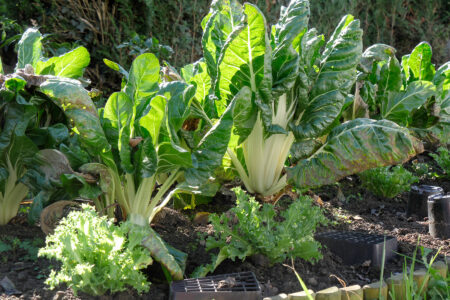
a bench in a sunny corner. Soon enough, there were green shoots, and then before I knew it there was a mass of green leaves, each struggling for a bit of the pale January sunlight. Another problem became evident: Watering a mass of leaves makes even watering impossible. Some were too wet, some too dry. But I was harvesting fresh greens! What was surprising to me was that chard grown indoors was unlike the chard I had gotten at the store. My plants produced tender, mild-flavored leaves, unlike what I remembered chard leaves to be (leathery with a strong flavor). But while I had found a solution to my scurvy concerns, my plants were increasingly over-crowded and light-starved.
About that time, I came across an idea for container growing call “flood and drain,” where the pots — set in a tray of some sort — are flooded, allowed to soak, and then drained. One claimed benefit was to provide air to the roots when the rising water in the tray pushed out the existing air then drew in fresh oxygen to the roots as the water level receded when the tray was drained. The other advantage to this method is that the flooding water removes any salt buildup that might accumulate from the liquid fertilizer. I also heard this method was called “passive hydroponic,” and it appealed to me, because it was kind of hydroponic, but allowed me to use organic liquid fertilizers and organic potting soil.
It was becoming pretty obvious the crowding and lack of light were real limitations to my mini garden. Then, the idea of a trough on the windowsill came to mind, combining a way to water all the plants uniformly and efficiently all at once. Great, now how to make this trough? Wood? Sheet metal? The choices all seemed expensive, clumsy, prone to leaking...then the light bulb went on in my head: gutters!
I started researching gutters. The ones at my local hardware store would not fit the pots I had chosen. The pots were 4” by 4” by 5” high, and were too wide at their base for the gutter profiles I had seen. I just love the internet. With a lot of searching I found that Lowe's stocked a vinyl gutter that had a unique profile that fitted the quart pots perfectly. And they also had a complete line of end caps, hanging brackets...the works! My Gutter Garden was born — at least in my imagination.
From there it was simple; everything went together easily. Cutting the 8-foot gutter sections into 4-foot lengths was no problem using a hacksaw. The end caps and mounting brackets snapped together with no tools required. But I needed a drain of some sort. The hardware store had lots of bits and pieces but they were all too big or too “something else” in the plumbing section.
What I needed was a piece of threaded tubing that I could put into the gutter and attach a vinyl tube for draining the water. Digging through remnants of projects and repairs at my house, I came across the remains of a lamp. And there it was: a threaded tube 3/8-inch or so in diameter with a nut to tighten it in the lamp. I had been in the wrong section of the hardware store. No doubt there are many other solutions, but this one was easy and with nuts, fender washers and rubber washers, the drains fit easily into a hole drilled in the bottom of the gutter without a trace of leaking. Mounting the gutter assemblies onto a pieces of 1-by-4 lumber attached to the south window frame was all it took to complete my Gutter Garden.
That was January 2012, and I am still cutting tender, mild leaves from my original chard plants in April 2013. The amount of dark green chard that a gutter garden can produce has been surprising to me. It started as an experiment, and the results have demonstrated to me that this growing method produces a significant amount of super fresh, organic produce that stays fresh until you want it. Of all the plants I've tried since, chard has been the best producer. None of the plants have gone to seed; they just keep growing new leaves as the outer ones are trimmed off. Most importantly I've had no sign of scurvy, just lots of the best-tasting greens I have ever eaten.
Lee Bentley blogs about life on Magpie Farm, located in the mountains of Northern New Mexico. Check our cottage industry product at www.PrimalCare.net.