

What size garden to feed family of 4 for a year? Learn how many plants per family member each year and how many square feet that will take to feed a family of 4 for up to a year, including strategic planting schedules and techniques.
When I was young, I heard two things that changed my life. One: Many people would starve to death standing in a field of ripe wheat next to a cow. And two: Humans are the only animals that don’t necessarily know how to feed themselves. Our culture has become so specialized that we leave food production to the experts. As a result, those not directly involved have lost the ability and the skills necessary to obtain their own sustenance. Faced with a lactating cow in a field of ripe wheat, many people wouldn’t have the faintest idea what to do.
One of the goals my husband and I had for our homesteading journey was food self-sufficiency. While raising livestock helped, our focus was primarily on a highly productive garden. We had no prior gardening experience, so it was a steep, sometimes frustrating, learning curve.
What to Know Before You Grow
Is it possible for a garden to feed your family for a year? Yes, if you keep in mind that homegrown food is one-ingredient food. It’s up to you to learn to combine those ingredients into creative and tasty meals. Also, be prepared to work. Food doesn’t just spontaneously grow – it needs a helping hand in terms of cultivating, planting, weed and pest control, harvesting, and preserving.
What you plant in your garden should fulfill several criteria:
- Plants you like to eat.
- Plants that’ll grow in your area.
- Plants you can grow in enough quantity to sustain you.
- Plants you can preserve.
Food Requirements
People often vastly underestimate how much food they eat in a year. For self-sufficiency, grow more than you think you should. A tongue-in-cheek saying among gardeners is that one-third of your plants will give you a bumper crop, one-third will give a reasonable crop, and one-third won’t do squat. In years past, it wasn’t unusual to plan a garden in hopes of preserving double what a family needed to get through a year, because they never knew when a bad harvest might occur.
To increase food self-sufficiency, I recommend livestock for meat, milk, manure for compost, fat (such as lard or tallow), fur or leather for clothing or household use, eggs, pest control, and more. Livestock (chickens, goats, pigs, cattle) round out the interconnectivity that should be the aim of every homestead. However, if you can’t keep livestock, it’s crucial to grow plant-based protein sources, such as nuts and legumes.
What Size Garden to Feed Family of 4: Land Requirements
There’s no one-size-fits-all solution to how much land is necessary to be food self-sufficient. There are so many variables, including soil type, rainfall, latitude, elevation, and whether you’re raising livestock. By some estimates, an intensively cultivated garden as small as 1,200 square feet might be able to produce enough for a family of four, but this doesn’t account for non-growing spaces, such as access paths. Additionally, some highly productive plants (notably squash) need space for the vines to spread.
For a more realistic estimate, I think a family of four needs at least a quarter of an acre for garden space. You’d need additional room for livestock or field crops, such as grain or hay.
Maximize Garden Gains
To maximize productivity, consider the following:
- Your garden spot should get at least six full hours of sunshine per day, preferably more.
- Companion planting (mixing and matching compatible plants that grow well side by side) increases yields. For example, plant spinach with peas or pole beans. The peas or beans will provide natural shade for the spinach and improve soil fertility by increasing nutrient availability. Plant borage with tomatoes to attract pollinating bees, or plant it with strawberries to enhance growth and flavor.
- Succession planting involves planting a smaller section of a fast-growing crop (such as beets or spinach), then planting the next section a week or two later, and so on through the season. This helps provide a continuous harvest all season long. You can also succession-plant different vegetables in the same bed throughout the summer.
- Intercropping mixes fast- and slow-growing vegetables. Both are planted at the same time, and the faster-growing plants are harvested and eaten before they interfere with the slower-growing ones. This technique increases the efficiency of a smaller garden space and can double or triple the amount of food grown in the same space. The Three Sisters (corn, pole beans, and squash) are an excellent example of this. The corn provides the beans with a structure to climb; the squash spreads out to offer root shade, weed suppression, and soil retention; and the beans produce nitrogen that aids the growth of the corn and squash. Three crops, same garden space.
- Think vertically. Trellises (panel, arched, or obelisk) can produce a heavy return on very little space. Strawberries or potatoes can grow in towers. Even fruit trees can be espaliered against garden walls.

- Raised beds are wonderful for improving soil, lengthening the growing season (the soil heats up sooner in spring), and growing more intensely in a small space. Surface area can be increased by mounding the soil in the bed, which adds even more planting space.
- Staggering the plants instead of planting in straight rows means you can fit 10 to 15 percent more plants per area.
- Extend your season with row covers, low tunnels, or cloches. Clear-plastic cloches can extend the growing season, and netted cloches can protect plants from insect pests.
- Weed control is vital and must be addressed before weeds get a foothold and are able to outcompete garden plants (trust me on this!).
Plan Perennial Plantings
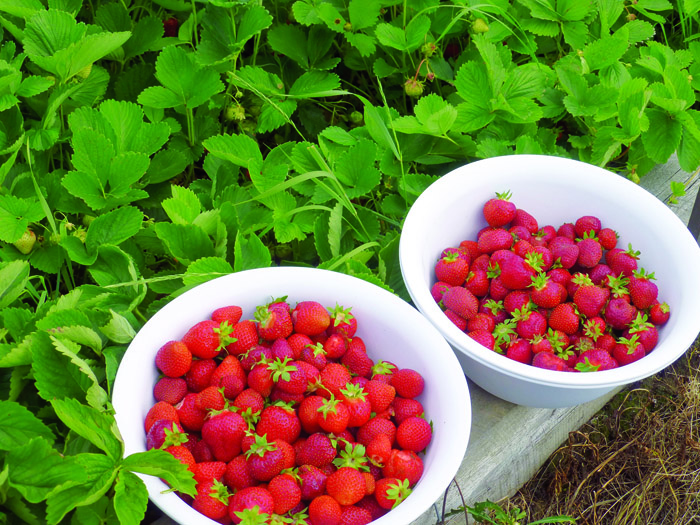
A self-sufficient garden needs perennial plants. Fruit and nut trees, avocados, grapes, berries, asparagus, and many herbs are examples of perennials that’ll regrow year after year with minimal effort on your part, depending on your Zone. Many gardeners plant perennials around the perimeter of their garden space and annuals in the center.
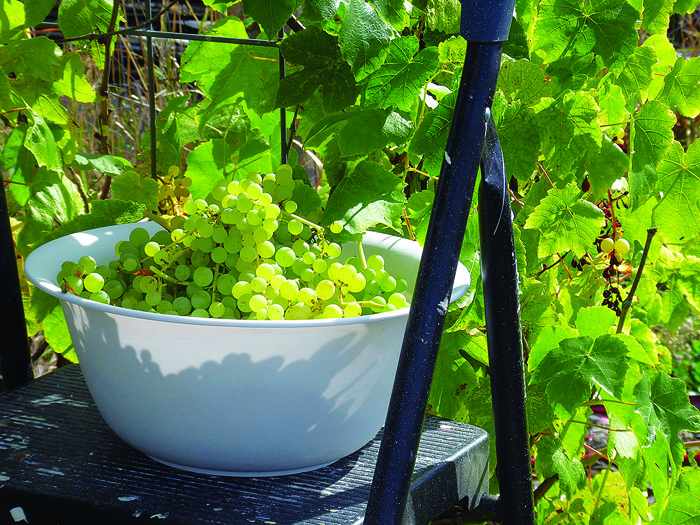
For a garden that meets all of your food needs, you’re looking at a vegan diet. Some people may want this, others don’t. If you’re eating less meat, dairy, or fats, you’ll need more vegetable proteins, such as perennial nut shrubs and trees, in addition to annuals, such as beans.
Rules to Remember
- Grow what you like to eat. You might be able to grow zucchini easily – most people can – but why bother if your whole family dislikes zucchini? (On the other hand, dried and ground zucchini makes a good gluten-free flour substitute.)
- Plant what will grow in your area. You can’t grow mangoes in Alaska. Become familiar with the USDA Plant Hardiness Zone Map, which most seed companies use when listing their varieties for sale. Local nurseries usually carry plants that grow in your area. Get advice from nearby gardeners and extension offices.
- Grow what you can preserve by canning, fermenting, freezing, dehydrating, freeze-drying, or storing.
- Focus on the plants that’ll give you the most caloric and nutritional bang for your buck, particularly if you have limited growing space. There are four crops that should be in every self-sufficient garden, particularly if you have no calorie sources from animal proteins: corn, potatoes, beans, and squash. All of these are versatile, prolific, and store well under the proper conditions. Cultivars are available for almost any garden. Of course, we’ll be healthier if we eat more than four crops. Other calorie-and-nutrient-dense crops include carrots, Jerusalem artichokes, cassava, peanuts, quinoa, soy, sweet potatoes, turnips, beets, amaranth, cabbage, and rutabagas. While not necessarily caloric powerhouses, onions and garlic are easy to grow and add a delicious punch to any meal.
How Many Plants to Grow
There are several ways to plan how much food to grow. Let’s say you want dry beans to cover 25 percent of your family’s diet. According to “Dr. Prepper” on SurvivalBlog.com, one 50-foot row can produce 5 pounds of dry beans. For 25 percent of one person’s diet, you’d need five 50-foot rows of beans, multiplied by the number of family members.
Another way to establish garden goals is to plan based on meals. If your family eats, say, 3 quarts of canned green beans per week as a side veggie for meals between November and March, that’s approximately 60 quarts – or 120 pounds – of green beans. (Most quart jars hold 2 pounds of food.)
Yields vary depending on climate, soil, and cultivar, so let’s continue to use green beans as an example. A healthy green bean plant can produce 20 to 30 pods per bush bean, and 30 to 50 pods per pole bean. About 15 pods weigh 2 pounds, which means about 900 pods will yield 60 quarts of canned green beans. This translates to 30 to 45 bush bean plants or 18 to 30 pole bean plants.
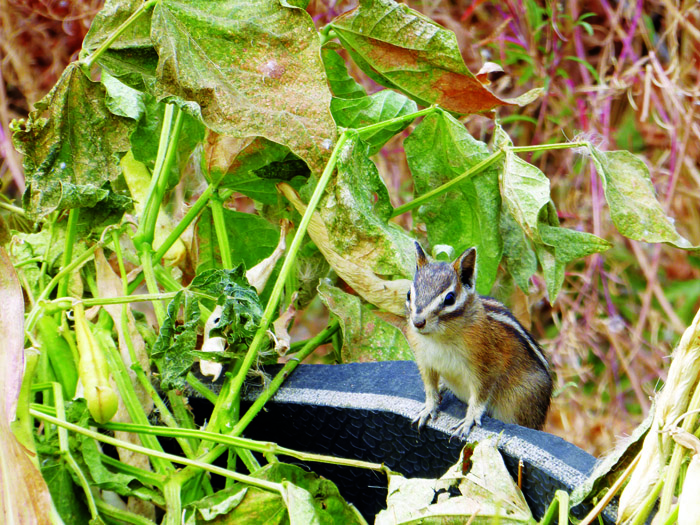
For another example, if you enjoy spaghetti squash and plan to eat one squash per person twice a week between November and March, this would mean 40 squash per person over five months. Each spaghetti squash plant will yield about six squash, so seven squash plants per person will yield enough harvest to carry you through the winter.
By using these methods to calculate your family’s favorite veggie sides, you can determine how much corn, peas, carrots, beets, potatoes, or other vegetables to plant.
There are also online garden-size calculators to help you determine how much space you’ll need for a self-sufficient garden, depending on various criteria, including the number of family members and types of crops.
Keep in mind the relative amounts of harvest. From one raised bed, we can grow 30 pounds of potatoes, but from the same bed, we might get 2 pounds of dry beans. Both foods have their advantages, but one is far bulkier.
If you have space, a grain crop (wheat, oats, barley, etc.) can vastly increase your food repertoire. Also, depending on the climate, oil-bearing crops (olives, oilseed pumpkins, oilseed sunflowers, etc.) might be an option, though you’ll need to develop oil-extraction techniques.
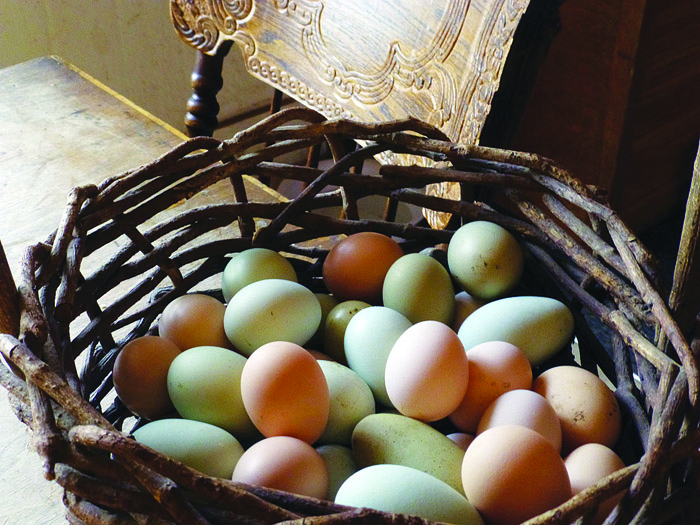
Even animal proteins can be calculated this way. If your family goes through two dozen eggs per week, use this to calculate how many hens to keep. Assuming one hen lays five eggs per week (this varies according to age, breed, temperature, stress, time of year, quality of feed, etc.), then five hens can provide about 25 eggs per week. Assuming losses, start with about 7 to 8 chicks in early spring to collect this many eggs by autumn.
Paper Gardening
A garden, we learned the hard way, isn’t just a plowed-up space where you plant seeds. We suggest planning a garden on paper before doing anything else. Believe me, it’s far better for your garden to fail on paper than in the ground. Take time during the cold months to:
- Consider your challenges. Are you in an area prone to drought? What’s your soil like? What kinds of pests do you routinely face? What space constraints do you have? What’s the best way to reduce or eliminate any issues? You could install a drip-irrigation system, bypass the ground and garden in raised beds if weeds are a problem, raise your fences to discourage deer if they frequent your garden, or incorporate vertical plantings to maximize space.
- Sketch out your garden space, approximating the dimensions and shape. Unless you’re blessed with a huge area, you’ll have to restrict your gardening dreams to the boundaries of what space you have available. Prioritize crops based on your goals.
Go Forth and Garden
There’s far too much uncertainty in the world to be uninvolved in personal food production. If you’re interested in self-sufficiency, the time to start is now. Gardening is a skill, and, like any other skill, it takes practice and repetition. The rewards, however, are tremendous. It’s delightful to visit the grocery store and realize how much you don’t need to purchase because you’ve already grown and stored it at home. Now, go forth and garden!
Patrice Lewis is a homesteader, homeschooler, author, and speaker. An advocate of simple living and self-sufficiency, she’s practiced and written about self-reliance and preparedness for 30 years.
Originally published in the February/March 2026 issue of MOTHER EARTH NEWS and regularly vetted for accuracy.





