
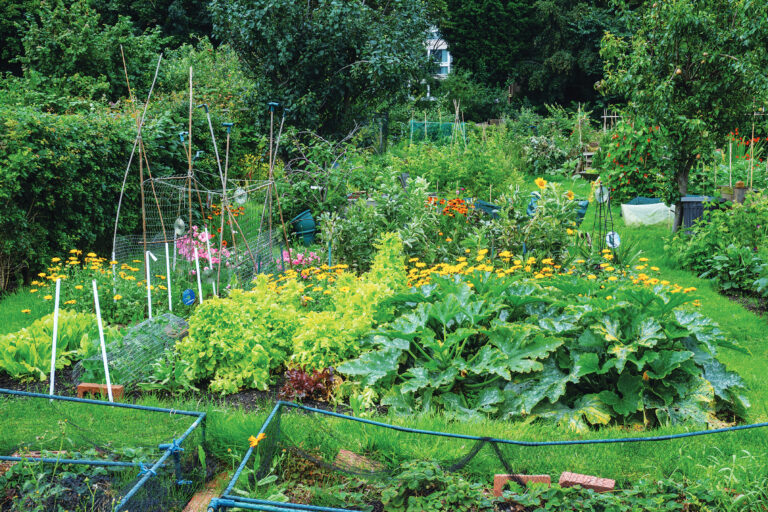
Discover regenerative backyard gardening to build soil, capture carbon, and grow more food with a permaculture approach, cover cropping, perennial plantings, companion planting, living mulches, and crop rotation.
The term “regenerative agriculture” was coined in the 1980s, but its roots and practices have been around for thousands of years. At its core, true regenerative farming views farmland as an ecosystem with interconnected parts that help each other thrive. This contrasts agriculture that uses land and soil as an expendable resource that’s depleted with heavy, repetitive, extractive production. Regenerative growing might include keeping soil covered to reduce erosion and carbon loss; limiting soil disturbance to support underground microbial communities; maximizing species diversity; integrating animals to build your soil’s fertility; avoiding synthetic pesticides and fertilizers; and capturing carbon belowground. These practices can apply to a large farm, a backyard garden plot, or a container on your apartment balcony.

Regenerative Backyard Gardening
Like regenerative practices, victory gardens are seeing a surge in popularity. The concept originated during World War I, and during World War II, 18 million “victory gardens” sprouted up across the U.S. – in yards, parks, vacant lots, school grounds, and church lands. The goal was to put as much land as possible into production to supplement rationed food, and at that time, around one-third of the vegetables produced in the U.S. came from these gardens. These days, while we’re not navigating food rations, we are facing skyrocketing food prices and increasingly intense weather patterns that put pressure on our food supplies.

I think we could combine these two ideas and embrace victory gardens again, but with a climate-conscious spin. Let’s reclaim land everywhere to use for localized production of healthy, fresh food. But while we’re at it, let’s also keep the soil covered so we don’t lose it to erosion; work to build species diversity and root mass belowground; and, perhaps most importantly, set a goal to sequester as much carbon as we possibly can in our garden’s soil. I’d like to call this a “climate victory garden,” one that grows a ton of food and builds the health of soils everywhere. Here are some simple steps to help you reach that goal in your garden.

Planting Tactics for Belowground Benefits
Carbon is the building block for plants’ growth. Plants use carbon dioxide during photosynthesis. A quantity of carbon is also used to produce photosynthates, which are transported to the soil. This process is known as “sequestration.” So, just by growing plants, we can prevent carbon emissions from going into the air and send carbon into the ground instead, where it’s profoundly useful to plant life.

But climate victory gardening goes beyond putting plants in the ground. It involves growing as many plants as possible, covering the maximum amount of ground for the maximum amount of time. Soil life doesn’t just use carbon; it also releases it. However, carbon dioxide released under a canopy of plants will further feed plant growth; this is why it’s important to have many actively growing plants in place.
- One approach is to use synergistic companion planting, which places differing species in close proximity, based on their complementary characteristics. For example, tall plants with short plants (sweet corn and bush beans), sun-loving plants with shade-tolerating plants (tomatoes and mustard greens), slow growers with fast growers (leeks and salad radishes), and deep-rooted plants with shallow-rooted plants (parsnips and lettuce). This method means plants can grow close together without competing for the same growing niche, making better use of ground space and often offering other benefits as well, such as pest disorientation, beneficial shade protection, and weed suppression.
- Another approach is using transplants. They’re most commonly used to jump-start the growth of frost-sensitive annuals in spring, but they can be used throughout the growing season. You can have them ready to make successive plantings of fast-growing crops, such as lettuce and scallions; to plant your autumn garden of peas and broccoli; and to put in your overwintering garden of leeks, cabbage, and kale.

- Living mulches help keep the soil covered. They’re plants that aren’t necessarily intended for harvest but are placed between principal crops to protect the soil from weathering and to suppress weeds. These living mulches will frequently extract nitrogen from the atmosphere for the betterment of your soil – all while sequestering carbon. Often in place for many years, they tend to be perennials or self-seeders. Possible living mulches include red or purple prairie clover; cowpeas; native strawberries; alfalfa; and creeping thyme, to name just a few.
- Cover crops are popularly used to protect the soil and keep it active throughout the winter months. Crimson clover, field peas, oats, and rye are popular choices. An easy alternative is to leave your non-diseased garden plants in place at the end of the season (if not in their entirety, at least a few inches of stem with the roots intact) for soil protection and to offer space for beneficial insects to overwinter.


Mix and Match
Perennial plants offer several carbon-sequestering-specific benefits. Many perennials have large root systems, which is key to their “perennial” success and makes them capable of reaching farther into the soil and storing carbon at deeper layers in more stable situations. Because they stay in place for multiple years, planting and soil disturbance are minimized (limiting the amount of carbon released into the atmosphere). Also, the soil microbiome tends to thrive in such undisturbed situations and can thus better conduct its carbon-sequestering activities. The perennial food garden may contain such herbaceous favorites as asparagus, rhubarb, horseradish, Egyptian walking onions, watercress, sorrel, or sunchokes.

You could also experiment with managing any of a handful of annual crops in a perennially producing bed. Techniques include selective harvesting, which leaves plant residuals to regrow (for garlic, shallot, and Irish potato); hard cutting back, which leaves intact roots in the ground (radicchio and runner bean); and a combination of consistent harvesting and self-seeding (arugula and kale). In all cases, with heavy, protective winter mulching, these crops can be purposefully managed to produce for you repeatedly.

Permaculture is another approach that keeps the ground covered and full of growth. It’s done by “layering” different plants into “guilds” (groups of plants that grow well together and support each other), occupying all aboveground and belowground space. Imitating natural ecosystems, fruit or nut trees typically anchor plantings, with herbaceous and vining plants, fruiting canes, and shrubs filling in their understories – together creating a dense, photosynthesizing canopy above the soil.

Size Up
Though we can only see the aboveground parts, plants represent much more biomass potential underground.
Some herbaceous plants have naturally larger root systems than others, which is often the reason for them having “mineral mining” and “drought tolerance” reputations. Nitrogen-scavenging oats and rye and nitrogen-fixing alfalfa are well-known for their large root systems, offering excellent green manure and cover crop options.

And while perennial plants of all sorts tend to have extensive root systems, woody plants – shrubs and trees – have a natural size advantage. Include them in your landscape whenever you can.

Meritorious Management
Many common garden-management practices help sequester carbon and protect it. You’re probably doing a number of them already, but here’s a reminder of why they’re so important.
- Composting: Composting kitchen, garden, and yard waste disposes of things you don’t want and gives you something you do want – a rich fertilizer to help plants grow. Compost feeds plants by first feeding the soil with organic material, which keeps soil microorganisms healthy. Their health not only facilitates healthier (and therefore more carbon-consumptive) plants, but also spurs them to sequester more carbon on their own.
- Crop rotation: Crop rotations that emphasize maximizing plant diversity also foster a diverse microbial soil community, which in turn encourages soil nutrient availability and tilth (crumbly soil that helps with water infiltration). It also breaks the cycles of insect pests and plant diseases for each plant and plant family. Together, this reduces the need for synthetic fertilizers or pesticides, which are detrimental to microbial communities.
- Digging in: Practitioners of French intensive gardening “dig” the soil, meaning they remove 12 to 24 inches and then put it back, loosening it in the process. By facilitating deep root growth in this fashion, they’re able to place plants into tight quarters, knowing roots will be able to move down for growth rather than laterally – which they do to an extreme extent.

- Mulching: Though using living plants is better, it’s important to mulch in situations when more plants just won’t work. Weed-free hay, straw, chop-and-drop plants, autumn leaves, or wood chips will suppress weeds and protect the soil, as well as add carbon to it. Mulching materials tend to be carbon-rich; in situations when you intend the mulch to be temporary, sprinkle on some (nitrogen-rich) alfalfa or blood meal to help speed its breakdown.

Feed the Soil, Feed the Plants
The key to optimizing carbon sequestration is to raise the healthiest of plants. The more they grow, the more carbon they’ll pull from the atmosphere for their own growth, the more carbon they’ll push into the soil for soil microbes, and the more carbon the soil microbes will themselves pull in.
Perennials benefit from a nutritional boost in spring prior to the emergence of new growth, with a slight emphasis on nitrogen. Another application can be used when plants move to their flowering and fruiting phases and need ample phosphorus.

The ideal is to meet your plants’ nutritional needs with on-site solutions. Crop rotations for annuals can be useful. Compost should be on hand as much as possible, and the occasional chop-and-drop mulch will support plants as they slowly break down. Also, composted animal manure (plus the bedding), particularly from fowl, tends to be rich in nitrogen.
Green manures can take the lead when your ground really needs some TLC, with buckwheat and lacy phacelia being two exceptionally fast growers that offer quick results.
Finally, if you need additional nutritional support, nitrogen-rich blood meal, phosphorus-rich bone meal, and potassium-rich kelp meal are natural, renewable nutrient sources.

All of these methods, whether intended for a climate victory garden or because that’s the way you were taught, foster self-reliance while taking meaningful action to rebalance our atmosphere – a movement that has a real potential to grow!
Leah Smith is a freelance writer and grower living on her mid-Michigan family farm, Nodding Thistle. She can be reached at NoddingThistle@Gmail.com.
Originally published in the August/September 2026 issue of MOTHER EARTH NEWS and regularly vetted for accuracy.






