

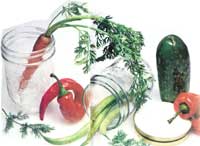
An easy way to bottle up some of your garden’s best
moments using these pickled vegetable recipes. Don’t stop at cukes. Pickle zukes, tomatoes, carrots, beans and peas.
Homegrown Pickled Vegetable Recipes
Pickles capture the essence of summer. They can be spicy as
a breeze off the flower bed, or sharp as sudden lightning;
sweet as slow July evenings, hot as long August nights.
When you put up pickles, you preserve, warm memories for
the cold days ahead.
Pickling is an easy way of “putting food by.” The pickled vegetable recipes
here are all for fresh-pack, or quick-process,
pickles–which you can turn out in an
afternoon–rather than for brined, or fermented,
pickles, which may take several weeks. Each recipe involves
merely cleaning and cutting the vegetables to appropriate
lengths; preparing a vinegar-based pickling liquid; packing
the vegetables and liquid in containers; and either
immersing the jars in boiling water for a few minutes or
allowing the pickles to age in the refrigerator until their
flavors have mellowed.
Before you gather up all those excess vegetables your
garden is producing and go to work, get hold of a good
canning guide before using these pickled vegetable recipes. The standard one is the USDA’s Complete
Guide to Home Canning, Preserving and Freezing ($4.80
postpaid from Dover Publications, New York,
NY). A few tips should serve to give you an idea of
what you’re getting into.
Ingredients: Vegetables should be fresh,
firm and free of mold and blemishes. If possible, use only
pickling (pure granulated) salt; it has no iodine (which
darkens the pickles) or anticaking agents (which cloud the
liquid). If pickling salt is unavailable, just use
non-iodized table salt and resign yourself to murky brine.
Vinegar must be between 4% and 6% acid; homemade or gourmet
vinegars of unknown acidity simply aren’t safe as
preservatives. Either white or cider vinegar will do,
according to your taste; white is preferable for
light-colored vegetables, since cider will darken them. If
you use garlic (as several recipes call for), keep in mind
that it harbors bacteria that can cause spoilage. Before
adding it to the jars, peel the cloves and boil them for 1
minute in water or in the vinegar solution.
Vegetable Pickling Tools and Processing
Utensils: Pans for heating the pickling
liquid should be enamel, stainless steel or glass, copper,
galvanized or iron utensils may produce off-colors or form
undesirable compounds. You’ll need a water-bath
canner–a large pot with a tight-fitting lid and a
rack to hold canning jars. (Inexpensive models –$10
or so–are often available at discount and hardware
stores.) Jars should be the kind sold specifically for home
canning: glass jars with two-piece metal caps (a flat metal
lid and a metal screw band). Don’t reuse leftover
containers from supermarket foods; they won’t seal
properly.
Processing: Pack and seal the jars as the
manufacturer directs. Usually, this means filling each jar
to within ½ inch of the rim, wiping the rim clean of
all food particles, placing the lid on the jar with the
sealing compound down and screwing the metal band on tight.
Immerse the filled jars in boiling water in the canner
(there should be 1 or 2 inches of water above the jars),
cover the pot, bring the water back to boiling and boil the
jars gently for the time specified in the recipe. (Start
timing when the water returns to a boil.) Remove the jars
from the canner and check to make sure that the lids have
sealed properly; again, follow the manufacturer’s
directions. Most lids form a small depression in the center
as they seal–giving off a “pop” as they do so.
Storing: Allow the pickles to cool for 12
to 24 hours, then remove the screw bands and store the jars
in a dark, cool place. Pickles improve with age; let them
sit for 2 or 3 months before eating them. Because the
vinegar solutions are highly acid, few bacteria can live in
them. Even so, be alert for signs of spoilage: Discard
untasted any food from jars with leakage, bulging
lids or spurting liquid.
A shelf full of pickles–with their rich reds,
brilliant greens, bright golds and warm browns–can
brighten a gray January day. So put some summer in your
pantry. Make pickles!
Super-Good and Extra-Easy Dill Pickles Recipe
4 pounds cucumbers
3 cups white vinegar
3 cups water
1/3 cup salt
For each pint jar:
2 tablespoons dill seed
3 peppercorns
1 or 2 dried cayenne peppers (optional)
Wash cucumbers. Depending on your preferences and the size
of the cucumbers, either leave them whole or cut them in
half or into spears.
Combine vinegar, water and salt, and heat to the boiling
point. Pack the cucumbers into hot, clean jars. Add dill
seed, peppercorns and peppers (if desired). Seal the jars
and process in a boiling water bath for 10 minutes. Makes
6-8 pints.
Note: For kosher dills, add 1 clove of garlic to each pint
jar.
–Debra A. Mackiewicz
Bread-and-Butter Zucchini Recipe
6 pounds medium-size zucchini
1½ cups sliced white onions
2 large garlic cloves
1/3 cup salt
2 quarts (2 trays) ice, crushed or cubes
4 cups sugar
l½ teaspoons turmeric
1½ teaspoons celery seed
2 tablespoons mustard seed
3 cups white vinegar
Wash and drain zucchini. Slice ¼-inch thick,
discarding ends. Add onions and garlic. Add salt and mix
thoroughly; cover with crushed ice or ice cubes; let stand
3 hours. Drain thoroughly; remove garlic cloves.
Combine sugar, spices and vinegar; heat just to boiling.
Add drained zucchini and onion slices and heat 5 minutes.
Pack hot pickles loosely into clean, hot pint jars to
½ inch of top. Seal and process in a boiling water
bath for 5 minutes. Makes 6-8 pints.
Hot Herbed Carrots Recipe
4 hot peppers
4 cloves garlic
1 teaspoon rosemary
2 pounds baby carrots (or 2 pounds larger carrots cut in
4-inch lengths)
2 cups water
2 cups white vinegar
3 tablespoons sugar
3 tablespoons salt
Halve the peppers lengthwise. In each of 4 pint jars, put 1
pepper, 1 garlic clove and ¼ teaspoon rosemary. Pack
jars full of carrots. Combine water, vinegar, sugar and
salt, and bring to a boil. Reduce heat and simmer for 5
minutes. Pour liquid over carrots, seal and process in a
boiling water bath for 10 minutes. Makes 4 pints.
Dilled Green Beans Recipe
4 pounds (about 4 quarts) whole green beans
For each pint jar:
¼ teaspoon hot red pepper, crushed
½ teaspoon mustard seed
½ teaspoon dill seed (or 1 dill head)
1 clove garlic
5 cups vinegar
5 cups water
½ cup salt
Wash beans thoroughly; drain and cut into lengths that will
fit into pint jars. Pack the beans in clean, hot jars. Add
red pepper, mustard seed, dill seed and garlic.
Combine vinegar, water and salt; heat to boiling. Pour
boiling liquid over beans, seal and process in a boiling
water bath for 5 minutes. Makes 6-8 pints.
Tangy Mixed Mushrooms Recipe
Little button mushrooms make a pretty pickle, but their
flavor is not in the same league with that of boletus
mushrooms, dried specimens of which are used here to lend
their fine, dark taste and deep, earthy color. Look for
dried mushrooms labeled cepes, porcini, boletus and so on.
2 pounds small, firm white button mushrooms
1 ounce (about 2/3 cup) dried porcini, cepes or other dried
boletus mushrooms
4 cups water
3 teaspoons salt
l½ cups red wine vinegar
l½ cups distilled white vinegar 3 large cloves
garlic, peeled and halved
2 dozen black or white peppercorns
6 medium bay leaves
9 whole cloves
3 large blades mace
Wipe the button mushrooms clean with a damp cloth and trim
the bases of the stems. Combine the mushrooms, dried
boletes, water and l½ teaspoons of the salt in a
large saucepan. Bring to a boil and simmer, uncovered,
until tender, 10 to 15 minutes. Pour the whole business
into a bowl, let cool, then cover and refrigerate
overnight.
Drain the mushrooms in a colander set over a bowl (save the
liquid for a delicious soup or sauce base). Either remove
the pieces of boletus or leave them mixed with the buttons;
although not comely, the pieces are delicious.
Combine the remaining salt with the two vinegars and the
seasonings in a saucepan and bring to a boil. Cover and
simmer 5 minutes.
Meanwhile, divide the drained mushrooms among heatproof
storage jars that have snug lids. Divide the seasonings
from the boiling-hot pickling liquid equally among the
jars, then pour the spiced vinegar over the mushrooms. The
liquid should cover them well; if not, add a little more
vinegar or water. Let cool, cover jars and refrigerate to
mellow for at least 3 days before using. At serving time,
you may want to drain the mushrooms and toss them with a
little olive oil. Makes about 3 pints and keeps for up to 6
months in the refrigerator.
–Helen Witty
Pickled Sugar Snaps Recipe
Although the sugar snaps are not processed, they will keep
indefinitely in the refrigerator.
12 ounces sugar snap peas
2 cloves garlic
2 teaspoons yellow mustard seed
Several sprigs of fresh dill
1 medium onion, sliced thin
1 fresh or 2 dried hot red peppers
1 cup white vinegar
½ cup water
1 teaspoon salt
String the sugar snap peas by cutting the stem end off with
a small, sharp knife and continuing around the sides,
pulling the string off in one motion. This goes very
quickly.
In the bottom of a quart jar or crock, place the garlic and
mustard seed. Begin adding the peas, the dill and the onion
alternately. At some point, add the hot red pepper so that
it will look attractive in the arrangement. Continue until
all the peas have been used and the container is firmly
packed.
Mix the vinegar, water and salt together. Stir until the
salt is completely dissolved. Pour over the peas. If you
need more liquid to cover the vegetables completely, add
more vinegar.
Cover and refrigerate for at least 2 months before using.
If you sample before this time, you will probably be
disappointed, as they will not have had time to develop the
desired flavor or crispness. Makes 1 quart.
–Sherrill & Gil Roth
Jalapeño Pepper Relish Recipe
This relish is very hot, but perfect with Mexican food,
pita combinations and potato dishes.
1½ pounds jalapeño peppers 2 pounds green
tomatoes
¼ cup salt
Wash and dry peppers and tomatoes. Remove caps from peppers
and cut into 3 or 4 chunks, but don’t seed them. (If your
fingers are sensitive, wear rubber gloves while handling
the peppers.) Core the tomatoes but don’t peel or seed
them; cut into chunks the same size as the peppers.
Grind the vegetables together in a food processor or put
them through the medium blade of a food mill. Do not grind
too thoroughly, as the mixture should be crunchy, not
mushy.
Put the mixture into a saucepan and add salt and vinegar.
Stir and bring just to a boil over medium heat. Spoon into
hot, clean jars. Seal and process in a boiling water bath,
5 minutes for half-pints and 10 minutes for pints. Makes 8
half-pints or 4 pints.
–Sherrill & Gill Roth
Fiery Red Relish Recipe
Later in the season, when jalapeños turn red, try
the preceding recipe using red peppers and ripe red
tomatoes.
This relish is dazzling to look at and is as intensely hot
in flavor as it is flaming in color. Its preparation
differs only in the handling of the tomatoes. Since ripe
tomatoes contain more liquid than green ones, wash, core
and seed them to get rid of as much of the juice as you
can. Cut them into chunks, then place them in a colander
over a bowl and let drain for ½ hour. If you skip
this step, the relish will be too thin. After the tomatoes
have drained well, continue with the preceding recipe.
Because of the loss of liquid, the yield will not be the
same. One-and-a-half pounds of red jalapeños and 2
pounds of red tomatoes will make 3 pints or 6 half-pints of
scorching relish.
Minted Onions Recipe
4 cups white vinegar
¼ cup sugar
2½ cups mint leaves
Few drops green food coloring (optional)
4 cups sliced peeled onions
4 pimientos, thinly sliced (optional)
Tie mint up in cheesecloth. In a saucepan, mix vinegar,
sugar and mint; simmer the mixture for 10 minutes, then
remove from heat.
Add food coloring (if desired), onions and pimientos, and
bring to a boil. Remove mint. Pour into clean, hot jars and
process in a boiling water bath for 5 minutes. Makes 2
pints or 4 half-pints.
Garden Salad Recipe
4 cups sliced cucumbers
3 cups sliced green bell peppers
3 cups sliced yellow squash
2 cups sliced green tomatoes
3 cups sliced onions
2 cups sliced carrots
2 cups sliced hot or mild banana peppers
Salt
½ gallon vinegar
5 or 6 cups sugar
1 teaspoon turmeric
Mix the sliced vegetables and sprinkle them with salt.
Cover with ice and let stand for 2 or 3 hours.
In a large kettle, mix vinegar and sugar and bring to a
boil, then add turmeric. Remove vegetables from ice water,
shake off as much water as possible, and pack into clean,
hot jars. Process 5 minutes in a boiling water bath. Makes
about 10 pints.
Note: Other vegetables may be used in addition to, or in
place of, those listed above–cauliflower, zucchini,
just about anything that’s around the house and garden at
pickling time.
–Kathleen Davenport
Curry Pickles Recipe
Cucumbers and onions to fill 4 or 5 pint jars, sliced
thin
3 cups vinegar
3 cups sugar
1 tablespoon dry mustard
1 tablespoon turmeric
2 tablespoons hot curry powder
1 tablespoon celery seed
3 whole cloves
5 slices ginger root
½ teaspoon Tabasco
Pack cucumbers and onions into jars. Combine vinegar, sugar
and spices and bring to a boil. Pour liquid over
vegetables, seal and process in a boiling water bath for 10
minutes. Makes 4-5 pints.
Article reprinted with permission of Workman Publishing.





