Jeannette Beranger: Holiday season is coming up and people are always trying to scramble for that heritage bird for the holiday season. And you should be looking now. Don’t wait until November or December to get a holiday bird. Many people probably are sold out by now taking pre-orders.
[00:00:18] But if you really wanna enjoy a heritage bird, now is the time to be putting your order in. For geese it may be too late, ’cause there are even fewer resources for that. But I do love myself a holiday goose for Christmas I’ve already got my order in and looking forward to enjoying these birds.
[00:00:38] Josh Wilder: Welcome to the Mother Earth News and Friends podcast. At Mother Earth News, for 50 years and counting, we’ve been dedicated to conserving the planet’s natural resources while helping you conserve your financial resources. In this podcast, we host conversations with experts in the fields of sustainability, homesteading, natural health, and more to share all about how you can live [00:01:00] well wherever you are in a way that values both people and our Mother Earth.
[00:01:06] Jessica Mitchell: We’d like to thank our sponsor for this episode, Brinsea. That’s B R I N S E A, chick incubation specialists. They’ve been focusing on egg incubator design continuously since 1976, resulting in egg incubators, chick brooders, and incubation accessories. They offer unparalleled practicality, reliability, superior hatch rates, and healthy chicks. Innovation you can trust.
[00:01:36] Josh Wilder: Hello. Thank you for listening to this episode of Mother Earth News and Friends. I’m your host, Josh Wilder, and with me today I have Jeannette Beranger from The Livestock Conservancy. How are you doing, Jeannette?
[00:01:46] Jeannette Beranger: I’m doing fabulous.
[00:01:48] Josh Wilder: Great. So today we’re talking heritage breeds, and specifically heritage poultry, what kind of updates there are for 2026, and what to think about and consider if you’re wanting to bring a [00:02:00] heritage flock into your life.
[00:02:02] Jeannette Beranger: There’s actually quite a bit going on for poultry this year with all different kind of species, not just chickens. One of the exciting things that we have going on with chickens is we’ve embarked upon a recovery program for Derbyshire Red Cap chickens, which are probably the most endangered breed in, in our conservation priority list right now.
[00:02:27] At one point in the 1800s, they were actually quite widespread throughout America, and today there’s probably less than 150. There’s just very few, and I’m being generous with that number. But we saw an opportunity to start to work on building numbers and we’ve worked with Green Fire Farm.
[00:02:49] They did an import of some British birds a couple years ago, and although they don’t offer them through their catalog, ’cause they’re building [00:03:00] numbers they were able to give us some hatching eggs to start our project. And once they had their needs fulfilled. And so we’ve started a little flock.
[00:03:11] We managed to hatch out about 25 and that’s a good size flock to start with. Our goal is to identify some American genetics and incorporate that into our breeding program to develop, an American line, the British line, and then a line combining the two, and carefully integrating the diversity so that, not everybody’s related to everybody.
[00:03:39] Sometimes when you get something super rare, you just wanna cross-breed it to help with hybrid vigor, but the problem is you can homogenize the entire population by incorporating those rare genetics into everything. So that’s where conservation breeding kinda gets complicated is you [00:04:00] really wanna get your hands on those new genetics, but you’ve gotta be really careful, ’cause if you overuse the new genetics, then, you’ve ruined your opportunity for taking advantage of that diversity for the long term.
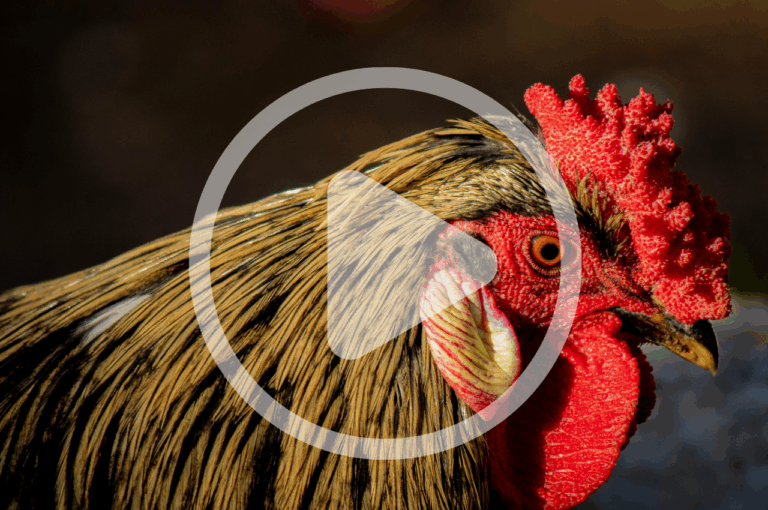
[00:04:14] Short term it, it helps, but long term you really have to make some divisions there. So the Red Cap they’re a really interesting breed. They’re a very old British breed and they’re called Red Caps ’cause they have these enormous rose combs, and they’re really kinda unique in the chicken world.
[00:04:33] They… It’s like they’re wearing this giant, crown and it really stands out. And they were actually a really great utility fowl back in their heyday in England. And with some of the historic references that I’ve
[00:04:49] lucrative chicken breed to have on a homestead farm because they were excellent foragers, they laid a lot of eggs, and it didn’t take a lot of inputs [00:05:00] to keep them productive. So for, a homestead farm or a subsistence farmer, that’s a really great fowl to have And even in the UK they’re relatively rare.
[00:05:13] And so the project our goal first is to really build numbers and then start to do some really heavy selection on bringing them back to their breed standard. Right now males are maybe five or six pounds, but the standard says they’re supposed to be eight, so we’re a ways away from that.
[00:05:35] And and you can actually accomplish that over time. We have some really good materials on The Livestock Conservancy’s website on production selection of chickens. And the techniques can be used for any breed of chicken. They’re really basic, what to look for on a chicken’s body to [00:06:00] determine how to, how that animal is going to produce for you.
[00:06:05] There are ways you can tell how they’re gonna be more meaty, there are ways you could tell that they’re gonna lay more eggs, believe it or not. And using those techniques you can really improve your flock. And so even if you’re not working with Red Caps, if you’re working with any breed out there, our chicken breeding manual can be utilized to your benefit for really any breed of chicken.
[00:06:29] And that combined with your Standard of Perfection so you understand where you’re gonna set your goals. The Standard of Perfection that’s put out by the American Poultry Association is like the Bible for understanding what a chicken’s supposed to look like and how it’s supposed to grow out. So really whatever’s in that book is gonna be your end goals for your breeding project.
[00:06:55] I always love these recovery programs because they’re just really interesting, [00:07:00] it gives you a real deep dive into the breed and it makes a significant difference for the breeds over time. I’ve been part of a couple of recovery projects like this, one with the Buckeye that we started, gosh, I hate to date myself, but almost 20 years ago we started the Buckeye project.
[00:07:20] And same thing, they were super rare, they weren’t meeting breed standard. And after 10 years of working at it the birds were back to breed standard, numbers were great, a new Buckeye club was formed, and the Buckeyes are doing great today. They’ve got a good fan base and there are really good Buckeyes out there compared to where we started 20 years ago.
[00:07:47] And then about 10 years ago we had started a Crevecoeur chicken conservation project. Same thing, fewer than 150 birds in tough shape, really [00:08:00] small. That was another one that actually Green Fire helped us with in importing some French Crevecoeur genetics, which was a game changer. We were able to, like I said with Red Caps, combine those import genetics with American genetics and carefully, bring the birds up to standard and try to maximize diversity.
[00:08:21] And I’m happy to say the Crevecoeurs are doing really well now. There are thousands of them out there instead of hundreds, and they’ve got a real fan base now. You could see some good ones showing up at the shows and feel like mission accomplished. We’ll still keep our eye on them, but they’re doing much better than they were.
[00:08:39] So I’m hoping over time the same thing’s gonna happen with the Red Caps. There’s already great interest in them. We do have a Facebook kinda blog for them. That’s the Red Cap Chicken Conservation Project, and you can see, updates we put in, photos of the birds as they’re growing out.
[00:08:59] We put in [00:09:00] some of the things that we’re learning about the breeds historically and biologically. And so we’re trying to chronicle our voyage with the Red Caps on that that Facebook page. So it’s gonna be a fun project and I’m really looking forward to seeing what we can accomplish.
[00:09:17] And we don’t have birds available for people, so they’re still super, super rare. Trying to get stocks, nearly impossible. We’re hoping somewhere down the line we’ll be able to start offering hatching eggs, but that’s probably not a reality for the next couple of years as we build numbers.
[00:09:35] But we’re getting some important work done, so if you’re patient, eventually you should be able to find some. So that’s one breed project, and then I’m winding up our National Poultry Census, and that’s project that we do every five years. And we do it in collaboration with the American Poultry Association.
[00:09:59] [00:10:00] And this is the only effort to try and count chickens and breeds in the US. Otherwise, there’s nobody else doing it, and people ask why bother?” And it’s because we really need to know how are the breeds doing. We’re not gonna know which breeds need help if we’re not counting birds.
[00:10:17] And we’re not counting backyard pets, we’re counting breeding flocks and birds that are actually gonna do the breeding. We’re not talking about the birds that are gonna be processed as meat And and it gives us a snapshot of the health of populations and what’s happening out there. We do bre- break it down into color varieties, which is interesting for the APA to understand because there may be some color varieties within the breeds that are disappearing and we try to make the determination can those color varieties be resurrected through the [00:11:00] ones that are still doing well?
[00:11:02] A lot of color varieties are developed from what we call sports of other colors. Like black birds, they can throw birds that are blue. They can throw birds that are white. They can throw birds that are red and if you have the black birds then you can resurrect the other colors eventually through birds that are sports.
[00:11:27] And that’s where it gets a little bit complicated, ’cause you have to throw some color genetics in there and ask experts in the know what colors do we really need to be worried about? So poultry just isn’t easy. I swear everything we do at poultry is just really complicated.
[00:11:45] If you have birds and you haven’t participated in the poultry census you still have about a week to go and visit the Livestock Conservancy’s website and click on the link for the poultry census which will be in our banner. [00:12:00] And participate. Everything is confidential unless you wanna be known as a resource for your particular breed.
[00:12:08] And we really need your information, ’cause we need to know how the breeds are doing out there. So that’s been taking up at least, ooh, I think we launched that in February, so it’s a long process, and once we close the survey then we’ll be analyzing all of the results and making the results public through our website and the APA and we’ll be publishing stuff just to get word out there and let people know what, what needs help and what doesn’t.
[00:12:41] We’re real excited about that. And then with other species the other big news is turkeys. It’s turkey time and it’s one of the species that always struggles to get a new generation of breeders out there. And part of it is [00:13:00] that people just don’t know how to, manage or breed heritage turkeys because, they’ve been losing ground as the old-timers age out, and there’s nobody to, not a lot of people to learn from.
[00:13:14] And this past couple of years we’ve been working on revising and updating our turkey husbandry manual which is available free for download on our website. And that’s a manual to teach you how to raise turkeys on pasture for the holiday market. And the, the other manual is a turkey breeding manual, and this one we really flipped upside down and added a whole bunch of new things, including a chapter on color which was really needed ’cause the birds that are showing up at a lot of the poultry shows really are not ideally colored, and I think a lot of it is because people just don’t [00:14:00] quite understand the standard.
[00:14:02] And so we have a entire chapter dedicated to color for each of the colored breeds. And I’ve been around the block for 40 years with heritage breeds, and I learned so much about turkey color genetics this year, and it’s not straightforward. And I was able to tap into the mind of Frank Reese, who is a turkey judge and master turkey breeder in his own right, and we were able to work together based on his know-how and also his mentor’s know-how the great Norman Kardosh, who was a famous master turkey breeder and turkey judge.
[00:14:42] And he was able to give me tips of the trade from both his experience and Norm’s experience to put in this book. So this is stuff you’re gonna find nowhere else, and if you’re going to be breeding turkeys and envision that you wanna have turkeys that meet breed [00:15:00] standard at, or produce show-quality birds, this is the manual that you’re gonna go to.
[00:15:07] And the, the icing on that cake is it’s also free for download on our website. You can buy hard copies, but we felt it important that because this is a priority species for us, that we give every tool possible for people to be able to be successful with their turkeys. That’s the, the big things that are happening this year.
[00:15:30] Holiday season is coming up and people are always trying to scramble for that h- heritage bird for the holiday season. And you should be looking now. Don’t wait until November or December to get a holiday bird. Many people probably are sold out by now taking pre-orders.
[00:15:49] But if you really wanna enjoy a heritage bird, now is the time to be putting your order in. For geese it may be too late, ’cause there are even fewer resources for [00:16:00] that. But I do love myself a holiday goose for Christmas I’ve already got my order in. And looking forward to enjoying these birds.
[00:16:09] They’re a real special addition to a holiday meal. And if you’re afraid of investing in some of these birds because they’re kinda expensive there’s plenty of stuff online to help you walk through how to cook one of these animals. And and it’s not rocket science, it’s just you gotta know what you’re doing ahead of time and plan for it.
[00:16:29] And so that’s what’s cooking with poultry with the Livestock Conservancy right now. We’re working on planning for the future and what projects we’re gonna be taking on. We’ve got some interesting DNA work that we’re we’ve collected all the samples and done the analysis, and now we’re waiting for the right grad student to be able to take all that data now and crunch it and see what it all means.
[00:16:56] We’re particularly interested in the part of the genes [00:17:00] that represents immune function. And what’s really very intriguing about what we’ve found so far is that there are gene variants within the heritage breeds that are non-existent in commercial poultry. So that means there’s something going on with their immune systems that’s not going on with commercial poultry and aspect of disease resistance or parasite resistance. We don’t quite know yet, but we know that it’s nonexistent in commercial birds, so before we throw the baby out with the bathwater, maybe we should hang on to these birds until we figure out what that all means. We also are working with USDA on cryopreservation of cells and tissue samples of poultry for their collection.
[00:17:57] Maybe the technology’s not here today [00:18:00] to be able to manipulate that and create viable chicks, but it’s coming down the pike. So preserving what we’ve got in the here and now is really important because, we could still be losing genetic diversity, and by the time that technology comes around maybe that diversity’s gone.
[00:18:19] So we’re doing that. We’re also working with the Smithsonian Institution, Also doing some cryopreservation, but also the Smithsonian has a really important specimen collection that is used by people from around the world. And in their avian collection, the vast majority is exotic birds, and now they’re starting to think, “Hey, it’d probably be important for us to, expand our domestic bird collection.”
[00:18:50] And so we’re working with them on that which I’m really excited about because that means the public’s gonna have more exposure to these breeds [00:19:00] and the diversity they represent. So lots of exciting things happening.
[00:19:05] Josh Wilder: Yeah, sounds like it. Yeah.
[00:19:08] Jessica Anderson: Brinsea products are designed to be long lasting and energy efficient. Their Advance Series incubators and brooders feature the latest state of the art digital control systems, providing instant readings of temperature and humidity to ensure successful hatches and healthy chicks.
[00:19:26] Check out Brinsea incubators and more at www.Brinsea.com. That’s www.Brinsea.com.
[00:19:39] Josh Wilder: Now I was curious, going back to the Red Caps, what sort of thresholds do you have on different breeds and does it depend on the breed or the species?
[00:19:47] Jeannette Beranger: We have a very specific formula for, deciding which breeds are on the conservation priority list and which ones aren’t. One of the first things that we think about is [00:20:00] have they been in the US a long time? And with the Red Cap, it’s, they’ve been around a long time here in the United States.
[00:20:09] A lot of people think, animals that are recent imports yeah, they’re rare in the US, so they should be considered for the conservation priority list. If we did that, we’d have a list that was extraordinarily long, and you also have to consider they’re rare here, but are they rare from where they come from?
[00:20:28] So that’s a really pertinent question for us. And I’ll give you an example, not poultry, but with pigs with Meishan pigs. They’re a recent import that came into the US in, I think, late ’70s, early ’80s. And they’ve been around China for thousands of years. They’ve only been here for a recent amount of time, but now we probably have the majority of the world’s population of these pigs here in the US, and in [00:21:00] China the population’s really small.
[00:21:02] So in that case, it’s really important for us to pay attention to what we’ve got because they’re not secure where they come from, and that’s the kind of question we would, we’d ask the same thing for poultry. Are the animals that are here in the US pertinent to the global population? And then, of course, we have numbers with critical, with birds that are critical, they’re gonna have a estimated global population of less than 1,000.
[00:21:30] When you get to the next category of threatened you’d have fewer than 1,000 birds in the United States with a estimated global population of 5,000. And then you’ve got watch, which is fewer than 5,000 in the US and global population less than 10,000. And then the final category is recovering, where, they’ve surpassed all the criteria.
[00:21:53] But you still wanna keep a watch on them because breeds can slide very easily. They can come into [00:22:00] vogue and go out really fast, which is why a lot of our breeds are rare in the first place. We also look at the numbers of breeders. If it’s a breed that’s petitioning to come onto the list w- we have to have at least three breeders within the US.
[00:22:17] Not all of the birds can be on one farm because that’s by no means secure. We wanna see that there are birds in multiple farms And and that there’s enough diversity for them to survive as a population. If they all came from just three animals then they’ve hit a bottleneck that it’s not sure if they’re gonna survive or not.
[00:22:40] Some do, but there’s things like that we take into consideration.
[00:22:45] Josh Wilder: For sure. Any given year how many, you know, I don’t know if this is something you keep track of necessarily, but how many breeds do you have, even from recovering that you have your eye on basically?
[00:22:57] Jeannette Beranger: Almost 200.
[00:22:59] Josh Wilder: Okay. [00:23:00]
[00:23:00] Jeannette Beranger: Yeah. So it’s a big j- and that includes all the species.
[00:23:03] Josh Wilder: Sure.
[00:23:03] Jeannette Beranger: And a vast majority of them are poultry. Yeah, poultry takes up a big chunk of our resources and it’s a big list and we don’t have a huge staff we pull together twice a year to take a look at the conservation priority list and see if we need any kind of refocus on any particular breeds so that if something happened that was unforeseen that, maybe warrants more attention, or if something great’s happened and somebody’s taking on a, a major role in, in helping a breed then maybe we can back off a little bit.
[00:23:46] So we do reevaluate a couple of times a year and it’s a two-day process because we have so many breeds. But it’s really important to try and keep your finger on the pulse of what’s happening out there [00:24:00] because again, we’ve got limited resources and we gotta make sure that they’re focused in places where they’re really gonna make a positive effect.
[00:24:11] Josh Wilder: So yeah and the, like the resources you had mentioned earlier, we’ll have the links to some of those in the description of this this episode. And as far as other ways that people can support Livestock Conservancy, obviously like you mentioned, getting your goose or heritage turkey for Thanksgiving is a great way to support the breeds and your work. But what other ways could people help heritage breeds or Livestock Conservancy specifically?
[00:24:37] Jeannette Beranger: There, there are all kinds of ways. Certainly to join the conservancy. We’re a membership organization. But for people that y- wanna d- wanna do something with animals but don’t necessarily wanna be a breeder, buying animals from breeders really helps the conservation effort, ’cause you’re giving a market for those animals.
[00:24:58] And only the top [00:25:00] 10% of animals should be retained as breeders, ’cause you want the best of the best, and the general rule is only the top 10% make the cut as breeding quality. So either the rest get processed or they can go to people that maybe just wanna keep the breed for eggs or what have you.
[00:25:20] And that really, that, that gives a market to folks. And so that, that’s very helpful. Certainly talking to people about the breed or, posting to social media. All the time I’m posting little snippets about, animals on my place or other people that I’ve visited.
[00:25:38] And I share with friends and family. And they really love the, the little details that I throw in there about breeds I’ve encountered. And again the food aspect of it is very helpful to the breeders as well. We do have an online breeders and products directory, so if you’re looking for meat or eggs or [00:26:00] birds you can find them on our breeders and products directory.
[00:26:04] We also have a online classifieds. And then we have a listing of breed clubs too. If you can’t find it on our list, we’ve got a list of breed clubs that you can tap into to try and find the breeds or products that you’re looking for.
[00:26:20] Josh Wilder: Okay. And, just to kinda wrap things up, obviously, I’ve been working with you for a while, and obviously you’ve been doing this for, I think you said over 20 years, and but if somebody’s starting their chicken keeping journey or any sort of poultry and they, and, they start hearing about heritage breeds, what’s your elevator pitch for why heritage breeds?
[00:26:42] Jeannette Beranger: My elevator pitch is that it, heritage breeds mean something, and These animals are the future of the security of agriculture.
[00:26:56] Without the diversity that they represent, we’re in deep [00:27:00] trouble eventually with the commercial birds. Commercial poultry are dependent on a very limited amount of genetics and in order to fix any genetic problems that we might face in the future, and they’re already here. We’re already having problems with our commercial poultry.
[00:27:20] Like commercial turkeys, there’s a big hip dysplasia problem with them. That’s not a good thing to have in your population, and where are you gonna fix it? You’re gonna go back to heritage turkeys. So that’s why they’re really important. And then from a culinary aspect, and I’m a foodie at heart, these animals represent flavors and textures and culinary experiences you are not gonna get from commercial poultry.
[00:27:47] I think that heritage birds offer so much and and they’re just they’re beautiful to look at. They come in all shapes and colors and personalities and, it’s [00:28:00] easy to find the perfect bird for you if you whittle it down to, what are you expecting from the bird, you want it to be a pet? Do you want it to be a meat bird, a egg bird both, what kind of place do you live on? Is it cold? Is it hot? Is it wet? Is it dry? You put all these factors together and then whittle the list down to these birds that are adapted to that particular set of circumstances, and then the last question you ask yourself is, do you like it?
[00:28:28] Are they cool-looking? And and then you can find the perfect breed for you. And I guess my final message with all of that said is don’t fight Mother Nature. When you’re picking birds for your place, pick birds that are adapted to your land and your climate, have the personality you’re looking for, and will do the job that you’re expecting them to.
[00:28:52] So if you’re expecting like a Leghorn chicken to be a big fat meat bird, it ain’t gonna happen. If you’re expecting a Cornish [00:29:00] chicken to be a heavy egg layer, it ain’t gonna happen. Do your research. Figure out what breed’s gonna work for you and and, it will make your life and the bird’s life much more pleasant.
[00:29:12] And yeah, that’s my elevator speech.
[00:29:16] Josh Wilder: Great. Appreciate it. All right. Thanks again for updating us and love to have you back as soon as you can to hear more about your Red Cap program and everything else you’re working on.
[00:29:25] Jeannette Beranger: Yeah. Hopefully we’ll have results on the poultry census by then.
[00:29:29] But thank you for having me. Yeah.
[00:29:30] Josh Wilder: Absolutely. Thanks.
[00:29:32] Jeannette Beranger: Bye now.
[00:29:35] Jessica Anderson: Thanks again to Brinsea, our sponsor for this Mother Earth News and Friends podcast episode. You too can experience the Brinsea difference and maximize your hatch rates with Brinsea incubators that monitor temperature and humidity and are made of antimicrobial materials.
[00:29:52] Brinsea ships worldwide and provides stellar customer support to answer all your questions. Hatch your chicks with [00:30:00] Brinsea, the leader in innovative incubation research. Learn more at Brinsea.com. Again, that’s www.Brinsea.com.
[00:30:12] Josh Wilder: Thanks for joining us for this episode of Mother Earth News and Friends. To listen to more podcasts and get connected on our social media, visit www.motherearthnews.com/podcast. You can also email us at podcast@ogdenpubs.com with any questions or suggestions. Our podcast production team includes Kenny Coogan, Alyssa Warner, and myself, Josh Wilder.
[00:30:39] Music for this episode is the song “Hustle” by Kevin MacLeod. The Mother Earth News and Friends podcast is a production of Ogden Publications.