Alyssa: [00:00:00] What is a geodesic dome?
Shelby: So a geodesic dome refers to the shape of the structure.
So it is a structure that is comprised of triangles and there are different frequencies which refers to the number of segments there are between pentagons. So the geodesic structure is made up of triangles that make up pentagons and hexagon shapes. What’s great about the geodesic structure is because it utilizes triangles instead of a traditional rectangular frame, it’s very strong. The triangle makes it a very rigid structure. Whereas if you had a structure of the same size that was made out of a rectangular shape, you would have to add a lot of extra braces and supports to accommodate heavy snow and wind loads. Whereas with the geodesic structure, you don’t have to do that. It does it on its own.
Josh Wilder: Welcome to the Mother Earth News and Friends podcast [00:01:00] at Mother Earth News for 50 years and counting. We’ve been dedicated to conserving the planet’s natural resources while helping you conserve your financial resources in this podcast. We host conversations with experts in the fields of sustainability, homesteading, natural health, and more to share all about how you can live well wherever you are in a way that values both people and our Mother Earth.
Alyssa: Hello and welcome to the Mother Earth News and Friends [00:02:00] podcast. My name is Alyssa Warner and I’m the producer here at Mother Earth News. Today we’re joined by Shelby Lucero, who is here with Growing Spaces, and they make these fantastic geodesic dome greenhouses. Shelby, can you tell me a little bit about yourself and your company?
Shelby: Yeah. Thank you so much for having me. I have been with Growing Spaces for the last five years, and I have worked in pretty much every department that we have here. I started out making components and worked my way up the ranks. I am now in the marketing department and I actually have a growing dome myself, so I live and breathe everything that we do here. And I really believe in our product and that it can help gardeners in all different climates and states, even different countries, grow food all year round. That’s so fantastic.
Alyssa: What’s your favorite thing to grow in your greenhouse?
Shelby: My favorite is tomatoes.
We have a really short growing season here. I’m in Colorado. That’s where our [00:03:00] company is based out of, and we have a very short growing season. And typically if you plant your tomatoes outside, you’ll be lucky to get one that turns ripe on the plant before it freezes. So with our domes, we’re able to start our tomatoes as early as January, and then we were harvesting our first tomatoes in. March, April timeframe. So it really gives you a jumpstart on the traditional growing season that you have.
Alyssa: Oh, that’s so amazing. So when you think about greenhouses, you usually think about three season growing, about season extension in the fall and the spring. Is there such thing as a four season garden?
Shelby: Yes, there definitely is. When you are thinking about a four season greenhouse, you do have to think a little bit farther than just a structure itself that is absorbing sunlight. You really have to think about insulation and ventilation and the ability for the structure to absorb heat [00:04:00] and also release that heat as well.
So really honing in on the temperature regulation. And so that’s one of the great things about a dome is that it is extremely energy efficient and it also helps to have even light throughout the day. So not only are we honing in on the inherent strength of the dome shape, but we’re also really using that natural curvature of the dome to get as much sunlight as we can and thus helping us warm up our thermal mass, which I’m sure we’ll touch on here in a little bit, and that’s really what makes this work all year round.
Alyssa: So you mentioned thermal mass there. Is that how you heat a greenhouse without electricity?
Shelby: Yes, the thermal mass is a form of passive solar technology that we’ve incorporated into our greenhouses. It’s something that you can do with any style of a greenhouse, but what’s nice about what we’ve done is that we use this thermal mass in the form of an above ground pond. And so this creates its own [00:05:00] ecosystem within your greenhouse.
So you’ll have fish and plants, and you’ll use the water from your pond to irrigate your gardens as a natural fertilizer. And the way that the pond works is that it’s always positioned on the north wall. And it’s coupled with a few different technologies. So there is a reflective insulation, which you can see behind me here.
This is always behind the pond, and this helps to reflect the sun’s rays back into the greenhouse when the sun is low on the horizon in the winter, and it actually helps to deflect some of the sun’s rays away in the summertime when you’re not really looking to heat your greenhouse, you’re trying to keep it cool.
So the pond water absorbs the heat of the sun during the day through the dark painted sheet metal, which creates the pond shape, and then it slowly releases that heat at night, which avoids the extreme temperature swings that you have with a traditional style greenhouse that doesn’t have any thermal mass in it.
Yeah. We also have an under soil ventilation system, which [00:06:00] is a corrugated pipe. It’s almost like a mini climate battery, if you will. It runs through the perimeter of your growing beds inside of the greenhouse, and there’s a fan behind the pond that pushes that warm or cool air, depending on the season, through the raised garden beds and out to the opposite side of the greenhouse to help further regulate the temperatures.
Alyssa: So does that mean your climate inside of your greenhouse, your temperature is inside of the greenhouse? Is it about the same or is it different depending on how close or far you are to the pond and the fan?
Shelby: So there are gonna be microclimates within any type of a greenhouse, but with a growing dome, especially because of the pond.
So your pond is going to be the most temperate, the most controlled throughout the year. And then your eastern side is typically gonna be a little bit cooler. You’ll get the early morning sun. The southern side is going to have the most extreme temperatures. So in the summertime, that’s gonna be your hottest area.
In the [00:07:00] wintertime, that’s gonna be your coolest area because it is the farthest away from the pond. And then the western side is typically pretty warm. It does get the intense afternoon sun. So we usually plant a lot of our heat loving crops in the summertime, specifically along that south and west area of the greenhouse, because they really like those warm temperatures.
And then we can keep some cooler weather crops, some crops that don’t tolerate the heat as well, closer to the pond and to the eastern side.
Alyssa: Really interesting. What is a geodesic dome?
Shelby: So a geodesic dome refers to the shape of the structure.
So it is a structure that is comprised of triangles and there are different frequencies which refers to the number of segments there are between pentagons. So the geodesic structure is made up of triangles that make up pentagons and hexagon [00:08:00] shapes. What’s great about the geodesic structure is because it utilizes triangles instead of a traditional rectangular frame, it’s very strong. The triangle makes it a very rigid structure. Whereas if you had a structure of the same size that was made out of a rectangular shape, you would have to add a lot of extra braces and supports to accommodate heavy snow and wind loads. Whereas with the geodesic structure, you don’t have to do that. It does it on its own.
Alyssa: That is very cool. I’ve seen a lot of pictures of domes like this basically covered in snow, like really heavy, rocky mountain snow. It’s really cool ’cause snow is so heavy, snow is so heavy.
Shelby: We have a customer in Haynes, Alaska who sent us some photos. She had six feet of snow on top of her greenhouse. You couldn’t even really tell that there was a dome there and it did just fine.
Alyssa: That’s fantastic. These must [00:09:00] be really fantastic for places with lots of snow because snow just is extra insulation at some point.
It starts cold and it starts being warm.
Shelby: The other nice thing about the shape is that it sheds the snow off naturally. Your greenhouse will get warmer and the snow will start to shed off, and then we actually recommend leaving some of the snow built up on your north wall because it will eventually, as you’re saying, get a little warm and it’ll start to create an air gap in between your pile of snow and your dome, which further insulates the greenhouse.
Alyssa: That is fantastic. So I love the dome idea. I love the product that you make, but in case we have viewers at home, listeners at home who already have a greenhouse, can any greenhouse be like a deep winter greenhouse?
Shelby: Not technically a deep winter greenhouse. You can make modifications if you do have an existing structure to allow you to garden throughout the winter. When [00:10:00] it comes to a deep winter greenhouse, you do have to think about the materials that you’re using to build the structure. A traditional style hoop house that just has a plastic sheet greenhouse covering isn’t going to be able to retain that much heat.
You could add some thermal mass in there. You could utilize row covers to help you get a little bit more out of your season. But, one of the things that makes our greenhouses able to retain that heat is that we do have insulation. There is a two foot wooden insulated foundation wall that’s part of all of our greenhouse kits.
And so it’s like the walls of your house where it’s a wooden frame with studs, and then you fill in the gaps with a rigid foam insulation. You can even do spray foam insulation. You can get really in depth with it if you need to, and then we also utilize a five wall polycarbonate material.
So if you are looking to rehab your greenhouse or you’re looking into getting a greenhouse, the five wall [00:11:00] polycarbonate has an R-value of about 2.8, which doesn’t sound like a whole lot, but when you’re talking about greenhouse coverings, a plastic film is going to have close to nothing. So that little bit of extra is going to help keep your greenhouse warmer in the winter and cooler in the summertime.
Alyssa: Awesome. What about for folks who might not want to keep up with the maintenance of a pond? Is there any other way to replicate like that thermal mass in a greenhouse without keeping live fish?
Shelby: Yes, so you could adapt the concept of the thermal mass. You could do milk jugs, just painted a dark color. You could do barrels that are a dark color. Whatever materials you also are using to create your raised beds or your flooring of your greenhouse will also impact your thermal mass. If you’re really looking for heat retention, using a stone paver or a brick material for your flooring and your beds can help you retain some extra heat.
But you have to keep in mind that in [00:12:00] the summertime, that’s gonna make it a little bit warmer, so then you’ll be looking at ways to cool it. But, those strategic choices will help you extend your season, even if you’re in a regular style greenhouse.
Alyssa: That is really interesting. We have an article on MotherEarthNews.com that’s about building a tiny PVC greenhouse with bubble wrap.
That’s just for seed starting. And I’m remembering they used those giant black totes and I think spray painted the lids so they were also black. Then you can use that when it’s not full of water to store your greenhouse supplies. I loved that multipurpose multi-use idea, although stacking two of those totes one on top of the other while they’re full of water, I imagine was very heavy.
Shelby: Yeah. That’s also something you wanna think about is water does weigh a lot. Our ponds are secured to the walls of the greenhouse itself to give them structural support. So just think about that. If you’re going to be stacking anything, make sure that [00:13:00] you have some type of way to attach it or hold it together so you’re not walking into a big spill when you come back.
Alyssa: I am really curious about this pond. Folks with a greenhouse with an indoor pond, is that just for fertilizer? Do you do aquaponics, fish, farm?
Shelby: Yes, all of the above. Some people just opt to put like traditional style goldfish or koi fish in the pond more for ornamental purposes.
People often do that because they are a heartier fish so they can tolerate the heat of the summer and the cool winters if you’re looking for fish, for food production, we do have people who have opted for tilapia, bluegill, catfish. There’s lots of different options. But when you get outside of the realm of goldfish and koi, you just need to be a little bit more aware of the requirements for each of those type of fish.
Like tilapia, for example. Your water can’t go below 50 degrees or they won’t survive. So you just [00:14:00] have to be a little bit cognizant of that. We do have people who have turned the pond that comes with the growing dome kit into the main tank of an aquaponic system. They have put in PVC pipes and filters and they’ve pumped the water through deep water culture beds.
We do have some examples of that on our website. There’s actually somebody up in Boulder who did that concept with a 42, so very large pond. Lots of aquaponics happening in there. You don’t have to be limited to just pond plants for the top of the pond, you can buy wheat.
We manufacture some floating planters, but you can also find or make your own using a mesh and basically like a pool noodle is the most inexpensive way to do it. And then you could plant things like lettuce tomatoes, herbs, and you can actually grow edible plants right [00:15:00] on the surface of your pond water.
So there’s lots of different ways to use the pond besides just the thermal mass.
Alyssa: That is really cool. We love seeing all the different systems come together. As someone without a pond, I do have to buy my own fish fertilizer, but I think it’s very cool that you have a system that can produce a lot of its own inputs.
Shelby: Yes. You’re really designing your own mini ecosystem with any type of a greenhouse. Minimizing as many of those inputs as you can is gonna be the most cost effective and the best for your garden and the health of your plants in the long run.
Alyssa: This kind of dome system that you have set up, is that the only kind of passive solar greenhouse or are there other kinds of designs that you might consider?
Shelby: There are some other styles of passive solar greenhouses. The most popular would be the walipini style. And with those types of greenhouses, you’re typically digging down into the earth and then creating just a very shallow kind of roof [00:16:00] structure and you’re really growing most of your food underground.
One of the drawbacks to that type of a system is that, especially in the wintertime, if you’re trying to grow in the winter, when the sun is low on the horizon. Your plants might end up getting a little bit laggy because they’re not getting as much sunlight as they would like. And you also have to think about drainage when you’re gonna be digging anything down into the ground.
So there is a little bit more prep work when it comes to doing that style of a greenhouse, but it is an option.
Alyssa: I think those are really cool. I was reading an article about them last night and it sounds like they do really well close to the equator because, like you said, of the angle of the sun, which is why, again, I thought it was so cool when I saw y’all were in Colorado and doing domes because having also tried to grow plants in Colorado and struggled with very green tomatoes, it felt like they never got ripe.
I think that’s so cool that you have a different kind of greenhouse for a different elevation for a different area of the world. [00:17:00] I know it’s really easy to look for a one-size-fits-all solution in gardening when we can all learn everything online, but sometimes everyone has a slightly different need.
Are your domes particularly popular in a specific latitude or do you see them go all over the country?
Shelby: We have a very large amount of domes in Colorado. Our domes were designed in the Rocky Mountains for use in the Rocky Mountains, but they have been adapted for many different climates. We actually have them in all 50 states and.
I wanna say we’re up to 16 countries around the world now. We have different options as far as adding ventilation. We can give you some different ideas for how to insulate your foundation wall. Different ideas that you can do. You can even do a climate battery if you’re trying to grow tropical plants in Idaho.
There’s lots of different ways that we could help you adapt the structure to your goals and desires.
Alyssa: I’m sorry, did you say climate battery?
Shelby: Yes. [00:18:00]
Alyssa: Can you tell me what that is?
Shelby: I can give you a little overview. We are not climate battery experts, but we do have customers who have used them for their greenhouses.
And the basic idea is that at four to six feet below the earth’s surface, the temperature is pretty regulated at about 55 degrees Fahrenheit. What people will often do, and you can do this with any style of greenhouse, before you build the structure, you dig down the four to six feet and you’ll run a series of pipes through the ground.
Then what you’ll end up doing is back filling the earth on top of those pipes. Typically, when you do this type of a system, you’re also going to be doing an ICF foundation or an insulated concrete form foundation, which you do often see on houses and things like that. But that helps to further insulate the ground, and so you’ll have an intake and an exhaust fan.
Then the air will be pushed [00:19:00] through those tubes under your greenhouse. It’ll be warmer or cooler depending on the season. The climate battery does, help a lot in the wintertime for people in more northern latitudes, and then that air is exhausted into the greenhouse at the warmer temperature of the 55 degrees.
Alyssa: Oh, that is so cool.
Alyssa: I did notice when I was looking through all the components of a greenhouse, something that I think people don’t think about are things like fans. I think we have this wonderful, beautiful, [00:20:00] idealized view of a greenhouse if you’ve never grown one, that they just exist and they just are warm or cool when you need them.
But I did notice that a lot of what you have is solar powered. Do you need electricity to run a greenhouse or is it possible to 100% solar power a greenhouse?
Shelby: It is possible to 100% solar power your greenhouse. That is really what our company was founded on, was the idea of being able to grow food year round off-grid.
We use passive solar technology, like I said, so our fans each have their own solar panel and they will operate when the sun is shining. So they’re not gonna be running at nighttime. But the way that we circumvent that, if you’re needing more cool air at that time, is that we have a temperature sensitive vent panels. There’s certain panels of our greenhouses that open and close at a certain temperature. There’s a mineral [00:21:00] wax solution inside of the mechanism, so you don’t have to go out and remember to open or close your greenhouse. It does it for you.
And then all of our fans are on thermostats as well, so you can set it to the temperature, you’d like it to turn on and off at.
Alyssa: Oh, that’s very cool. That’s intensely cool. It is certainly how technology works. I love that you have this combination of high tech and I mean wax that expands when it gets hot.
That’s pretty low tech. That’s so neat.
We’ve talked about all of our different passive solar technologies and opportunities. If I were to start greenhouse growing, and I wanted to grow in the winter, when would I plant, when would I plant to have things in the winter?
Shelby: So what we typically do is we end up planting our plants and we’re in [00:22:00] zone 5B, just for reference.
We will start all of our winter crops around mid-September and that way they have a good amount of time where it’s warm still, but not super hot. It, there’s still plenty of daylight hours for them to get started, and then we’ll go ahead and get them transplanted and they’ll grow. Throughout the wintertime, your growth does slow down pretty significantly regardless of what style greenhouse you’re growing in, just because of the limited daylight hours.
Getting that jumpstart in the fall and what you’ll typically be starting is gonna be things like leafy greens, brassica. Your kales, broccoli, cauliflower, all of those kinds of things do really well through the winter months as well as your root vegetables. Carrots, beets, parsnips, turnips, all of those kinds of things as well can be grown throughout the winter.
Alyssa: We do have a video on our website about the Persephone period and the area of time where things will just keep [00:23:00] in your garden, even if you have a hoop house, even if you have a greenhouse, no matter what your climate is. If there’s no sun, you don’t get plants. Is there a way to add supplemental light to a greenhouse?
Shelby: There is. Typically if you’re adding supplemental light, it’s gonna be via electricity. You’ll have to plug in your LED, or whatever type of a grow light you’re using. But that can be supplemented by having a solar array with a battery system. You just have to do a little bit of that legwork to get you there.
Alyssa: But it sounds like if you’ve planned ahead and you’ve planted enough brassicas, they’ll get you through that period where they’re not really growing new things, right? That’s the hope, I guess. Can you tell us a little bit about what’s growing in your greenhouse right now?
It looks so lush and green in there.
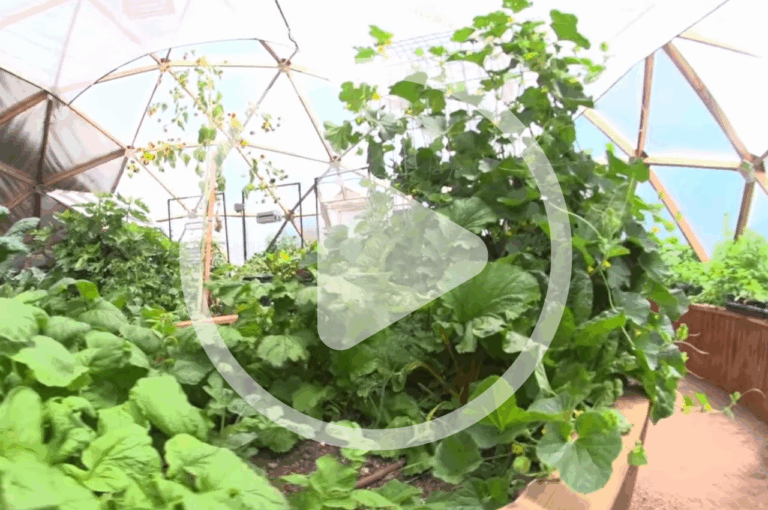
Shelby: Right now we do have, a lot of our summer stuff planted. And this will last us until that September timeframe when we get ready to transition over for [00:24:00] winter. Right next to me, I have marigolds, which are great for pests because aphids and white flies and things don’t like the scent that they put off.
So they can help with pest control. They also help with pollination. I’m sitting in our doorway, so these are right by the door. We also have some dahlias right behind me. Over here there’s a fig tree. That’s also one of the benefits of the dome shape is that you get a lot more vertical height than you have in a traditional style greenhouse.
So you can grow trees. And what’s great about a fig, especially if you’re looking to garden throughout the winter, is that they’re deciduous. So they’ll lose their leaves in the wintertime, and that way you’re not impacted the amount of sunlight that the rest of your garden is going to get. We also have lots of, what else have we got in here?
Cucumbers, tomatoes, there’s some eggplants right behind me. There’s a giant tomato that’s like eight feet tall which is over here. Lots of variety in here. Like I said, in the winter time we’ll transition over [00:25:00] to mostly leafy greens and brassicas.
Alyssa: Is there anything else that you do to prepare for the, summer, fall to winter garden transition?
Shelby: It’s always a great idea for any gardener that’s transitioning from season to season to test their soil. You’ll wanna make sure that you have enough nutrients in your soil, especially because in the summertime a lot of us gardeners like to grow heavy feeder crops, like our tomatoes, for example, will uptake a lot of the nitrogen out of the soil.
And then your brassica are also going to be pretty heavy feeders, so you wanna make sure that you put some of those nutrients. Back into the soil before you start your winter garden. And we also like to winterize our greenhouse, which is something that you can do with any type of a greenhouse that you have.
What that looks like for us is that we’re going to disengage all of our events. So we’re gonna take the pistons out so that they’re not trying to open during the day because we really wanna trap as much as that of the heat as we can and we’re also gonna [00:26:00] do the same type of a thing with our fans where we’re going to either turn the thermostats all the way up. So they’re only kicking on if it gets 100 degrees in the greenhouse, which we don’t really see in the wintertime. Oftentimes we will go ahead and put some insulation inside of the fan or over the opening just to kind of give us that little bit of extra security.
Alyssa: I do remember when I lived in Colorado, there were times where I would. Still bike in like tank tops and shorts to work because the sun is strong. It was winter, but it would be like so hot in the wintertime. Is that something that you have to worry about with the greenhouse where there are a few days that are very hot and very sunny, or does it all just become a wash because it’s cold otherwise?
Shelby: If you know that you’re gonna have days that are gonna be really hot . You can leave one of your vents engaged that way it does give you that little bit of [00:27:00] security. If it does get really warm, you can always prop your door open to get some fresh air flow inside. And it’s also a great idea for the winter to have internal ventilation within your greenhouse. So we like to do that with, they’re called horizontal airflow fans or half fans. And so those will just be circulating the air within the greenhouse itself. That helps to prevent things like you know, powdery mildew can become a thing in the wintertime in a greenhouse structure, so it helps to improve air circulation and keep some of those fungal diseases lower.
It also helps to decrease the humidity a little bit because you will build up some extra humidity with everything being closed up.
Alyssa: And then what about size? I know we have a wonderful, beautiful greenhouse growing course from another speaker, Leah Webb. And she has a gothic style greenhouse and it’s very long.
She says one of the reasons why [00:28:00] she knows she can get a big, long one is because she will never, ever, ever heat it. She’s never gonna go through grow through the winter, so she doesn’t have to heat it. Is winter growing only possible in a small sized greenhouse.
Shelby: Not necessarily. It really depends on the amount of thermal mass that you have within the structure. One of the nice things about purchasing a growing dome kit like we sell here is that we’ve done all of the math for you so you don’t have to think about any of those calculations and trying to figure out the physics and all of that kind of stuff.
We have six different sizes ranging from 15 feet in diameter, which is about 150 square feet all the way up to 42 feet in diameter, which is over 1300 square feet. So there’s lots of different sizes that you can work with. You just have to up the thermal mass as you go. If the 15 has a smaller pond, then the 42 [00:29:00] does.
Alyssa: Does the pond take up more space of the greenhouse, the bigger the greenhouse gets? Or is it all pretty standard. The gradation is about the same.
Shelby: The gradation’s about the same, no matter the size. It’s takes up about 10% of the floor space, which does sound like a lot, but as I talked about earlier, it’s still usable growing space and it’s still a functional part of your greenhouse.
Once you do get into the 42 size, the ponds become a round structure, and that’s just because of the volume of water that they hold. And then our four smaller sizes are more oval shape, so they don’t protrude into the greenhouse as far, but they still give you the amount of thermal mass that you need.
Alyssa: You have covered some really great ways to make sure you’re using a lot of the surface area of your pond through aquaponic or hydroponic growing of course if you want to also have fish. That is so cool and I love that you can also grow trees. It’s like looking at an I spy picture. The longer I look at the background [00:30:00] behind you, the more I’m seeing how much space that you’re really using. You have a table back there with some chairs where you can just chill. Like you mentioned, your beds seem to be made with a brick, with stone.
Shelby: We have a combination in this greenhouse.
We do have a section that’s made out of brick pavers, and then the other beds in this dome particularly are actually made out of adobe and I think I saw on your website you had some videos on how to make like earthen raised beds. So that’s also an option as well.
Alyssa: A gentleman named Uncle Mud, Chris McClellan, who does a lot of our natural building stuff.
It’s so cool that you can just build things with mud and clay and they work forever and they’re great for temperature regulation.
Shelby: Yeah, and if you’re trying to keep your thermal mass a little bit lower, you don’t want it to be super hot in the summertime, wood is a great material. Cedar [00:31:00] is something that we recommend for people because of its rot resistance naturally. So building your beds out of a cedar material, or we’ve also used galvanized metal and a external wood frame. There’s really tons of different options of what you can do with your raised garden beds.
Alyssa: Awesome. Well, I think that’s a wonderfully positive note to leave off on when we’re dreaming and daydreaming about all the possibilities. Can you tell us a little bit about where we can chase up Growing Spaces if we have more questions about growing in the winter?
Shelby: Yes, of course. You can always give us a call. Our local number is (970) 731-2120, give us a call. We’re always happy to talk to people about different ways that they can make their dream gardens into reality. We also have a website, GrowingSpaces.com, and we’re on pretty much any social platform that you might be on. Facebook, Instagram, YouTube, [00:32:00] we have a really large collection of videos on our YouTube channel with lots of gardening advice, not just pertaining to the dome, but also just in general. It’s a great resource and back to Facebook, if you are interested in learning more specifically about growing domes, we have a public group called Growing Dome Enthusiasts, and it has a little over 10,000 members in it now so it’s a great place for you to be able to put out your feelers, ask some questions, see if there’s people in your area. We found that a lot of our community that own growing domes loves to share it. So people might invite you over to come see it in person.
Alyssa: That’s wonderful.
That’s fantastic. Thank you so much for joining us today, Shelby. We’re gonna be daydreaming all about how we might incorporate some of these techniques into our future gardens.
Shelby: Thank you so much for having me.
Alyssa: And until next time, folks, thanks for joining us. Until
[00:33:00]
Josh Wilder: Thanks for joining us for this episode of Mother Earth News and Friends. To listen to more podcasts and get connected on our social media, visit www.motherearthnews.com/podcast You can also email us at podcast@ogdenpubs.com with any questions or suggestions. Our podcast production team includes Kenny Coogan, Alyssa Warner, and myself, Josh Wilder.
Music for this episode is the song Hustle by Kevin MacLeod. The Mother Earth News and Friends podcast is a production of Ogden Publications.