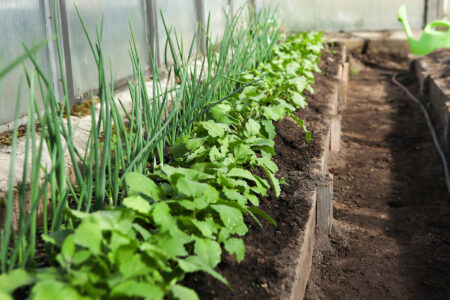
Winter crops in November 2016. Photo by Wren Vile
The benefits of crop rotations are to optimize the health and fertility of the land; maximize productivity; reduce pests, diseases and weeds; meet Organic Certification requirements and make the planning work easier on the brain. On a more invisible level, crop rotations help maintain the soil food web — a balance of the tiny soil micro-organisms which keep the soil organic matter healthy and able to fend off pathogens.
One of the core tenets of organic farming is that continuous production of the same crop in the same field or plot can never be justified, not for any reason, even though this involves competing against the “efficiency” of industrial agriculture monoculture. Most crops will grow well in a hoophouse, but not all can provide the return to make the venture profitable. The art and science is to grow a range of crops that will provide good income year-round, while taking good care of the soil, so that the business is sustainable.
Winter crops in January 2018.Note that the same crops are not in the same beds.
Part of the crop planning process can include grouping crops that do well together, and not grouping plants that share diseases. Outdoors, mixed plantings can help reduce insect pests and diseases, but in the cramped quarters of a hoophouse, nothing airborne is far from anything else.
Outdoors, planned rotations also optimize the opportunities to plant cover crops, but in hoophouses, most growers relinquish the advantages of cover crops in favor of bringing in sources of fertility from outside in order to maximize crop production from the covered space.
We do not have a fixed rotation in our hoophouse, although this possibility is worth considering, as it makes the brainwork much less, compared to ad-hoc rotations. We certainly have a few sequences that work, that we repeat from year to year, but we also have had wrinkles (timing, height and shading) causing us to juggle the rotation and make new plans. The biggest example is our need to manage nematodes, which I will write more about another time.
Rotating crops in the hoophouse is its own special challenge: we want to grow the same crops every year, in a very limited space. When planning we aim to avoid growing any family in the same place as it was the previous year. We try to do this by whole beds or half beds, rather than smaller areas. Two years isn’t a long rotation, but we rationalize that the time spent growing four or five other unrelated crops acts to even out the soil nutrients, discourage pests and diseases, and make the soil ready to grow that crop family again.
Our winter hoophouse crops fall into three main families: brassicas (turnips and radishes as well as the more obvious leafy types), lettuce (this group would include chicories and endives if we grew them), and chenopods (spinach, chard and beets). We plant smaller amounts from two other crop families: legumes and alliums. Our approach is to rotate the main families each cool season, and fit in the less common families (alliums and legumes) to fill out the space, ad hoc, still avoiding putting them in the same place as the previous winter if possible.
Our three winter crop families are something I keep in mind when making salad mixes too. In order to maximize the nutritional variety, I try for 50% lettuce, 25% spinach/beet greens/baby chard and 25% small brassica leaves.
Our summer crops are mostly nightshades (three beds) cucurbits (two beds) and legumes. Tomatoes are really too tall to go in the narrow, short-height edge beds (which also suffer from being colder), so the nightshades rotate on/off the six main beds each year. We then juggle the other crops, paying more attention to new homes for the cucurbits than for the legumes. We are also influenced by when the winter greens will be finished.
This is an extract from my new book The Year-Round Hoophouse, which will be published November 20, 2018. See that book for information about some well-thought-out hoophouse crop rotations in New York, Michigan, Maine and Hawaii. In there I also have information about alternatives to crop rotations, as well as intercropping, relay planting, double cropping, fast catch crops, and suggestions for crop sequences (follow-on crops). All you need to cram your hoophouse full of good food crops!
Also see my earlier postsHoop-House Intercropping in Spring and How to Make a Winter Salad Mix
Pam Dawlinghas worked at Twin Oaks Community in central Virginia for more than 27 years, growing vegetables for 100 people on 3.5 acres and training many members in sustainable vegetable production. She is the author ofSustainable Market FarmingandThe Year-Round Hoophouse. Pam often presents workshops at MOTHER EARTH NEWS FAIRs and at sustainable agriculture conferences. She is a contributing editor with Growing for Market magazine, and a weekly blogger onSustainableMarketFarming.com. Read all of Pam’s MOTHER EARTH NEWS postshere.
All MOTHER EARTH NEWS community bloggers have agreed to follow our Blogging Guidelines, and they are responsible for the accuracy of their posts. To learn more about the author of this post, click on their byline link at the top of the page.