

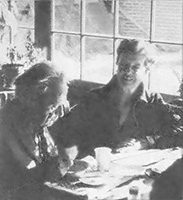
Helen and Scott Nearing share their homesteading advice with MOTHER’s readers, including putting the garden to bed for winter, raw food diets and recipes and building a homestead yourself.
Helen and Scott Nearing are light-years ahead of most of us
when it comes to living a life of voluntary simplicity in
harmony with nature. Back in 1932 they began homesteading a
run-down farm in Vermont’s Green Mountains, and
later–when the slopes around them exploded into ski
resorts in the early 50’s–Helen and Scott moved to a
rocky inlet on the Maine coast . . . and started all over
again.
That’s where you’ll find the Nearings today: They’re still
clearing brush, still building the stone structures they’re
famous for, and still raising most of their vegetarian diet
themselves in productive wholistic gardens . . . just as
they’ve been doing for 50 years.
Naturally, the Nearings have learned a good deal about
homesteading over the years . . . and they’ve agreed to
share that knowledge with MOTHER’s readers in a regular
question-and-answer column. Send your queries about
self-reliant living on the land to Helen and Scott Nearing,
THE MOTHER EARTH NEWS ® , 105 Stoney Mountain Road,
Hendersonville, North Carolina 28791. Please don’t expect
personal replies, though. The most frequently asked
questions will be answered here–and here
only–so that we can all benefit from what the
Nearings have to offer.
With cold weather upon us, my husband and I were wondering
what the best way when “putting the garden to bed for winter” might be.
Could you please outline the methods you use each autumn to
prepare your growing plot for the following spring?
After the last harvest is in, we weed our entire
garden and cultivate it thoroughly. Once we’re certain that
frost has killed or driven away any nesting slugs, we mulch
the plot . . . using hay, autumn leaves, or seaweed.
(Mulching too early will give the slugs a warm home in
which to survive the season.) At this time we also put a
blanket of loose mulch over the hardy plants (such as kale,
brussels sprouts, leeks, or parsley) to help them winter
over.
My husband and I have long dreamed of starting an organic
truck farm on our 12 acres of tired Florida land . . . but
we’re at a loss as to how to begin. Although there’s an
abundance of information about raising organically grown
vegetables on a small garden plot, you see, there seems to
be precious little practical advice available on how to
start, run, and make a comfortable living from a larger
enterprise. And–as we expected–local farmers
assure us that eking out a family income from a “giant
garden” is impossible . . . especially if we rely upon
organic methods. Surely, though, there are other folks
who–like us–would love to try a small-scale
version of the family farm, but who are afraid to go ahead
without a solid information base.
We’re accustomed to the hard work that’s required to build
up the soil, and are willing to cut our expenditures to the
bare minimum in order to reach our goal. Do you think we
have a chance? What literature can you suggest to help
guide us?
With 12 acres of Florida property at your disposal,
it sounds as if you have a splendid opportunity to
experiment with potentially profitable year-round growing
ventures. We suggest starting with a small cultivated plot,
however . . . you can enlarge your enterprise as you
learn.
As far as appropriate literature is concerned,
there are a number of helpful gardening and small-scale
farming books put out by Garden Way Publishing Co. (Dept.
TMEN, Charlotte, Vermont) and Rodale Press, Inc.
(Dept. TMEN, 3Emmaus, Pennsylvania). Two of our books–Living the
Good Life and Continuing the Good Life–discuss
self-reliant farming.
We moved back to the land several years ago . . . and now
we wouldn’t trade our country lifestyle for the rushed pace
of the city under any circumstance. However, my wife and I
are still occasionally questioned by incredulous urban
dwellers as to how we can stand to “live out in the sticks
and away from all civilization”.
Do you know of any writings that would help me
explain–in simple terms-the joys of living off the
land?
The following quotation (which is included in
Helen’s bookWise Words on the Good Life)
perhaps expresses your feelings best:
“When the sun rises, I go to work,
When the sun goes down, I take my rest,
I dig the well from which I drink,
I farm the soil that yields my food,
I share creation. Kings can do no more.”
Ancient Chinese 2500 B.C.
You often extol the virtues of eating a diet consisting
primarily of raw foods . . . and I was wondering how you’re
able to accomplish this goal during the winter months when
your garden is no longer producing.
We have a homemade greenhouse that furnishes us
with delicious greens year round. Our winter menus are
supplemented by carrots, beets, rutabagas, turnips,
potatoes, onions, and apples-all from our garden-which we
store in bins in the cellar and consume until the new crops
come in.
Here’s a tasty winter salad, talon from Helen’s
cookbook, Simple Food for the Good
Life:
Winter Salad Recipe
1/2 head of lettuce or cabbage, finely
chopped
4 stalks of celery, chopped
1 green pepper, chopped
3 apples, chopped
4 tablespoons of oil
2 tablespoons of vinegar
A handful of nuts
Combine the vegetables and apples with the nuts.
Then add the oil and vinegar, toss the salad to coat the
ingredients thoroughly, and enjoy!
It would be helpful to me if you’d devote some space to a
description of your home . . , including its size, how it’s
heated and plumbed, and how long it took to build.
We’ve written a new book, Building
With Stone in Our 70’s and 90’s, which describes–with
over 200 photographs–the construction of our latest
stone house. While we wait for publication, here’s a
preview:
We cleared the land and built roads into our
property some ten years ago. The next year we constructed a
stone outhouse and a garage/workshop/storage
building–complete with a flagstone floor–of
rock and hand-hewn timbers.
During the following three summers, we put up the
35 foot by 53 foot two-story house . . . the back half of the
structure has a cellar underneath the kitchen and the
pantry, and includes a bathroom with a Clivus Multrum
composting toilet. For cooking (and some heating) we use an
old King Kineo stove. The front portion of the house has a
pine-paneled, flagstone-floored study and living room with
a fireplace, and we use a “Free Flow” woodstove in winter
for heating.
Upstairs there are two bedrooms–also paneled
in pine–each with a balcony. One room faces east and
overlooks the garden, while the other faces west and has a
view of Penobscot Bay.
We have running water in the kitchen and bathroom
(Helen dowsed and found sparkling clear water 74 feet
down!).
In 1977 we finally moved into our new house, and
set to work building a stone wall around the garden and
adding a solar greenhouse. The whole operation of clearing
the site, building, and settling in took a long time …
however, we’ve never hurried with our construction or
gardening projects. Instead, we’ve always been willing to
take the time to do it right. As a result, we now have the
house we want and can sincerely say that we enjoyed every
minute of our work!
EDITOR’S NOTE: The Nearings will be glad to mail a price
list far their books to anyone who sends a self-addressed,
stamped envelope to the Social Science Institute, Dept.
TMEN, Harborside, Maine.






