

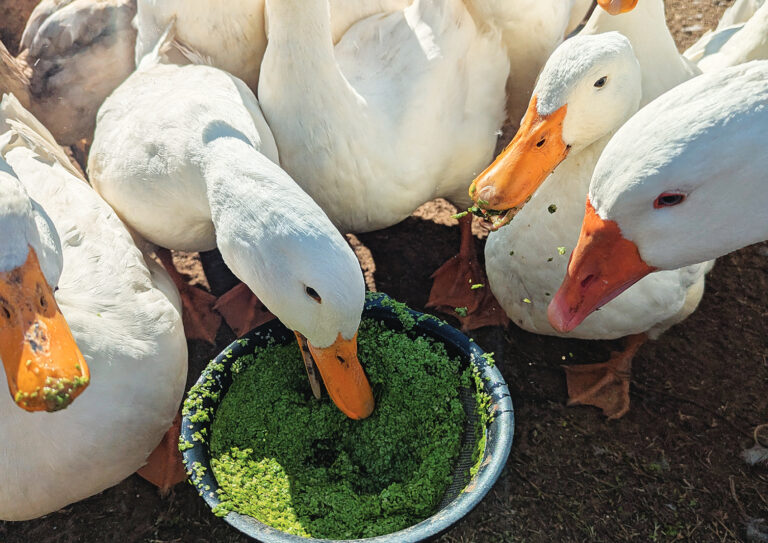
Reduce your dependence on bagged feed by building homemade fodder systems; learn how to grow fodder, hydroponic fodder, and how to make tree hay.
We all have stories about how homesteading called to us. For my family, we decided to make some healthy lifestyle changes midlife. As a health coach, I thought it made sense to grow and raise as much of our own food as possible, so I did what many of us started off doing: I planted a garden and I bought my first six chickens.
Those first chickens taught me so much, but those six birds, which soon turned into 20, cost us much more than the 100-plus poultry we now raise seasonally and aligned with nature. As we stumbled through learning via books, conventions, and mentors, I was lucky to fall into a group of farmers asking “Does what we feed our livestock matter?” This question changed everything for me regarding how I wanted to raise my food.
By 2020, we were seven years in, and, as the grocery shelves went bare of toilet paper and other products, so did the shelves of many feed stores. I’d already been teaching about our seasonal approach to feed freedom, but I saw the shift during that time to others wanting to raise hardy, self-sufficient livestock as well. Our ancestors didn’t rely on bags of fast food for themselves or their animals, so why should we?
I love sharing what’s worked for us, but I’ll remind you that my methods in my soil, space, and weather won’t equal instant success for someone living in Alaska or Florida. However, I believe we can all attain success in designing a seasonal plan to work with nature, no matter where we choose to homestead.
Hoof-to-soil ratios, permaculture techniques, and rotational grazing are key to our success. Just because we want all the animals doesn’t mean we have the proper space for them. Stationary livestock are expensive. Keeping animals going with seasonal forage not only saves us money, but also feeds the livestock a species-appropriate diet while encouraging natural behavior.

How to Make Tree Hay
We took the money we were spending on standard monocropped corn- and soy-based feeds, and instead began investing in native plants and trees from our local seedling program. For us, that meant oak, walnut, pecan, persimmon, mulberry, and more. We focus on encouraging silvopasture space by nudging nature with selective tree removal. Trees are fed to the ruminants as “tree hay” while providing us with firewood. Tree hay can be fed fresh or dry in place, which is how we choose to use it, but many people bundle and dry branches for winter feed. This brings more sunlight to the forest floor, encouraging more native grasses, which you can then graze in the summer months.
When feeding tree hay, get to know your local trees and rule out any that may be toxic to livestock. Your local extension office and large-animal vet are good sources of information. Avoid yew and ponderosa pine. Also, some cherry and plum trees can expose livestock to cyanide, especially in wilted leaves.
Pay attention to what your livestock like to browse if they have access to the woods during the growing season – that could be a good source of tree hay. We’ve had success with oak and the native fruit and nut trees we put in. Make sure your livestock have access to varied forage so they can pick and choose. If your livestock had to get all their nutrition from oak cuttings, for example, the tannins could build up to a poisonous level. Tree hay should be viewed as a good supplement to pasture or hay.
Since we rotationally graze our animals (cows, sheep, and pigs), tree hay can easily be dropped in place while the leaves are still intact and left until livestock are moved to that area to forage. This will keep the leaves on the trees to be consumed later. For smaller or stationary livestock, harvest tree hay in bundles of 3-to-4-foot branches. After you’ve hung it on a fence to dry, store it in a dry place and feed as needed all winter. Our rabbits are fed mixed tree hay and bundles of dried herbs. This is also a great option for garden plants, such as sunflowers and sunchokes. Again, be aware of local plants to avoid, and always offer an array of choices.
Seasonal Slaughter
Historically, oak forests were valued as much for lumber as for finishing pigs in fall. Livestock that weren’t going to be retained for breeding purposes were butchered before winter soils became bare. We, too, began filling our freezers once a year along this seasonal timeline, with our pigs finishing on fall forage of acorns, nuts, and persimmons. Some lambs are harvested in fall rather than spring, after they’ve foraged on pastures all summer. We even harvest our heritage poultry in fall, as forage becomes less available. New chicks hatched in early spring will be laying well by the time older layers are harvested, which provides plenty of eggs for us all winter as well as plenty of meat for the freezers. An old hen makes a fabulous table bird with all of her healthy yellow fats from foraging, and an old rooster is never tough once pressure-canned for shelf-stable storage.
This seasonal harvest allows us to feed fewer mouths through winter, when forage is scarcer, and allows pastures to rest and recover before spring hatchlings, calves, and lambs arrive in need of the nourishment of fresh graze.
How to Grow Fodder for Livestock Feed
We use sprouted fodder through winter to supplement the breeding stock. While we minimize hoof-to-soil ratios to the bare necessity, we still expect them to forage for most of their nourishment. A single pound of seed can easily become 6 to 8 pounds of fodder while encouraging your livestock’s natural instinct to forage rather than rely on a never-ending bowl of feed. We use simple, stackable, 28-quart totes. We drill tiny holes in the bottom of the tubs for drainage, 1/2-inch holes in the upper sides for airflow, and small holes in the lids, so when they’re stacked up, only the top tub needs to be watered. Fodder systems don’t have to be complicated.

Homemade Fodder Systems
We started by studying seed blends and then created our own blend of wheat, millet, barley, black oil sunflower seeds, peas, and lentils as a base. I add other seeds from what grows in our cover crops or milpa (corn, bean, and squash) garden. Often, we’ll add milo, sorghum, and buckwheat as well. Remember, we’re only supplementing in small amounts, so don’t get hung up on meeting all of their nutritional needs. This is just a bonus to their forage. My simple, daily fodder routine takes only minutes a day:
- Soak 2 pounds of seed overnight in a large bucket and add plenty of water and a dash of vinegar to help clean the seed and prevent mold.
- The next day, rinse the bucket of seed, spread it into a cleaned tote, and water well. This will begin your stack. Spread the seed fairly thin – 1/4 inch to no more than 1/2 inch deep; more will cause mold issues.
Start soaking another 2 pounds of seed in the bucket, which will go into a tote the next day, and repeat this simple process until you have a 5-to-7-day stack of fodder at different stages of growth. - Between Days 5 and 7, harvest one tray and present it to your livestock. Which day will be dependent on fodder growth; poultry may like shorter “grass” with some seed remnants, while rabbits and ruminants prefer longer forage. We all know pigs aren’t picky.
- Clean the empty tray with a little soap and water before adding seed from the bucket to keep the process continually going. You may want two or more stacks, depending on how many animals you feed.
For instance, I usually have two stacks of five totes. I feed two totes a day, one from each stack. A single tote goes to all of my poultry and one to our rabbits, as well as treats for our pigs and sheep.
I have a simple 16-foot cattle-panel hoop house covered in plastic for winter warmth and sunlight; we don’t use heat or grow lights in our Zone 7 climate. This is where we grow our fodder from late fall through early spring. When spring arrives, we stop growing fodder and our livestock go back to grazing cover crops and forage.
Hydroponic Fodder
Aquatic plants are gaining traction because of their ease of production in many climates, as well as for their nutrient density. After some research on nutritional values, I dove into using duckweed and other aquatic plants as a viable replacement to soy, without the detrimental effects that monocrops do to our environment. The website Feedipedia is a great resource to search nutritional values of livestock feed options, with plenty of references and studies listed for further information.
Azolla (Azolla spp.), an aquatic fern, and duckweed (Lemna minor), a freshwater plant, multiply rapidly. This can make them invasive in nature, so manage your production carefully and don’t dump your tubs in the local stream. For us, growing these plants in stock tanks and IBC totes has become an amazing asset to easily control and supplement everything from pigs to poultry. These plants can be dried for winter feed (on screens or trays) or overwintered in greenhouses when the temperature dips. Duckweed has the necessary minerals and amino acids that our poultry need to lay eggs, as well as lysine for healthy pigs.
We found research regarding supplementing with water hyacinth (a freshwater herb), so we now grow all three plants for every type of livestock on our farm. A few water hyacinths a day thrown into our Dexter cows’ hay has seemed to help their milk production as much as alfalfa does, so now they get it as treats on the milk stand.
It’s easy to rotate 3 to 6 totes of any size to supplement feeding daily for all three mentioned aquatics. Skim from one new tote per day before returning to the original. In proper temperatures, you’ll have plenty when you return to where you started.
Duckweed multiplies faster the warmer it gets and prefers water 68 degrees F or higher to multiply. It will double its mass daily at temperatures between 80 and 90 degrees, or even higher. When the temperatures get too cold, it will sink to dormancy but revive when temperatures are proper for growth. Duckweed will die if it freezes. We overwinter it in smaller amounts in the previously mentioned hoop house to prolong the season as well as to have a jump-start on growing in spring.
Water hyacinth is similar to duckweed as it relates to cold sensitivity, while azolla can grow at temperatures down to 41 degrees. I’ve found that these aquatic plants are all happier with warmer temperatures, and we’ve had our best success with duckweed, out of the three mentioned. We keep a stock tank heater in their containers inside the hoop house for more protection. Our small rabbit colony lives on the ground in the hoop house, so I believe that between the deep litter method and the passive-solar heat from the water totes, we’ve created a successful combination that means we don’t have to heat the hoop house with electricity, other than during a hard freeze like we had a few years ago.

Use what you have to get started; no expensive setup is needed. A minimal plant purchase will multiply faster than you can imagine. The biggest bonus is that it can be a fully closed-loop system; if you feed manure to aquatic plants, they grow even faster. We’ll mix rabbit manure in a bucket of water at a 1-to-10 ratio and let it ferment for 2 to 3 days to create a compost tea. We then add the tea to our totes whenever we see the duckweed begin to slow production or lighten in color.
Larvae and Minnows
The other real winners for our homestead, when it comes to alternative feeds, are black soldier fly (BSF) larvae and minnows. A single BSF larva can convert its weight in agricultural waste daily and turn it into another high-protein food source with healthy omega-3 fats. BSFs also have lysine, which our pigs need to thrive, as well as calcium that our poultry need to lay. We use local brewers’ grains to attract BSFs naturally. You need only a few containers with drainage to hold 4 to 6 inches of damp agriculture substrate. We’re beginning to use the same shallow fodder totes for this setup as well, but we originally started by setting up an old broken freezer with the lid propped open. We think this can be an even better use for that bag of feed: Wet it down slightly and it will soon have BSF flies laying eggs and creating pupae! Many will tell you that the flies won’t lay their eggs in the food source, but I haven’t found this to be true.
We also don’t have any fancy ramp setups for the larvae to crawl out of. We just consistently add more substrate after we scoop out larvae; in the freezer setup, you’ll have larvae of all sizes. I just scoop enough larvae out of the freezer to add to a fodder tote, throw in a few pounds of food source (brewers’ grains, commercial poultry feed, garden waste, coffee grounds, etc.) and stack it in the same way we do our fodder system, so I have a tote a day to feed the poultry and pigs. BSF turnaround is 21 days, so feed it to livestock around Days 15 to 17 for the largest larvae, or just choose to use a continuous scoop-and-feed method for ease.
We also hang 5-gallon “junk” buckets in our coops and chicken tractors for supplementing in place. We drill 1/2-inch holes throughout the bucket sides, as well as a few larger holes on the lid. We fill these buckets with the same substrates, and as BSF larvae finish the feed, they crawl out of the holes and drop to the ground, where the poultry quickly consume them. BSFs aren’t picky eaters and will quickly convert most any food waste – meats, grains, and garden scraps – into a much more beneficial food source for most livestock. Because of their quick bioconversion of waste, they reduce pathogens and aren’t disease carriers, unlike the common housefly. BSFs have worked so well for us that our goal this year is to raise them for a more controllable and consistent setup, and to add butterfly nets for fly-breeding huts. Wish us luck!
Lastly, if you have ducks and chickens, minnows are a win. We started with a dozen rosy-red minnows, and within weeks, we had hundreds, now thousands. Minnows are cold-water fish, so we have yet to use a heater. They’ll stop breeding under 65 degrees, so we move a small breeding group into the hoop house for winter; an old ice chest works great for extra insulation. We also don’t use a pump or aeration for our minnows or our aquatic plants, which prefer calm waters.

We rotate water (along with added fish waste) weekly to feed our garden, or even to fill a duck pool, while adding fresh water back to all totes. The 250-gallon IBC totes have a great garden-hose adapter available to make draining them simple, and we’ve also added spigots to 55-gallon barrels for the same reason. We feed the minnows only in midwinter; the other three seasons, they feed on mosquito larvae, as well as the algae and aquatic plants we grow. This isn’t only an easy supplement that can work within your aquatic fodder system, but it’s also a fantastic boredom buster for your poultry. Because the minnows encourage the hunting instinct, the poultry will excitedly fight for fishing rights in a small pan or child-sized pool, creating free entertainment for all involved.
There’s much more I could discuss about this topic, but the bottom line is: The more we grow and raise for our livestock, the less dependent we are on bags of processed feed. In addition to the previous methods, there’s more livestock feed potential with milpa gardens; herb beds; perennial plantings; crops that feed twice, such as sunchokes and sweet potatoes, with their plant matter and tubers; amaranth or sunflowers, with their foliage and seed heads; and cover crops, such as clover, buckwheat, and turnips. These can feed more than your family – they can feed your foods. This seasonal approach provides not only healthier, happier livestock, but also healthier foods for us. My advice is to keep it simple, use what you have, and adapt as you find what works for you. I’m always learning and adjusting as we go, but we’ve come a long way since those first few birds, and our entire homestead is healthier for the lessons along the way. I hope you find our trials and successes helpful, and I encourage you all to “think outside the bag.”
As you venture into the world of growing, raising, and sourcing food for your livestock, remember a few precautions to ensure the well-being of your animals. Learn how to identify toxic forages in your area and avoid them. Also, because all animals have basic calorie, protein, and mineral needs, start by gradually adding any of these feeds as a supplement to your animals’ diets. They aren’t meant to replace balanced rations, especially without carefully checking to make sure species-specific requirements are being met.
– Mother
Blaze Baxter is a health coach and homesteader. She shares blogs, courses, and guides on seasonal living, animal-based nourishment, and ethical farming practices at Bad Baxter Farm. Her goal is to empower others to thrive with nature.
Originally published in the August/September 2026 issue of MOTHER EARTH NEWS and regularly vetted for accuracy.





