There are so many nuances to what compost tea is. And certainly, a lot of confusion. This article aims to clarify, teach, and inspire you to learn about compost tea and make it yourself using the compost tea recipe near the bottom of the page.
Compost tea is the liquid form of decayed organic matter (compost) that we apply to improve plant growth. Its main goal is the cultivation of diverse beneficial biology to support soil fertility and ultimately the growth of healthy plants.
But first, why care about compost tea in the first place?
Compost Tea Benefits
There are indeed so many benefits to learning about and using compost tea, but ultimately, the goal is to improve plant growth and production. Along the way, we improve so much more. Producing compost tea:
- Deepens your understanding of the different life forms and processes that are necessary for producing lush, vigorous, and robust fruits, vegetables, and flowers.
- Increases the beneficial microbial population in your soil and thus lessens the strain on your plant to “fix” the soil around it. That way, your plant can outsource the job of nutrient absorption to the microbiology around its roots (rhizosphere) and around its leaves (phyllosphere) and focus on growing big and strong.
- Increases the beneficial microbial population in your plants’ foliage or leaves. The introduction of aerobic bacteria with well-formed aggregates that adhere to the surfaces of your leaves, and stems, help with nutrient uptake (1) and inhibit the growth of pathogens such as Downey mildew (2), and other fungal diseases (3).
- Improves plants’ immune response to diseases and even pests. Compost tea organisms can occupy infection sites and prevent other disease-causing organisms from finding the plant. Beneficial metabolic yeasts and fungi aid in the creation of polyphenols (4) and other secondary metabolites in plants, that are not merely responsible for the structure of plants, the flavor, and sweetness of the fruits, and the creation of seeds, but also their defense against pathogenic fungi and bacteria (5).
- Increases the nutrient bio-availability to your plants. “The most nutrients in the world, in the soil are held within microorganisms.” – Troy Hinke, Living Roots Compost Tea Since what we aim to do in compost teas is to increase the population of beneficial microbes, these in turn increase the nutrient capacity of your soil and plants.
- Improves the soil’s ability to retain water (6), thereby reducing the plants’ need to be watered more frequently.
- Combats the effects of certain chemical pesticides and residues. Except for persistent long-lasting herbicides such as clopyralid, aminopyralid, and picloram compost tea has been shown to break down herbicides in a composting process (7).
- Improves the soil’s tilth (crumbliness) and structure. The biology in compost tea helps build soil aggregates that improve the structure, stability, and crumbliness of your soil (8). So that it is not too compacted (like clay) nor too fine (like sand). This in turn allows optimum movement and storage of gases, water, nutrients, biological activity, and energy in the soil.
- Lowers your gardening/farming inputs. It is estimated that the cost to brew one gallon of compost tea is 25-35 US cents (9). This is far less than buying any soil amendment and allows us to use what we have to improve soil and turn organic wastes that we would otherwise have paid to have hauled into the landfill. Bill Mollison, the father of permaculture used to say, “The problem is the solution.” By producing compost tea we solve the problem of waste in our gardens/farms and have turned this waste into a means of food production. This last benefit leads us to the number 10 benefit of compost tea.
- Helps the environment.Creating compost to be made into compost tea allows us to capture carbon in the soil and utilize natural biology to do the heavy lifting in food cultivation. Not only do we waste less time, effort, fuel, and money to grow our food, but we also use a process that supports regenerative agriculture and ecology. While not the end-all and be-all of organic growing, compost tea plays a huge role (perhaps the biggest role) in regenerative agriculture when used as part of a sustainable soil program alongside other organic/permaculture methods.

Now that we’ve figured out the benefits, let’s go back and refine our definition of compost tea.
Expert Definition of Compost Tea
Dr. Elaine Ingham, renowned soil scientist and main proponent of the idea of a soil food web (10) answers the question, “What is compost tea?” in the USDA’s Soil Primer (11). “The simplest definition of compost tea is a brewed water extract of compost,” Dr. Ingham says. She qualifies the term “compost tea” with technicalities that are often lost on the everyday gardener and farmer. A common practice among compost tea brewers is the addition of food for the microbiology in the tea to grow to levels far beyond what they normally would in compost alone. Dr. Ingham proposes that compost tea made without the addition of food for the biology to develop is not compost tea at all, but merely a “compost extraction.” Despite Dr. Ingham’s specific definition of compost tea, you’ll find published research calling both compost tea (fed) and compost extraction (not fed) by the same name: compost tea.
According to Eric Fisher, author of “Compost Teas for the Organic Grower,” (12) “Compost teas are either aerated, non-aerated or a combination of the two. Aeration is simply the process of applying oxygen to a solution. In the absence of atmospheric oxygen, anaerobic processes take over.” We try to keep away from cultivating anaerobic bacteria (bacteria that can survive at low or no oxygen levels) because many of these types of bacteria are harmful to humans.
Compost research specialist, Troy Hinke’s description of compost tea is “a liquid form of compost that provides soil and plants with beneficial biology.” This sounds simple enough. He adds that the purpose of compost tea is “to provide plants with nutrients and disease suppression (capabilities).” What we’re trying to do is pull out all the beneficial micro-organisms that are in good compost into water, and then send them off to support our crops. So if the liquid compost doesn’t have good bugs in it, it’s no good.
As alluded to above, there are a few kinds of compost teas/extractions to note. The main categories are:
- Activated Aerated Compost Tea (AACT)
- Aerated Compost Tea (ACT)
- Compost Extracts
- Leachate
1. Activated Aerated Compost Tea (AACT)
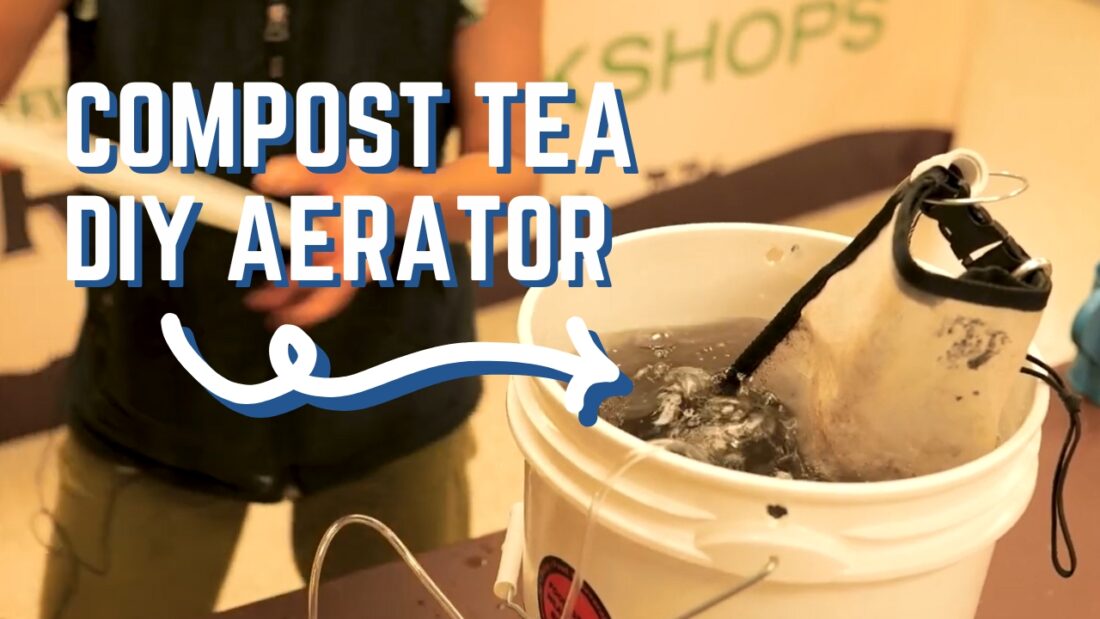
Activated Aerated Compost Teas or (AACTs) are compost teas that are fed “microbiological food” before they’re brewed or aerated. During the brewing process, oxygen is bubbled through the tea, and the amount of oxygen in such a brew should be greater than 6% (14).
The foods that are commonly used to increase microbial levels are blackstrap molasses, fish hydrolysate, yeasts, corn meal, brown sugar, humic acids, and powdered kelp.
Of these biological foods, compost tea experts generally discount molasses or sugars since they increase the numbers of aerobic bacteria, while also increasing the numbers of anaerobes and pathogens (should the original compost from which your tea is derived happen to be pathogenic).
2. Aerated Compost Tea (ACT)
But what if we didn’t feed the biology in our compost teas? Would the effects still be the same?
Soil Test Results for Vermicompost PDF
Test Results for Vermicompost Extract PDF (Brewed but not fed)
The PDF soil tests above show that there is a significant drop in biology when I brewed my vermicompost into what is sometimes referred to as Aerated Compost Tea or ACT or “compost extract” by those who have undergone Dr. Ingham’s Soil Food Web programs. This is where the literature gets confusing. Those educated by Dr. Ingham, adhere to using the technical term “compost extraction” instead of “compost tea.” But published research will sometimes cite Aerated Compost Tea (ACT) and not mention feeding the biology supplemental nutrients. For Dr. Ingham and her students, compost teas that aren’t fed are always just extractions, even if they’re aerated.
To help clarify this term, I sent two vermicomposts and vermicompost tea/extraction samples to the Soil Food Web lab nearest me to get an idea of what kind of life I was indeed brewing in an unfed compost tea solution. I found the following results shown in PDFs. As you can see from the PDFs above, the microbiology of my vermicompost tea/extraction is significantly reduced. Despite being aerated, the good guys just didn’t survive without having been fed anything. Why, you may ask, should you choose not to feed your compost tea?
Keeping Your Tea Safe
A study by Dr. David T, Ingram (15) of the USDA showed that adding any biological food whatsoever to your compost tea before brewing increased pathogenic growth to dangerous levels provided there were indeed pathogens like E.coli and Salmonella in your compost in the first place. However, brewing without supplements showed that even when there were pathogens present that these bad guys would become negligible after the brew and be far outnumbered by the good bacteria. Basically, if you feed bacteria sugar, good or bad, they like it and will grow! But if you don’t feed them, at all your compost tea will be safe but your beneficial microbiology population may not be high enough to benefit your crops. How can you be sure your original compost is pathogen-free?
Test your compost and water for the presence of pathogens by:
- Sending your compost and compost tea samples to a lab – Choose one as close as possible to where you are brewing your tea (16).
- Try out these home test kits (17) for the presence of E.Coli and coliforms.
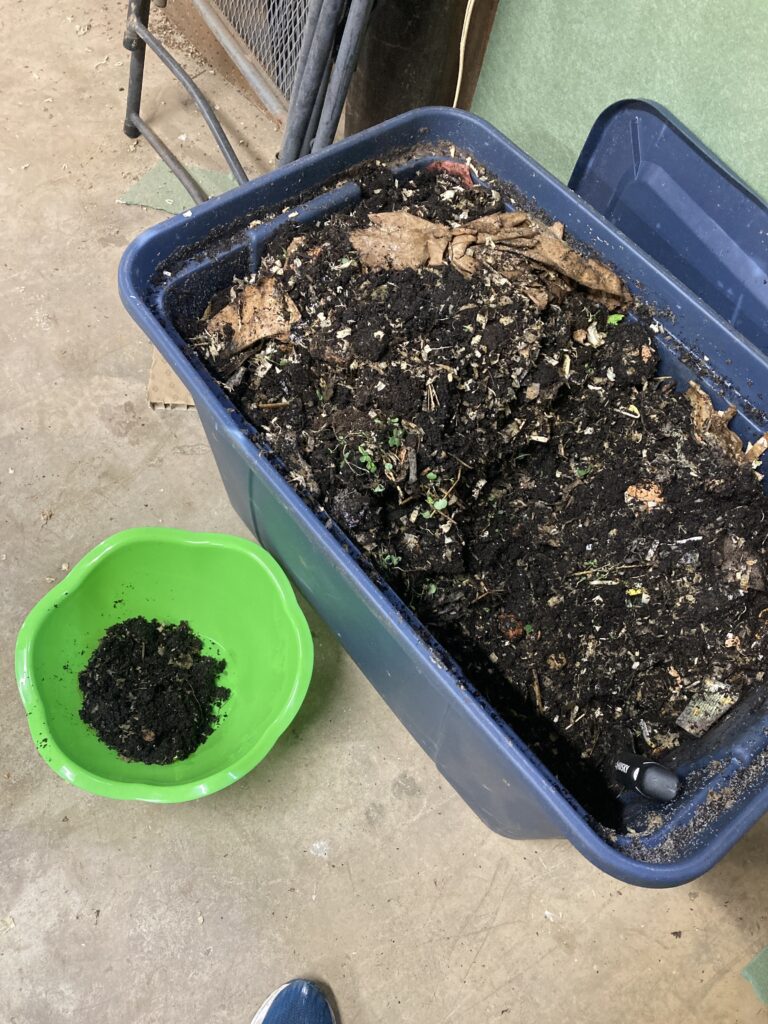
Some things to note, studies have shown that the red wriggler composting worms (Eisenia fetida) used to make vermicomposts, greatly reduce pathogens (18). Looking at my own vermicompost above, my specific sample showed no pathogens present!
The National Organic Program (NOP) (19) offers the following guideline to ensure that compost tea made from hot/thermophilic compost is pathogen-free:
- For an in-vessel or static aerated pile, compost should maintain a temperature of between 131°F (55°C) and 170°F (77°C) for three days.
- For a windrow system (that just means piled up compost without a bin), this temperature must be maintained for 15 days, and the pile turned a minimum of five times within that time period.
3. Compost Tea Extractions
Compost tea extractions or compost extracts are the results of plunging your compost in water (around 2-4 cups in the 5-gallon bucket or 1 gallon of compost per 50-gallon brew) and massaging your semi-permeable mesh bag so that you extract the biology that lives on the surface area of the soil. Break up clumps and move your compost bag so that you can break the material as small as possible and use it in a compost extract. According to Dr. Ingham, you can get an extraction in as little as 15 minutes, but the more your “steep” your compost, the more concentrated your extract becomes. In herbalism terms, this would be called an “infusion.” So the longer you steep, the better, but steep it no more than 12 hours without aeration, so that you don’t end up with an anaerobic brew. Repeat this 1-2 more times to get a stronger extraction. Remember that according to Dr. Ingham, even if you brew this concoction, this is still technically, a compost extract as you’ll not be feeding this biology.
Why would you want to do a compost extract instead of a compost tea?
- As mentioned above, if you want to ensure a pathogen-free solution, without having to test your compost beforehand, this is the way to go.
- You are pressed for time and you don’t have 12 to 24 hours before you need to amend your plants
- You want a soil biology that’s more akin to low levels of oxygen as a root drench rather than as a foliar spray (which contains biology that can adhere to the leaves and is definitely more air-loving. Those bugs do not develop the ability to cling to leaves unless they’re fed and brewed for a long amount of time.)
- Extractions have a greater shelf-life than compost teas. Compost teas need to be used within 2 hours of brewing or else they can grow, but according to Troy Henke, extracts can go longer without the risk of turning anaerobic and stinky.
4. Compost Leachate
This is the type of compost product that you do not want to use. These are the dregs and drippings of compost that collect at the bottom of your compost bin and are likely to harbor pathogens. You can never be sure how long it’s pooled at the bottom of your compost container and whether or not it has gathered and cultivated any bad bugs along the way. This is why it’s best not to use leachate from your compost bin and run the risk of contaminating your crops. In a podcast, garden author and host Christi Wilhelmi (20) shared an anecdote of how she tested the effectiveness of leachate and had all of her plants die quickly after applying leachate to them.
How to Make Compost Tea Without a Pump
Bucket-Fermentation Method
One client from the Permaculture Gardens Grow-It-Yourself Program, recently purchased a Compost Tea Brewing Kit (21), only to determine, she did not like the sound of the motor running in the back of her house for 24 to 48 hours. So she decided to ditch the pump and simply steep her compost in the mesh bag, stirring it occasionally to extract the biology into the water. This way of making compost tea is known as the Bucket-Fermentation Method and the brew time for this is typically from 7 to 10 days. According to compost tea researchers, Steve Diver and Dr. Ingham, this method dates back hundreds of years in Europe and is more akin to a compost watery extract than a “brewed” and aerated compost tea. Now we get to the practical part.
DIY Compost Tea


Making your own DIY compost tea is simple. Don’t be fooled into thinking that the drone of a fish tank pump complicates the process. As long as you have an aquatic pump that has a flow rate of 715 GPH (gallons per hour), a 5-gallon bucket, a mesh bag, and some good compost, you can make compost tea.
Requirements for finished compost are detailed by the National Organic Program as follows: “The compost pile is mixed or managed to ensure that all of the feedstock heats to the minimum of 131º F (55º C) for a minimum of three days. The active composting process is finished when the pile returns to ambient temperature levels.”
The time of “finishing” your compost can also vary if your compost is thermophilic (heats up to 131F) or a slow-burn “cold compost” that just sits there and is ready in as little as four months to one year. Other factors that affect the “curing” time are moisture and temperature. The end result should be that they smell rich and earthy and not stinky. If your compost is stinky, that’s a sure sign that something has gone awry in the composting process.
There are many compost tea recipes out there but in this one, I would like to propose starting with vermicompost because:
- You can buy vermicompost in bags from garden stores or even order them online
- Vermicomposts are shown to reduce pathogens
- If you have a vermicompost bin at home, then you’re all set and don’t need to buy anything!
- I like to leave the composting process to the experts (the red wriggler worms) since I am a lazy gardener.
If you start with a vermicompost base, you’ll be brewing a more bacterially dominant (good for leafy vegetables) compost tea with the following recipe:
DIY Compost Tea Materials
To make your own DIY compost tea prepare the following:
- A 5-gallon bucket
- A 715 GPH or 1110 GPH air pump (22) – This is an aquatic pump
- Tubing that fits snugly with your pump and is long enough to snake to the bottom of your compost bin
- 1 Tbsp fish hydrolysate
- A compost mesh bag (23)
- A big stick to hold the mesh bag suspended in water
- A quart-sized mason jar full of finished compost
- Clean unchlorinated, pathogen-free water – Well water, as long as it has been tested for pathogens, or rainwater is perfect! Water from the grid is chlorinated and must be off-gassed for a day to let the chlorine dissipate.
- Optional: A hand drill and drill bit to drill 2 holes to hold the stick in place from which you’ll suspend your mesh bag. Alternatively, you could use the “Bubble Snake” (24).
How to Make Compost Tea
- Fill your 5-gallon bucket with clean rain, well, or unchlorinated water.
- Drill two holes just below the lip of our 5-gallon bucket
- Thread a sturdy stick/skewer through those two holes as shown in the video below.
- Suspend the compost above the water using a pantyhose or a mesh bag and your sturdy stick/skewer.
- Attach the tubing to the pump’s air tubing nozzles so that it is snug and will not pop off when the pump is turned on.
- Submerge the tubing (not the pump) into the water and make sure it can be secured to the bottom of the bucket with a stone or with the “Snake Bubble” if you choose to use one.
- Add 1 tbsp of your “microbial starter” as biological food. Do not use molasses or sugar-based additives. Use fish hydrolysate.
- Turn your pump on and allow the air bubbles to aerate the bucket
- Leave this aerated for 12 -24 hours.
- When finished, turn off your pump and harvest your compost tea. Use the tea within 2 hours of turning the pump off
How to Use Compost Tea
- As a root drench. You can use your tea as a root drench to increase nutrient absorption and stimulate your plants’ immunity.
- As a foliar spray. Given that your compost tea microbial population is at adequate levels, you can use 5 gallons of compost tea, per acre. If you know that there is not much life in your soil, water your garden with the tea every week until you see positive results in plant growth.
Dr. Ingham provides similar guidelines for compost tea applied as a foliar spray in her Compost Tea Brewing Manual: “If tea is within the desired range indicated on the Soil Foodweb report, then it can be used at 5 gal/ac (50L/HA). If organism numbers are greater than this, then the tea can be used at a lower rate, relative to how much it can be diluted based on getting adequate coverage on the leaf surfaces.”

Be sure that you have passed your compost tea through a strainer or sieve to remove particles that can clog your backpack or hand sprayer before you use it as a foliar spray.
Key Points to Remember:
- The benefits of brewing your own compost tea are enormous. Despite what many gardening blogs say about compost tea not being worth the time, I can say that I have seen enough evidence in conducting research (25) and observing my own garden to support compost-tea-making as a cost-effective and time-saving way to grow abundantly. It is much easier to outsource the work of growing plants to the beneficial microbiology in the soil than trying to figure out every detail myself. The best way to do this type of outsourcing is to cultivate these microbes through compost tea. These good bugs know much more than us about what needs to happen to make good fruits, veggies, and flowers grow!
- The point of compost tea is to cultivate the excessive growth of good bacteria in a small media of water. This means a little compost will go a long way. Remember to use unchlorinated water before brewing to avoid killing the good microbes.
- Use the compost tea right away and see a boost in soil fertility. Once you stop the aeration of your tea, you’ll want to use it immediately before the biology dies or worse, harbors pathogens.
- Finally, don’t be afraid of making compost tea. It’s one of the most cost-effective ways to grow an abundant garden. And the amount of time invested in setting up your own compost tea bucket will teach you how to stop and recognize the real heroes in the gardening world, the soil food web.
There’s an ecosystem below ground that supports the ecosystem above ground. It’s about time we pay attention and work with the soil life to help them support our lives. Compost tea is a simple way that we can work with that soil and plant ecosystem. Go and give it a try!
Composting Tea Resources & References
- https://en.wikipedia.org/wiki/Foliar_feeding
- https://onlinelibrary.wiley.com/doi/abs/10.1111/j.1439-0434.1986.tb00909.x
- https://link.springer.com/chapter/10.1007/978-1-4612-3168-4_22
- https://www.sciencedirect.com/topics/chemistry/polyphenol
- https://www.ncbi.nlm.nih.gov/pmc/articles/PMC7047909/
- https://www.soilfoodweb.com.au/about-our-organisation/actively-aerated-compost-tea-information
- https://www.tenthacrefarm.com/persistent-herbicides-compost-bin/
- https://link.springer.com/referenceworkentry/10.1007/978-90-481-3585-1_142#:~:text=Stable%20soil%20aggregates%20form%20a,%2C%20biological%20activity%2C%20and%20energy.
- https://farmsmart.libsyn.com/wb8
- https://en.wikipedia.org/wiki/Soil_food_web
- https://www.permaculturegardens.org/pdfs
- https://www.amazon.com/Compost-Teas-Organic-Grower-Fisher/dp/1856233278
- https://medlineplus.gov/ency/article/002230.htm
- https://www.academia.edu/31999318/The_Compost_Tea_Brewing_Manual_Fifth_Edition
- https://pubag.nal.usda.gov/catalog/18297
- https://www.soilfoodweb.com/laboratory-technicians/
- https://www.amazon.com/Premium-Drinking-Water-Test-Kit/dp/B0837Z5PBJ/
- https://pubmed.ncbi.nlm.nih.gov/29415111/
- https://www.ams.usda.gov/sites/default/files/media/Compost_FINAL.pdf
- https://gardenerd.com/blog/podcast-compost-tea-with-nicky-schauder/
- https://www.amazon.com/Compost-Tea-Kit-Special-BubbleSnake/dp/B01ASVAV54/
- https://www.amazon.com/Compost-Tea-Kit-Special-BubbleSnake/dp/B01ASVAV54/
- https://www.amazon.com/Bubble-Magic-Compost-Micron-Small/dp/B07MXRKNLJ/
- https://www.amazon.com/Compost-Tea-Kit-Special-BubbleSnake/dp/B01ASVAV54/
- https://projects.sare.org/sare_project/fs23-353/