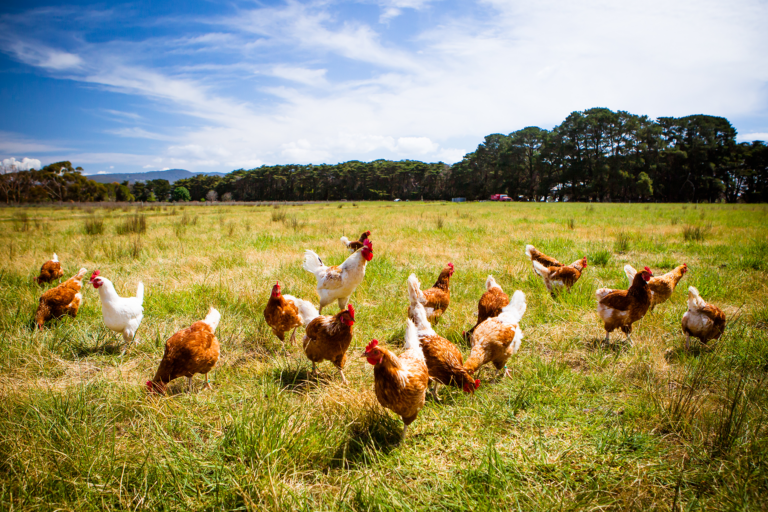
Beginning chicken farming started with lessons learned from grandma for this sustainable farmer and New York Times best-selling author. In his memoir, Gaining Ground (Lyons Press, 2013), Forrest Pritchard returns to the family farm and struggles to bring it back to life. Wishing to imitate to the pure and personal farming techniques of his grandparents, Pritchard learns the hard way what it takes to farm organically, live sustainably, and turn a profit while taking care of crops and livestock.
As far back as I can remember, chickens have been in my life. It’s been a blessing, with occasional cursing.
When I was three years old, I recall playing in my grandmother’s henhouse, a solid, gray cinder-block building that sat a few hundred feet from the front porch of her house. Though the coop had a human-size door, I was fascinated by a tiny, ground-level wooden opening built into the wall. This little door was no more than 12 inches square, big enough for two hens at a time to pass through on their way to their daily constitutionals. Watching them come and go, appearing and disappearing through this little dark hole in the wall, felt hypnotic. It was something akin to the cadence of counting sheep.
Lithe and flexible, I made this little opening my entrance as well. Inside, the floor was bedded with bright golden straw from wheat harvested on the farm. A dozen laying boxes were nailed along one wall, stuffed with clean pine shavings. Nearby, a rickety roost was engineered of rough sawmill lumber, a perfect perch for the 25 hens my grandmother kept.
First-Time Egg-Collecting Experiences
A year later, when I could no longer contort my body through the tiny opening, she put me to work gathering eggs twice a day. Since there were never more than 15 or 20 to gather at one time, I was given a small galvanized bucket she called her “tin pail.” This little bucket suited me perfectly, as it was directly proportionate to my five-year-old stature.
I was just tall enough to unlock the rusty latch holding the door, and I shoved my weight against the heavy wood. Inside, I stood on tiptoes, peering over the edge of the nesting boxes. Many of the nests were empty, but every other box or so held several large, brown eggs nestled into the soft bedding.
I gathered these one by one, gently placing them in my pail. There were always one or two hens still on the nest, and the birds allowed me to reach slowly beneath them, groping through soft belly feathers for eggs they had tucked away. These eggs were warm orbs of pleasantness, fitting smoothly into the rounded cup of my palm.
Occasionally, as I reached toward them, the hens would strike at me with the velocity and precision of a snake, a painful reminder that they were defenders of their nests. With practice, I began to identify these birds ahead of time. Certain hens carried a malevolent expression in their eyes, subtly cocking their heads in anticipation of my offending hand. Thirty years later, I would grimace as my own son received his first peck on the fingers, an experience that always hurt more from surprise than from the actual bite.
The eggs were occasionally oddly shaped, sometimes elongated like gherkins, or as round as a golf ball. Beautiful speckled patterns danced across the shells. I came to appreciate the heft and balance of a bucket filled with large brown eggs, the pressure of the handle an indicator of how well the hens had laid that morning. Although the job unquestionably felt like a chore, there was a satisfaction in fulfilling my responsibility and playing the role of farmer.
Chicken Routines
When I became a farmer myself, I realized this childhood satisfaction came with a context. The coop had been built in advance, protecting the birds from predators and bad weather. Daily labor involved hauling feed and water, as well as providing oyster shell and granite grit for eggshell development. The floor needed constant attention, lest manure became a sanitation problem. At the end of the season, older birds were culled from the flock and replaced with younger hens. These younger hens, raised from chicks, wouldn’t begin to lay eggs until they were nearly six months old. The chores, I realized, literally never stopped.
Perhaps more than any other animals on a farm, laying hens are creatures of habit. They have no issues with the same scenery, the same schedule, the same routine day after day after day. Descended from jungle fowl, their chicken ancestors never flew south for the winter because everything they needed was right around them, year-round. Modern chickens seem to have inherited this trait from their ancestors. As long as they have food, water, and a place to roost, they appear remarkably content to spend their lives on the same piece of real estate, no Caribbean vacations required.
With this in mind, I always suspected that the worst punchline ever written was actually conceived by a chicken. Everyone knows the joke: Why did the chicken cross the road? To get to the other side, of course. Funny? Never. What human comedian could ever write such insipid material? He’d be groaned off the stage.
“Why would I even want to cross the road?” I can imagine a chicken comedian musing. “I mean, I guess if I absolutely had to (not that I’m considering it, mind you — this is purely for the sake of discussion) I would probably cross it because … for some unimaginable reason … I needed to get to the other side. Ridiculous. [Shakes her head and pauses.] Hmm. [Thoughtfully scratches her wattles.] You know, the more I think about it, it’s not only ridiculous … it’s hilarious! Why did the chicken cross the road? To … get to the other side. Cackle cackle cackle! Take my rooster, please!”
Of course, chickens do wander around a little bit, chasing after beetles and scratching their way across a grassy pasture, but they journey only so far. As soon as evening shadows lengthen, they punctually stop whatever it is they are doing and immediately head toward their coop. They seem to have not only an inner clock but also an internal homing device. Within minutes they are in bed, beak tucked snugly under a wing.
In the morning, they wake at the first hint of sunrise. There is no such thing as “sleeping in” for a chicken, and certainly no snooze alarm. When the sun is barely a pink smudge on the eastern horizon, she is already up, stretching, preening, and doing her chicken yoga. She’s the proverbial early bird, ready to go get those worms.
How Do I Know if a Chicken is Happy?
A coop of chickens is a lot like high school, where a large part of each day is spent maintaining the pecking order. This is rather the exact opposite of Facebook. Instead of “friending” their fellow hens, chickens will posture, peck, and downright clobber each other, demonstrating their individual superiority within the flock. Their goal is to preemptively “unfriend” as many hens as possible, ensuring a wide berth around the feed trough, or a prime perch on the roost. It’s like a social network for egg-laying bullies.
Yet, somehow, they always manage to sort themselves out and enjoy the day. Happy hens are easy to identify. They are the ones who are “singing,” a peculiar blend of clucking and cooing that melds into a single, stretched soprano note of baaaaaaawck, bawck, bawck, bawck. A henhouse filled with singing chickens is a joyful sound, and it’s a sure sign the chickens will lay lots of eggs that day.
Birds that aren’t laying eggs, on the other hand, are silent and jittery, and they take a long time to settle down once startled. After a chicken gets out of her routine, she becomes just like that office mate who has had way, way too much coffee. But it’s amazing how a favorite song can brighten a mood. If they had lips, our hens would undoubtedly whistle while they worked.
Early Lessons in Raising Poultry
For a 4-H project the summer I was twelve, my father and I built a henhouse on the edge of our yard and started our own small flock of laying hens. That August, I crated up three brown hens, a gorgeous Rhode Island Red rooster with extravagant green tail feathers, two cackling guineas, and a large Pekin duck and entered them in our county fair. I also submitted a dozen eggs, painstakingly sorted, based on uniformity of color, size, and shape.
In a community still heavily aligned with agriculture, and out of the hundreds of hens, ducks, and roosters that were exhibited that week, each of our birds won a blue ribbon, and our eggs received Best in Show. I had always assumed there was nothing especially remarkable about how we raised our poultry, and I certainly didn’t expect to garner special recognition. But at that Friday night’s awards ceremony, I was awarded the trophy for Best Overall Poultry.
A 4-H’er herself, Betsy was named Horticulture Queen the same year. It was 1986, and we were thrust into the spotlight of local agricultural celebrity. I felt like the Tom Cruise of chicken farmers.
Free-range chickens simply belonged on our farm, fitting in as naturally as a sunset on the horizon. By the time I graduated from college, though, I understood that there was an enormous difference between the way my grandmother had taught me to raise chickens and how most birds were grown.
My father had several friends who owned gigantic poultry barns, raising meat chickens in the steep hills of West Virginia. They fattened these birds, tens of thousands at a time, in windowless, automated confinement buildings. This type of farming was described as a sideline to what they considered their real jobs, such as school superintendent or highway department administrator.
I listened as they complained bitterly of electricity bills and grain prices, the cost of labor, and the meager profits they received for the chickens they raised. While my dad commiserated with them, hands shoved into pockets, hats pulled low over their eyes, the only thing I could wonder was how anyone could live with the smell.
As one of my dad’s friends put it, his daily chore was to “put on a gas mask and pick out the dead ones.” The look on his face carried no trace of humor or irony. He was merely stating a fact.
The odors emanating from these confinement houses were, to be generous, nose-wrinklingly pungent. Elevated levels of ammonia burned my sinuses, triggered headaches, and left me physically nauseated. My nastiest memory is of a confinement shed that had been recently cleaned, where months of manure had been bulldozed into a mountain of excrement and feathers. Dozens of dead chickens, in various states of decomposition, protruded from the heap. Even from 50 feet away, the putrid odor was staggering. I knew that if I were to ever have a farm of my own, it wouldn’t look anything like that.
Chicken Tractors and Poultry Fences: A Conversation with Grandma
Instead, once I was out of college and had fully made up my mind to farm, I began studying alternative, old-fashioned production models. There were dozens of early 20th-Century techniques describing chickens on pasture, methods that improved upon the pasture pens that my father and I had engineered. After reading these books, I could now envision our birds genuinely free-ranging, enjoying the liberty to roam and forage. If we were going to keep chickens, I resolved this was how we would raise them.
As I turned various ideas over in my mind, I realized I should talk to my resident chicken expert while I could still get her advice.
“To be honest,” my grandmother began, after I had explained my model to raise a hundred laying hens on pasture, “I like your ideas about cattle a whole lot better.”
I tried to take this backhanded compliment in stride. Had she forgotten that a mere 12 years earlier I had been Jefferson County Poultry King?
“But people love free-range eggs,” I reminded her. “I learned that from helping you.”
“Oh, yes. That’s certainly true. And eggs are so nutritious. Very healthy, a completely balanced diet. You know, when I was in nursing school …”
I resisted the temptation to roll my eyes. My grandmother, now close to 90, somehow managed to steer nearly every conversation back to her days as a nursing student.
I intercepted her thought. “You were taught that eggs were the perfect food, and you fed them to patients recovering from tuberculosis or swine flu or whatever horrible disease was around back then. And …” I added, stretching out the “and” as she tried to interrupt my interruption, “and they always recovered faster than patients at other hospitals.”
Her eyes widened. “Why, Forrest. How did you know all that?” She winked. “You must have been listening to me after all.”
“And that’s exactly why I want to raise chickens. I mean, I was practically brought up in your henhouse.”
She smiled briefly but then turned serious. “Well, I’ve been listening, too. I think it’s a fine idea, but I’ve got several concerns. How are you going to keep the foxes away? I always closed my birds up at night in the coop. Foxes will kill your chickens as fast as you can put them out there.”
“I’ve thought about that. They’ve got this great poultry netting now, with step-in posts, and you can move it around very easily. Plus, it carries a shock when you hook it up to an electric fence. The chickens stay where you want them, and you can give them fresh grass each day. It’s engineered to keep the foxes out.”
She arched her eyebrows. “My word, they certainly didn’t have that when I was raising chickens.”
“I know. It’s … kind of a game changer.”
She thought for a moment. “But what about cleaning out the coop? Twenty birds is one thing, but a hundred birds make quite a mess. They like to do their business wherever they please, you know. If you want healthy chickens, you’ve got to keep the germs out. When I was in nursing school they taught me –”
“To wash your hands 20 times a day. I remember.” I nudged the conversation back to chickens. “But that’s the beauty of this kind of system. Where they roost at night, the floor underneath them is made of wire. All the manure just falls right through, onto the grass.”
“What do you mean, ‘falls right through’?”
“Well, I took an old silage wagon and cut the floor out of it and replaced the bottom with wire. Then I built a roof over it and put a bunch of laying boxes inside. The chickens go in and out whenever they please, laying their eggs, and roosting at night. Since the floor is made of chicken wire, the poop falls straight through. No mess. And the whole thing is on wheels, which means I can just roll them to a fresh spot every day.”
Her attention was rapt. “You mean, it’s like a coop on wheels? And the manure falls though the bottom, onto the grass?”
“Exactly.”
“And … you just fertilize as you go.”
“Right.”
Her eyes drifted far away. “My word,” she said. “That’s … that’s clever. Grandson, that’s very, very clever. Now that you describe it like that, well, it’s a whole lot better than chickens running around getting eaten by foxes.”
My heart swelled a little with her praise. In our family, encouraging words were delivered from a cupboard of paucity, as though compliments must be rationed. An endorsement like this from one of my elders was more than just a coup … it was a chicken coup.
“So you think it’s doable?” I asked.
“Feasible,” my grandmother corrected. “My English teacher always told us ‘doable’ isn’t a real word.”
I sighed. This was my life in a nutshell, with my grandmother. One step forward, but with edits. “Okay, feasible. Do you think it’s feasible?”
“I think it’s a fine idea. I think it’s a very fine idea. I’ll look forward to hearing how it goes.”
Beginning Chicken Farming
A month later, I drove a pickup load of young chickens through our meadow. I parked the truck next to the mobile coop, where I had placed feed and water as housewarming gifts. Though nervous, I could hardly wait to see the chickens walking around on fresh, clean pasture. Satisfied that I had made every effort to prepare for their arrival, I dropped the tailgate and began shooing birds out the transport crates.
It was like chicken déjà vu. The first five no sooner touched the ground than, confused and panicked, they sprinted wildly into the tall, distant grass. I flashed back to the time when Dad and I inadvertently set the entire coop free and quickly shut the crate before I lost any more. From afar, I could see the grass tops moving haphazardly as the five chickens ran toward a destination I will never know. I later spent hours looking for them, but these birds were never seen again.
In my excitement to get the birds onto the pasture, I had forgotten to set up the poultry netting. Shaking my head, I wanted to kick myself for such an obvious oversight. I unrolled and staked the net, providing an established periphery, a chance for them to gradually acclimate to their surroundings. What I thought would be a flock of 100 birds turned out to be 95.
Those first five escapees certainly became fox food. And despite my best efforts over the next 15 years, after hundreds of small improvements made from hard-won experience, they weren’t the last. Nature always finds a way to strike a balance.
First Eggs from Free-Range Chickens
But a week later, when I gathered my first bucket of brown eggs, it was with an indescribably happy feeling. Cracked into a skillet, the golden yolks glowed like harvested sunshine, rising above a landscape of sumptuous egg white. These yolks were so supple they could be tossed back and forth between my hands like a ball without breaking. Just as my grandmother had taught me, I wiped the inside of the eggshell with my index finger, getting every last drop.
I made myself a big plate of scrambled eggs and toast and was immediately transported back to the days of my childhood, to afternoons at my grandparents’ house, where scrambled eggs and fat wedges of homegrown tomatoes were dished onto plates for lunch. These were truly the eggs that my grandmother had raised so long ago, and I knew that once people at the farmers’ markets tasted them, they would be amazed.
Still, I tried not to kid myself. A few buckets of free-range eggs and a freezer of grass-fed beef might be commendable, but my marketing was untested, my meat was mislabeled, and 95 chickens could lay only so many eggs. As I checked the mail each day, receiving an unending stream of literary magazine rejection letters, I couldn’t ignore the invoices and overdue bills that crowded the mailbox. My parents’ dining-room table, long ago retired from its intended use, seemed permanently buried beneath a landslide of paperwork. How many dozen free-range eggs would I have to sell before I put a dent in that pile of bills?
After two full years back on the farm, the stack had grown only deeper. Opening day of farmers’ market was less than a week away. If we were ever going to turn the farm around, now was our moment.
More from Pritchard’s Gaining Ground:
Save Money, Save Time, Buy Hay

Reprinted from Gaining Ground: A Story of Farmers’ Markets, Local Food, and Saving the Family Farm by Forrest Pritchard, with permission from Lyons Press, an imprint of Globe Pequot Press, 2013.