

There’s one form of hunting that’ll appeal to almost
anybody who appreciates having a good excuse to roam the
outdoors on a beautiful winter’s day. And–although
the sport can provide you with a collection of the giant
racks of buck deer and bull elk and moose–there are
no “seasons” or bag limits, and no licenses are required .
. . because the idea is to collect the antlers after
they’ve been shed. Best of all, anyone who has legal access
to woods or wilderness where the wild ruminants roam can
enjoy (and probably profit from) this activity, once he or
she has picked up some pointers on the benign form of
hunting.
The Animal Watch
In my home state of Wyoming, the no-kill trophy chase
begins just before January, with preseason scouting. At
that time of year most wild game animals are fighting to
survive winter’s cold, and–on calm days–the
antlered beasts usually band together in areas where a
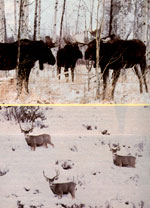
little browse has been uncovered by earlier winds. Moose
frequently congregate in river bottoms, where they tear at
willow buds to fuel themselves, while deer are more likely
to group on the south (or warmer) sides of hills until
another storm drives them into timber to escape the
life-sapping winds.
I rarely approach any animals that I see but, instead,
watch their habits through binoculars. (When humans get too
close, the creatures will almost always run, and flight
forces them to waste precious energy.) Then I use a map to
record the spots where the deer and moose in my area seem
to hang out. I draw lines indicating heavily traveled snow
trails, too, and note timbered areas that appear to shelter
big game in harsh weather. Tracks will usually lace these
spots.
Not long after my scouting, deer and moose will begin to
shed their antlers. The base of the horn loosens from the
skull, and when the animal bumps a tree or moves its head
quickly, the antlers shear off relatively painlessly.
Larger racks seem to drop first. Probably this happens
because big bucks, bull elk, and bull moose have so much
leverage applied to their noggins by their weighty headgear
that a quick twist of the neck wrenches off loose antlers
far sooner than would be the case with spindlyhorned
specimens (young animals with little overhead mass may well
carry one or both projections far into the spring).
Once my region’s moose and deer have discarded their racks,
I focus on locating the winter hangouts of elk, animals
that tend to molt later (they start to do so during the
early days of March in Wyoming). Elk habitats, during the
late winter and early spring, vary from sunny open slopes
to snowbound timber tracts to treeless mountain valleys. I
map such places and then wait until the sighting of a
number of bare-headed bulls tells me that their shedding
season is all but over.
The first part of spring, then, is prime time for elk
trophy-taking. Don’t delay your hunt too long, however . .
. when summer comes, most of the past winter’s antlers will
be hidden from view by sprouted greenery or ruined by
gnawing rodents.
The Shedding Seasons
If you’re uncertain about just when to expect antlers to
start hitting the ground in your region, here are some
rough rules of thumb.
Game management officials in the West say that moose begin
to drop their headgear in mid-December, and that they’re
usually finished by mid-January. It’s a slightly different
situation in Alaska, where–as game biologist Dave
Hardy of Juneau points out–antler shedding is in full
swing from December through February. In the northeastern
states prime moose-shed time lasts from the end of December
to mid February.
Deer can be expected to drop their horns from late January
through February in the Southwest, while in such a typical
western state as Wyoming the season spans late December to
early February. Deer in the not-so-typical western state of
California, on the other hand, discard their antlers from
mid-November through April, with shed time varying from one
herd to another, according to the state’s wildlife
biologists.
Eastern whitetail deer lose their head growths from
December through early February, while midwestern bucks
begin to shed in late January and continue into February.
Maine’s regional wildlife biologist Gary Donovan tells me,
though, that the peak shed is earlier in his state . . .
running from the end of December through mid-January.
(Here’s a special tip for eastern horn hunters: Deer yards,
where whitetails gather during heavy winter snows, are
excellent areas for springtime inspection, as are the
trails leading to and from the yards and any nearby bedding
and feeding locations.)
In the Southeast (Georgia, for example), buck deer begin to
go “bald” in early January. The shedding usually
peaks by the end of that month, but continues for
a few weeks more. Alaskan deer, although thousands of miles
to the north, are only slightly out of step with their
southern cousins: Blacktails there meet the invisible
barber from the middle of December until the end of
January.
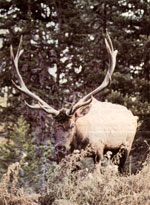
Elk, as I’ve already mentioned, are slow to shed their
horns. Wyoming bulls do so from early March through the
first of May. Californians can expect their state’s wapiti
to lose their racks from February through April.
No one, of course, can tell exactly when a given group of
animals will shed, because nature sets no firm timetable
for this event. An individual beast may even lose one horn,
only to carry the other for some weeks longer. That’s why
preseason mapping of animal move ments is so important. The
records help the antler hunter to determine which areas
hold the greatest yield potential.
Be aware, though, that since the size and pattern of
snowfall varies from one winter to the next, antlered
critters can’t be expected to occupy the same places every
year. You’ll have to prepare a new map of animal haunts
annually.
On The Hunt
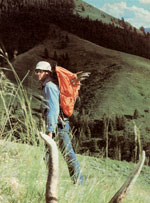
When I set out on my collecting forays, I carry a backpack
frame on which to lash my trophies. I used to take the
frame with the pack in place, but I’ve found that it’s
easier to tie antlers on when the bulky sack isn’t there to
get in the way. My water, rope, food, compass, and
emergency survival gear are hauled in a small daypack,
which I attach to the frame’s upper portion. (By undoing my
daypack’s straps and looping them under the frame’s top
crossbars, I can be certain that these provisions ride
comfortably.) Binoculars-which every outdoorsperson should
own–and a camera are added to my gear. I then stuff
one red bandanna in a pocket, and I’m ready to set out into
the habitat that my benefactors are vacating.
Actually, I always delay my departure until the snow has
melted enough to insure that any animal I do encounter
won’t be overtaxed if it runs from me. I prefer
not to wait for total thaw, however . . . because
horns are easily seen on snow, whereas they blend
incredibly well with the bare earth and are thus tougher to
spot in the warmer weather.
In any case, the “harvest” requires one heck of a lot of
cross-country clambering, and lightweight
binoculars–in the 7- to 10-power class–can save
both energy and time: They’ll help you confirm whether or
not a “something” that appears to be an antler actually is
. . . without your having to check out each possible find
close up.
Careful scrutiny is necessary, because deer horns
frequently resemble downed branches or exposed tree roots.
Examine each object for the details that identify antlers.
For example, are its tips pointed and lighter in color than
the main beam? Does its surface seem smooth, or is it
apparently bark-covered? Do small twigs branch off at the
“expected” angles? And, finally, is it shaped like
an antler? If you’re still uncertain, try walking just far
enough to get another perspective before actually heading
for the spot. By following this routine, you should be able
to shave the number of false alarms–and nonproductive
side trips–to a minimum.
Moose wintering grounds–which are typically at
relatively low elevations–are normally the first to
be relieved of heavy snow, so during my explorations I
thoroughly crisscross every area where I’ve formerly
spotted bulls. Willow thickets, whose young shoots often
keep the massive animals from starvation, are choice cover
to search . . . but don’t neglect boggy stream edges, which
the moose like to travel, or thick lowland brush and timber
in which they ride out storms.
Stay alert and try to look literally everywhere. I once
found a fine antler on the bottom of a clear beaver pond
while looking for trout. No doubt aquatic plants had lured
the moose to feed there at the time when, as it happened,
its horns were being discarded. I fished the unexpected
bonus out by means of a shoestring noose tied to a willow
branch.
Don’t, however, feel that you have to carry home every horn
you find. Sunbleached antlers are good for mementos, but
they hold little real value. Freshly shed, brown-colored
beams are the prizes to seek . . . and, of course, are also
the hardest to spot.
When you do come upon the souvenirs you’re after, remember
that you could hurt yourself should you trip and fall on
their pointed tips . . . so always hold antlers with the
points down. It’s also important, when hiking on slopes, to
carry racks in the hand that’s on the downhill side, since
a person who’s traversing steep terrain generally tries to
fall uphill. I usually tie my horns to my backpack frame,
but still I make sure they’re pointed away from my neck and
back.
The Payoff
Antler hunting can provide you with great outdoor exercise
and the thrill of finding what you’re seeking. However, the
additional benefits of the sport are probably greater than
you’d imagine.
For one thing, by making a field survey of buck whitetail
or bull moose antlers, the game hunter will be able to
determine the animals’ population density for a given area
(these beasts seldom migrate to distant ranges, as do mule
deer and elk). Since the dropped horns belonged to game
that’s still alive, that information should help the
stalker decide whether or not the region contains enough
animals to support a hunt during the next archery or gun
season.
Of course, you might simply want to pick up some of these
wilderness prizes for household display (the occasional
“freak” horns you’ll find are excellent conversation
pieces). Or perhaps you’ll use them in craft projects: I’ve
seen antler-tip jewelry . . . a huge antler picture frame .
. . horn belt buckles . . . and a variety of other items
that incorporate the free-for-the-gathering raw material.
[EDITOR’S NOTE: In the next issue of MOTHER, the author
will show you how to make a number of different–and
salable–craft products from antlers.]
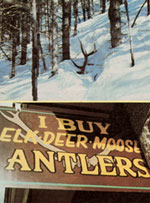
Then again, many people search out discarded racks because
of their market value. Where I live, most horns with
brownish color can be sold for about $6.00 a pound, and the
price is still rising. Some Oriental purchasers grind
quality beams into a powder, which is sold as an
aphrodisiac. Jewelry firms and novelty or tourist shops
help keep the demand up by making curios from antlers.
As you can see, then, there’s cash to be made . . . but the
truth is, I hope the prices don’t go any higher. As one
businessman put it, “Pretty soon the rewards will be so
great that poachers will start taking animals out of season
just for their heads” (much as tusk hunters have helped
bring elephants close to extinction).
Scavengers who search out already shed antlers, on the
other hand, are providing the market with a quickly renewed
resource.
Keep in mind, however, that national parks don’t allow
visitors to remove antlers, and neither do some wildlife
preserves . . . illegal collection in such areas could put
you in the slammer. And state laws vary: California, for
example, allows residents to possess tule elk
antlers but not to sell them.
The inconsistency of the rules points out the need for
prospective horn hunters to contact game officials
regarding local regulations before setting out after any
trophies.
Interestingly enough, though, one of the largest legal
antler roundups does take place on a preserve . . . the
National Elk Refuge not far from Jackson, Wyoming. The
catch is that only local Boy Scouts are issued the permit
that allows them and their supervisors to comb the area,
after the 7,000 to 10,000 elk that winter there have cast
off their horns and left. One record season saw the Scouts
gather a whopping 8,793 pounds of antlers in less than a
full day.
I had the opportunity to go along and photograph that event
one year, and I was stunned at the booty collected. The
take would have covered a basketball court to a depth of 15
inches!
The Horns of Plenty
If you’ve done your scouting and mapping well, you may find
yourself confronted by a really rather pleasant
problem . . . that is, you could well collect so many
antlers that you can’t carry your entire haul home in one
trip. In such a case, simply stash the surplus treasures in
a place where few people will travel, and come back for
them later.
In my somewhat remote area, I’m not much concerned that
someone will stumble across my cache of hard-earned
hatracks, but I do dread the possibility that I’ll forget
where I put them! My “security” is provided by the red
bandanna I mentioned earlier. I just knot the kerchief
around a low bush to flag me down on the return trip.
Of course, you won’t always be blessed with such bounty.
There are times when even the most conscientious searcher
will come back empty-handed. For that reason I seldom go
afield only to find antlers. To do so would invite
letdowns, so I include a camera and telephoto lens among my
gear. I snap away at whatever wildlife I see during horn
hunts . . . photographing everything from sassy red
squirrels and blue grouse to coyotes and elk calves (which
I don’t approach). Thus I seldom end a trip without rewards
of one kind or another.
Furthermore, every time I advance to claim a fresh rack,
all the work and previous disappointments seem worthwhile.
Fingering the story of rut fights and winter hardships
that’s etched on every antler allows me to appreciate more
fully the lives of the wild creatures that produced these
trophies . . . which just lie there, free for the taking.





