
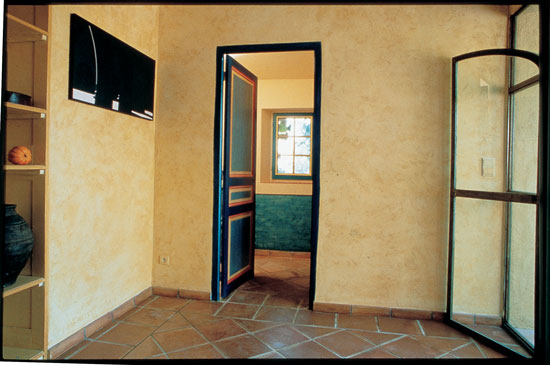




Nothing is more pleasing to the eye and nurturing to the soul than being surrounded by colors you love. Everyone has a favorite, whether soothing blue, cheerful yellow, or calming sage. Now more than ever we’re using gorgeous paint colors and intriguing faux finishes to create distinctive, beautiful living spaces.
But before you roll out the drop cloths and head for the paint store, consider this: Most paint contains chemicals and compounds that are definitely harmful to the environment and potentially harmful to you and your family. Even latex, considered the “safe” paint by most, contains some of these detrimental compounds.
The good news is that many paint manufacturers, large and small, are going “green,” providing ecologically improved paints for use indoors and out. When these paints are used correctly and with proper ventilation, most of us will never suffer ill effects, especially when we choose less toxic ones.
A Primer on Paint and Its Problems
All paint has three major components: a pigment for color and hiding power; a binder that holds the pigment to the surface; and a carrier that maintains the pigment and binder in liquid form for ready application. While household paint has not contained lead since it was banned by the Consumer Product Safety Commission in 1978, it may contain other harmful chemicals, including petrochemicals and solvents, mercury, formaldehyde, benzene, and a slew of others that can have harsh effects on the human body–from temporary dizziness to acute breathing problems, or even cancer.
There are two kinds of paint: oil-based and water-based, or latex. Oil-based paints contain drying agents, formerly linseed, soy, or tung oils; now, more often, that agent is a synthetic polymer known as alkyd. Oil-based paint requires a petroleum- based solvent for clean-up. Latex paint contains fewer harmful substances than oil-based paint, and because it’s water soluble, requires no chemical solvents for clean up. While both are available for indoor and outdoor applications, latex is the popular choice for interior use.
In fact, health concerns and environmental regulations are pushing the paint industry gradually to phase out oil-based paints and move toward latex, even for outdoor applications. “Latex paint is more breathable, has better color and mildew resistance, and expands and contracts with the wood more easily than an alkyd paint,” states the Choose Green Report, the publication of Green Seal, a nonprofit organization that sets rigorous environmental standards for products and services.
So, you’re saying, that makes it easy. Just use latex. Unfortunately, however, it’s not that easy. Even latex paint contains volatile organic compounds, or VOCs, that are harmful to you and the environment, although at levels lower than those found in oil-based paint.
The Trouble with VOCs
When exposed to sunlight, VOCs produce ground-level ozone, a major contributor to air pollution, indoors and out. “Studies have shown that ground-level ozone is harmful to both human health and agricultural crops,” according to a recent Choose Green Report.
Should we worry about the VOCs we create when we paint? Garret Brodhead of NonToxiCA Paints, a zero-VOC paint manufacturer, puts it this way: “According to the EPA, nine percent of the air-borne pollutants creating low-level ozone pollution come from the VOCs in paint. Nine percent. That’s a lot.” And an EPA study shows that VOCs are consistently ten times higher indoors than outdoors. That number rises to 1,000 times higher with a fresh coat of paint.
The American Lung Association reports that VOCs can induce a number of physical problems: eye and skin irritation, lung and breathing problems, headaches, nausea, muscle weakness, and liver and kidney damage. The elderly, pregnant women, small children, and those with compromised immune systems or environmental allergies are especially sensitive.
Choose Green Report editor Margaret Blanchard says to use your nose to sniff out VOCs. “Everyone knows that smell,” she says of new paint odor. It comes from VOCs, and “as long as you can smell it, it’s outgassing,” or emitting VOCs into your air space. The first four days are the worst, so make sure you properly vent the room you’re painting during that period, but smaller amounts will still be emitted over time. VOCs also cling to fabrics and carpeting, multiplying the problem.
Brodhead issues this strong warning about VOCs: “These toxins last for years. Most people think that when they paint their bedroom, the smell lasts for a couple of days then goes away. No problem. But it doesn’t go away; it just goes somewhere else.”
The EPA regulates the amount of VOCs permissible from any product, and some states, such as California and New York, regulate VOC emissions for their own communities. The Choose Green Report provides information and a list of paints it recommends in its August/September 1998 issue.
Safe, or Safer, Paint Alternatives
So now what? Can you have gorgeous, colorful walls without poisoning yourself or the environment? The answer is a resounding “kind of” from paint experts such as John Harris, chemist and co-owner of Belcaro Paints in Denver, Colorado. “Even with reduced VOC levels, chemically sensitive people may still have reactions to the chemicals in paint.” But he adds that such VOC-reduced paints are, indeed, a step in the right direction for the environment.
Large paint companies such as Benjamin Moore, Glidden, Kelly Moore, and Sherwin-Williams have heeded the environmental call and now market zero-VOC, low-VOC, or odor-free paints. While “it is virtually impossible for a paint to eliminate VOC emissions entirely,” according to Environmental Building News, February 1999, these and other manufacturers have developed paint products that emit much lower levels. “Most of these paints still use colorants with some solvent, so tinting the paint will introduce a small amount of solvent,” the newsletter reports. Most are available only in lighter colors. “Only one paint, ICI’s Lifemaster 2000, is independently certified as VOC-free.” This paint uses a more expensive, solvent-free colorant system to achieve richer colors. Many alternative paint companies, however, offer broad color selections that are low- or zero-VOC. Use the resource directory we’ve provided to obtain information about these products.
American Formulating & Manufacturing has developed its Safecoat line of paints especially for those who suffer from chemical sensitivity or environmental illness. These paints are formaldehyde-free, have very-low VOC content, and are formulated with additional sealing properties that result in minimal outgassing. Harris recommends the Safecoat line to chemically sensitive patrons.
Smaller paint companies offer their own lines of alternative paints. The Old-Fashioned Milk Paint Company in Groton, Massachusetts, makes paint from milk protein, lime, clay, and earth pigments. Packaged as powder to be mixed with water, milk paint is available in “deep, rich colors” and lighter shades, according to vice president and general manager Anne Thibeau. “It’s the most durable paint known to man,” she says. “Traces have even been found on King Tut’s tomb.” Milk paint will show water spots, however, so it requires a sealant such as the company’s low-VOC clear acrylic product. Casein paint is another type of milk paint, usually sold in liquid form.
Beyond Paint–Stains and Pigments
Natural Choice Products in Santa Fe, New Mexico, makes Bioshield products, a selection of paints, stains, thinners, and waxes from naturally derived materials. In addition to casein milk paint and zero-VOC paint, Natural Choice sells a full line of stains and sealers for wood applications such as hardwood floors, doors, trim, and exterior finishes. Bioshield Primer Oil and Resin & Oil Stain are recommended by garden gurus Smith & Hawkins for wood garden furniture, but they also may be used indoors on porous wood, stone,
or clay surfaces. While the Primer Oil employs some solvent, for the most part these natural finishes use linseed and orange oils in place of solvents and colorants made from ground stone and food-grade dyes that make them safe enough to eat. Natural Choice General Manager Deborah Binnion says to keep in mind that water resistance may be somewhat less than with traditional sealants.
Nine percent of the air-borne pollutants creating low-level ozone pollution come from the VOCs in paint. Nine percent. That’s a lot.
The Natural Choice catalog also features Livos nontoxic products from Germany. Jim Logan Architects in Boulder, Colorado, recommends Livos’ UraStain Paste, a water-soluble, earth-based tint available in a variety of colors, to stain doors and woodwork, and Gleivo Liquid Beeswax as a sealant. This eco-architectural firm experiments with many nontraditional products, including natural fabric dyes for adding nontoxic color to interior spaces.
For something a little different, New York-based Sarut markets natural mineral pigments made from ochre sediment found in France; it’s available in six shades, from pale yellow to burnt brown. Mixed with linseed oil and paint thinner, these colored “dusts” create a patina wash; optional green, blue, and red oxides provide color. Obviously, however, the end product contains chemicals you may want to steer clear of if you’re looking for a completely nontoxic product. For artists, these pigments also come in chunky pastel chalks called Ochre Pebbles as seen in “Goods,” page 34. They’re great for drawing directly on surfaces to create murals or stenciled finishes. Mix the provided resin with alcohol to create a fixative.
Most alternative products are admittedly more expensive than traditional ones, but environmentally conscious consumers expect to pay a little more to be “green.” Alternative paints and finishes are available by mail order, on websites, and through environment-friendly product catalogs. They’re also sometimes found in retail stores.
Natural Faux Finishes
Interior finisher and color expert Sara Noel of Noel Designs in Denver, Colorado, says today’s hot faux finishing techniques can be achieved in a less toxic manner, although it can be tricky. “You can use the safer paints for faux finishes, but one of the problems is they dry very quickly. This makes it more difficult to achieve the finish you’re going for, because you have less working time.” Quick drying time also results in more visible texture from brush strokes and rollers.
Noel recommends slowing down the drying time by adding an acrylic glazing medium that is less toxic than the traditional oil-based products often used in faux finishes. “Make sure your faux finisher isn’t using an oil product,” Noel warns. “Acrylics are better than oils, and bring us one step closer to being environmentally conscious and conservationist.” Chemist Harris of Belcaro Paints agrees: “Acrylics still contain harmful substances, but are generally more environmentally friendly than oil-based products.” Noel recommends Benjamin Moore’s Pristine Glazing Liquid or Golden’s art acrylic products, available in most paint stores.
No Easy Answers
While paint companies are continually finding new ways to formulate safer products for the environment, few if any perfect solutions exist at this point. Those who are chemically sensitive should test each product, states Harris, even if that product is VOC-free. He has customers sleep with a product sample on their bedside table to ensure they have no reaction.
But the good news is we now have many less-toxic paints available, and that means fewer harmful chemicals and compounds in the air we breathe. And for those not chemically sensitive, the safer color is sure to be healthful and provide comfort, inspiration, and a chance to express your individuality. Be creative, be playful, be wild, but choose environmentally conscious paints for your new “green” color palette!
Jennie Shortridge is a freelance writer whose work has appeared in Mademoiselle, Glamour, At-Home Mother and Mountain Living.