The following blog post is a contribution to the 2011 Blog Action Day focused on food issues.
As our food system has shifted from decentralized, local small-farm “agri-culture” to highly centralized industrial “agri-business,” this has caused the nutrient content of many foods to decline. Numerous factors are causing this decline, including breeding for ever-higher yields, food processing, cheap sugar and oils, and industrial meat and dairy production.
In some cases, the declines have been very gradual. Over the last 100 years, important minerals in WHEAT varieties grown on the Great Plains–iron, zinc, phosphorous and sulfur–have declined from 20 to 33 percent.?Sulfur is essential for plants to produce protein, so a drop in sulfur indicates a decline in protein content. One study found that contemporary wheat varieties contain ONLY HALF AS MUCH PROTEIN as older varieties! During this same period, YIELDS of wheat have at least doubled as a result of “green revolution” varieties that are shorter, but require heavier levels of fertilizer and irrigation than older varieties. In CORN, studies show similar trends–a doubling of yield, but accompanied by declines in important nutrients.
Food Processing Is An Additional Factor
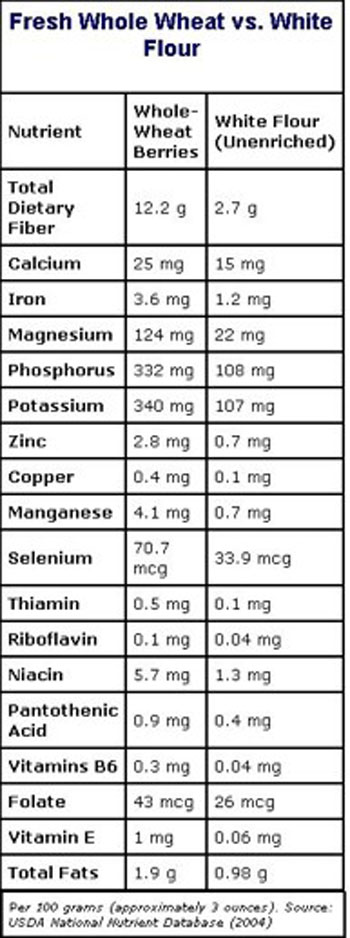
Not only have the nutrient levels in corn and wheat declined as farmers have switched to higher-yielding, more profitable varieties, but food processors then remove the germ from these grains when they produce flours, because this gives flours and breads longer shelf-life. Longer shelf life could be useful at home, too, but it comes at a stunning cost:??
The nutrient density of our FRUITS and VEGETABLES has also declined as new, higher-yielding varieties have been adopted. Breeders have used hybridization to improve yield, earliness, growth rate, disease resistance and uniformity. But no one was measuring changes in nutrient content (or flavor). We can now document “broadly declining nutrient concentrations” in fruits and vegetables over the last 50 years.?Careful analysis of historical nutrient data from both the United Sates and Great Britain has been conducted by Dr. Donald Davis of the University of Texas. Dr. Davis has found that protein, calcium, phosphorus, iron, riboflavin and vitamin C have all declined in fresh produce, while carbohydrates (starch and sugar) appear to be increasing.?
Reasons for Nutrient Declines
The Environmental Dilution Effect. Since the 1940s, scientists have known that yield increases achieved from fertilization, irrigation and weed control sometimes decrease mineral concentrations. ??
The Genetic Dilution Effect. Some scientists are now recognizing that in many cases breeding for higher-yielding varieties has lead to reduced nutrient levels in food crops. BROCCOLI, for example, is a significant source of calcium for many people. Newer varieties give dramatically higher yields, but calcium content has plummeted from 13 mg/g in 1950 to only 4.4 mg/g in 2003.?
Malnutrition For Some
In less developed countries, adoption of “green revolution” wheat and rice varieties has lead to “hidden hunger.” People get enough calories (carbohydrates) from these grains, but not enough nutrients, leading to malnutrition and disease.
Increasing Percent WaterMost studies are conducted on a “dry weight” basis. Those studies that measure trends in nutrient concentrations on a “fresh weight” basis often show that the percent water is increasing.?Some of the increase in percent water is due to excess use of chemical nitrogen fertilizers. (This nutrient is difficult to hold in non-organic soils, so growers often over-apply it.) Organic growers use only natural, slower-release fertilizers, so organic produce often has lower water content, making it more nutrient-dense, pound for pound, than industrial products.?WHEN THE WATER CONTENT INCREASES, THIS MEANS THAT PER POUND OF FRESH WEIGHT, WE ARE GETTING LESS FOR OUR MONEY, AND LESS NUTRIENT VALUE PER BITE!
What About Meat, Poultry and Dairy Products?
Industrial production of animal products is fraught with problems and is clearly unsustainable and inhumane. It offers cheaper, but less-nutritious, food. Breeding animals for rapid growth, and raising them in filthy confinement conditions on unnatural, high-grain diets, is causing “conventional” meat, eggs, butter and cheese to be less nutritious in various ways.
For example, eggs from heritage chickens raised on pasture contain up to 30 percent more vitamin E, 30 percent more vitamin B-12 and 50 percent more folate, than industrial eggs (from intensively bred hybrids) sold in most supermarkets.
Here’s what Dr. Bruce Ames says about folate and vitamin B-12, in his paper, “Increasing Longevity by Tuning Up Metabolism,” published in Nature magazine: “Folate (and vitamin B-12) deficiency cause chromosome breaks in human genes … and have been associated with increased risk of colon cancer. 15-year use of a multivitamin supplement with folate lowered colon cancer risk by about 75 percent.”
“Folate and vitamin B-12 deficiencies are associated with cognitive defects in humans. … Inadequate folate intake … has been associated with an estimated 10 percent of heart disease in the United States.”
Compared to industrial beef and dairy products, foods from animals raised on pasture are often richer in vitamins E, A and D, beta-carotene, and heart-healthy, cancer-fighting fatty acids (omega-3s and CLA). Grass-fed products also contain less total fat.
Why This Nutrient Decline Trend is Not Being Widely Discussed
Companies that sell food to us have a vested interest in funding and promoting studies that are positive toward the products they sell to us. Any topic that threatens companies’ bottom lines is not likely to be chosen by researchers, nor is funding for the research likely to be available. “Independent” university research is often heavily influenced by corporate interests.
In the case of plant breeders’ newest technology, genetic engineering, the influence of vested corporate interests has become so extreme that companies will not even release seeds of GE varieties to researchers who want to study them. Or, they require the researchers to sign an agreement that gives the company the right to refuse to allow the research results to be published, if the company does not like the results. So much for using science to get at the truth.
The Obesity Epidemic
There is an additional factor that is making our diets less nutritious: adoption of higher-yielding grain varieties has meant that these primary sources of sugar and starch have become less and less expensive, causing corn syrup in particular to be added to more and more processed foods, and to be marketed extensively as soft drinks.?Sodas are now often less expensive than bottled water!?And did you know–one can of Coca Cola contains 10 TEASPOONS OF SUGAR!?Humans have a natural sweet tooth–it evolved to help us know when wild foods were ripe and prime for eating.?Most of us choose the least-expensive foods. This is only natural, since we can’t see which products are more nutrient-dense.?But super-cheap sugars and starches, together with our natural tendency to choose whatever is least expensive (and sweetest), is causing us to consume far more carbohydrates than we need, as well as fewer essential vitamins and minerals.
Also, thanks to cheaper, higher-yielding corn and other oil crops, we now consume far more vegetable oils than our bodies evolved with, and the balance of important types of fatty acids in these oils has shifted in a way that researchers now report is harmful. Industrial meat and dairy production has also contributed to this shift in ratios of beneficial fatty acids.
The Result Is Our Obesity Epidemic
We now live in a world where about a billion people suffer from hunger and malnutrition, while another billion suffer from obesity.
The Consequences of Inadequate Vitamin and Mineral Intake
Q: How many ESSENTIAL VITAMINS AND MINERALS are there? “Essential” means that for optimum health, we must consume them in our food.
So far, scientists have identified 40 essential nutrients:
VITAMINSVitamin A
Vitamin B1
Vitamin B2
Vitamin B3 (niacin)
Vitamin B5
Vitamin B6
Vitamin B7 (biotin)
Vitamin B9 (folic acid)
Vitamin B12
Vitamin Bp (choline)
Vitamin C
Vitamin D
Vitamin E
Vitamin K
MINERALS
Boron
Calcium
Chloride
Chromium
Copper
Fluoride
Iodine
Iron
Magnesium
Manganese
Molibden
Nickel
Phosphorus
Potassium
Selenium
Silicon
Sulfur
Zinc
Vanadium
AMINO ACIDS
Alpha-linolenic acid (ALA)
Linoleic acid
Arginine
Isoleucine
Histidine
Leucine
Lysine
Methionine
Phenylalanine
Tryptophan
Threonine
Valine
Most nutritionists are taught that the average American diet generally provides adequate levels of the 40 known essential vitamins and minerals. But some scientists argue that the current “recommended daily amounts” are not sufficient to prevent long-term DNA damage that leads to cancer and accelerated aging. Here’s how Dr. Ames put it: “Inexpensive, processed foods and drinks are calorie-rich but poor in micronutrients, and as a consequence, the United States and other developed countries are now facing an epidemic of obesity associated with micronutrient malnutrition.”?Ames explains that “common micronutrient deficiencies are likely to damage cell DNA by the same mechanism as radiation and many chemicals …” ZINC DEFICIENCY, for example, is associated with cancer in both humans and rodent models. 10 percent of the U.S. population ingests less than 50 percent of the RDA for zinc. IRON DEFICIENCY is also associated with DNA damage, and INADEQUATE VITAMIN D is linked to several types of cancer, according to Dr. Ames.?Current government guidelines recommend that we eat 5 to 9 servings of fruit and vegetables per day. Eighty percent of children and 68 percent of adults do not eat five servings per day.
Dr. Ames points out “THE QUARTER OF THE POPULATION THAT EATS THE FEWEST FRUITS AND VEGETABLES HAS ABOUT DOUBLE THE CANCER RATE FOR MOST TYPES OF CANCER, WHEN COMPARED TO THE QUARTER WITH THE HIGHEST INTAKE.”?
What Can You Do?
Eat more VEGETABLES AND FRUITS.
REDUCE YOUR INTAKE OF REFINED CARBOHYDRATES, such as sugar, white flour and rice.
Eat more WHOLE GRAIN FLOURS and BROWN RICE.
Inexpensive home grain mills together with refrigerators and freezers make it easy for anyone to grind their own fresh flours. Homemade whole-grain bread takes only a few minutes a day and costs about 50 cents per loaf!
When you can, grow your own or shop at farmers markets and CHOOSE HEIRLOOM, NON-HYBRID, LOWER-YIELDING VARIETIES.
In your garden, BE CONSERVATIVE WITH FERTILIZER AND IRRIGATION.
Choose meat, dairy and eggs from PASTURE-BASED PRODUCTION systems, and do not worry so much about the saturated fats in these foods.
Choose ORGANICALLY GROWN PRODUCE whenever you can.
Be prepared to PAY MORE for food that comes from lower-yielding but more nutrient-dense grain and produce varieties, and from more humane, less-intensive grass-based egg, meat and dairy production.??
Take a daily MULTIVITAMIN AND MINERAL SUPPLEMENT.