

Asparagus is one of those strange vegetables–you
either love it or you hate it. Perhaps you have that all
too common childhood memory of stringy, limp stalks that
were so overcooked that they forced you to shun the green
stuff ever since. When I was little, fresh asparagus recipes were foreign to my large family; it was too
expensive. When we did have asparagus, it was often the
gastronomically challenging variety mentioned above. A
special treat then, was visiting my grandparents’ house
during asparagus season, knowing that I was sure to dine on
what I thought was a rare, exotic, and slightly scary
vegetable.
My grandmother had an asparagus patch behind her garage not
too far from her prize winning flower garden. She was a
proper grandmother who wore a dress every day of her life,
even if she never left the house. That’s why it was
intriguing to me to see her don old pleated pants to work
in the garden. She must have looked like Jean Harlow
wearing those pants during the 1930s. That’s one of my best
memories of my grandmother: gray-haired and garden-gloved,
kneeling next to me in the asparagus patch while we scouted
the perfect stalls. We’d then lunch on steamed asparagus
with plenty of butter (butter wasn’t evil back then),
cucumber sandwiches, and homemade ginger cookies.
Buying Asparagus: The best asparagus is available
sometime in February up until the end of June, with April
and May peak months in the Midwest. It’s best to buy
asparagus only when it’s in season and extremely fresh. It
must be refrigerated or stored standing in an inch or so of
water in the supermarket immediately after harvesting to
maintain its flavor and nutrients. The vitamins C, E, and A
found in asparagus will diminish rapidly at room
temperature. Also, it will lose some of its residual
sugars, which impart flavor, and the stalks will lose
moisture, making them tough and stringy.
Look for firm stalks without ridges (a sign that the
asparagus is ancient). The tips should be bright green,
tightly closed, not wilted or gone to seed. The diameter of
the stalks is not directly related to quality or
tenderness, but stalks that measure about 1/2″ in diameter
are usually preferable.
Varieties: American asparagus is green while
European asparagus is purple-streaked or white-streaked. The prized white variety is planted underground to
prevent the development of chlorophyll, which turns it
green. This process yields more fibrous and stronger
tasting spears but is more expensive and less nutritious.
Storage: If store bought, cut a little off the
ends and refrigerate standing in an inch of water in a deep
container. Cover loosely with a plastic bag that doesn’t
touch the tips. Take care not to store in the back of the
refrigerator where the tips will often freeze. Depending
largely on its freshness when purchased, the asparagus
should keep 3-5 days.
Preparation: Break off the tough bottoms of the
stalks at the point at which they break off naturally.
Rinse briefly in cold water. Whatever cooking method you
choose, cook quickly until tender but still bright green
and slightly crisp. Add the skinny stalks last so they
won’t overcook.
Steaming: Use a vegetable steamer or a minimal
amount of simmering water to steam the asparagus in a
covered pan for 35 minutes, depending on the thickness. If
using for a salad, dunk immediately in cold water for a
second to stop the cooking, then refrigerate.
Microwaving: Arrange the spears in a covered pan
with all the tips pointing toward the center of the pan.
Add 1 tablespoon of water or butter. Microwave 2 minutes,
rotate the pan and turn over the stalks, and microwave up
to about 2 more minutes. This is not my favorite method of
cooking asparagus because it sometimes doesn’t cook
uniformly.
Roasting: Place the asparagus on a baking or
cookie sheet and drizzle lightly with olive oil, seasoning,
or herbs. Roast uncovered in a 450°F oven for about 4-5
minutes, turning them over once.
Asparagus-Potato Salad
6 small red or white, skinned potatoes, halved and cut
into 1″ pieces1 small red pepper,
thinly sliced
1/2 red onion, finely chopped
1/2 pound asparagus, tough bottoms removed, and cut on
diagonal into 1 ” pieces
1/4 cup parsley or chives (or a combination of both),
chopped
In a covered saucepan, using a vegetable steamer (or using
a small amount of simmering water), steam the potatoes
until a fork can be inserted–about 15 minutes. Remove
and place potatoes in a bowl with the red pepper and onion,
then toss. Steam the asparagus the same way for a few
minutes just until tender. Rinse immediately under colder
water briefly to stop them from cooking further. Toss into
the salad with the parsley and enough vinaigrette to coat the vegetables. Chill or serve at room
temperature.
Asparagus Vinaigrette
1 large clove garlic, peeled and smashed2 small shallots, peeled (optional)
1 1/2 tablespoons Dijon mustard
2 tablespoons balsamic vinegar
2 tablespoons olive oil
1/2 teaspoon grated lemon rind
1/4 cup lemon juice
1/8 teaspoon cayenne pepper
1/2 teaspoon salt
freshly ground pepper
1 tablespoon fresh dill weed (optional)
Mix well in blender.
Smoked Tomato Sauce
Try using this low-fat sauce instead of hollandaise sauce
to serve over hot asparagus. This dish can be served at
room temperature as a salad, but make sure that you
slightly undercook the asparagus because it will continue
to cook as it cools.
2 large fresh ripe tomatoes (or 5-6 Italian plum
tomatoes)1 teaspoon mild
oil
1 clove garlic, minced
1/8 teaspoon jalapeno pepper, minced
2 tablespoons fresh lime juice
1/2 teaspoon sugar
1/4 teaspoon ground cumin
1/4 teaspoon oregano
1/4 teaspoon thyme
dash of salt
1 pound asparagus, trimmed and steamed
Using a long fork or knife, roast the tomatoes one at a
time directly over a high gas flame until the skin becomes
charred in spots, blistered, and loose. Insert a knife into
the core of the tomatoes, one at a time, and roast them
over a high gas flame. Cool a few minutes, then peel off
the skin, core, and finely chop. Sauté the garlic
and pepper in oil on medium-high heat briefly while
stirring. Add the tomatoes and the rest of the ingredients.
Stir and turn off the heat so that the sauce cooks for not
even 30 seconds. Steam the asparagus and serve it topped
with a few spoonfuls of sauce.
Asian Asparagus
1 pound fresh asparagus, cut diagonally into 1
“pieces
1 tablespoon sesame seeds, toasted*
1 teaspoon sesame or walnut oil (or any mild oil)
1 small clove garlic, minced
2 teaspoons rice vinegar (or white wine vinegar)
1 tablespoon tamari (soy sauce)
1 teaspoon sugar
2 teaspoons fresh ginger root-peeled and grated
1 tablespoon sherry or rice wine
1 tablespoon water
few dashes chili oil or cayenne pepper
Sauté the garlic a few seconds. Stir together the
rest of the ingredients and pour into the skillet. Add the
asparagus and cook for about 2 minutes on medium heat until
the asparagus is done but still a little crisp. Serve
topped with sesame seeds.
*To toast sesame seeds: Place them in a small heated
skillet on medium-high heat. Heat for about one minute,
stirring often so they don’t burn. Remove from pan
immediately when they begin to “smell toasted.”
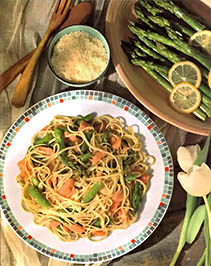
Smoked Salmon and Asparagus with Linguine
I buy smoked salmon at a local fishery where it’s smoked
but still moist and not too salty. If you can’t get smoked
salmon, grill some fresh salmon steaks with leftovers for
this simple pasta dish the following day.
4 large cloves garlic, minced
1 tablespoon olive oil
3/4 cup unsalted chicken brothfew dashes
cayenne pepper
freshly ground pepper
1 pound asparagus (about 1 1/2 cups), trimmed and cut on
the diagonal into 1 ” pieces
1/4 cup white wine
1/2 pound smoked salmon, deboned and cut into 1
“pieces
12 ounces linguine
1/4 cup freshly grated parmesan or romano cheese
1/4 cup parsley, chopped
In a large pot bring water to boil and add linguine. In a
skillet sauté the garlic in the oil for about 30
seconds. Add the chicken broth and seasonings and heat
until boiling. Add the asparagus and cook on medium to
medium-high heat for about 2 minutes until the asparagus is
almost done. Add the salmon just long enough to heat it,
stirring as little as possible so the salmon will remain in
pieces. Drain the linguine and toss linguine, salmon,
asparagus mixture, and cheese together in a large bowl.
Serve topped with parsley and additional cheese if you so
desire.
Asparagus Frittata
1 teaspoon butter8-10 asparagus spears,
tough ends removed and cut on the diagonal into 1/2″
pieces
2 tablespoons onion, minced, or 2 small shallots, peeled
and minced
2 eggs
dash milk
dash cayenne pepper, salt
freshly ground pepper
1 teaspoon mild oil
2 tablespoons freshly grated parmesan or pecorino romano
cheese
chives, chopped (optional)
Turn on the oven broiler. In an 8″ nonstick skillet
sauté the asparagus and onion in 1 teaspoon of
butter for a minute or so–just until the asparagus is
tender. Remove from the pan. In blender blend the eggs,
milk, and seasonings. Heat the oil over medium-high heat
until the pan is hot. Pour the egg mixture into the pan,
tilting it to evenly coat the bottom. After about 30
seconds, lift up the egg in a few places to let the runny
egg out. Reduce heat to medium when the bottom is light
brown. Top the eggs with the asparagus and then the
parmesan cheese. Put the pan under the broiler
for about 30-60 seconds, watching so that the eggs don’t
burn. Remove from the broiler and slice in half. Top with
chives. Serves two.





