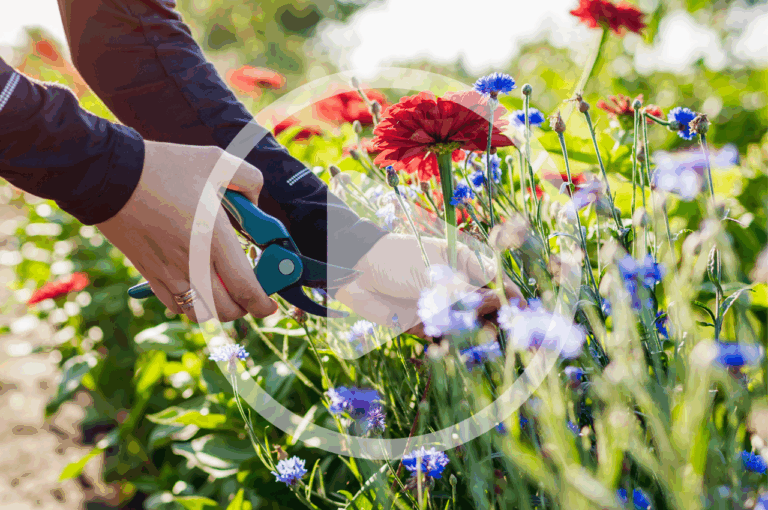
Andy Wilcox: I’m a really irregular pincher. And that kinda goes to my theory in a cutting garden that everything should be easy everything should be enjoyable, and you really shouldn’t stress. If your aim for a cut flower garden is to bring you joy but then it’s causing you stress and angst instead you’re doing it wrong.
But that said I don’t take a measuring stick out there and measure these plants before I pinch ’em off. But for plants that I am gonna pinch, I usually like to see at least two pairs of true leaves. So that’s, you have the seed leaf that comes out and just looks like this fat little baby leaf, and then the true leaves that look like the actual leaf of the plant.
And so I wanna make sure that there’s at least two, two, three pairs of true leaves and that plant is a little well-established. Because what we’re gonna go in and do is wound it, right? We’re gonna pinch off that growing tip and some of the plant. So I want it to be established and looking healthy before I do that.

Josh Wilder: Welcome to the Mother Earth News and Friends podcast. At Mother Earth News, for 50 years and counting, we’ve been dedicated to conserving the planet’s natural resources while helping you conserve your financial resources. [00:01:00] In this podcast, we host conversations with experts in the fields of sustainability, homesteading, natural health, and more to share all about how you can live well wherever you are in a way that values both people and our Mother Earth.
Hello, and welcome to this episode of Mother Earth News and Friends. I’m Josh Wilder, and with me today I have Andy Wilcox. Thanks for joining me today.
Andy Wilcox: Hey, thanks Josh. A pleasure to be here.
Josh Wilder: Why don’t you tell the listeners a little bit about yourself and the article you’re reading today?
Andy Wilcox: Okay. So I’m Andy Wilcox.
I’m a garden writer, horticulture writer, educator, speaker sometime flower farmer. And I’ve been passionate about gardening and soil and the whole process of how that changes people for years. I’m a master gardener up here in the frozen north eagerly awaiting spring. And today we’re gonna talk about some perfect plants for a cut flower garden.
A lot of folks struggle with exactly how to get that cut flower garden going or what they should plant, and so we’re gonna, we’re gonna chat about it a little bit today.
Josh Wilder: I appreciate that. That description of your garden I can only imagine it’s quite beautiful to spend time in the spring.
Andy Wilcox: It’s very nice in spring, summer, and fall, but right now it just looks like a winter wonderland.
Josh Wilder: Yeah. That, that kind of transitions well to my first question.
In your experience, what’s the most challenging gap month for a garden and what plant varieties do you rely on most to try to bridge that transition- Yeah … for annuals?
Andy Wilcox: So the trouble for me is always early summer. None of the annuals are blooming [00:14:00] yet and this is when some of the perennials that we talked about can really step in, as well as any of those plants that we grow from bulbs.
Those spring daffodils or tulips. Peonies, tulips, bushes like pussy willows, and forsythia, and serviceberry are all great choices. And the nice part about some of those blooming bushes is they don’t have to be right in the garden proper. They can be located on the edge of your yard or up against the foundation or wherever you can squeak a little space in.
And they make a great addition to help flush out whatever else you’ve got in bloom. Yeah, nobody expects a flower in April, but come May, we expect flowers, and it can be hard to have anything going on in May and June, especially if you’re focusing on annuals.
Josh Wilder: For sure. And as far as pinching, are there specific heights or leaf note counts you look for before doing some of that in different varieties?
Andy Wilcox: So I’m a really irregular pincher. And that kinda goes to my my theory in a cutting garden that everything should be easy everything should be enjoyable, and you really shouldn’t stress. If your aim for a cut flower garden is to bring you joy but then it’s causing you stress [00:15:00] and angst instead you’re doing it wrong.
But that said I don’t take a measuring stick out there and measure these plants before I pinch ’em off. But for plants that I am gonna pinch, I usually like to see at least two pairs of true leaves. So that’s, you have the seed leaf that comes out and just looks like this fat little baby leaf, and then the true leaves that look like the actual leaf of the plant.
And so I wanna make sure that there’s at least two, two, three pairs of true leaves and that plant is a little well-established. Because what we’re gonna go in and do is wound it, right? We’re gonna pinch off that growing tip and some of the plant. So I want it to be established and looking healthy before I do that.
I think I mentioned for the dahlias, yeah, when they’re about six to eight inches tall is usually a good time to do that. And that’s, as when they’re as tall as your hand is long, that’s usually a pretty good time to start pinching any of those flowers that you pinch. I did wanna mention, we talked about branching sunflowers as a choice to grow in the cut flower garden, and those are fine to pinch when they get a little bit bigger, but don’t pinch any regular sunflowers.
Any flower that’s going to make just one bloom like a standard sunflower if you pinch it, you just might [00:16:00] not get that bloom. So when we pinch, we’re trying to make a bushier plant with more stems that are gonna make more blooms. And so for a plant like a standard sunflower that only makes the one that’s just something that we don’t pinch.
But otherwise just about every annual in there that we talked about benefits from pinching.
Josh Wilder: Okay. Now, you’re up in Wisconsin, right? Yeah. And probably a stone’s throw from a lake or three. So your summers are probably fairly humid, if I’m not if my memory serves me correctly. Yep
Andy Wilcox: yep.
Josh Wilder: So beyond spacing and getting some air circulation there, do you use any foliar sprays or soil health practices to manage mildew?
Andy Wilcox: So I’ve tried a few foliar sprays. I’ve tried the baking soda and the milk, which I always thought was weird that I’d go out and spray milk in my garden.
And and I’ve tried a couple of other products. I’ve never really been impressed with the results but that’s probably because I wait too long and I don’t do it regularly enough. The using a foliar spray for powdery mildew is really you need to start as a preventative and then keep at it [00:17:00] regularly, every week or two.
You’ve gotta keep up with it. And I’m just not that organized when it comes to my cut flower garden to get that done. And that said, I in the flower garden I don’t have a terrible problem with powdery mildew. I get some on my zinnias and, but it’s usually not enough to really impact the blooms.
The Monarda, that bee balm, will typically pick up some powdery mildew by the late summer. But by that time it’s done blooming and it’s been growing for months, and it’s already put a lot of energy into the root system, so it doesn’t seem to slow it down a lot for me. Other locations, some folks do have more problems with powdery mildew.
But yeah I like to rely on keeping a healthy, vigorous plant and then- That air circulation and making sure that I don’t have everything just super crowded. And for folks who are having trouble with powdery mildew, watering from below can also help. We often say it rains from above.
Why not water from above? But you’re just reducing the time that those leaves are wet. So if it rains once a week but you’re watering four times a week, you can really reduce how long those leaves are wet by watering from below.
Josh Wilder: And going, on other, additives [00:18:00] and supplies in the garden, do you support using any flower food sugar, vinegar, that sort of thing to make a difference for some of the flowers you recommended?
Andy Wilcox: Sure. You’re talking like in the vase once they’re harvested?
Josh Wilder: Yeah.
Andy Wilcox: Yeah. For home enjoyment your cut flower garden at home fresh water is all I use. And the flowers I recommended in the article, they do very well with that. I think one of the keys to remember is that the flowers you go out and cut from the garden are days or even a week fresher than what you might get at that florist shop.
And so you’ve got that advantage going for you right off the bat. You went out and you cut ’em in the morning and they- you plop them into a vase and, you’ve got ’em going from day one, where they’re fresh and they’re still, taking up water. They’re still doing their cycle.
For me, it comes down again to being simple and enjoyable, and if I’ve gotta dip flower ends in boiling water and then put in some s- some vinegar and then a little sugar solution I’m not having fun anymore. Now it’s turned into a chore. I just want some bouquets in the kitchen to enjoy or to give away to a neighbor or whatever, so if your fo- if your cut flower [00:19:00] garden is producing blooms then you’re always gonna be able to go out and get a fresh bouquet. So if your flowers are only lasting a week, which a week is pretty average for cut flowers fresh from the garden, then you’re already doing better than you’d get ’em from the florist, and you can go out in a week and get more.
So I typically don’t bother with any of those additives.
Josh Wilder: Sure. Sure. Yeah, and that’s, I think from my experience talking to folks who are interested in growing a cut flower garden the interest generally stems from getting some flowers at the farmers market, for instance, and the difference that they’ve seen in that from a florist.
And really just the variety of bouquets, ’cause you’re not gonna get some of the… having a ricino in the bouquet, for example, and some, and many florists.
Andy Wilcox: Yeah. And, a farmers market is another great source for cut flowers. I’ve sold at farmers markets before, and most of those flower farmers are cutting them either the night before or the morning of.
They’re waking up at 4:00 AM and they’re out there snipping blooms, or I was always out doing it the night before until dark and then trying to arrange them. So you’re still getting ’em very fresh, yeah.
Josh Wilder: For sure. Now as far as if [00:20:00] you’re trying to store some of the flowers if you’re not a professional seller.
Are there any DIY storage mediums like vermiculite, et cetera, to keep ’em hydrated without rotting over the winter?
Andy Wilcox: Yeah. So it’s a great question and people often have trouble especially with dahlia tubers. They have trouble storing those over the winter. I should admit this. I really often don’t do anything.
That’s just because I’m pretty lucky with my basement. I have one side of it that stays pretty humid. And it’s good enough that most of my dahlias sit in a milk crate over the winter and they might get a little bit wrinkly, but they’re still looking all right, and still easy to divide, and when I plant them in the spring they pop up.
But that said, a lot of people have trouble storing those tubers, and I used to have trouble storing them. And some varieties don’t store as well as others. And so when I do need to do some storage for them that’s a little bit more involved I separate ’em by variety, which is for my own sanity.
It’s not for storage. It’s just so I remember what’s where in the spring. And then I get cheap plastic tubs. They’re usually clear [00:21:00] sided just so I can see what’s going on inside. They don’t have to be. That’s just my preference. And they’re, they’re kinda shallow. So you’re talking maybe those tubs that you would get from the big box store that are 14 inches long and 10 inches wide, but they’re only maybe six inches deep.
And then pine shavings that you get I think people buy ’em for pet rabbits or something.
Josh Wilder: Chickens a lot of times too. Yeah.
Andy Wilcox: That sort of… so pine shavings that you might get at the feed supply store or any of that sort of material. And I’ll put a layer in the bottom, and then I’ll stack the dahlia tubers one deep.
Sometimes I’ll put another layer of pine shavings and then another layer of tubers. And then I leave the lid just slightly ajar. So I don’t seal it down. I’ll leave that so that there can be the slightest exchange of air back and forth. And then you gotta go down and peek at ’em. If you’ve had trouble before with them either being too dry or too humid, you’re gonna have to go down and check on ’em and see how they’re doing.
And so then you’ve got a system set up where if they’re a l- getting a little dry you can mist them and shut the lid for a few days. If you go down there and there’s condensation all over the plastic, which is why I like the clear plastic, you can pop the lid off for a couple days [00:22:00] and adjust that humidity.
When a dahlia tuber is storing well, it’ll look kinda similar to a potato in that it’s still firm, that skin is still tight. By late spring they’ll start to get a little wrinkly and wizened looking and that’s okay. But they shouldn’t look like a shriveled up parsnip. They should still have that…
Some moisture in ’em. You can also use vermiculite if you can get it at a reasonable price. Works very well. A hint for the audience if you buy vermiculite at the garden center it’s expensive, but if you ask around at perhaps the nursery or a feed store, sometimes they’ve got it.
I just bought- I think it was a two cubic yard bag. It’s huge. It’s more vermiculite than I will use in the next decade, and I got it for, I think, $17. So as opposed to the little tiny bag at the retail, if you can find a place that sells in bulk, you can… Of course, you gotta store a two-yard bag of vermiculite, but you can get it for a lot cheaper.
So I’ve used I’ve used a little bit of peat moss. It’s not my favorite. But I’ve used vermiculite, but I’ve kinda just landed on the pine shavings. And you can buy them in a big bale, [00:23:00] and, I store 100 Tudela tubers, and I don’t go through a whole bale,
Josh Wilder: All right. Appreciate it. Yeah, that’s great advice.
And thanks so much for coming on and reading the article and answering some follow-ups.
Andy Wilcox: No happy to do it.
Hopefully everyone gets out there and plants some flowers this year.
Josh Wilder: Yeah, and if you’re just hearing this on the podcast feed, please go out and and pick up an issue of the April/May Mother Earth News, ’cause these these flowers are beautiful.
Andy Wilcox: Thanks.
Josh Wilder: Yeah, absolutely. And that’s all we have for today. Thank you, Andy. All right.
Andy Wilcox: Great. Thanks, Josh.
Josh Wilder: Yep. Take care.
Thanks for joining us for this episode of Mother Earth News and Friends. To listen to more podcasts and get connected on our social media, visit www.motherearthnews.com/podcast. You can also email us at podcast@ogdenpubs.com with any questions or suggestions. Our podcast production team includes Alyssa Warner and myself, Josh Wilder.
Music for this episode is the song “Hustle” by Kevin MacLeod. The [00:24:00] Mother Earth News and Friends podcast is a production of Ogden Publications.