
Learn what to plant for winter gardening, plan for Persephone, adapt your growing methods, and choose good cultivars to eat homegrown greens all winter long.
Imagine this: It’s Christmas. You’re surrounded by family and friends for a memorable feast. Your table is full of delicious dishes, but something is missing – the final touch. You bring out a fresh, crisp salad of chicories, lettuces, and spinach. This salad has a special flavor. Why? Because it was harvested just a few minutes ago from your little greenhouse, despite the biting cold of winter. Growing a garden in winter may seem ambitious, even impossible, but it’s actually within reach – even for home gardeners. With the right cold-weather techniques and a few simple tools, it’s entirely possible to harvest fresh vegetables year-round, even through the harsh winters common to my northeastern climate. But possibility isn’t the best reason to do it – desirability is!
These winter vegetables will be the best you’ve ever tasted. Sweetened by the cold and enriched by low temperatures that concentrate their natural sugars, they’re among the richest and most flavorful crops you can grow. The idea of winter harvesting isn’t just about extending the season. It’s an invitation to rethink our relationship with the Earth and with time itself. Winter turns the garden into a place of experimentation and wonder. With some preparation and the use of protective structures, such as greenhouses, you can not only extend the life of your crops but also enjoy vegetables with unique flavors and textures.
What we do here in the Northeast is not only possible, it’s well within your reach if you follow a few essential principles.
Plant Early Enough to Stay Ahead of the Persephone Period
The main challenge of winter gardening is the lack of light from November through January. When daylight drops below 10 hours, plants simply stop growing. This drastic reduction in light – known as the Persephone Period, after the Greek goddess associated with the cycle of the seasons – slows photosynthesis to a crawl and limits active plant growth. This was one of the first and most important lessons that market gardeners across the northern regions confirmed through years of experience: Success in winter gardening begins with understanding the limits imposed by day length. That’s why timing is everything. To harvest in the heart of winter, crops must be sown or transplanted early enough to be well-established before the Persephone period begins.

Once plants have built strong roots and a healthy leaf canopy, they can essentially “hold” in the ground, waiting to be harvested while the world outside lies dormant.
Modify Your Growing Methods
In winter, cold winds are one of the biggest threats to crops. They quickly chill the soil and dry out plants, making them more vulnerable to frost. To overcome this, I rely on what I call the layering principle: stacking different levels of protection to create a more stable, resilient environment for the plants. The first layer is the greenhouse or main shelter. This structure acts as a windbreak and creates the base level of insulation. On my farm, we often reinforce the north side of a tunnel with reflective insulation – a simple step that helps retain heat and prevent precious energy from escaping into the cold night.
Winter is a season of contrasts: While everything seems asleep under the snow, hardy vegetables quietly thrive, ready to surprise you with their sweetness and resilience.
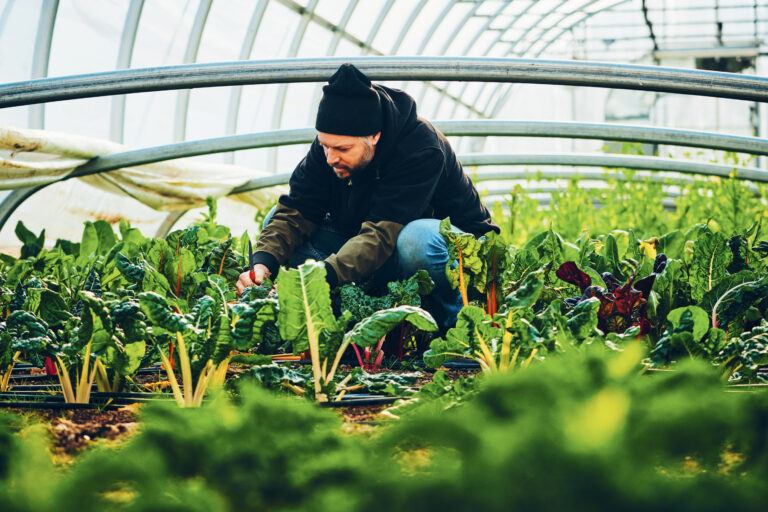
Inside the greenhouse, a second layer comes from mini-tunnels or low hoops covered with plastic. These create a “greenhouse within the greenhouse,” capturing extra heat and buffering crops from sudden temperature swings. What amazes me year after year is how well this simple setup protects even the most delicate greens. On the coldest January nights, when the temperature outside plunges below minus 20 degrees F (minus 29 degrees C), the tunnel itself feels icy. Yet under the inner hoops, the spinach remains untouched. Without that extra layer, the crop simply wouldn’t survive.
Finally, floating row covers provide the most flexible form of protection. They’re light, easy to move, and incredibly effective at holding warmth close to the plants. In mild conditions, one layer is usually enough. When a deep cold snap arrives, I’ll stack two or even three covers. It can make the difference between a thriving crop and frozen leaves. Think of it as dressing your crops for winter. Just like you’d wear a coat, a hat, and a scarf on a windy day, your vegetables also need multiple layers to stay comfortable. By combining these protections, you’ll create a microclimate where plants not only survive but thrive, even while the wind howls outside.

- Ventilate and acclimate. To strengthen crop resilience, gradually expose them to the cold. One tip that works well for us is to partially open the greenhouse on mild nights. Ventilate regularly to prevent stagnant air and reduce disease risks.
- Irrigate. Excess humidity can encourage fungal diseases. Here are some good practices: Water once a week during the period when daylight is below 10 hours. Only irrigate on sunny days. Avoid wetting the foliage when watering.
- Protect. Avoid unexpected visitors to your winter harvests. Mice and voles love the cozy shelter of row covers and tunnels. Use traps or barriers to keep them out and safeguard your crops.
Plant Cold-Hardy Winter Plants
To succeed in winter gardening, choose vegetables adapted to harsh conditions.
Spinach, for example, is a true winter champion. Its tolerance to frost allows it to thrive even in freezing temperatures, developing an unmatched sweetness. Kale becomes even tastier after exposure to the cold, its leaves turning slightly sweet and crunchy. Mâche (lamb’s lettuce) and tatsoi, two other hardy crops, continue to grow slowly, even under a blanket of snow.
Here are some recommended winter vegetables:
- Bok choy (also called “pak choy”) is fast-growing and excellent grown between other crops.
- Carrots sown in late summer store well in the ground under light mulch. Try ‘Napoli’ or ‘Bolero.’
- Cilantro is a good complement to leafy greens. ‘Calypso’ is a good cultivar.
- Claytonia, also known as “winter purslane” or “miner’s lettuce,” is hardy and tasty. It’s ideal for late-season harvests.
- Green (evergreen) onions are great for adding diversity to winter harvests.
- Kale is robust, tolerates heavy frosts, and remains flavorful all winter. ‘Siberian’ and ‘Red Russian’ are good cultivars.
- Mâche (lamb’s lettuce) grows slowly but tolerates extreme temperatures; it’s perfect for winter salads.
- Mizuna is fast-growing and great for salad mixes.
- Radishes grow quickly and are perfect for early or late winter harvests.
- Spinach is hardy and delicious, perfect for cold tunnels or unheated greenhouses.
- Swiss chard provides steady harvests.
- Tatsoi is a slow-growing but cold-tolerant Asian green.
Remember that when you plant is as important as what you plant. These guidelines work well in my northeastern climate. If you garden in a different region, adapt the timing and techniques to your own conditions. We direct-sow carrots in early August and kale, Swiss chard, and turnips in mid-August. You’ll want to get seeds for lettuce, mâche, cilantro, and spinach in the ground in early September. Mid-September is a good time to plant arugula, mizuna, mustard greens, radishes, and tatsoi. Bok choy and green onions are best grown from transplants. We plant out the green onion starts in mid-August and the bok choy seedlings in early September.

Don’t Get Discouraged
This last rule may be the most important. Winter is unpredictable, and even with the best planning, setbacks will happen. A cold snap might come earlier than expected, a planting may not take off, or mice and voles might sneak under the covers. But here’s the truth: Every challenge in winter gardening is also an opportunity to learn. What makes winter growing so rewarding is that it invites you into a different rhythm, one where you’re constantly adapting, observing, and discovering.
When something doesn’t work, it’s not a failure – it’s part of the process. Take notes, adjust your timing, and try again. Each season builds your skill, your intuition, and your confidence. And then there are the small victories – lifting a row cover in the middle of January to find tender spinach waiting for you, or pulling a sweet, crisp carrot out of the frozen ground. These moments are nothing short of magical. They remind you why winter gardening is worth the effort, not just for the food itself but for the sense of wonder it brings.

Stay curious, stay motivated, and remember that every attempt counts. Winter gardening is about embracing nature’s unpredictability while savoring every success, big or small. That’s how you’ll transform your garden into a place of abundance and discovery, even under the snow.
The Car Shelter Turned Greenhouse: An Accessible Solution
A simple carport converted into a greenhouse can be an affordable and effective option for extending the growing season. These structures are easy to find and can be adapted to grow a wide variety of winter vegetables.

To optimize its effectiveness, you can install soil-heating cables to maintain a mild temperature, add a small pellet stove or an electric heater during extreme cold, insulate the north side of the greenhouse with polyethylene to retain heat, and ensure good ventilation with small fans or solar-powered systems to prevent excess humidity. With these adjustments, even amateur gardeners can turn a temporary shelter into a productive and durable greenhouse.
On sunny winter days when the outside temperature rises above freezing, you can pull back the floating covers for a few hours. This will give your crops maximum exposure to sunlight and natural warmth, and it will help reduce excess humidity inside the tunnel. Don’t forget to replace the covers before nightfall to lock in the heat.
This article is excerpted from In Your Garden: The Complete Guide to Home Vegetable Gardening with Jean-Martin Fortier (New Society Publishers) by Jean-Martin Fortier.
Originally published in the December 2026/January 2027 issue of MOTHER EARTH NEWS magazine and regularly vetted for accuracy.