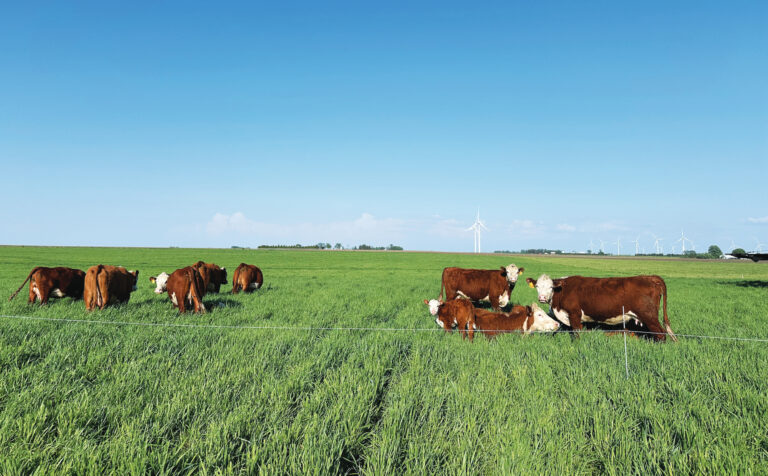
Learn about perennial Kernza grain nutrition, benefits, and how and when to graze livestock in an intermediate wheatgrass field.
In 2023, during one of the worst droughts I’ve ever experienced in the Upper Midwest, with only 9 inches of rain until August in a place where our average rainfall is upward of 36 inches, I walked out into my field of perennial Kernza wheat and witnessed mushrooms growing in the field and earthworms leaving their middens on the soil surface. When I stuck my spade into the soil to see what was happening below, I pulled up a single plant’s surface root ball mass that had aggregates like thousands of gumballs lining each root strand. The moist smell was intoxicating. When I walked out into the field on a moonlit night, I could hear the earthworms “thwurping” through the soil – coming to the surface and going back down. While the corn and soybeans were wilting all around me, my Kernza was as green as could be.
Even after harvest in late August, it just kept growing, all because of the lively soil it had helped build and its deep roots that reach 8 to 10 feet down. That one Kernza crop in itself helped save me thousands of dollars because I didn’t have to buy expensive hay in a severe drought. After it was harvested for grain that year, it regrew and created lush green grass throughout the fall months. My grass-fed sheep and cattle grazed that first field into December that year, not needing a bale of hay until January.
In 2024, we had more than 12 inches of rain in just the month of May, and I witnessed, yet again, the power of Kernza and its ability to soak up not only the rain that fell on my land, but also my neighbors’ surface runoff – and there was a lot of it, because corn plants in May are only a few inches tall. Every day that month, I could walk out into the field and not get any mud on my boots; Kernza’s deep roots soaked up every inch of rain that fell. If those plants could talk, they’d be saying “Bring it on!”
That spring, I grazed 150 ewes and their lambs and 20 cows and their calves until early June, when I pulled them off the field so the grain could grow. What I witnessed that first spring grazing season was that the sheep and cattle took only the top leaves off the plants, never the stems. Granted, we use a system of adaptive rotational grazing so they can’t eat plants down to the ground, but the fact that they never touched the stems, where the baby grain head lives before it elongates, is a synergy made in heaven. The cows and sheep create what looks like a manicured shag carpet, trimming the top fresh leaves off the plants and leaving the rest. Those leaves keep growing after the animals leave the paddock, so within a few days, you can’t even tell they were touched by a grass-eating ruminant. While my animals graze Kernza, they seem to ignore their free-choice minerals, salts, kelp, and humates. They appear to receive what they want from the Kernza forage. Those deep root systems just keep giving.

Falling for Kernza Grains
Kernza (Thinopyrum intermedium) is the trademarked name for the perennial grain produced from improved intermediate wheatgrass. I was first introduced to this grain through a Minnesota organic farmer who was helping a farmer-owned cooperative get off the ground. The cooperative was focused on marketing perennial and winter annual crops.
I had been looking for alternative crops that could help us use fewer expensive inputs on our family farm; crops that we could plant on our organic acreage to reduce our tillage, suppress weeds, and provide forage for our sheep and cattle. The main challenge seemed to be a lack of markets for grains other than corn and soy.
The farmer who introduced me to Kernza had invited me to a field day where another grower was showcasing how perennial Kernza was helping with his grazing operation. He suggested that I come to the meeting to learn not only about the agronomic side of growing Kernza grain, but also the marketing side. In one fell swoop, I was able to see Kernza growing in a field; walk inside a soil pit to see the deep root systems; hear from a farmer about how the crop has helped his cattle-grazing operation; learn about ecological benefits, including water quality, soil health, and climate mitigation; and meet farmer-growers who’d organized into a cooperative to help bring this crop to market and then promote it together.
Kernza was developed by The Land Institute, a nonprofit organization dedicated to the perennialization of grain crops. The Institute was co-founded by pioneer plant geneticist Wes Jackson. The Institute trademarked Kernza for identity preservation and for sharing community research. The trademark protects against unscrupulous producers, ensuring that products marketed and sold as Kernza are, in fact, Kernza. Because Kernza is still actively being improved by the ag research community, the trademark allows the Institute to collect research data on the crop from farmers and share those reports with the community to improve the grain.
They want to see a future of agriculture that aligns closely with what happens in nature, naturally. I think what they’ve done is nothing short of extraordinary.
Perennials come back year after year, without the need for much tillage, fertilizer inputs, chemical inputs, labor, or fossil fuels, and they help keep soil in place. Iowa, where I live and farm, needs a lot of help to keep soil in place. Prior to colonial settlement, Iowa was mostly prairie and oak savanna. It’s why our soils here are naturally rich enough to grow corn, a high-input-need crop. However, after altering almost every acre of native prairie in what’s now Iowa – 99.99 percent of it, in fact – we’ve lost nearly 7 inches of topsoil since 1850. Our valuable soils, a finite natural resource needed to grow food, are lost to the production of field corn, a grain that’s nonedible to humans unless it’s ultra-processed and that’s instead predominantly used as a subsidized fuel additive.

The Land Institute saw this decline across the Corn Belt, and especially in Kansas, where it’s based. This prompted the Institute to start breeding programs dedicated to perennial grains, with agriculture that functions in diverse mixtures, such as a prairie ecosystem. Beyond Kernza, The Land Institute and a host of global partners are working on perennial versions of cereal grains, oilseeds, and pulses, including perennial rice, sorghum, wheat, rye, barley, lupin, sainfoin, silflower, quinoa, flax, and more. Kernza is the most commercially developed in the U.S. so far. Research on the environmental impacts and improvements in the breeding programs of perennial agriculture systems are ongoing.
Aiding the Grain
After that field day in late July 2021, I got myself a Kernza Grower license from The Land Institute and planted 15 acres of Kernza in late August after an oat and red clover crop. I’d harvested the oats earlier in July and was growing a field of red clover to suppress weeds. I thought I could use the decaying clover for the small amount of nitrogen Kernza needed as green manure, and then no-till drill the small kernel-sized grain into the soil, changing out a gear mechanism to allow for the seeding density it required at 11 pounds per acre. It turned out that clover is a robust perennial, as it should be, and it didn’t die fully after an herbicide pass to terminate it. The Kernza came up spotty, paired with surviving clover. My goal of no-till Kernza was foiled that year, and that Kernza became an expensive cover crop instead.
That winter, I got close to more growers who were early adopters of this perennial grain, learning what had worked for them, and I also learned from university research trials at the University of Minnesota’s Forever Green Initiative (FGI). In August 2022, after a harvested oat crop, I spread some organic chicken litter, lightly tilled it in with my soil finisher, rolled it to make a firm seed bed, and drilled my 11-pounds-per-acre Kernza intermediate wheatgrass in before a soft rain. Within weeks, I could eyeball the rows of a single-bladed grass poking out of the soil’s surface.

By this time, I was a member of the Perennial Promise Growers’ Cooperative, paying my annual dues even if I wasn’t yet actively growing the grain successfully. I and several farmer-growers put in a large chunk of change to receive a dollar-per-dollar matching grant to help propel the co-op forward. And soon, I was on its working volunteer board, helping to steer the perennial ship to the promised land of viable markets for perennial grain crops. Little did I know just how difficult swimming upstream is, starting from scratch in terms of basic infrastructure required to get from the farm gate to the end buyer.
To get a new grain to market is difficult and requires a lot of support, from federal and state incentives to grants. The predominance of corn and soybean infrastructure, propped up by federal ag policy, makes anything else that much more difficult and risky to build. These policies have created an environment where specialization wins and diversification loses. Clean water, clean air, healthy soil, rural town viability, and other benefits of biodiversity aren’t in a farmer’s wheelhouse when trying to stay afloat. Some larger food companies are willing to take a chance on grains that are traceable and perennial, because they value the benefits to the ecosystem they can share with their customers.
Besides young wholesale marketing efforts through the Perennial Promise Growers’ Cooperative, I’ve started creating retail-ready consumer-packaged goods that I sell through our virtual farm store and ship nationwide and to regional food co-ops. I use a grain cleaner and dehuller a few hours south of me and a licensed food processor and miller a few hours north of me, hauling totes and bags in between them to get my products direct to marketplaces. Market diversity is important and reduces the farmer’s risk of a new grain crop that has no safety nets.
But this is a crop that doesn’t really need a safety net; instead, what it needs is cash incentives, because it does so much in terms of public benefits. It slows down, holds, and cleans water, which reduces nitrate loads from cornfields before that water enters municipalities. It absorbs carbon dioxide from the atmosphere. It gets animals out on the land instead of in feedlots, which, when properly managed, builds soil health. It naturally spreads fertilizer versus using fossil fuels. It also creates grassland habitat, where birds can nest from May to August. I think it provides so much benefit to the public that I shouldn’t have to pay property taxes when growing it!

Kernza Grain Nutrition
Kernza is mighty in nutrition. Besides its sweet, nutty flavor, it’s high in fiber, magnesium, thiamine, zinc, and protein as well as many other micronutrients.
Nutrition may be the final key to making perennial grains a mainstay in our diets. I sure hope so, because I love growing perennial Kernza. To grow nutritious food for the people and animals I care for is meaningful work that I want to keep doing. I want others to experience the joy of growing perennial grains so we can see our once-perennial prairie landscape return to deep-rooted ecosystems while we grow delicious, nutritious crops that deliver ecosystem benefits and put more money in the hands of farmers. This crop can grow rural livelihoods and rural communities.
As climate change continues to test our resilience as farmers, we need crops that will help us withstand the extremes we’re experiencing, including droughts, floods, insect infestations, high winds, bigger storms, and intensive hail. Perennial grains, perennial crops, and perennial pastures for grazing livestock are the answer.
Wendy Johnson is a regenerative organic farmer and grazier in Northern Iowa, where she operates Jóia Food & Fiber Farm and co-manages 1,000 acres of conventional corn and soybeans with her dad. She’s a contributor to the new book Living Roots: The Promise of Perennial Foods.
Originally published in the October/November 2026 issue of MOTHER EARTH NEWS and regularly vetted for accuracy.