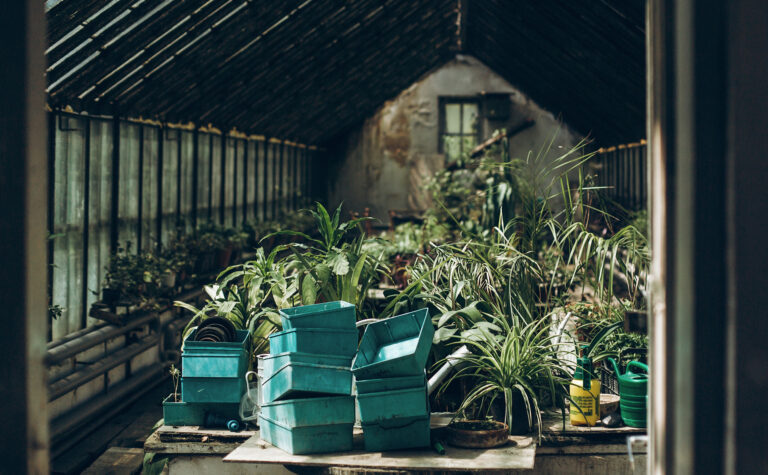
What is a solar greenhouse? Don’t all greenhouses use the sun? Well yes, but a solar greenhouse uses the sun’s energy not only for growing, but also to provide all of the greenhouse’s heating needs. In contrast to traditional all-glass or all-plastic greenhouses, which often rely on fossil fuels to grow year-round, solar greenhouses can create warm year-round growing environments using only the power of the sun, natural materials and energy-efficient design. As a result, they can grow much more –citrus, avocados, fruiting tomatoes – year-round using less energy, water and resources.
Here are the seven basic elements of solar greenhouse design. By following these, you can create a naturally abundant, self-sufficient growing oasis, allowing you to grow more with less energy and hassle. For more on designing your own solar greenhouse, see The Year-Round Solar Greenhouse: How to design and build a net-zero-energy greenhouse, which includes how-to info as well as many case studies for tailoring your structure to any climate.

Orient the Greenhouse Toward the Sun (the South)
This is where solar greenhouse design begins: the sun. The sun is not only your source of light for growth in the greenhouse, but your source of heat. Thus, if growing year-round in cold climates, you need to capture enough solar energy through your glazing to heat the greenhouse. Glazing is just a word for transparent materials, such as glass or clear rigid plastics. All these light-capturing materials should face where light is coming in: the South if you are in the Northern hemisphere (*For the rest of this article we’ll assume a location in the Northern hemisphere). The sun moves higher and lower throughout the year, but it is always South. A very small percentage of light comes directly from the North, and thus these sides are better off insulated.
Insulate the North and Everywhere Else
Solar greenhouse design depends not just on capturing enough solar energy, but trapping it in order to keep the greenhouse warm enough during cold periods.
This is usually where traditional greenhouses fail: they collect just as much energy as solar greenhouses (and often way too much) but can’t retain that heat when temperatures drop. Solar greenhouse design depends on adding insulation on every surface that is not needed for light collection. This means the entire North wall should be fully insulated. In addition, you can / should insulate some of the east and west sidewalls. These only get direct sun for a few hours a day and thus can lose more heat than they gain, depending on your location and climate.
How much insulation is right? It all depends on your climate and site. Look at other solar greenhouses, or contact a solar greenhouse designer who can provide a climate analysis or suggestions, to get an idea.
Insulate Underground
Most people think of a greenhouse as four walls and a roof, but they miss a very critical fifth plane: the ground. Just as the greenhouse will lose heat to the outside air when it’s cold, it will also lose heat to the ground below it. The topsoil freezes just like the air, and without an insulating barrier, those freezing temps will enter the greenhouse through the floor.
Moreover, by insulating around the perimeter of the greenhouse, you not only prevent heat loss through the floor, but you also couple the greenhouse to a large store of thermal mass underground. Like other materials – water, concrete, and stone – soil acts as thermal mass, storing energy and slowly releasing it, like a battery. Connecting the greenhouse to this insulated mass helps naturally even out temperature swings.

There are a few different methods for insulating underground. The jist is to install insulation around the perimeter of the greenhouse to create a pocket of insulated soil underneath. This pocked is connected to the soil deep underground, which maintains a steady temperature year-round (often between 40-60 F in most US climates). By insulating around the perimeter, your greenhouse has just tapped into this source of steady year-round temperatures and large store of thermal mass. This is also the reason why some people partially bury their greenhouse underground.
Maximize Light and Heat in the Winter
Solar greenhouse design – and passive solar design in general – relies on the premise of strategically controlling light and heat gain. Namely, you want to maximize light when it is absolutely needed (the winter) and reduce light when it is abundant and creates too much heat (the summer).

It’s important to keep in mind the angle of the sun during different seasons, as shown in the graphic above. In the winter, light comes in at a low angle and in the summer it is much higher in the sky (note these angles vary by your latitude). Thus, on vertical South surfaces, you want to use a high light-transmittance material, such as glass, to absorb as much of this light and heat as possible. You do sacrifice insulation at night, but at this time of year light and heat gain are the top priority. Thermal mass should be used to store some of this heat for temperature regulation. You can also angle the South face of your greenhouse so that it absorbs more light (and less is refracted off) as shown in the commercial solar greenhouse below.
Reduce Light and Heat in the Summer
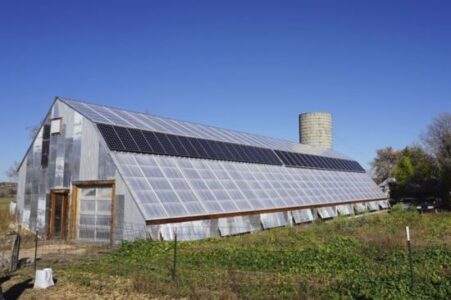 In the summer, you have just the opposite problem: for most climates with hot summers there can be too much light, which creates excessive heat. Because days are longer, light is less imperative at this time of year. Most plants will do better with a light-diffusing glazing that has a lower light transmittance, particularly on the roof (where summer light will come in). At Ceres, we recommend a polycarbonate plastic with at least 2 air pockets for good insulation. The roof is the biggest area for heat loss in a solar greenhouse, so using a thicker, more insulated material helps cut back on heat loss through the roof in the winter.
Use Thermal Mass
Thermal mass is any material that has the capacity to store large amounts of thermal energy. All materials have some ability to store energy, but some have much more than others. Water for instance can store about 4 times as much heat as air, making it one of the more popular thermal mass materials (or heat sink) used in greenhouses. Other materials are concrete, stone, or the soil underground.

The most common method to add thermal mass is by using large quantities of water, because it has such a high heat capacity and is easy to come by. By stacking several 55-gallon drums of water in a greenhouse, the grower can cheaply add a lot of thermal mass. Barrels should be stacked where they are in direct sunlight in the winter, and need to be stabilized to prevent from falling. Other methods include building concrete or stone into the greenhouse, such as using a concrete North wall or flagstone floor.
Making mass smarter
Standard, or passive methods of thermal mass are most common, but have a couple limitations. First, you can get micro-climates: the mass will affect the air directly around it, but the warming / cooling effect can be limited to the surrounding area. Second, mass can take up a lot of space in the greenhouse that could otherwise be used for growing.
To overcome these and add extra capacity to thermal mass, there are more advanced systems to make mass more effective. The most common is store heat in the soil underground using a Ground to Air Heat Transfer (GAHT) system or climate battery. This system uses fans to circulate air underground and store heat in the soil underneath the greenhouse. It also takes advantage of the stable temperatures of the soil underground to provide year-round heating, cooling and some added air circulation / dehumidification. Running fans does take electricity, but the system as a whole can give you much more of an effect for heating and cooling than passive thermal mass alone.

Maximize Natural Ventilation
We’ve talked about passive solar heating in the greenhouse, but this is only one half of the equation. Greenhouse ventilation is essential to cool the greenhouse, and keep plants healthy. Moving air forces plants to grow stronger and reduces problems the risk of molds, insects and pathogens.
To maximize natural ventilation you want to create a path of least resistance for the air to move. Place intake vents lower and exhaust vents higher to take advantage of natural convection. The intake vent will draw in cooler outside air and it will naturally rise and be exhausted higher up. The result is additional airflow, without added energy.
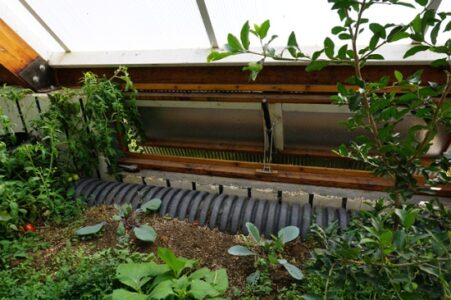
It’s necessary to control ventilation (either manually or automatically) so you get the right amount of cooling but not too much. For that reason, I recommend automated vents, either automated solar powered vent openers (which use wax cylinders to open and close without electricity) or exhaust fans. More on different ventilation strategies here. I recommend using more than one method so you have a back-up, and making sure vents are well sealed and insulated when not in use.
How much ventilation do you need? This is another area that depends on your climate and greenhouse design.

The above are the general principles of passive solar greenhouse design. However, it is important to realize a solar greenhouse should be tailored for the local climate. A greenhouses in Maine will require more insulation and different glazing materials than one in Texas. For that reason, we recommend and getting recommendations from professionals or experienced growers in your area when creating your design.
Lindsey Schiller is a greenhouse designer and co-founder of Ceres Greenhouse Solutions, which researches, designs and builds energy-efficient year-round greenhouses. She is also co-author, along with Marc Plinke, of The Year-Round Solar Greenhouse: How to Design and Build a Net-Zero Energy Greenhouse.
All MOTHER EARTH NEWS community bloggers have agreed to follow our Blogging Best Practices, and they are responsible for the accuracy of their posts. To learn more about the author of this post, click on the byline link at the top of the page.