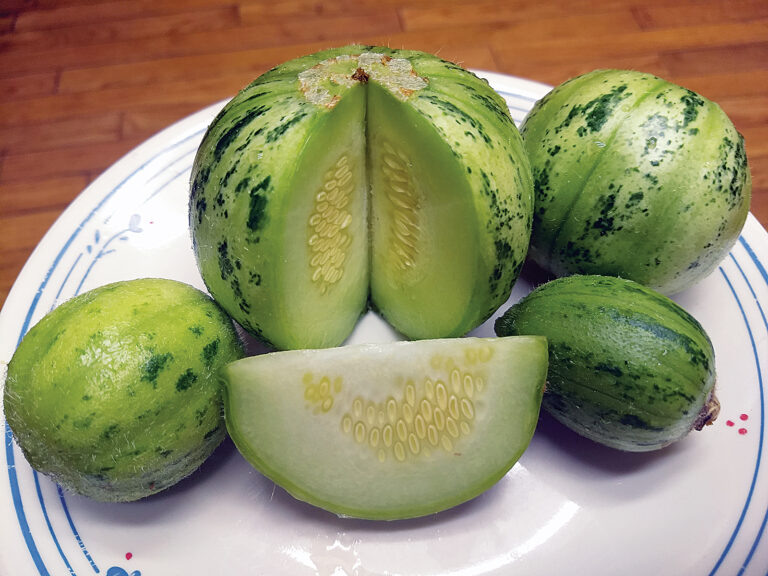
Learn about cucumber melon plant history and pick up some frugal gardening ideas to get your garden growing.
When I say the word “cucumber,” perhaps your imagination conjures up a cylindrical, dark-green, juicy, thick-skinned fruit that can be a bit bitter. Or, maybe you envision a long English or a thin-skinned Persian cucumber. But what if you could envision – and experience – something wonderfully distinct? That’s what your seeds have in store.
Cucumber Melon Plant
While today’s standard cucumbers are the species Cucumis sativus, which originated in India, the Western world once defined cucumbers as a type of muskmelon (Cucumis melo). Originating from Africa, these cucumber-melons are picked in their tender-yet-crisp immature state, like zucchini, and then eaten as gourmet cucumbers. (“Cucamelons,” on the other hand, are Mexican sour gherkins, a different genus and species from cucumbers and muskmelons.)
The most recognizable cucumber-melon today is a snake melon. Often referred to as “Armenian cucumbers” by Americans, these slender muskmelons are often considered a specialty cucumber variety. While many think of snake melons as pale, some varieties are dark, striped, or splotched. Admirers of this type of cucumber prize its flesh for being bitter-free and gentle on the stomach. Though they can be grown in a variety of climates, similar to other muskmelons, they perform best in hot, dry conditions.
But not all cucumber-melons are long. A shorter type of muskmelon that’s picked like a zucchini and eaten as a cucumber is the ‘Carosello.’ These cucumbers bear a resemblance to zucchini so striking that they’ve perplexed even seasoned gardeners. Like zucchini, the first flush of fruit sets in clusters around the crown of the plant. The fruit itself shares many of the same color and shape variations admired in zucchini. The fruit’s color can be light, dark, striped, splotched, or checkered, while the shape can be round, oval, or almond-shaped with smooth or scalloped edges. To top off the resemblance, if the fruit isn’t regularly harvested, it’ll quickly size up. In addition to the benefits growers admire in snake melons, ‘Carosello’ often exhibits a tender-yet-crisp texture and a rich flavor not generally associated with cucumbers.
Despite the past popularity of snake melons and ‘Carosello’ cucumbers, demand began to diminish with the introduction of Indian cucumbers into Europe in the 7th century. Perhaps people changed their tastes to favor a cucumber with a slightly bitter rind, or perhaps the climate changed so wet, cool conditions favored Cucumis sativus. More likely, the thick rind and firm flesh of the Cucumis sativus made it more favorable for storage and transport. In any case, cucumbers aren’t quite what they once were.
This knowledge provides a slightly broader perspective on what defines a cucumber. Perhaps you could call a cucumber a fruit from a vine that’s juicy and crisp. So plant those seeds and enjoy the delicious results.
– Jay Tracy
Frugal Gardening Ideas
I’m a beginning gardener, and I’m anxious about the upfront costs. What are some ways I can save money on getting my garden started?
If you’re creative, flexible, and water-wise, you can grow food for almost no money. Here are some of the things I’ve found free of charge in the past year, with the approximate prices if purchased new, and my sources.
Water can be a big expense in gardening, especially if you’re supplied by city water. However, water can also be “found.” We have a small bucket in the kitchen sink that collects hand-washing water, water from rinsing produce, and water left over in drinking glasses. We have a 5-gallon bucket in the shower that catches water as the shower warms up (over a gallon per shower). And we have almost 1,000 gallons of rainwater storage in various containers, ranging from 55-gallon drums from the salvage yard up to a 350-gallon container from Craigslist. We use all this water on fruit trees, raspberry canes, landscape bushes, squash, cucumbers, peas, and beans. This water goes directly into the soil; we don’t use it on leafy greens.
In addition, we run the greywater from the washing machine out to the fruit trees. (This is legal in my state and county.) It runs into a gravel bed adjacent to the trees and provides all the water the trees get in summer. Our summer temperatures reach up to 100 degrees Fahrenheit and average in the upper 80s. We remain in the lowest tier for our urban water bill even though we’re 100 percent self-sufficient for vegetables in summer and 75 percent self-sufficient in winter.
I grow only the seeds I can get free. I like the adventure of this, never knowing what I’ll get. I volunteer at a community garden, and the volunteers receive some seeds. Once you work with other gardeners, a whole network of trading opens up to you. Neighbors are usually eager to trade if they garden too. A nearby town has a seed bank where all the seeds are grown on the property, saved, and then given out to the community. These seeds are special to me, because they’re fresh, free, and proven to grow well where I live. They’re also open-pollinated, so I can save seeds from them myself. My Buy Nothing group includes other gardeners, and I’ve asked for, and received, rhubarb crowns and compost tumblers. I’ve also given away countless seedlings through this group.
Item Approximate Cost Source
- Greenhouse $200 Facebook Marketplace
- 3 large decorative terra cotta pots $100 each Friend
- 3 smaller terra cotta pots $50 each Friend
- Insect cloth $30 Friend
- Frost cloth $30 Friend
- Bird netting $20 Friend
- 2 watering cans $7 each Friend
- 1 garden ornament $35 Friend
- 5-gallon bucket $5 Friend
- 3 cubic yards compost $25 to $40 each City zero-waste program
- 8 raspberry plants $8 each Friend
- 3 compost tumblers $120 each Friend/Buy Nothing
- 3 rhubarb crowns $10 Friend
- Seeds $20 Community garden
- Water N/A Collected rainwater
- 3 tomato towers $20 Wood from Buy Nothing
- Fig tree $50 Cutting from a friend
- 50 strawberry plants $40 Neighbor
In addition to saving money with free gardening, growing your own food has environmental and social impacts. Food that’s not shipped long distances saves the burning of fossil fuels in transportation. Gardening is a social activity, and when we join with our friends and neighbors, we all become more self-sufficient and resilient, with a network to help us through the hard times and to celebrate the good times. So, next time you hear people saying growing a food garden doesn’t make financial sense, I hope you’ll remember some of my experience.
– Karen Dawson