

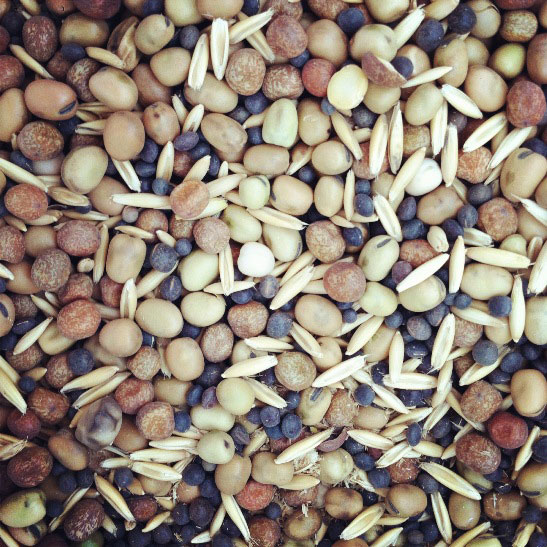
A cover crop, also known as a living mulch or green manure, is a mixture of legumes and grasses planted to help build soil health. While planting cover crops isn’t common practice in modern industrial agriculture, it is widely celebrated by many ecologically conscious farmers, gardeners, and foresters around the world. One such notable proponent was Japanese natural farmer and philosopher, Masanobu Fukuoka, who used cover crops to revegetate desertified, broad-acre landscapes. (Check out his book Sowing Seeds in the Desert.)
Whether you’re working on large landscapes or in a 4-by-8-foot raised bed garden, you can use a cover crop to perform many beneficial biological services. A good cover crop will build soil structure by increasing aeration, water retention, and reduce erosion. Plus, it will help create more biodiversity by inviting beneficial insects, suppressing weeds, pests, and diseases. There isn’t a bad reason to plant a cover crop. With that, here’s a little on what and when to plant.
What and When to Plant
Cover crops will do wonders for building the health of your soil overall, but you can select specific varieties to achieve desired results. For example, choose hairy vetch to fix nitrogen into the soil, or choose rye to help prevent erosion. Here is a great PDF resource for choosing what crops to plant by U.S. region.
The best time to plant a cover crop will depend on your bioregion, soil type, climate, and more. In general, plant cover crops in any soil that could use an added boost of health. It’s true, this could equate in a desire to plant a cover crop across the entire earth’s surface — but let’s start small.
Consider planting in a garden bed previously growing with “heavy feeders,” or vegetables that require a lot of nutrients like corn, melons, squash, and tomatoes. The cover crop will help recharge and replenish those nutrients lost, and prepare the soil for next season’s crop.
How to Plant Cover Crops
One of the best parts about planting a cover crop is that they’re simple and easy to sow, grow, and harvest. Here’s a brief breakdown on how to get started planting.
1. Prepare garden beds. Pull any mulch layer to the side. Remove weeds and/or any leftover plants from last season. I like to cut plants at the stem, just above the surface of the soil, and leave the roots intact in order to retain soil structure and give roots the chance to breakdown and deposit their nutrients directly into the soil. You can do the same if you feel inspired to do so. In the end, make sure to level the surface of your garden bed with a rake to prepare for seeding.
2. Broadcast seeds. With your seeds in a bag, bowl, bucket, or seed spreader, broadcast them evenly across your garden area. To determine how much seed, just look to the instructions given on the bag, ask the folks at your local nursery, or do some of your own research online. When using legume seed, consider using an inoculant, or a species-specific bacteria, to help with the process of nitrogen fixation. The extra money and labor (the cost is a few extra cents per pound, and the labor involves mixing the inoculant powder with water and seeds before broadcasting) is a good investment. Lastly, remember that there’s always a chance that seeds won’t germinate, or will be lost to hungry birds, so err on the side of spreading more than less seeds if you can.
3. Finishing touches. With your seed broadcasted, lightly rake them into soil. Cover with a light layer of mulch, just enough to protect them from birds, but not too much that fragile seedlings won’t be able to poke through and reach for the sun.
4. Water. If you planted your cover crop in the fall, do a rain dance and wait for nature to help ensure the growth of your nutrient boosting crop. If you planted a summer cover crop, consider supplementing with irrigated water until seeds sprout.
5. Harvest time. If all goes well, your cover crop will grow tall and abundant throughout the growing season. Before it goes to seed, you can cut it back and leave the green material on the surface of soil to break down (often referred to as the “chop and drop” method). A further option is to cut and gently till the material into your soil using a garden hoe to incorporate those nutrients. Lastly, you can always harvest and add it to your compost pile.
With your cover crop grown and incorporated back into your garden, your soil is now ready for a new crop of delicious annuals!
Jeff Davis is a writer, educator, designer, and life-long learner from Southern California. He has experienced ecological, off-grid, and communal living in the U.S. Virgin Islands, Solomon Islands, Costa Rica, Hawaii and beyond. Today, he offers permaculture design and installation services, and his most recent project includes an urban farm that grows organic produce for a neighboring restaurant. Read all of Jeff’s MOTHER EARTH NEWS posts here.
All MOTHER EARTH NEWS community bloggers have agreed to follow our Best Blogging Practices, and they are responsible for the accuracy of their posts. To learn more about the author of this post, click on the byline link at the top of the page.





