

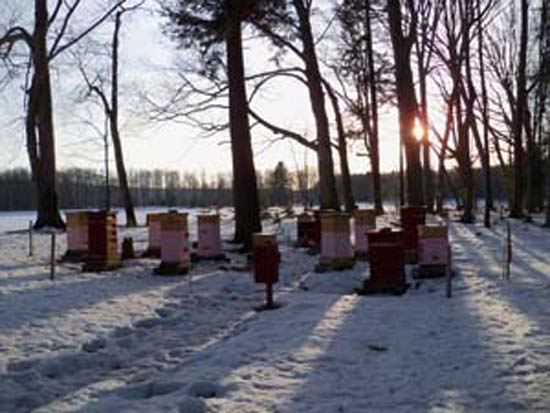
Here in the northeast, we have been experiencing temperatures near zero at night, and in the teens and twenties during the day. It has been a long, cold winter for everyone, including honeybees! It is still much too cold to open up the hives to do a thorough inspection. However, this is the time of year when beehives can be lost to starvation, so it is important to try and do a quick check to make sure the bees have enough honey to hold them over until warmer weather arrives, and the first blooms appear.
To do this quick check, you need a day that is at least in the 40’s, preferably with plenty of sun and little wind. We were lucky enough to have a two day break with temperatures near 50 degrees, so we were able to do a quick check of our hives.
While the bees are not usually very active this time of year, they are likely to be very unhappy when disturbed! I take the usual precautions of using a smoker and veil, although it does feel very strange to be walking out to the beeyard with a smoker and veil when there is a foot of snow on the ground!
Assessing Beehive Health in Winter
After gently puffing the smoke into the entrances, I wait a minute, and then remove the outer cover, remove the super of straw (see my earlier post, In the Beeyard: Final Winter Preparations), and then gently pry off the inner cover. Here is what I look for:
1. Where are the bees? If the bees are clustered at the very top of the uppermost super, they may be in trouble. Bees work their way up eating honey through the winter, so if they are already up top, honey stores may be low. If I can hear the bees “humming”, and the cluster is somewhere below the top super of honey so I can’t see them, they are probably in good shape.
2. How much honey is left in that top super? Are the frames of honey in the top super still full? Are about half of them empty? Or, are most or all of them empty? For our area, if the top super is less than three-quarters full, I plan on doing something to supplement the food supply.
If you have determined that your bees may need some help staying fed until the end of winter, there are a few different ways to get some emergency feed to them. If you have any frames of honey you have saved or that you can take from a hive that did not make it through winter, they can be put in an empty super, and set right on top of the current top super. You can also remove empty frames and replace them with full frames, but try not to disturb the cluster of bees – they are trying to keep themselves and the queen warm!
If you plan ahead of time, you can make “fondant”, or sugar candy, to put on top of the upper super. There are many recipes for honeybee fondant online. Here is one link to Bee Hive Journal that has several different recipes. It is important to cut or break the fondant into small enough pieces to fit under the inner cover.
A third way to feed the bees in winter is called the “Mountaincamp Method”. You simply lay a sheet of newspaper over the top super. You can make a few thin slices in it, and pour granulated sugar over the top. Not the preferred way to feed bees, but good in a pinch! Again, if the cluster is already near the top, be careful not to disturb them too much.
Whichever method you choose to supplement your hives, be sure to have it ready ahead of time. This time of year it is important to work calmly but quickly, and to close the hives back up as soon as you can! The bees need time to reform the cluster, and warm up again.
While I am there, I also take some time to clean the lower entrances. I remove the mouse guard, and use a metal skewer to gently pull any dead bees and debris out onto the ground before replacing the mouse guard. This improves ventilation, and gets the hive ready for when the bees start flying in the spring.
Taking the time to do a quick check can help hives that might be in trouble make it until spring, and give you the peace of mind that you have done everything you can to help the bees make it through a long cold winter.







