

When my husband and I married in 1972 we had a wedding typical to most weddings in Parkman, Ohio, my hometown. The ceremony was at the church and the reception was at the Community House. The Mothers Club managed the Community House and provided the homecooked food. We did the decorating ourselves. Originally a cheese factory, many, many years ago, the Community House has been the place for community gatherings for as long as I can remember. We still go there for their pancake breakfast if we are visiting relatives in March and we still see people we know. I guess I assumed that every town had something akin to a Community House, but attending weddings over the years, I’ve come to realize weddings have become something entirely different than what we had.
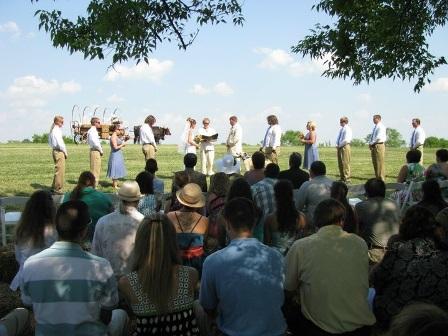
Two years ago our daughter and son-in-law got married and wanted nothing to do with the conventional wedding of today. They set out to plan a wedding that truly was born out of love. They had met in 2004 at Brookview Farm. First Betsy, then Chris left for Arkansas. Now they were moving back and wanted to get married where they fell in love. With the blessing of Sandy and Rossie Fisher, owners of Brookview, plans started rolling. Just so you know, this is not an agri-tourism facility, just friends helping friends. The reception would take place in the barn, which would have needed much more work to have passed inspections for using it as a rental hall. This was just a fun gathering of people used to country ways and knowing where to step to avoid hurting themselves. The wedding ceremony itself was held outside, officiated by a friend of Betsy and Chris’s. Luke, Betsy’s brother, used his ox team and wagon to bring the wedding party to the site and take the bride and groom away. The guests sat on straw bales outside.
The wedding was set for June 19 and it was natural for me to grow some of the food. We wanted to source the rest locally and realized that finding a caterer to go along with all our plans might prove difficult. They have their own suppliers and ways of doing things. So, we called our friend Molly, who agreed to join us in this adventure. Molly is the principal viola in the Richmond
Symphony, but has a love of food and hospitality. The Symphony takes a break in the summer, so she was available. We also wanted to make this a zero-waste event, or as close to it as we could get. I had often talked of incorporating recycling and using non-disposable items at events with my classes at the community college and this was a great opportunity to put that into action. Linda, Steve, and Jen signed on as her crew, all former students of mine and now friends. It was exciting for all of us to see what we could do.
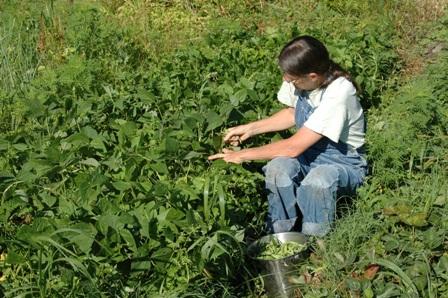
I grew all the beans, garlic, onions, parsley, and most of the lettuce. The farm manager at Brookview raised the pork that became barbecue, cooked right there at the farm by Chris’s uncles on the large grill. Chris’s aunt and uncle grew the potatoes. Molly bought the rest of the produce from local growers and did her best tracking down the best choices for other ingredients. She even met up in a parking lot with someone from Virginia Vinegar Works to get the vinegar for the coleslaw. Chris’s cousin made the cake. We had to think of everything. We rented tables, chairs, tablecloths, and dishes. Did you know that if you rent dishes you don’t really have to wash them? Hosing them off in the crates they came in is sufficient, and we had a hose handy right outside the barn. We found it was cheaper to buy stainless steel silverware from a restaurant supply through the internet, than it was to rent it. That silverware has since serviced another wedding. A friend scoured Goodwill Stores everywhere for silverware for his wedding, using the mix-and-match eclectic approach. You could do that with dishes, also. Half-pint jelly jars served as wine glasses and punch cups. Pint canning jars were our beer mugs and water glasses. I already had lots of jars. Quart canning jars held local flowers for the centerpieces. Women’s
flowered handkerchiefs were used as napkins for the hors d’oeuvres and colorful men’s handkerchiefs were the dinner napkins. They were gifts for the guests to take home. We hope they continued to use them as either cloth napkins or handkerchiefs.
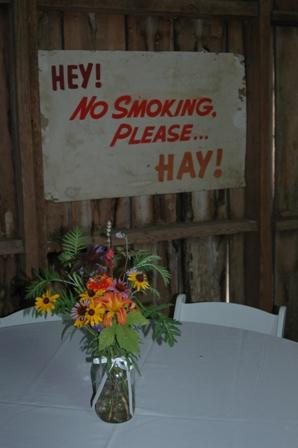
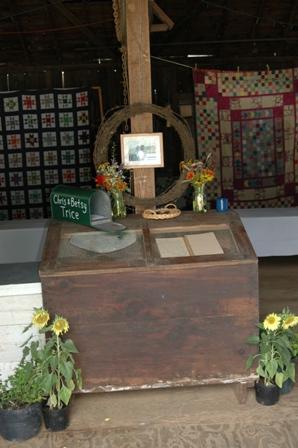
On the wedding morning, Betsy picked flowers from everywhere she had been scouting out, including roadside ditches, and her friends put the bouquets and centerpieces together in the barn. That old dusty barn needed a LOT of cleaning before we could have a wedding there. In the process we uncovered some pretty neat no-smoking signs from the 1950’s that we dusted off and posted. Some things we could work around, such as the old farm wagon, and other things were incorporated into our décor, such as an old feed box.
Some areas, however, needed covering so I brought all my quilts to hang. We tied up clothesline and used clothes pins to attach them, or just draped them over the wagon and a cart. Unintentionally, I was having my own quilt show, and in a barn, no less. Wow! There was one area in the barn that had building materials salvaged from other places. That was off limits and that week Betsy had the idea to pull out the doors that were there and lean them against a board that she and her dad put up. That made a unique wall to hide the building supplies. The morning of the wedding I was worried that someone would take too close of a look and pull one over on themselves, so we put up the leftover clothesline in front of them.
When everyone is really working together, their thinking comes together. Just before he left to get cleaned up, Chris walked by and said he would bring back photos to hang up on that line. I had some extra clothes pins, so I left them out. By the time the guests arrived, the photos were up, with absolutely no pre-planning at all. Find more details about the wedding at Homeplace Earth.
Now, if you are planning a wedding that is in the next couple months, and reading this has your head spinning with ideas, realize that it all takes some doing. Everything doesn’t come together as easily as those pictures on the doors. If you begin to live that way, though, finding creative uses for things, avoiding disposable dishes and decorations, growing some of your own food and getting to know local growers, your next event, no matter how big or small, will take shape in much the same way. Have fun with your party planning!
Photos by Cindy Conner





