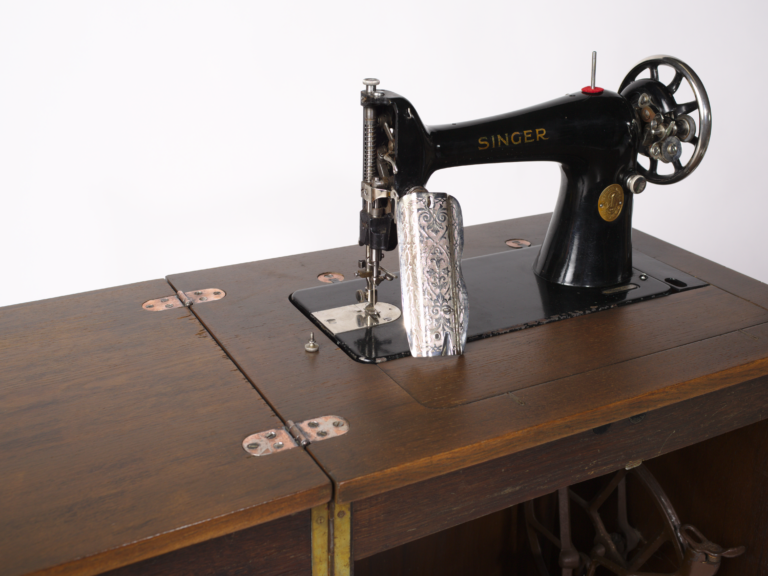
White Family Rotary treadle sewing machines are well-made and easy to operate – but with key differences from modern electric machines. Learn how to use a treadle sewing machine and reclaim a heritage skill.
When I was young, I’d watch in fascination as my mother used her treadle sewing machine, an 1800s Singer that belonged to my great-grandmother, to fashion fuzzy coats, couch covers, and zippered pencil bags. I’d sit on the floor and watch as her feet deftly pedaled fast on the straightaway and then slowed as she rounded a curve or reached an end.
Built before electricity, the Singer purred, interrupted only when the ancient leather belt flew apart. Mom would stop pedaling, rejoin the belt ends with a bent nail and string, and resume sewing. Without realizing it, I was learning much about human-powered machines just by watching my mother sew.
Finally, at age 11, I was allowed to use the machine myself. What a thrill to pick out a Raggedy Ann pattern at Ben Franklin in town for my first project. The fabric, buttons, and stuffing came from my mother’s scrap box – what she called “glad rags.” They may only have been faded remnants of former garments, but she was “glad to have them.”
For the ruffles, I used the Singer pleat-gathering tool. Embroidering the facial features required attaching another clever gadget. I followed the directions in the yellowed manual, eventually trying out each attachment as I completed Raggedy Ann. As a teen, I modified straight-legged jeans by adding triangles of gaudy fabric to create bell bottoms. It was the 70s, what can I say? After a car, my next big investment as a young adult was a $400 sewing machine that could form buttonholes and even had some extra fancy stitches (that I never used). I just plugged the machine in and away I went, consuming a million miles of thread over the years as I crafted curtains, quilts, clothes and even a boat cover or two.

Nothing compared, though, with the satisfaction of sewing with that antique treadle machine. The hum of an electric motor is impersonal and the speed challenging to control. But, I grew up being told technology is better. My mother, too, gave away her treadle in favor of a modern plastic and tin marvel. Thankfully, her treadle did not end up in the city dump with mountains of others.
Searching For an Antique Treadle Sewing Machine
On our journey to self-reliance, my husband, Darren, and I have been gathering human-powered tools when we can find them. It’s surprising and sad how quickly hand- and foot-powered tools were junked when electricity became available. From 1850 to 1890, more than 100 apple-pealing devices were patented. Then none, except those running on electric power. And so it goes with thousands of other nifty human-powered appliances.
I drove by a fix-it shop recently and couldn’t believe my lucky find – an antique stainless steel hand-powered washing machine sitting out front. I zoomed in the parking lot and ran over to the washer, only to discover petunias blooming in the rusted out basin. Our search for non-electric tools revived memories of that faithful Singer. Within a few days of putting my brother-in-law on the lookout, he found an abused White Rotary treadle machine at a Springfield thrift store for $60. Even though I was somewhat discouraged by its neglected condition (I didn’t even take a picture), I was eager to get it home and start refurbishing. I wasn’t interested in beauty; I just wanted a working treadle machine.
The machine appeared (and smelled) as if it was stored in a chicken coop. The cabinet was brutally battered and the hand wheel was nearly paralyzed, but we rolled up our sleeves and got to work. Darren replaced broken boards while I disassembled, oiled and cleaned the machine. I took a few photos to remember how to put it back together. We learned that unless a machine is severely rusted, it is not difficult to restore. Ours was not missing pieces, but even those can be found online for little expense. I bought 25 feet of leather belt online (enough for a lifetime) for less than $10. Copies of manuals are also available, which you may need to learn to thread your machine. I discovered that opposite of other machines, the White hand wheel is turned away from the operator to sew. That took some getting used to.

One handy online source is www.TreadleOn.net. And here is a great 1975 Mother Earth News article by Helene Ellis illustrates “Tips on Buying, Restoring and Using a Treadle Sewing Machines.”
As we worked, Darren and I marveled at the White’s quality craftsmanship. Online copies of advertisements reveal this machine was built to be affordable for the average household, costing about $55 new in 1913. Yet, the cabinet has in inlaid ruler, handsome curved drawers and detailed wrought iron stand. The machine is adorned on every side with golden decals. Darren was especially intrigued with the precise machine work. After cleaning and oiling the treadle in the shop, he gave it a few pumps to get it spinning and then came in the house to fetch me. We went out and saw the flywheel still silently turning minutes later, perfectly balanced and smooth.
Between the two of us, we had the cabinet and machine looking and running like new in three days. Then, I couldn’t stop sewing. I scoured the house looking for small repair projects – a kitchen curtain, cover for the cinder block holding our water filter and padded arm rests for my rocker. Then, just for fun, I created a true scrap quilt of ragged clothes, bits of leftover fabric and old pillow stuffing.
Lessons Learned on How to Use a Treadle Sewing Machine In the Modern Era
We soon learned the White has one very distinct difference from other treadles. The top of the hand wheel is turned away from the operator to sew. Sure, the wheel will turn toward the front as in other machines, but the thread will bunch up and make an awful mess. Treadling “backwards” took some getting used to, sort of like driving on the opposite side of the road, but now is a mindless motion.
That was lesson Number 1.
Then, since the machine had only one bobbin, I went online to eBay and bought four “vintage” bobbins in a package from the 1950s or 60s for about $2.50 each. Although they are slightly different in appearance (stamped “Japan”), they work just as well as the original bobbin.
Recently, when I realized I needed many bobbins for different thread weights and colors, I ordered a bargain pack on eBay – 20 bobbins for $15 and free shipping. These bobbins are brand-spanking new and shiny. I assume “made in China.”

In the bobbin case, the modern bobbins work just fine … but, the center hole is a tad larger than the older bobbins, so they spin on the bobbin winder instead of winding on the thread.
That was lesson Number 2.
My husband solved this problem by suggesting I apply a tiny dab of masking tape to the bobbin winder shaft. His solution worked perfectly. So, yes, you can buy new bobbins instead of the extra cost for antique or vintage bobbins. You can even sew with them. However, to save trouble, I recommend finding older bobbins if you can. They are certainly worth the additional cost.
Treadle Sewing Machine Tricks
I’ve learned a few other tricks worth mentioning:
- If you have used an electric machine most of your life, as I have, you’ve surely gotten used to modern conveniences, such as automatic forward and backward stitching to lock in your starts and stops. Old treadles stitch only forward. So, you can make a few stitches (about 1/2 inch), and then pivot on the needle to turn the fabric 180 degrees and reverse your line of stitching back to your starting point. Then stitch forward again. This takes extra time and is awkward when sewing large pieces.

- An easier method of locking in your stitches is to start out with very short stitches (I set my length on 0). Stitch about half an inch and then increase the stitch length to about 4 for regular sewing. As you near the end of your line of stitching, reduce the stitch length again to 0 or 1 for the last half an inch. This should hold under most circumstances. At the top of pockets, however, I use the forward/backward technique.
- Because there is no zigzag stitch for finishing seams, I stitch about 1/8-inch away from the first seam in places where I fear the fabric could unravel over time.
- In places of stress or with loosely woven fabric, I’ll make a flat-fell seam, turning under the raw edges. If there is an easier solution, I’d love to hear about it.

Reflections on How to Use a Treadle Sewing Machine
So, even without 1,000 stitches to choose from, I absolutely love my old treadle and wouldn’t trade it for all the bobbins in China. The stitches are smooth and uniform, even when sewing through eight layers of heavy denim. The one exception, however, is if using cheap thread (the dollar-store variety), the machine will skip stitches. Use quality thread.
This is also the easiest machine to thread, oil and adjust. With my fancy electric machines, I would often scowl when it was time to rethread or wind a bobbin because it was a nuisance. No longer. Threading this machine takes just a few seconds. I have not tried out any of the attachments yet for my machine, but will get around to it on the next snowy day. Check back soon to learn more about sewing with a treadle.
It’s been a few months since we restored it, but I still marvel at the machine’s strength, precision and ease of use. I picture the machine’s original owner, whoever she may have been, in a long calico dress sewing bushels of baby clothes by lantern light. The machine was surely a treasured piece of furniture in her home. Now, 100 years later, I wouldn’t trade my antique White Rotary for a hundred brand-new sewing machines.
Linda Holliday lives in the Missouri Ozarks where she and her husband invented the WaterBuck Pump.