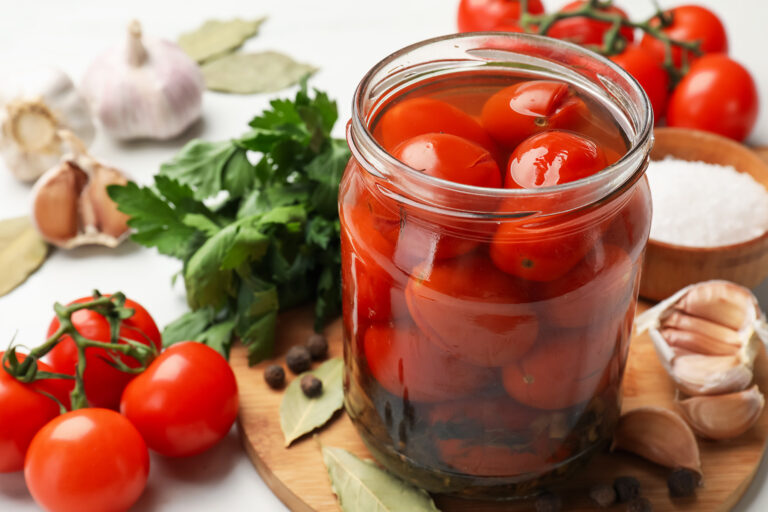
Store your abundant tomato harvest with the best canned tomatoes recipes for making homemade juice, soup, sauces, and pickles. Take advantage of any of these recipes using home-canned tomatoes.
This article is included online for historical interests only. Please follow today’s canning safety guidelines outlined by the National Center for Home Food Preservation.
“You tell ’em I’m puttin’ up ‘maters for th’ winter, that’s what. People might laugh at such stuff as this, but I’ll tell y’, I’m not about to let ’em rot.”
— Hillard Green, quoted in The Foxfire Book.
Hillard Green has the right idea. The old adage “Waste not want not” applies for sure in these days of exorbitant food prices. And those of us who grow our own have always known the value of preserving nature’s bounty for off-season use.
Best Canned Tomatoes Recipes for Preserving
Since tomatoes are easy to grow and often plentiful, you may find yourself up to your ears in the ripe, scarlet fruit as frost approaches — and a few hints on the preservation of the harvest may be welcome, along with some tomato recipes to enjoy. I’ve also taken the canning jar shortage into account in preparing this article, and have included some guides to the use of alternative containers (along with directions for a couple of preservation methods which require no jars at all).
Canned Tomatoes
Tomatoes are really a fruit and have always been canned accordingly — by the cold pack method, in a boiling water bath. Until recently, the high acid content of all garden tomatoes made this practice perfectly safe.
Now, however, low-acid varieties of the fruit have been developed, and if you’ve heard nasty rumors about the possibility of botulism even in canned tomatoes, these new types are the culprits. If you’re putting up such tomatoes, either raise their acidity by adding vinegar or process them in a pressure canner as you would any other low-acid food. The home economist at your county extension office can give you detailed instructions for handling of doubtful cases.
Better still, start with a good old reliable tart variety of tomato and proceed as follows: Prepare the jars for canning according to the manufacturer’s instructions; or wash the containers in hot, soapy water, rinse them well, and boil or scald them (I simply dip mine in boiling water and set them aside).
Select only firm, ripe tomatoes, place them in a colander or wire basket, and dunk them into boiling water just long enough to loosen the skins (usually half a minute or so). Remove the fruit from the hot bath, let them drain, and pull off the skins with the aid of a knife (try not to injure the flesh). Then slice the tomatoes — I cut them into quarters — and pack as many chunks as possible into each jar, pressing them down with your fist or fingers. Leave about half an inch of clear space at the top of the container. Add 1 teaspoon of salt (or substitute sugar, if you like) per quart. You might want to experiment with various other seasonings: garlic salt, oregano, basil, etc.
Adjust the lids on the jars according to the maker’s instructions and process the containers in a boiling water bath for 35 minutes (or for 10 minutes at 5 pounds pressure in a pressure canner). (Many authorities recommend that pint jars of tomatoes be processed in boiling water for 35 minutes, and quart jars for 45 minutes. For more specific details of canning methods, see a reliable guide such as the Kerr Home Canning Book or The Ball Blue Book — Mother.) Remove the jars from the canning kettle and seal the lids, if necessary, as directed by the manufacturer.
Glass containers of tomato products should be kept in a cool, dark place and wrapped in paper, if need be, to exclude light.
Tomato Juice Recipe
Some folks prefer to can tomatoes and then make juice from the preserved fruit during the less frenzied days of winter. If you want to put up juice at harvest time, however, here’s a good method:
Wash, scald and peel ripe tomatoes. Remove their cores and cut the fruit into eighths, simmer the sections to softness, and put the pulp through a fine sieve. Collect the juice and pour it into hot jars to within a quarter inch of their tops. Add 1/2 teaspoon of salt per quart and process the containers for 10 minutes in a boiling water bath. Follow the manufacturer’s instructions for handling lids.
A possible alternative is suggested by Helen Nearing, who puts up tomato, rose hip and raspberry juices in 1- and 2-quart commercial orange juice bottles (the kind with the spongy plastic ring in the cap (also used to hold prune and cranberry beverages). Her procedure — described in a letter to Organic Gardening and Farming magazine — is to fill the hot, sterilized containers to the top with boiling juice, screw the covers on tight, let the contents cool, and store the bottles without processing them at all. (See “How to Beat the Canning Jar Shortage (And Come Out Ahead!), below, for further details on using recycled jars.)
Tomato Sauce Recipes
Many delicious tomato mixtures such as chili, taco, or vegetarian spaghetti sauce may be canned if you have sufficient jars. (Some of these products may also be frozen.)
To put up a favorite sauce, just prepare the food as you would for immediate use — but cook it a little more briefly than usual to allow for the heat of processing. Pour the hot mixture into hot jars and process the containers for 45 minutes in a boiling water bath, or for 10 minutes at 5 pounds of pressure in a pressure canner.
Many sauce recipes call for not only tomatoes and spices but onions, celery, and peppers — all low-acid vegetables. Until recently, most cooks canned such combinations by the boiling water bath method and served them with confidence, knowing that the finely chopped or ground additional ingredients had been thoroughly penetrated by the acid tomato juice. These days, if you’re not sure of your ‘maters’ acidity, processing in a pressure canner is the wisest course. If you plan to include any vegetables other than those I’ve mentioned, it’s best to follow a good canning guide’s recommendations on method and timing.
Sauces and other tomato specialties are often reduced to the desired thickness by “cooking down.” If done over direct heat, this process requires constant watching and stirring to prevent the ingredients from sticking to the kettle. An easier method is to pour the juice or pulp into shallow pans, skillets, roasters, etc., place the containers in a 350 degree oven, and stir the liquid every 15 or 20 minutes until it reaches the consistency you want — which should take 1 to 3 hours.
The oven cooking-down method takes much of the bother out of recipes such as the following, which makes a spicy product that can be used as a catsup, steak sauce, flavoring for baked beans, etc.
Mary Jean Colby’s Chili Sauce Recipe
- Enough ground ripe tomatoes to fill a large mixing bowl
- 1 or 2 medium-sized green peppers, ground
- 1 or more medium-sized onions, ground
- 1 cup vinegar
- 1-1/2 cups sugar, honey, or molasses
- 2 tablespoons cinnamon
- 1/2 teaspoon allspice
- 1/8 teaspoon cayenne (red) pepper
- 1/4 teaspoon cloves
- Salt to taste
Cook down all ingredients to the desired thickness (this recipe makes a sauce, remember, not a paste). Pour the product into clean, hot jars, process the containers 10 minutes in a boiling water bath, and seal them — if necessary — according to the manufacturer’s instructions.
Ruby Hoop’s Regal Tomato Soup Recipe
The following recipe produces a concentrate, which is diluted before serving to make as Ruby says “a creamy, flavor-filled soup”.
(Yield: 10-11 pints)
Ingredients:
- 6 medium onions
- 1 bunch celery
- 8 quarts cut-up tomatoes
- 3/4 cup sugar (or honey)
- 1/4 cup salt
- 1 cup butter or margarine
- 1 cup flour
Instructions:
- Chop the onions and celery and put them into a large kettle with just enough water to start a good boil and prevent scorching. Add the tomato pieces and cook the vegetables until they’re tender.
- Then put them through a food mill to remove seeds and chunks, and return the pulp to the kettle along with the sugar and salt.
- Cream together the butter and flour, add the well-blended mixture to the boiling purée, stir thoroughly, and continue to simmer the combination until it thickens slightly (to about the consistency of thin gravy).
- Pour the product into hot jars and process them in a boiling water bath for 45 minutes, or in a pressure canner for 10 minutes at 5 pounds.
- At serving time, empty the concentrate into a saucepan, add 2 pinches of, soda per pint, warm the tomato mix slightly, and dilute it with an equal amount of milk or water. Then heat the soup to eating temperature.
Catsup Recipes
Catsup is a combination of puréed tomatoes and/or other vegetables, spices, sugar, and vinegar. The purée is made by either of two basic methods: [1] blending the raw vegetables and cooking them down or [2] simmering the ingredients, sieving them, and reducing the pulp to the desired thickness. Vinegar can be added either before the cooking down, or mixed in later to dilute the thickened juice. Both techniques are described in detail after the lists of ingredients in the recipes that follow. Choose your system according to what equipment you have (or don’t have), or work out a combination of steps to suit yourself.
Catsup can be canned in jars or put up in cappable commercial bottles with tops that fit tightly enough to exclude air and prevent spoilage. Some persons, however, have reported trouble in getting really airtight seals with recycled containers.
Catsup Recipe No. 1
(Yield: about 5 pints)
Ingredients:
- 48 medium-sized tomatoes
- 2 ripe (red) sweet peppers, seeded
- 2 green sweet peppers, seeded
- 4 onions
- 3 cups white vinegar
- 3 cups sugar or honey
- 3 tablespoons salt
- 3 tablespoons dry mustard
- 1/2 teaspoon ground cayenne pepper
The following ingredients tied in a cloth:
- 1-1/2 teaspoons whole allspice
- 1-1/2 teaspoons whole cloves
- 1-1/2 teaspoons broken stick cinnamon
Catsup Recipe No. 2
(Yield: about 3 pints)
Ingredients:
- 48 medium tomatoes
- 2 medium onions
- 2 cups cider vinegar
- I cup brown sugar or honey
- 2-1/2 teaspoons salt
- 1/2 teaspoon cayenne pepper
- 1 tablespoon paprika
The following ingredients tied in a cloth:
- 1-1/2 tablespoons broken stick cinnamon
- 1 tablespoon whole cloves
- 3 cloves garlic, chopped
Catsup Recipe No. 3
(Yield: about 2 pints)
Ingredients:
- 32 medium tomatoes
- 1 cup sliced onions
- 1 cup vinegar
- 1/2 cup sugar or honey
- 4 teaspoons salt
- 1/4 teaspoon cayenne pepper
- 1 teaspoon celery seed
The following ingredients tied in a cloth:
- 1/2 teaspoon whole allspice
- 1-1/2 teaspoons whole cloves
- 1-1/2 teaspoons broken stick cinnamon
Newfangled Method (blender and oven): Fill the blender 3/4 full of raw tomatoes and other vegetables and whizz the contents at the highest speed for 4 seconds or until the makings are well purged. Add the ground spices and set the mixture aside. Pour the vinegar into a pan (not aluminum), add the whole spices tied into a cloth bag, simmer this combination 30 minutes, and bring it just to a boil. Combine the spiced vinegar with the puree and add sugar or honey and salt. Cook down the catsup in the oven (see the directions under “Sauces”) or boil it to the right consistency on top of the stove or over an open fire. Pour it hot into hot bottles and seal them, or fill canning jars, process them in a boiling water bath for 10 minutes, remove them from the canner, and complete the seals-if necessary-according to the manufacturer’s instructions.
Old-fashioned Method (sieve and kettle or oven): Slice or grind the tomatoes and other vegetables and simmer them about 20 minutes, or until the, pieces are very tender. Put the pulp through a sieve to remove seeds, skins, and fibers, and add the ground spices and sweetening. At this point you have a choice: either [1] cook down the liquid to reduce it by half, and thin it to the desired consistency with spiced vinegar (see the directions under “Newfangled method”), or [2] mix the prepared pulp with the spiced vinegar and cook it down. Less time and fuel are required by Method 1. In either case, pour the catsup hot into hot containers and seal bottles or process jars as directed in the preceding instructions.
Dried Tomato “Bouillon” Recipe
A very old way to preserve tomatoes for flavoring soups and stews is to reduce them to “bouillon” cubes.
Wash and drain ripe tomatoes, cut them crosswise in half-inch slices, and pack them cut side up between layers of salt in a pot, crock, or wooden barrel. When they’ve stood for 24 hours, pour off and discard the watery brine and the seeds that escape with it. Boil the tomatoes to a pulp and rub them through a fine sieve. Then season this product to taste with cayenne pepper or paprika and salt, and boil it to the consistency of cream, stirring briskly, or use the oven cooking-down method, with occasional stirring.
When the cooking is finished, spread the purée to the depth of half an inch on large platters or non-aluminum cookie sheets and let it dry in the sun or in a slow oven. If the dehydration is done outdoors, be sure to protect your “bouillon” from insects with mosquito netting, cheesecloth, or screening. Cut the sheets into 3-inch squares when the pulp is still slightly moist. Once the drying is complete, pack the pieces in a clean, airtight container and store them in a cool, dry place. One 3-inch square will season 2 to 3 quarts of soup (enough for a large family).
Freezing Tomatoes
Whole tomatoes can be wrapped individually and frozen. Such fruit, however, should be used within two months — preferably for cooking, although some people do cut up the raw, frozen tomatoes and eat them at once in salads. The flavor doesn’t compare with that of fresh produce, but may still beat the taste of the dull hothouse specimens from the store.
For better results (and more economical use of freezer space), freeze tomatoes as uncooked pulp — or stew them first, leaving out bread, crackers, etc., until the dish is heated for serving.
Incidentally, if you like fried green tomatoes, try this: Cut the unripe fruit into quarter-inch slices, dip the pieces in cornmeal or wheat germ, package them, and store them in the freezer. Later, remove the tidbits and cook them, without thawing, either in a frying pan or in deep fat.
Pickled Tomatoes Recipes
Another use for green tomatoes, or for those that are nearly ripe, is in various old and new pickling recipes. But before you begin, please note the two following hints:
[1] According to the sources I’ve consulted, vinegar for pickling should have an acetic acid content of 4 to 6 percent. Commercial products are tested for strength and can be used safely, unlike homemade vinegars, which shouldn’t be substituted because their level of acidity is generally unknown.
I did, however, run across a test for the acidity of vinegar in a very old cookbook, and include it here:
To determine the proportion of acetic acid, suspend 4 or 5 ounces, by weight, of broken pieces of fine marble in 16 ounces, by weight, of vinegar. The acetic acid will attack the marble and will be gradually neutralized. Let stand overnight. Remove the marble, rinse it in cold water, dry it thoroughly with gentle heat on top of the stove (take care not to melt it) and weigh it carefully, 5/6 of its loss in weight is the quantity of actual acetic acid contained in the sample. And from this amount the proportion of acetic acid can be readily obtained. Good vinegar should contain about 5 percent absolute acetic acid.
[2] Pickles are darkened by the iodine in iodized salt, and the additives which prevent table salts from caking give the vinegar solution a cloudy appearance. You can avoid such problems by choosing pickling, dairy, or kosher salt for your preservation purposes. Here are two easy and delicious recipes for pickled tomatoes:
Ruby Hoops’ Sweet Tomato Relish Recipe
Ingredients:
- 4 cups ground green tomatoes
- 1 red sweet pepper
- 1 green sweet pepper
- 2 medium onions
- 2 or 3 tart red apples
- 2 cups vinegar
- 1-1/2 or 2 cups sugar or honey
- 3 teaspoons salt
- 2 teaspoons mustard seed
Grind together all the fruits and vegetables, and drain off a little liquid if there’s too much. Combine the vinegar, sugar or honey, and seasonings. Then bring the mixture to a boil and pour it over the ground ingredients. Heat the whole panful to a boil once more and hold it there for 10 to 15 minutes, stirring frequently. Pour the product into prepared jars, process the containers for 5 minutes in a boiling water bath, and seal them according to the manufacturer’s instructions. “Our favorite hamburger relish,” says Ruby. “I usually double or triple the recipe and give some away.”
Green Tomato Pickles Recipe
(Yield: about 4 pints or 9 half pints)
Ingredients:
- 2 quarts sliced green tomatoes
- Salt
- 2 cups cider vinegar
- 2/3 cup dark brown sugar
- 1 cup sugar or light honey
- 3 tablespoons mustard seed
- 1/2 teaspoon celery seed
- 1 teaspoon ground turmeric
- 2 large red sweet peppers, chopped
- 1 hot green or red pepper, chopped
- 3 cups sliced onions
Place layers of tomatoes-sprinkled with salt-in a crock or enamel pan, let the slices stand about 12 hours, and drain them. Bring the vinegar, sweetenings, and spices to a boil. Then add the sliced onions and boil the mixture gently for 5 minutes. Add the drained tomatoes and chopped peppers and, again, bring the contents of the pan slowly to a boil and simmer for 5 minutes (stir occasionally with a wooden spoon). Pack the pickles into hot jars, with care that the pickling liquid covers the vegetables. Adjust the lids, process the containers in a boiling water bath, and seal them according to the manufacturer’s directions.
Preserves and Conserves
Various cookbooks, and the makers of pectin products, offer recipes for preserves and conserves made of ripe and green tomatoes, sugar or honey, spices, apples, raisins, etc. The combinations are many, and can be varied according to your own imagination and taste. There are also very good recipes for green tomato mincemeat, a pleasant change.
How to Rescue Tomatoes From Frost
Green tomatoes that are still on the vine when frost threatens can be used in the above recipes. Or they can be allowed to ripen in any of several ways and eaten fresh or put up later.
Last summer, when we had to move and leave our garden behind, we gathered all the green tomatoes — whatever their size and took them with us. They ripened beautifully on windowsills, counters, and tables — all about the same time, so that I ended up canning most of the fruit.
On the other hand, if you don’t want to clutter up your entire house with ripening tomatoes for a couple of weeks, you may prefer to wipe the fruit clean, wrap each in newspaper, and then pack the ‘maters in cardboard boxes, and store them where they won’t freeze. Check for ripeness each day by gently squeezing the fruit and removing those that feel soft — for use fresh, canned or however you like. This procedure can extend your tomato season by weeks.
The last method I’m personally familiar with is to uproot whole tomato vines just before frost, shake off the dirt, and hang the plants upside down indoors. The fruit will then ripen in its own time, if you’re one of the people for whom this trick works well. You’ll just have to experiment to find out.
There is one more possibility, which I know of only through hearsay and not from experience: A friend of mine claimed the other day that tomato plants will grow and produce all year if planted in big pots and judiciously pruned to manageable size. If you’re venturesome — and have plenty of space and a large south window — go ahead and try.
Well, if you don’t get some tomatoes put up this year, don’t blame me! The only major hindrance is the shortage of canning jars and the sidebar below offers some possible solutions to that problem. Otherwise, you’re limited only by your imagination and energy.
Perhaps the bounty of a good tomato crop will leave you hoping, come November, that you never see (much less put up) another ‘mater! The feeling won’t last long, though, and you’ll find your harvest a never-failing source of good winter eating.
How to Beat the Canning Jar Shortage (and Come Out Ahead!)
For the past two summers, canning jars and lids have been as scarce as hen’s teeth in many areas. Large numbers of people have been affected, but not those who know the secret of salvaging what I call “oddball” containers.
You may already be aware that some commercial food products — mayonnaise and other salad dressings, mustard in large quantities, etc. come in jars that fit one or another of the standard canning lids (regular, wide mouth, or No. 63). Home economists of the agricultural extension offices discourage the use of such containers for canning methods other than the boiling water bath. Nevertheless, these particular “oddballs” have been processed successfully in many a pressure canner with a breakage rate no higher than that of bona fide jars.
All right so far, but in some regions it’s lids — not jars — that are really hard to find. Well, good news! Large numbers of commercial glass containers are fitted with self-sealing tops, and both parts are reusable.
Any time you come by a jar with a metal twist-off lid, look inside the cover. If you find a built-in plastic ring, you’re in luck. That band can be softened by heating, and the top — properly handled — will then reseal its matching container.
At canning time, keep such lids in boiling water until you’re ready for them. Then place the tops on the appropriate jars (now filled with hot produce), screw them down firmly-but not too tightly-and process the batch in the usual way. The containers will self-seal as they cool. Recycled tops don’t emit the characteristic “ping” which assures you that the conventional lid is properly closed, but you can check the seal by looking across a jar cover in a good light or by comparing it with an identical unsealed lid.
Fair warning: Canning with resealable commercial jars and lids is definitely not recommended by experts. All the same, many of us have done it successfully and have experienced no more failures than occur with regulation equipment It’s true that the breakage rate of such glassware increases at about 10 pounds of pressure — but name-brand jars are also more likely to collapse at that point. I heard of a woman who put up about 900 quarts of food last year in a variety of containers — old, new and oddball — and lost a total of only 11, with no particular type suffering more than another.
Jars with resealable lids contain a mind-boggling array of foodstuffs: salad dressing, breakfast drinks, non-dairy creamers (ugh!), instant coffee, sauerkraut, pickles, pigs’ feet, orange juice (1- and 2-quart sizes), cranberry and prune juice, jellies, peanut butter, dry-roasted nuts, etc. If you use as few of these plastic products as we do, beg empties from in-laws, friends, rummage sales, recycling centers, or wherever else you can glean them. Then keep the jars and lids together for future use.
A special note on baby food jars: Most of them used to be practicable home-canning containers, but the manufacturers seem to have changed the lid designs recently and the newer types don’t reseal. I’ve learned to avoid any that are hard to close, since they allow the jars to fill with water in the canning kettle. Another type of lid, one that goes on readily and are fitted with small black rubber sealing rings — also tend to leak. Tops that will reseal are those that screw on easily and have built-in white, spongy plastic bands like those found in other reusable containers.
No closable glass jar — even one that doesn’t qualify as a canning container — need be wasted. Those that can’t be resealed and won’t take standard lids can be filled with jams, jellies, and preserves topped with paraffin. I put up my apple butter this way (and, I’ll admit, I did lose a couple of quarts to mold last year). “Dud” baby food jars are fine for small amounts of jelly, or as freezing containers for infant-sized servings of homemade purees or whatever. Non-resealable bottles can be stoppered with corks to store such products as catsup.
Large jars which formerly held instant iced tea mix are good storage containers for dried foodstuffs and herbs, tomato “bouillon,” and anything else you please. Those with the green striped lids make pretty see-through canisters for lentils, beans, pasta, etc. The non-sealing covers of such glassware can be made more airtight with liners cut from blotting paper or cardboard.
While you’re collecting offbeat containers, you should also keep an eye open for secondhand lots of tried-and-true “real” jars — which are still available at farm sales and auctions. The green and blue types are now considered antiques and are priced out of sight, and you probably won’t be able to afford the variety with the glass-and-wire lids either, unless you buy just one for a keepsake. Ordinary quart and pint Mason jars, however, often turn up for sale by the boxful and may be priced pretty reasonably (depending on who happens to bid on them).
Canning jars are a permanent investment and should be treated with the care you give any other survival equipment. This means that you may possibly find yourself with boxes of perfectly good Mason jars for which you can’t buy replacement lids. Well, I hesitate to mention the fact, but if you’re desperate you can reuse some standard self-sealing lids-the ones with the spongy sealer rings-provided you were careful not to bend the metal discs when you opened the containers of food the first time around. This practice is strongly discouraged by agricultural extension home economists, who are truly devoted to the public’s best interests. Still, in an emergency, I’d rather try it than let food go to waste — and in some areas, 1974 was definitely an emergency as far as canning supplies were concerned. At least, if you try the idea this year, you’ll know at once whether or not the lids have sealed, and you’ll be able to reprocess any failures promptly.
Your own ingenuity may turn up still other ways to beat the canning jar shortage. True, some of your alternative containers will break, and others won’t seal — but failures are to be expected even under ideal circumstances. Best of luck!
This article is included online for historical interests only. Please follow today’s canning safety guidelines outlined by the National Center for Home Food Preservation.
Originally published as “Terrific Tomato Soup and Other Tomato Recipes” in the September/October 1975 issue of MOTHER EARTH NEWS magazine and regularly vetted for accuracy.