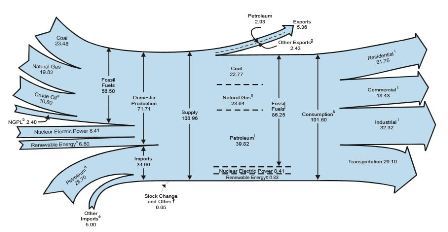
My generation is that last to have known and been raised by people who were born in the radio and television. My grandmother was born in 1885 shortly after the invention of the light bulb and telephone. Grandma taught me that nothing lasts forever. Fossil fuels won’t last forever. If we use them up or they become too expensive to extract before we build an infrastructure and transportation system that does not rely on fossil fuels, we will not have the energy we need to build that infrastructure.
We only have one shot at this. We only get one industrial revolution. If we don’t make the transition to a renewable energy system we will end up living in a preindustrial society. We are about half way through the recoverable resources of oil and coal and production is or has peaked. Within 25 to 50 years we may not have access to fossil fuels.
Let’s Do the Math
The public media has gone gaga over the oil bearing Bakken formation in Montana and North Dakota. The geological estimates of over 4 billion barrels of oil, 25 times more than previously estimated have been touted as some kind of miracle that will help make the USA energy independent. In a country that consumes from 18 – 20 million barrels a day, about 22% of the world’s oil, the 4 billion barrels of oil in the Bakken are a half a year’s supply. This is a really good math exercise for middle school kids to play with to get them used to exponents. (And a refresher for the rest of us)
While environmental groups are worried about convincing the congress and the world that we should do something about climate change by eliminating fossil fuels, I see no appreciation of the gift we have in fossil fuels because they contains the energy we need to build a sustainable future. I see no plans as to when and where what renewable technologies should be employed at what rate to mitigate climate change and prepare for the day when fossil fuels become economically and technically unavailable. I see almost no attention to a budget for replacement of the current energy infrastructure. My estimate is that it will cost upwards of 20 trillion dollars in this country. I will this math and money exercise in another post
The time frame is an even more interesting scenario. Vlacav Smil has studied this problem extensively and details it in his book Energy Transitions, History, Requirements, Prospects. Having learned to control fire we used wood as our energy source. Then began our use of coal and the timeline below details the evolution of fuel sources:
1740 – First Commercial Coal mines in Virginia
1890 – Wood provided half the world’s energy
1900 – Coal began to overtake wood
1900 – 2000 Coal to Oil
1950 – oil surpasses coal
1958 – natural gas surpasses coal
1965 – oil becomes the primary energy supply
2000 – 2??? Fossil Fuels to Renewable Energy
Please take note; the last transition may not be occur. When fossil fuels are exhausted the energy needed to build a renewable energy infrastructure will be gone. There is only one shot to get it right and the Borg appear to be in control. Get involved, teach your children well, but prepare to evacuate if you live in a city.
I believe that last drop of oil burned on this planet is likely to be in a Hummer guarding an oil field in the Middle East but I am definitely, positively sure that:
In the future,
We will sit on our front porches
With family, friends and neighbors,
Singing and playing acoustic music,
Until the stars come out and shine down upon us,
Undimmed by the fires of fossil fuels.
Sources:
Arctic National Wildlife Refuge, 1002 Area, Petroleum Assessment
3 to 4.3 Billion Barrels of Technically Recoverable Oil Assessed in North Dakota and Montana’s Bakken Formation —25 Times More Than 1995 Estimate
Energy Information Agency: How much oil does the United States consume per year?
Energy Infomration Agency: Energy Flow Diagram