Grass, Soil, Hope: A Journey Through Carbon Country (Chelsea Green Publishing, 2014) addresses a crucial question: What can we do about the seemingly intractable challenges confronting all of humanity today? Build topsoil. Fix creeks. Eat meat from pasture-raised animals. Soil scientists maintain that a mere 2 percent increase in the carbon content of the planet’s soils could offset 100 percent of all greenhouse gas emissions going into the atmosphere. But how could this be accomplished? What would it cost? Is it even possible? Author Courtney White says it is not only possible, but essential for the long-term health and sustainability of our environment and our economy.
For a minute, I thought I had stepped into that scene from Lawrence of Arabia where Peter O’Toole, approaching the Suez Canal on foot, sees a ship sailing across the sand.
I had parked on an earthen levee at the eastern end of Twitchell Island, in the great Sacramento-San Joaquin River Delta, east of San Francisco. In front of me was prime farmland, and in the distance, just beyond a slight rise, I saw a big cargo tanker plowing its way slowly across a field à la Lawrence — plowing the middle of the San Joaquin River, of course.
I didn’t drive to Twitchell Island to see farmland, however. I wanted to see a carbon sweet spot in action. Sweet spots are where big things happen in small places for a minimum amount of effort and cost. On Twitchell, a whole suite of big things had happened on just 14 acres of wetland in only a few years. Thanks to a high density of plant matter and a low rate of decomposition, wetlands are the world’s best ecosystems for capturing and storing the carbon from CO2 in their soils. Their destruction, conversely, releases lots of CO2 into the atmosphere as these soils dry out and oxidize. Moreover, at least one-third of the world’s wetlands are composed of peat, a type of soil created by dead or dying plants that are permanently water-bound. Peatlands, which include bogs and fens, contain 30 percent of global terrestrial carbon but cover only 3 percent of the earth’s land surface (8 percent in the United States) — which is a lot of carbon bang for the buck.
Alas, of the approximately 200 million acres of wetlands that existed in the United States during the 1600s, more than half have been destroyed, mostly by draining and conversion to farmland or commercial and residential development. Although the rate of destruction has slowed considerably in recent years thanks to our understanding of the critical role wetlands play in ecosystem health, roughly 60,000 acres are still being lost annually.
The Sacramento-San Joaquin River Delta was once a vast freshwater marsh thick with tule reeds, cattails, and abundant wildlife. At least six thousand years old, the marsh caught sediment that washed down annually from the Sierra Nevada range, building up soil that eventually reached 60 feet deep in places. When the delta began to be settled in the 1860s following California’s famous Gold Rush, farmers couldn’t believe their luck. Since the soil had often been submerged — a consequence of flat terrain, frequent flooding, and tidal action — it had essentially become peat, rich in carbon and other organic minerals. Crops grew vigorously in the fertile soil. Soon a new kind of gold rush was on — to grab land in the delta, drain it, and grow row crops by the bushel-load. By the 1930s, this “reclamation” work, as the government described it, was largely complete. Over 1,150 square miles of former wetland had been diked into fifty-seven separate islands, each surrounded by a levee.
The Land Began to Sink
Today, 98 percent of the delta lies below sea level, with many of the islands 10 to 25 feet down, requiring pumps to work continuously to keep plant roots dry enough to grow the crops. This sinking is called subsidence, and it starts when organic carbon in peat soils is exposed to air. Waterlogged wetland soils are anaerobic, or oxygen-deprived, which means organic carbon accumulates faster (via annual plant growth) than it can decompose. However, drainage in the delta created aerobic, or oxygen-rich, conditions in the soil, which encouraged rapid microbial digestion of the carbon, released into the atmosphere as carbon dioxide. In other words, the carbon literally vaporizes. As a consequence, the rest of the peat dries up and either blows or washes away. Scientists have calculated that the rate of soil loss in the delta under these conditions can be as much as 1 to 3 inches per year.
These lowering soil levels are putting a great deal of stress (hydrostatic pressure) on the levees requiring that they be continually raised and strengthened to prevent their collapse, a costly and time-consuming business. And ongoing subsidence creates the potential for a catastrophic failure of the levee system as the result of a major flood or earthquake. Breaches in the levees, though rare, have caused serious problems in the past. As if that weren’t enough, subsidence encourages salt intrusion from San Francisco Bay.
It’s not just row crops that are threatened, however. Two-thirds of all Californians get some part of their drinking water from the delta, and much of the state’s agriculture depends on the delta for a steady supply of (salt-free) irrigation water.
Not many people know that central California is a mammoth plumbing project, crisscrossed by a complex network of canals, ditches, and pumping stations. And most of the water in this plumbing system originates in the Sacramento-San Joaquin River Delta. Originating in watersheds that encompass 35 percent of the state of California, nearly half of all the state’s total river flow winds up in the delta, of which 7.5 million acre-feet of water, or roughly 25 percent, is delivered to huge pumping stations in the southern delta. Over 80 percent of this water is delivered to agriculture, supporting a nearly $45 billion industry in the state. Much depends on maintaining the integrity of this vast plumbing project. That’s why subsidence, weakening levees, expanding salinity, and rising sea levels due to climate change all combine to keep California’s water managers up at night.
Enter a group of scientists with the US Geological Survey in Sacramento, led by Robin Miller. In 1997, she and her colleagues came up with a novel idea to reverse subsidence in the delta: resurrect the marsh. Could the process that created the land-loss problem be reversed, they asked? In other words, could controlled flooding re-create the original marsh ecology and thus begin to build the soil back up as it did before?
To find out, they implemented an experiment on two 7-acre, side-by-side plots of farmland adjacent to a ditch that bisected Twitchell Island, located in the northwestern part of the delta. Twitchell Island had been “created” in 1869 by ditches and levees, and by 1997 it had dropped 6 meters (18 feet) below sea level. The scientists determined that 3 to 9 meters of peat soil remained on the island, which meant further subsidence was likely.
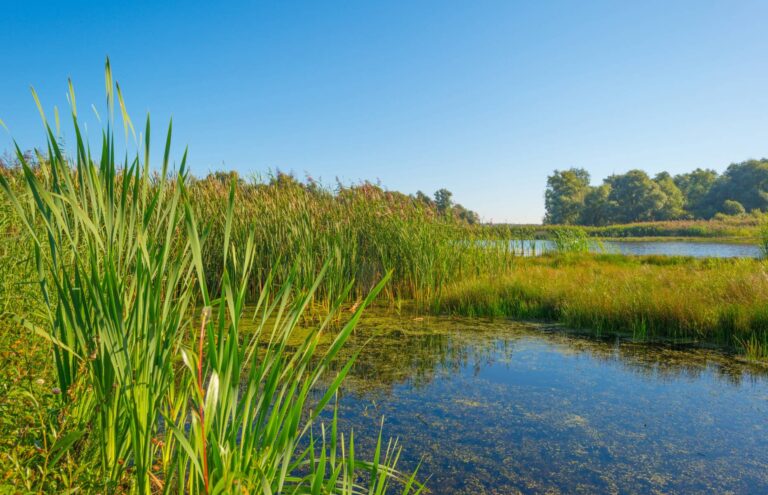
To test their hypothesis, they flooded the western 7-acre plot to a depth of 10 inches and the eastern plot to 22 inches. Tules were planted in a small portion of both plots. By the end of the first growing season, cattails had colonized both plots (the seeds arriving on the wind), which provided a screen for other plants, including duckweed and mosquito fern. Then things really took off. After just a few short years of annual managed flooding, the western plot had developed a dense canopy of marsh plants, as did the eastern plot, though it maintained some open water.
When they took measurements of the soil after seven years, they were amazed to discover that the soil in both plots had risen 10 inches–the result of 15 tons of plant material growing and dying per acre per year.
Good News
“Ten years after flooding,” wrote Miller in a peer-reviewed summation, “elevation gains from organic matter accumulation in areas of emergent marsh vegetation ranged from 1 to 2 feet, with an annual carbon storage rate approximating 1 kg/m2, while areas without emergent vegetation cover showed no significant change in elevation.”
This answered their research question: subsidence could be reversed by returning natural marsh processes to the land.
But the hopeful news was just beginning. The researchers tested the amount of CO2 that had been sequestered in this new soil as a result of their experiment. They suspected that 1 to 2 feet of dense, carbon-rich peat soil likely soaked up a lot of atmospheric CO2 — and they were right. In fact, as much as 25 metric tons per acre per year were sequestered in the study plots, according to their analysis. In comparison, a typical passenger vehicle emits 5 metric tons of CO2 per year. The 14 acres in the study plots sequestered the equivalent emissions of seventy passenger vehicles per year!

According to the scientists, if the entire delta could be turned into carbon farms, the net CO2 effect would be like changing all of California’s SUVs into small hybrids or the equivalent of turning off all residential air conditioners for a year. And that doesn’t even count the CO2 emissions eliminated by not farming the land (conventionally, anyway). And that doesn’t count all the other ecosystem services generated by a functioning marsh, including water purification and wildlife habitat.
The researchers called what they did a “carbon-capture farm” and hoped that the project would demonstrate that it is highly feasible to use managed wetlands to sequester carbon and reduce subsidence simultaneously. Although the specifics of this project are likely limited to the Sacramento-San Joaquin River Delta, it is nonetheless a very good example of a sweet spot. On just 14 acres, the project demonstrated how to reverse subsidence,reduce the risk of levee failure, sequester a lot of carbon, provide wildlife habitat, especially for birds on the Pacific flyway.
The experiment also raised other questions, which the team hoped to answer with a scaled-up project somewhere else in the delta: Is there some way to increase carbon storage in the soil beyond current levels? Could this be a buffer against rising sea levels? What are the total greenhouse gas emissions produced by restored wetlands, including methane and nitrous oxide, and how will this effect the overall goal of net greenhouse gas reduction?
The Project Was Cancelled
“The State of California stopped supporting the research when the budget problems hit,” Miller wrote to me in an e-mail. “Still, while the project was active, much valuable information was gained.”
One question that wasn’t addressed in the research occurred to me as I watched the tanker sail across the farmland on Twitchell Island that day: where’s the economic incentive to “carbon-farm” this land? For all the multiple benefits that restoring the marsh ecology would create, there’s no incentive for a private owner to stop farming here — not yet.
The scientists assumed the answer lay with the creation of a carbon market via a cap-and-trade program, in this case via a law called the California Global Warming Solutions Act of 2006, signed into law by Governor Schwarzenegger, with the goal of reducing California’s greenhouse gas emissions to 1990 levels by 2020. Similar to Australia’s model, the law required California to place a limit (or “cap”) on major emitters of greenhouse gases, such as power plants, fuel refineries, and the transportation sector. These caps will then decline by 3 percent each year. Concurrently, the state will distribute allowances, which are tradable credits, equal to the emissions allowed under the cap. Emitters over the cap must buy credits or otherwise offset their emissions or else face financial penalties. Ideally, market forces will spur technological innovation and investments in clean energy so that emitters can come under the cap and thus sell their allowances.
The farmers on Twitchell Island could benefit by selling offsets they had generated by converting their farmland back to delta marsh and sequestering all that lovely carbon! The linchpin is what scientists call additionality — meaning the carbon added to the soil is new or additive to the carbon already present. It’s this extra carbon that forms the basis of a tradable carbon credit. The key is hard numbers, which Miller and her colleagues had in spades. All that Twitchell Island farmers needed was a marketplace. Right?
Maybe. Many observers remain skeptical of the offset concept. When I first looked into it, I discovered a serious objection: “cap-and-trade” can easily become “cap-and-swindle.” At best, offsets may be illusory; at worst they may be fraudulent, thus imperiling the whole idea.
However, there was nothing illusory about what had happened on Twitchell Island, despite my Lawrence of Arabia moment. That’s why some are touting the demonstration project as a role model for other work, including Stephen Crooks, a San Francisco-based wetland restoration expert. “This is probably the highest sequestration of carbon dioxide you can get in a biological system,” he said in an article. “This is the foremost example of showing how you can restore wetlands and sequester carbon at the same time. We can use what has been learned as a very firm reference to help inform policy development in the United States and overseas.”
If a market could be created for wetland restoration, Crooks went on to say, it would have multiple benefits beyond carbon sequestration, including recreational opportunities for hunting, fishing, and birding created by the restored wildlife habitat, which, incidentally, would be an additional source of income for landowners. In fact, the Twitchell Island project demonstrates that all sorts of possibilities exist when we adjust our lenses to look at the world in a different light.
Starting with just a few acres at a time.

Read more from Grass, Soil, Hope in How Cattle Ranching Can Positively Affect Carbon Absorption.
Reprinted with permission fromGrass, Soil, Hope: A Journey Through Carbon Country by Courtney White and published by Chelsea Green Publishing, 2014. Buy this book in our store: Grass, Soil, Hope.