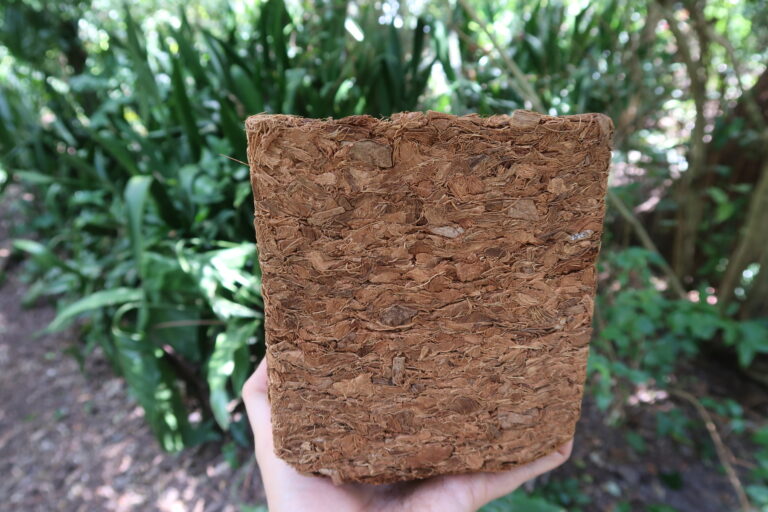
From soil amendment to building materials, when comparing coconut coir vs. peat moss, one goes above and beyond in its ability to create a sustainable world.
With a degree in Global Sustainability and running a carnivorous plant nursery, I questioned the use of coconut coir vs. peat moss. This was especially true during the pandemic when bales of peat moss disappeared off the big box store’s shelves.
In addition to carnivorous plants, gardeners have been using peat moss for a variety of uses, including as a soil amendment for acid-loving plants like blueberries, camellias, azaleas, and tomatoes. Peat moss retains water and is used in many store-bought soil and seed-starter mixes.

Coconut Coir vs. Peat Moss, Which is More Sustainable?

The problem with peat moss is that it is not sustainable in several ways. The first is the habitat peat moss comes from. I love carnivorous plants. I grow them and sell them so other people will love them too. Historically, I would grow many of them in a majority peat mixture because that is what they grow in nature. The hypocritical aspect is that when they extract peat, they destroy the ecosystem and biodiversity the peat was formed in, like bogs and swamps, which often contain wild carnivorous plants like sundews, pitcher plants, butterworts, and bladderworts.
Peat moss captures and stores atmospheric carbon dioxide, which can help reduce climate change. As sphagnum moss dies, the lower parts of the plant accumulate at the bottom of the bog and, over thousands of years, turn into peat. When people extract peat moss to use in a gardening setting, it releases carbon back into the atmosphere. Historically Ireland would dig it up and burn it for fuel which was an immediate loss. It is akin to burning fossil fuels.
A third problem when comparing coconut coir vs. peat moss, is that peat moss extraction dries up the bog. According to researchers from Imperial College London, the bog consists of concentrated carbon from dead plants that can release 100 times the carbon a wildfire does.
Can Coconut Coir Used as an Alternative to Peat Moss?

A garden alternative used a lot in African and Asian countries is coconut coir. In the past few decades, it’s been advertised to the pet reptile industry as a bedding substitute and, more recently, promoted as a peat replacement. One criticism when comparing coconut coir vs. peat moss is that coconuts are grown “on the other side of the world,” while peat can be harvested right here in our Canadian and South American backyards.
“Everything has a cost,” Dr. T.H. Culhane says. “People in the permaculture, renewables, and environmental spaces have somehow been lulled into thinking we can find a holy grail with no downside. Yet there’s going to be a cost to everything from some organisms or person’s perspective. Or some system’s perspective.
Culhane is an Associate Professor at the Patel College of Global Sustainability at the University of South Florida and the Director of the Climate Mitigation and Adaptation concentration.
He says we must ask ourselves three questions: What do we really care about? Which system do we want to benefit the most? And who are we trying to protect?
Coconut Coir vs. Peat Moss is Like Apples and Oranges.

“When you compare coconut coir vs. peat moss, how can you even make those apples and oranges sit in the same basket? They don’t.”
Culhane says we shouldn’t emphasize the fact that it traveled across the earth since we’re a global economy. Just think about the coconut you ate or drank. Or banana. Or smartphone.
While the coconut coir used fossil fuels to transport it on a massive ship from Asia, trucking the peat from Canada to the U.S. also uses fossil fuels. And we’re ignoring that we have coconut plantations worldwide, not just in the Eastern hemisphere.
Culhane adds that many coastlines in the United States could use coconuts to help with storm surges since it’s one of the few crops that will grow in salt water. To learn more about the coconut industry Dr. Culhane referred me to Matthew Grecsek, who also lives in Florida and is working on a strategy where coconuts save the world!
What Else Can Coconut Coir be Used For?

Grecsek is the founder and CEO of Globe-Eco, an agriculture-based, climate-tech business. He owns coconut plantations in the Philippines, and they’re turning that coconut coir into tables, chairs, floors, and walls. They have a process for turning it into a timber replacement to stop deforestation.
“A coconut tree will grow to a certain height, and then it doesn’t grow anymore,” Grecsek says. “All photosynthesis and carbon dioxide removal goes into the fruits which fall off on the ground and turn into waste, or the branches that fall off.”
He says, “Compare that to a regular tree that stores its carbon in the root system, leaves, and stems. As the tree grows, it gets larger and larger. But for coconut trees, they shed their fronds 14 times a year and generally produce fruit twice a year.”
“So, you’re talking about generating a tremendous amount of biomass,” Grecsek says. “This can be raw materials, for building materials, or for planting materials, and there are no other plants on earth that do that.”
Can Coconut Coir Win at Carbon Reduction?

Grecsek’s company is currently contending in the XPRIZE Carbon Removal competition. The goal is to tackle humanity’s biggest threat – fighting climate change and rebalancing Earth’s carbon cycle. The contest is funded by Elon Musk, and the grand prize winner will receive $100 million to further their business or organization.
With the potential of such a large prize, Grecsek is focused on the numbers. “They’re really concerned with two things: how much carbon dioxide is removed from the environment and at what cost.”
Grecsek is shooting for a target of around 30,000 tons of carbon dioxide removed a year. “We’ve spent so much time, literally over 10 years, to learn every aspect of the coconut.”
He says that coconut husks make up about 30% of the weight of a coconut. (The husk is the part you remove before you see the fuzzy brown thing in the middle, which most people recognize as a coconut).
Biochar When Comparing Coconut Coir vs. Peat Moss

“The husk is pretty much universally garbage in coconut countries, as it’s discarded and typically burned,” Grecsek reveals. He estimates around 10 million tons of carbon dioxide go up from burning the coconut husks each year. His company takes those fibers and turns them into a product that is standardized for building materials. The perceived use of these materials should last 100 years which helps Grecsek and his team calculate their carbon removal.
“What’s really interesting is the top four coconut countries represent the top four polluters of ocean plastics,” Grecsek says. “This is amazing because they’re small countries, yet they are the largest sources of ocean plastics in the entire world. We developed a process where we take up to 40% by weight of the coconut fibers and combine it with unrecyclable waste plastic (meaning any kind of waste plastic with labels, with food waste, etc.) and incorporate it into the building material.”
Imagine the impact this would have if those counties started implementing this process. A reduction in carbon emissions and plastic pollution, but also a decrease in deforestation due to sourcing alternative, sustainable building supplies.
Creating Biochar out of Coconut Coir

“We take the excess material we don’t use and create biochar out of it.” Biochar is a good soil enhancement, as it helps create and increase the soil organic matter.”
Like Culhane, in the question of coconut coir vs. peat moss, Grecsek understands that when you drain the bogs, you also disturb a lot of that embedded carbon. “Whereas in the case of the coconut core, it was a waste material anyway. The tree had already sequestered the carbon and turned it into a planting material.”
The first step to go from coconut husk to planting material is to dry out the plant material since it is part of a seed. The moisture content is around 60%, so Grecsek uses a machine that hammers it to remove the moisture. Depending on the process, you can be left with fibers that people typically call coconut coir or larger pieces called coconut chips or mulch.
Regarding sustainability, coconuts, and their byproducts fare much better when you compare coconut coir vs. peat moss.
Coco Soil Mix Recipe
Since coconuts are traditionally grown on the coasts, coconut coir and fibers may be salty. It is recommended that you soak them for 6-12 hours, drain the water, soak them again for 6-12 hours, and then soak them a third time to remove all the excess salt. This is especially true for carnivorous plants, which are sensitive to salinity. Some coconut products for gardening will advertise they have already been tripled-washed.
Vegetable and Ornamental Seed Starting Mix
- 1 part coconut coir
- 1 part perlite
- ½ – 1 part vermiculite
Coconut Coir Potting Mix
- 6 parts coconut coir and compost
- 1 part perlite
- 1 part vermiculite
Freestanding Garden Beds
- 1 part coconut coir
- 3 parts compost / native soil
Carnivorous Plant Mix for Venus Flytraps, Sundews, and Sarracenia pitcher plants
- 1 part coconut coir
- 1 part perlite
- 1 part sand
Carnivorous Plant Mix for Nepenthes pitcher plants
- 1 part coconut chips
- 1 part long fiber sphagnum
- 1 part perlite
Kenny Coogan earned a Master’s Degree in Global Sustainability and has published over 400 articles on pets, livestock, and gardening. He lives on a 1-acre homestead with chickens and ducks, managing a permaculture-style landscape. Coogan also runs a successful carnivorous plant nursery in Tampa. Listen to Coogan co-host the Mother Earth News and Friends Podcast by visiting motherearthnews.com/podcast.