

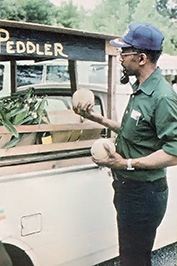
My friend Carol Lea and I didn’t go near a garden all last
summer, yet we netted nearly $35 a day selling produce. Our
source of fresh fruits and vegetables was a farmers’ market
in Knoxville, Tennessee. We’d simply make a 40-minute
“produce run” from our home base in Pigeon Forge each day, carefully select our purchases, load up our
just-the-right-size mini-pickup, and head back to the
mountains.
An Occasional Enterprise
We operated our peddling venture in an on-again-off-again
manner for most of the summer, since heavy rains frequently
put a damper on our business for days at a time. However,
the fact that our enterprise allowed us to work at our own
convenience–and still do fairly well–far overshadowed
the occasional uncertainty of the operation.
The longest period during which we were able to “run the
roads” on a daily basis was a 20 day rainless stretch during
the month of July. In the course of that dry spell–while we
were peddling only one not-really-full truckload each
trip–our average net per day came to $34.31, adding up to a
total 20-day profit of $686.20. We actually brought in
$1,633.85, but spent $808.23 for merchandise to resell,
$66.80 for gasoline for the truck, and $72.62 for
miscellaneous expenses, including ice and paper bags.
Furthermore, our earnings would have been greater if we
hadn’t taken a long weekend off over the 4th of July, which
would certainly have been the most productive four days of
the whole summer.
The amount of fresh food we procured varied: Our smallest
daily load cost $32, and the largest set us back $85.75. Of
course, some items didn’t have to be sold on the
first or even on the second day. Jars of honey, for
instance, were slow movers but good keepers, since we
didn’t have to worry about spoilage.
A Typical Day’s Purchase
On an average day, our shopping list might look something
like this:
15 watermelons @$1 ea          $15.00
30 cantaloupes @35¢ ea         $10.50
1 bushel of peaches             $5.00
1 bushel of tomatoes           $10.00
5 dozen ears of corn $1/dozen   $5.00
                              -------
                               $45.50
Another day, of course, we might want to try plums instead
of peaches (on occasion we couldn’t find any peaches, but
plums would be plentiful), or we might decide to buy white
seedless grapes or nectarines instead, especially if we had
some peaches or plums left over from the previous day’s
sales. Whatever items we bought, though, we always tried to
keep an interesting variety on hand and aimed to
stock only food that would make people want to yank the
yummies right off our truck and pop them into their mouths!
As you’d imagine, time often limited the quantity of goods
we could handle in a day. When the Pigeon Forge tourist
season was in full swing, we were simply unable to hit each
campground on a daily basis. In fact, during the height of
the season, when most of the 1,469 drive-in spaces in
the area were occupied, it would sometimes take us up to
two hours just to work our way through one campground because we spent
many minutes talking, reloading, and so forth in addition to actual selling time.
We discovered that late afternoon from 3:00 p.m. until
dark was the best time to catch people at their
“homes away from home.” We were sometimes able to cover
only two campgrounds within those hours, but the hungry
hordes in just one or two areas would often descend on our
offerings with a vengeance and leave our pockets full and
our truck all but empty (not that we minded, you
understand). In such cases we’d simply have to wait until
the next day to buy a fresh load.
An Ulterior Motive
Actually, our produce business was originally intended to
be nothing more than a means of letting travelers through
the foothills of the Great Smokies know about our shop,
Tennessee’s Mountain Peddler, where we market
country-smoked ham, sausage, bacon, cheese, and craft items
(and whose name we displayed prominently on the produce
truck).
Because we were already in business, we were a jump ahead
of most folks who might want to try a venture of this sort.
All the legalities and technicalities–such as securing city
and county licenses, and learning about liability insurance
and sales tax requirements in our state–had long ago been
dealt with.
Of course, there was still plenty of start-up work to be
done. We had to visit the campground owners and managers,
for instance to tell them of our plans and obtain
permission to pass through their property in order to sell
to their customers.
Most of the business folks were delighted with our idea. In
fact, they looked on it as a service they could provide to
summer campers. None of “our” owners ever charged us a fee
or commission, although they certainly appreciated the
few tomatoes, plums, or whatever that we’d leave for their
use when we started our rounds. We found that dropping by
with such gifts was a good way to say “thank you,” since
most of the campground managers were too busy to do much
personal shopping.
Getting Outfitted
Besides obtaining permission from the owners to sell in
their campgrounds, we had to gather some equipment before
starting our business. Our first necessity was a set of
scales. Fortunately, my partner’s dad had an extra, which
he let us borrow. Had we marketed only things we could sell
on a “per item” basis, we wouldn’t have needed scales.
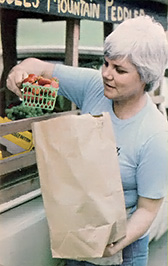
Since we were going to be “per-pounding” most of the
produce, however, we had to have some means of weighing it.
Our decision to sell by the pound also dictated a need for
paper bags. At first we simply bought lunch bags in sets of
100 at the local supermarket, but that source turned
out to be unnecessarily expensive. The sacks cost about
98¢ for 100, compared to the $4.00 for 500 of the same
size that we eventually learned could be purchased from a
paper manufacturing company located in the same part of
town as the farmers’ market. We wound up using two sizes:
No. 6 (holding about six pounds) for most items and No. 16
(16-pound capacity) for the larger produce, such as
cantaloupes or ears of corn.
And, let’s face it, whenever you’re selling anything you
have to be able to make change … but nobody wants to
lug around a cashbox or cash register on a truck (or shell
out the extra loot to buy one, either). We found that a
carpenter’s cloth nail bag (it cost $1.55 at our hardware
store) worked just fine for us. The sack allowed us to keep
change at our fingertips by simply tying on the apron and
stashing our cash in the pouches. ( We usually started out
each day with enough paper money to change a $20 bill, plus
$10 worth of coins.)
On our first few produce-purchasing rounds we had to buy
bushel containers along with the fruits and
vegetables, usually for 55¢ per basket. After that, we
simply swapped the containers when we went for more goods.
However, we did buy four half-bushel-baskets at our local
grocery store for 99¢ each because the smaller
containers fit on the side shelves of the truck. Our
bushels were then used to store additional goodies in the
truckbed, which were kept available to restock our
displays.
A Cover Story
Not long after we started our business, we found ourselves
forced to come up with a cover for the back of the pickup. Since our cash was
limited, and since we lacked the time we thought would be
needed to search out someone able to do (inexpensively) the
carpentry the job would require, Carol Lea and I originally just loaded up the
vehicle and made do with the tops from cardboard cartons–or whatever other temporary shelter we could fashion–to
help protect all our “tender vittles.”
We soon found out that, even so, a hot summer sun would
speed our products’ demise, and we decided a “cover-up” was
essential. Luckily for us, though, another of my partner’s
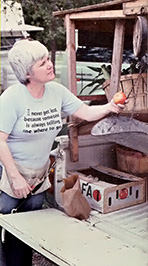
relatives came to our rescue. Before we knew it, we had a
homemade $50 “truck shed” with a roof that protected our
produce from the elements and outwardly tilted
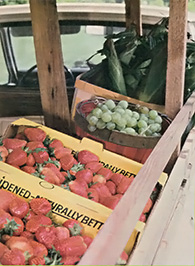
shelves that provided a marvelous way to show off our goods
as we meandered along the campground roads.
But even though the campers could see our displayed
produce, we always made a point of “hawking our wares” to
anyone we saw as we drove through, calling out
something like, “Need any tomatoes, cantaloupe, corn, or
watermelon today?” (People are sometimes a little shy about
being the first ones in line, but we found that if just one
brave soul stopped us, we’d soon be surrounded by other
people … including some who’d already answered “no” to
our inquiry!)
It’s All in the Buying
Experience, they say, is the best teacher, and our first
summer taught us the importance of buying the right things
at the right time at the right price. In order to do so, of
course, we first had to give thought to the campers who’d
be our customers.
Most of the summertime road people are unable or unwilling
to take much food with them. In fact, the majority of
the folks we encountered told us they’d set out with no
more than enough eatables to last a couple of days. The
average camper doesn’t have much space for perishable
items, since traveling food storage is usually limited to
an apartment-sized refrigerator or frequently just a picnic
cooler. And even though most campgrounds do make some
“staples” available (milk, bread, etc.), not many sell
fresh produce.
What’s more, vacation time is adventure time for many
people, and part of the excitement consists of the chance
to try regional foods, including homegrown fruit and
vegetables or items the visited area is well known for, such as a local variety of honey.
For all these reasons, then, most of the camping public
welcomed us when we pulled up, our truck loaded with almost
anything we figured folks could eat with little or no
preparation: peaches, grapes, bananas, apples, plums,
nectarines, cantaloupes, watermelons, tomatoes, corn, and
onions. (In our experience, such comestibles as cucumbers,
green peppers, beans, and okra would sell, but we were
never able to move them quickly enough to prevent our
losing money through spoilage.)
The Bigger the Better
In most cases, the larger our offerings were, the more cash
people were ready to hand over in order to sample the
goods. However, the rule didn’t hold true for watermelons.
Oversized melons are impressive, all right, but smaller
ones sold much better: Again, most campers simply don’t
have enough space to store or to cool even a medium-sized
melon. In addition, the fact that we could offer the
smaller beauties already chilled–in a
used-but-not-abused 52-gallon wooden whiskey barrel that we
cut in half and transformed into two of the dandiest melon
and ice toters you’ve ever seen–insured that the
little globes would be good sellers.
Bargain and Beware
Since one of the secrets of successful produce marketing is
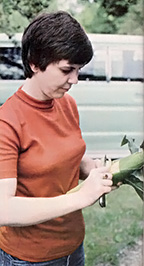
careful buying, we made a point of being picky,
inspecting every potential purchase with an eagle eye. Did
the fruit–we would ask ourselves–have a good
color? Was it firm, yet ripe enough to be eaten on that day
or the next? Or was it too ripe to permit much
handling? And, of course, we always had to determine if it
was the very best quality we could find on that
particular day and for the money we could spend.
Furthermore, we quickly learned the value of dickering on
price. The sellers could always say no, but bargaining
often left more money in our pockets.
It didn’t take us long, either, to discover the need for
caution when dealing with folks we didn’t know. We found
that most people we bought produce from were honest, but
there were a few tricks we had to learn to watch out for.
One favored technique, often
used when packing peaches, tomatoes, and apples that are to
be sold by the bushel, is “topping.” In this deceptive game, the bottom
of the basket is filled with some really pretty fruit, the
middle is loaded with poor specimens, and the best are
saved for last … to be placed right on top where the
buyer can’t miss ’em.
Even when the potential purchase is poured from the
seller’s basket into the buyer’s right before his or her
eyes, topping will be hard to spot because the carefully
selected bottom layer will then wind up on top. We learned
about such deception the hard way. Innocents that we were,
we bought one lovely-looking bushel of peaches without
checking “beneath the surface,” and–sure enough–those
in the center were cut and bruised so badly that we ended
up giving most of them away.
What to Charge
During the first weeks of our venture, we’d check the
grocery store prices daily, and try to sell our produce
for a little less than such outfits charged. However, we
soon found that this was unnecessary, as our customers
would let us know if we were overpricing or underpricing
anything: They simply didn’t buy at all, or they’d buy like
crazy! Whenever either happened, we knew that we had to
make some immediate adjustments (usually by 10¢ per
pound up or down).
In most cases, our policy was to double our money on those
items we sold by the pound and add a $1.00 markup on
per-unit goods such as watermelon or honey. And even though
we paid maybe 350¢ each for cantaloupes, we were able
to sell them for two different prices: usually
75¢ for small ones and $1.00 for bigger ones.
The largest profit percentage we ever earned on one
purchase was made during July at a time when most northern
Tennessee home gardens weren’t yet producing. Vine-grown
tomatoes were very much in demand, and we were able to buy
one 60-pound bushel of trucked-in “culls” for $5.00. (A
canning company had rejected them as “imperfect” because of
their markings.) We sold the bushel at 60¢ a pound
(which was less than the going retail rate at the time) and
cleared $31 on that one basket!
Much of the time, however, our prices would be determined
by the condition of our merchandise. The riper the fruits
and vegetables became, the lower we’d mark them. But, even
when items had gone beyond the selling point, they were
usually plenty good enough to eat. If use couldn’t use the
overripes, we always tried to find someone (family or
friends) who could. Actually, the fact that we were able to
enjoy “first pick” as well as “last call” on all our
produce proved to be a fine little side benefit …
especially since we’d purchased the goods at bulk-buying
prices!
At Summer’s End
As we looked back over that summer, we found that our
peddling venture had accomplished even more than we’d
initially hoped for. We were able to give our shop some
much-needed publicity through very personal contact with
people who would otherwise have been difficult to reach and
impress. We know we made more shop sales as a direct result
of seeking out the campers, since such customers would
often tell us that they’d seen our truck or had bought a
watermelon (or what have you) from us.
Best of all, instead of paying out $600 or more for the
kind of advertising that would have brought us to the
attention of a like number of people, we were able to bring
in well over that amount of cash, and still get the job
done. (We loved having our cake and eating it too! )
Besides that, we know we’ve stumbled on a good way to bring
in a little extra cash during the summer, regardless of
whatever else we might do or wherever else we might be. The
long holiday weekends–those that include Memorial Day, July
4th, and Labor Day–could be ideal targets for even
part-time campground produce peddlers … and, if you
grow your own eatables, your profits could be even bigger
than ours were!






