


Human households have contained domestic animals for thousands of
years. At present, no less than 61% of U.S. households have
animals, and more than half have more than one animal. The
popular literature has extolled the beneficial consequences
of contact with animals for human health. During the past
decade, television, radio, and the print media have
discussed the value pets have in lowering blood pressure,
providing aging folks with constant companionship,
improving survival after a heart attack, and making people
of all ages feel brighter and less lonely. Various studies
have demonstrated that household pets are perceived to be
family members.
Given these facts, it’s almost impossible to believe that
in 1990 alone, about 10 million dogs and 8 million cats
were euthanized in animal shelters across the United
States. And think of all the pets that have perished on the
streets without becoming a statistic. Unwanted behavior was
the number one cause for premature death of three-fourths
of these animals. Only 12% of them were euthanized because
of disease or old age. Most dogs and cats become unwanted
and homeless when owners can no longer cope with pet behavior
problems–behavior that is no longer acceptable to
owners, neighbors, or society.
These sad statistics are why behavior management is fast
becoming an extremely important function and responsibility
of veterinarians. As important as it is to vaccinate,
neuter, spay, and manage kidney and heart disease in today’s pets, it’s just as important that veterinarians
consider their responsibility to help clients and their
pets deal with unwanted and unacceptable behavior. In
fact, veterinary hospitals are often the first place to
seek counseling for behavior problems in pets because of
the importance in ruling out primary or secondary medical
problems that may be the root of the unwanted behavior.
Some examples of natural behaviors of dogs and cats that
are often unacceptable to people are chasing, biting,
growling, and other forms of aggression, marking with
urine, pulling at collars, territorial aggression, barking,
jumping, roaming, and digging.
The first generality in dealing with truly troublesome
behavior problems is this: Seek veterinary help first! I
can’t tell you the number of animals I’ve seen with medical
problems that actually cause unwanted behaviors. My
favorite example is the family who brings in their ancient
feline companion for euthanasia because “she’s been
urinating outside the litter box all week and she’s old
anyway.” Upon further questioning, it becomes apparent that
the cat actually has a cystitis, or bladder infection,
confirmed by a simple urine analysis, common in older
patients, and treatable with appropriate nutritional
counseling and antibiotic therapy.
The second generality is to be patient, especially with
young puppies and kittens, and with the geriatric animals
(these days considered to be any dog or cat over nine years
of age). Raising a puppy or kitten is similar to raising a
small child. Time and perseverance, which in our hectic
daily lives can be hard to come by, are of utmost
importance. Youngsters are not going to learn new behaviors
within a week or two; some may take a month or more.
Repetition is also a key.
You, as a parent, must think through all aspects of the
situation that may result in the unwanted behavior, and
then either avoid these or change certain aspects. It may
be helpful to arrange a time to speak to your veterinarian
to devise a program that analyzes and modifies the way you,
the owner, reacts to the behavior. For instance, is it the
older dog who’s at fault for chronically jumping on the
couch, or you for moving to another couch and avoiding him
every time he jumps?
Physical punishment of any behavior, especially aggressive
behavior, is counterproductive, as it usually leads not
only to fear and bodily harm, but a significant aggressive
response from the pet. Positive reinforcement is not only
conducive to long-term learning, but helps bond the animal
to the owner, relaying a sense of trust and understanding,
instead of intimidation and frustration.
Horse Diarrhea
Dear Andrea:
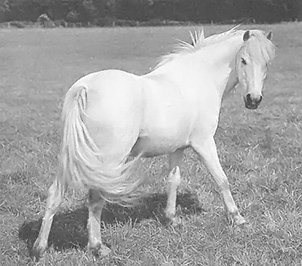
I have a quarter horse that has been suffering from
diarrhea for the last six months. A local horse doctor
suggested giving him wheat bran; an animal magazine
recommended brewer’s yeast; and my small-animal vet
suggested yogurt. All of these suggestions helped, but the
diarrhea inevitably returned. I feed the horse “Target”
feed and timothy hay. Please help.
Walter Nickel
Severn, Maryland
Dear Walter:
First off, look around and check if the other horses on the
farm are also abnormally thin or suffering from diarrhea.
If so, nutrition and/or parasites may be the problem.
Examine the quality of the feeds. Most horses will maintain
weight without gastrointestinal problems on 4-8 lb/day of a
fresh grain and 8-10 lbs./day of a high-quality grass hay.
Examine your management. Are there any routine farming
changes (time of haying, freezing of water, entry of other
animals into pasture) that might correlate with the onset
of the problem? Winter months are times when problems may
most likely be a true individual medical, versus
management, disease.
Feed the horse and observe it eating. If the animal has
difficulty chewing, drops grain, or throws its head while
chewing, your veterinarian may need to check the animal’s
teeth for sharp points, which could contribute to
maldigestion and diarrhea. However, chronic diarrhea in the
horse is most commonly attributed to parasites.
Specifically, Stongyles may invade the lining and
arteries of the large and small intestines. Many of these
parasites can also encyst in one area of the large colon,
causing severe malabsorption of water and consequent
diarrhea. Your veterinarian can prescribe a proper rotating
anthelmintic (antiparasitic) program appropriate for your
farm.
Some other more serious problems may result in chronic
diarrhea, such as an inflammation of the colon with micro
abscesses (granulomas) or tumor cells (lymphomas). Various
bacteria (Salmonella, Clostridium) are also
capable of causing diarrhea. Impactions of different areas
of the horse’s large intestine, particularly the cecum or
fermenting chamber, may result in colic or severe abdominal
pain, and in diarrhea. Your veterinarian can perform a
thorough physical and rectal exam to help determine if any
of these conditions are present. A parasite count or
bacterial culture of the manure can check for infectious
agents.
In an older animal, some routine blood chemistry profiles
can be run to check for liver or kidney disease, both of
which can contribute to diarrhea. I would suggest a
thorough exam and a few of these simple, inexpensive tests
before choosing feed additives or arbitrary remedies to
resolve this gastrointestinal problem.
Dog Chewing
Dear Andrea:
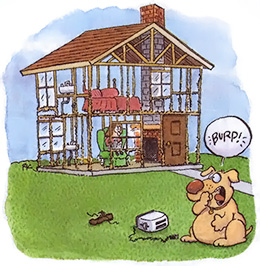
We recently bought a six-month-old Labrador retriever for
our young son to grow with. She’s now chewing the house to
shreds, from carpets to curtains to slippers to shoes.
HELP!
Louise Palmer
Binghamton, New York
Dear Louise:
Chewing is a normal canine behavior. Dogs use their mouths
like we use our hands for grasping food, gaining
information about the environment, relieving boredom, and
reducing tension. Chewing is also an important adaptive
behavior that protects the animal from entrapment. Besides
all this, for puppies at least, it appears to be great fun.
However, chewing becomes an unwanted act in a domestic
environment, especially when a valued object is damaged.
There are many reasons why dogs chew. Some are quite
obvious, such as the gingival irritation that motivates a
teething puppy. Your dog should have most if not all of its
permanent teeth in by six months of age, so I would
anticipate that this is not her problem. Certain dogs chew
aggressively because it invites attention from the owner,
like a tug-of-war game. Think about it for a minute: Can we
really expect a puppy to differentiate between a towel used
to tease it into play and curtains fluttering in the
breeze?
Anxiety is a leading cause of destructive chewing by adult
dogs. People bite their nails, smoke, and drink. Dogs
vocalize, pace, and chew. In most cases, chewing damage due
to this type of anxiety occurs when the owner is not at
home or is unavailable to the pet.
Phobias, such as fear of thunder or other loud noises, can
result in destructive chewing. Doors, window trim, and
walls often become the targets of chewing. Inappropriate
punishment methods, especially delayed or very harsh
punishment, can trigger problems. Delayed feeding can also
result in chewing problems, as the hungry dog explores the
house using its mouth to try to open doors and containers
in search of food. Boredom, lack of stimulation, and social
isolation can also contribute to destructive chewing
behavior.
First, rule out any gastrointestinal or teething problems
your pup may have by taking it to your veterinarian. Upper
gastrointestinal (GI) irritations, such as gastritis or
esophagitis may lead to destructive chewing. All too
commonly, young animals are affected by parasitism that may
cause simple GI upset and reflex chewing.
It’s difficult to pinpoint the cause of chewing in your
pup, but I suspect that it may be related to age, a high
level of energy, and possibly a need for social interaction
or attention. You may be promoting the chewing behavior by
actions you are not even aware of, such as throwing laundry
on the floor, opening the curtains in front of the dog,
etc. Try to analyze when the dog chews. It may be helpful to
keep a diary listing occurrences of chewing and relative
information to pinpoint the causes that initiate the
behavior.
Direct the dog’s chewing toward appropriate objects, such
as specific toys. You can even smear the toys with a piece
of cheese, some peanut butter, or gravy to encourage
chewing of them. The important thing is to never take
proper chewing for granted. Every time the dog’s mouth
touches the toy, it should receive praise or reward.
At the same time that you promote this desirable chewing,
discourage unacceptable chewing by spreading cayenne
pepper, mixed with a small amount of petroleum jelly, or
oil of citronella, on a piece of wood, a scrap of carpet,
or an old shoe. If the dog has a habit of chewing clothing,
try to put it out of reach on a regular basis. Every day,
try moving the offending items to a new area in the house
(confusion in itself is a deterrent). Hide booby traps
(such as balloons or a stack of beverage cans containing
coins) near the items you’d like to discourage chewing on.
Mousetraps set in an upside-down position are also very
effective. Leave the chew toys readily available during
these processes and place the emphasis on
positive-reinforcement training. Use the chew toys to play
with the pup, teach it to fetch, and always associate their
use with praise and reward.
If daytime boredom seems to cause the chewing, try leaving
the radio on during the day, or crate train the animal.
Teaching a puppy to stay crated for progressively longer
periods of time not only teaches it respect for its
environment (the crate) but also may allow you to retain
some of your valuables!
Dog Food Guarding
Dear Andrea:
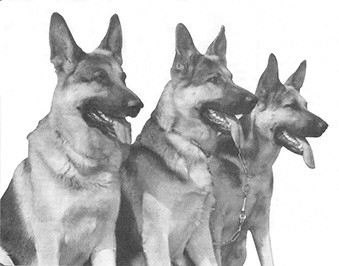
Our six-year-old German shepherd has become very protective
of his food bowl recently. We have a baby in the house and
are afraid that one day the baby will wander too close to
his bowl and get bitten. Can we train him at this age?
Anne Marie Baker
Minneapolis, Minnesota
Dear Anne Marie:
Food guarding is a common behavioral problem that may be
linked to a syndrome in dogs known as dominance-aggression.
Owners are almost always unaware that control of food is a
critical aspect of the social relations among dogs. For
instance, it is not uncommon to learn that when the dog was
young, it growled anytime it was approached while eating.
The owners believed that the puppy was afraid its food
would be taken away and wanted to reassure it that they
were friendly, so they left it in peace. The consequence
was that the dog learned it simply had to threaten people
to drive them away from food. Dogs with this syndrome
commonly growl at people who approach their favorite
resting area, such as a pillow or couch. Again, family
members may have fostered this behavior by assuming that
the dog should not be disturbed when resting, even if this
meant giving up their own favorite couch.
Again, I would suggest first seeking the care and
consultation of a veterinarian to make sure the dog isn’t
experiencing pain or having difficulty eating. Tooth
abscesses, fractures, or oral infections may cause
aggression associated with eating. Even eye and ear
problems may initiate an angry response around feeding
time. Many gastrointestinal problems, such as parasites,
food intolerance, or maldigestion may also cause displaced
aggression. Your veterinarian is able to examine your pet
for these things, and could do so via a simple physical
exam.
If the patient is an intact male, castration may make the
dog less aggressive, but I think that this is more helpful
in younger animals. It may also be detrimental to stress
the pet with surgery and hospitalization at a time in his
life when he is already confused by the arrival of a new
baby.
Because dogs with this syndrome have the potential to
severely injure people, the decision to attempt treatment
must be made carefully. It may be beneficial for you to
separate the child from the dog entirely, which could cause
further separation anxiety, but may be necessary for the
safety of the baby. It’s one thing to modify the behavior
of a 5-pound poodle who hoards clothing, but a different
situation completely to deal with a 100-pound shepherd who
may become unmanageably aggressive.
Let’s examine your behavior around feeding time. Do you
place the food down fearfully and fast? Does the dog take
command of the situation by barking for the meal or begging
and is then rewarded by being fed? Try placing the food
down first and then allowing the dog to enter the room, so
he associates few acts of yours with the actual feeding;
hence, he will have less to focus his aggression on.
Some veterinary behavior specialists have advocated
teaching the dog to assume a “down position” to reduce its
dominance and aggressive tendencies. Since any physical
manipulation of an aggressive animal may accentuate its
aggressive tendencies, the dog is taught to eat from a
submissive position (laying on its chest, elbows, and
hocks) by progressive, yet positive, reinforcement. With
the dog sitting, the food is held so that the dog must
lower its head slightly to obtain the reward. The owner
should say “down” and give the food reward when the dog
lowers its head. Over time, the owner requires the dog to
lower itself more and more in order to receive its food.
Eventually the dog must lie down to receive the food. In
such a position, few dogs will feel inclined to become
dominant. The dog should also be required to exhibit this
acceptable, submissive behavior before being fed, let out,
or petted: This will encourage future submissive behavior
and eventually stop the animal from growling near its food.
Certain spontaneous growling is initiated by the owner
staring at the pet, standing over its shoulders, or behind
its back while it is being fed. Think of your actions
during the entire feeding regimen and analyze the baby’s
presence during the meal. Don’t forget to offer the dog
plenty of care and compassion, such as grooming, exercise,
and attention independent of the child at first and then
slowly (and always supervised) with the child. Make sure
the dog knows that even though there’s a new baby in the
house, you haven’t forgotten who deserves the milk bones!
Some great behavior books to help with dog problems are:
How To Be Your Dog’s Best Friend, (1978, Little, Brown
& Co, Boston, MA) by the Monks of New Skete.
Good Manners for the Modern Dog, (1990, Perfect Paws, San
Francisco, CA) by Gwen Bohnenkamp.






