

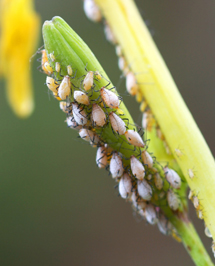
Here’s a rundown on insect infestations that have bugged my greenhouse.
(In general, insect problems are worst in midwinter when I
can’t vent as much as I should.)
Solving Solar Greenhouse Insect Infestations
Whiteflies are notorious pests. For best
control, trap them on yellow cards or boards coated with
something sticky like Vaseline or Tanglefoot. (Whiteflies
are attracted to the color yellow.) I buy Sticky
Strips — gooey-surfaced pieces of plastic — from a
greenhouse supplier and poke them into the soil around my
plants.
When whiteflies badly infested my cucumber and Chinese
cabbage vines, I achieved fairly good control by spraying
them with Safer’s insecticidal soap. (Other gardeners use
Basic H or mild household soap.) Test the solution on a
single plant first to be sure your crop isn’t sensitive to
it. Because whitefly eggs hatch 10 days after they’re laid,
apply the soap every 7 to 10 days for several weeks to
control succeeding generations.
Phosphorus or magnesium soil deficiencies can promote
whitefly infestations. Apply wood ashes or bonemeal to add
phosphorus, and dolomite limestone for magnesium.
Aphids are less active than whiteflies,
but just as damaging. They often attack plants dosed with
too much nitrogen. If you overdo the manure tea, dig in
some sawdust; as it rots, it’ll absorb some of the excess
N. (Don’t use cedar, walnut, or redwood sawdust — these
contain plant toxins.) Soap sprays kill aphids, but also
harm beneficial insects. For a safer treatment, hose the
soft-bodied pests off your plants. Immature ladybugs (you
can buy them by mail) gorge on aphids. According to Doc
Abraham, daddy longleg spiders eat aphids and other insect
larvae.
Spider mites bother plants, such as
ornamentals, that are shifted from house to greenhouse.
Infested plants may have mottled foliage and a skimpy,
delicate webbing among their leaves. Since the mites like a
hot, dry climate, your best defense is to mist and
ventilate the greenhouse. During severe insect infestations, try
swabbing the leaves (undersides, too) with a half-and-half
mixture of water and rubbing alcohol. Test it first,
though, to be sure it won’t harm your plants. To help
prevent the problem, be sure to supply your soil with
calcium (limestone or crushed eggshells will do the trick).
Pillbugs are among the most annoying
uninvited residents. These small, grey, oval, many-legged,
segmented crustaceans — which roll into a ball when
disturbed — feed on plant debris and hide under boards
and in crevices . . . to emerge when you’re not looking and
feed on roots and young seedlings. To prevent infestation,
remove fallen leaves, plant flats, and other hiding places
from the surface of the growing bed. I’ve also trapped
pillbugs under potato pieces, apple peelings, and
grapefruit and cantaloupe rinds.
Handpicking even a few pillbugs on a daily basis helps
lower their numbers. I have no illusion that my greenhouse
will ever be free of them (and they do help break down
plant debris); I’ll be satisfied if I can just keep them
from destroying my seedlings. I often protect valuable new
seedlings — like greenhouse cucumbers — by dusting
around them with diatomaceous earth.
While pillbugs nibble on seedlings and young plants,
another invader takes leaf pieces from older plants as
well. If you spot such evidence — and a telltale trail
of dried mucus — take a midnight safari into your
greenhouse with a flashlight. I bet you’ll find
slugs, happy in all that damp lushness.
You can trap slugs as you do pillbugs, and also spread wood
ashes or diatomaceous earth to irritate their soft bodies.
But I just visit the greenhouse several hours after first
dark, armed with a thick glove, a can, and a flashlight. If
I handpick the slugs for 7 to 10 days, their numbers drop
steadily. (My biggest haul was 50 in one raid!)






