

When the first frost hit, Joy and I were almost ready. The
garden was completely mulched, the tomatoes were covered,
the hoses were all properly stored, and I felt quite
confident that Jack Frost could go sit on a zucchini.
Unfortunately we left a few house plants outdoors–umbrella
trees, elephant-ear begonias, lacy-leafed ferns with long
Latin names–on which the Ice Man took his revenge. Some of
the plants are quite delicate–alive even in full
bloom–and will grow only as a favor to people with
green thumbs, like my wife.
“These guys will come back,” Joy said, bringing the
lifeless sticks inside. Back then, I wondered if she had
even noticed how stupendously dead they were. Still, Joy
has proved that if a gardener is good enough, even death
cannot kill them. It’s not that the plants would have been
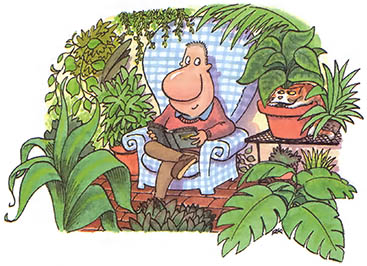
missed. A solarium, an indoor greenhouse, runs the full length of our kitchen, and
Joy does not let it lie fallow. Our year-round plant
population numbers in the high hundreds, reproducing like
rabbits and cross-pollinating each other on window sills
and shelves. Surrounded by green, we sit in front of the
stove for six months, sipping hot chocolate and plotting
new gardens.
Tarzan would feel at ease in our house. Ficus
benjamina, the weeping fig that spent all summer on
the porch, now grows high in a thicket around my desk, a
migrating Birnam Wood like the one that bugged Macbeth.
Dieffenbachia trees, notably one big-eared
Amoena, read over my shoulder. Outside, all is
deader than a frosted doorknob, but here in our winter
greenhouse, the stove fire roars and crackles, happy for
the extra oxygen.
Human brains feel much the same. Take mine, for instance. I
may lurch through the summer in a haze of physical labor,
but in winter my brain is soaked in oxygen. My life is
immersed in great blocks of free time to think and think.
And think. I call this phenomenon “The Greenhouse Effect.”
Oregon pioneers called it “cabin fever.” These early
settlers (who never exactly glowed with good health) sat
inside from October to June with virtually no sunlight or
fresh air. Sometimes their windows were the bottoms of
whiskey bottles (obtained by emptying the contents). Other
times, in desperation, they’d hatchet a hole in the wall to
let a little light into their moss-festered lives. But, of
course, a plain hole turns out to have an R-factor of zero,
which can leave a house and body mighty darn cold.
To give you an idea of just how dismal housing actually was
back then, remember that pioneer cats voluntarily chose to
live out in the barn. And you can’t argue with a cat’s good
sense. Indeed, the Oregon domestic house cat moved indoors
only when conditions there were pleasant enough to support
plant life.
Speaking of cats, I suddenly spy Boomer, our 15-pound
orange cat who gets by on a spoonful of brains and a gallon
of apathy. His rotund body is emerging from a leafy glen at
the base of an aggressive Dracaena. My fingers
scamper to the end of the armchair and jump, plopping like
a spider onto his furry cat shoulders. Boomer does a
passable back flip from a lay and sinks his sharp fangs
directly into his enemy: The Hand That Feeds Him.
He seizes my forearm in his paws and starts to rowel it to
bloody ribbons, but I slide the other hand up behind his
head into a cat nelson that he can’t scrape off. His look
explains that he expected this sort of dirty monkey cheat,
and he twists free with a grunt, taking a swing with fully
deployed claws that lacerate my thumb. He bounces away, and
the jungle swallows him once more.
Thumb gushing, I stare at the swaying underbrush where our
bookcase used to be. No doubt about it: We’ve all been
cooped up inside for way too long. Thank God we have this
jungle to keep us sane ‘tit spring.






