

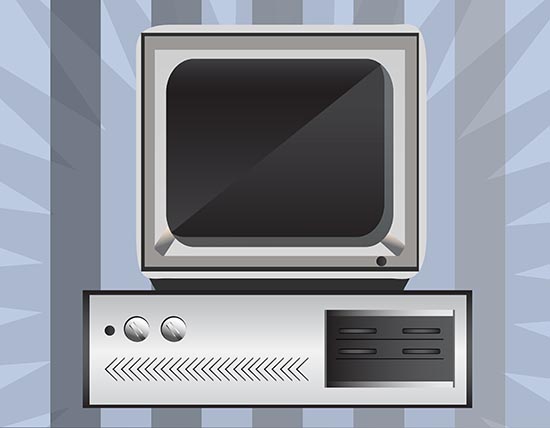
Radio amateurs, like many other people these days, are buying home computers. And regardless of how many additional uses he or she might plan for the machine, a ham purchaser almost always wants it to be part of a system of communication.
In theory at least, personal computers and ham rigs can be interconnected, and the combination can then be used to transmit and receive text by radio. Three types of codes are commonly employed for these transmissions: ASCII (standard computer keyboard code), Baudot (normal teleprinter code), and Morse (dots and dashes).
However, in this case, what seems to be simple in principle turns out to be not so easy in practice. For one thing, obtaining all the necessary bits and pieces of equipment — and integrating them into a smoothly functioning system — requires knowledge and patience. In fact, during the past few months, I’ve received a number of inquiries from hams who’ve tried to accomplish such a “marriage” but have been frustrated by the lack of information on how to go about it.
Well, if you already have a ham radio transceiver and a home computer, you have two of the four elements needed to create a working system. The third component is a piece of interface hardware called a modem (short for modulator/demodulator). This unit functions as a kind of translator, converting the 1’s and 0’s of computer language into the changing audio tones of radio language and vice versa. Finally, you’ll require the appropriate software. Just as a home computer needs game software to play games and accounting software to do bookkeeping, it will also need communication software in order to communicate. The overall problem is further complicated by the fact that there are many different makes and models of home computers … each with its own peculiarities!
If you want to build your own hardware and write your own software, I’d suggest that you take a look at back issues of ham magazines such as CQ, QST, 73, and Ham Radio. You might find an article that addresses your particular situation. Otherwise, you’ll have to go out and buy the parts you’ll need.
Again, before you purchase a modem and software, check out the ads in those same magazines. I recently did this and was drawn to a particularly interesting and reasonably priced hardware/software combination offered by Kantronics. The firm calls its modem The Interface, and its software Hamsoft. The Interface has a suggested retail price of $189.95 (though you can get it for less at some dealers). Hamsoft is priced at $30 to $75, depending on the make of computer it serves. Clearly, the folks at Kantronics have done their homework. They offer plug-in software modules (or diskettes) for most of the popular home computers: Apple II, Apple II Plus, TRS-80 Color Computer, Atari 400, Atari 800, Commodore 64, VIC-20, and Texas Instruments 9914A. Write to Kantronics for a catalog, dealer list, and full technical details.
NDR Net News
Gene McGahey (N5DDV) is coordinating a new Central States NDR Net. It meets Mondays, Wednesdays, and Fridays at 6:00 a.m. Central Time on 3862.5 kHz. Hams in the Midwest have been asking for just this kind of regional net, and here it is, folks … so let’s use it!
Sunspot activity and short days disrupted operations on the Transcontinental Net last winter. Things should be back to normal by the time you read this, though, but we really do need to pick a new time and/or frequency. Why not help make the decision? Join us Monday evenings at 10:00 p.m. Eastern Time, 7:00 p.m. Pacific Time, on 14245 kHz.
Reader Suggestions
Gary Goodenough (KA3EAA) suggests that 2-meter FM be used at demonstrations and other events where there are large crowds of people. In addition to being used by demonstration organizers to keep abreast of what’s taking place throughout the area, the hand-held radios could be very helpful in emergencies such as cases involving lost people. Gary also sees 2-meter FM as a good way to publicize some of ham radio’s benefits to nonusers.
Charles Watkin mentions President Reagan’s “deregulation fever” and wonders if the FCC might not be receptive to proposals for deregulating the radio spectrum. Charles’s suggestion is that low-power transmissions be allowed on both the AM radio and UHF TV bands on a non-interfering basis. Unlicensed operation would be allowed until and unless legitimate complaints were filed with the FCC. Does anyone feel like exploring this idea with the powers that be?
New Age News
Herb Clark (VE7HUC), has been involved with a number of interesting and worthwhile “New Age” groups. He mentions three of these that he feels the readers of this column would like to know about:
The first is called Planetary Initiative for the World We Choose, an offshoot of the Planetary Citizen program hosted by “Planetary Mary” Duffield (WA6KFA). The idea behind the group is “to offset the widespread sense of pessimism and anxiety being felt by many, and to give people a role in choosing their own future.”
Herb is also involved with the Foundation of Universal Unity, the organizer of the 1981 Human Unity Conference in Vancouver. The foundation will sponsor another Human Unity Conference this summer, to be held July 27-30 at Warwick University near Coventry, England.
Herb handled the ham radio hookups for the 1981 event, and wonders if there’s any interest among British hams in doing something similar this year.
Herb’s final suggestion is that we all become members of the Amateur Radio Friendship Club (ARFC), founded by Sparky Barr (W9KJU). The object is “to use ham radio to build a `Friendship Chain’ that will eventually span the world”. To join, simply make five new friends via amateur radio. It’s hoped that they will then support the idea and each will go on to make five new ham friends. (Sending the names of the five friends you’ve contacted, and a $1.00 donation to Sparky’s printing and mailing fund, will even get you an ARFC life membership certificate!) As Jan Sager (WB9RKJ) puts it: “Sparky is convinced that the `universal spirit of friendship’ can, and will, eventually bring all of our planet’s people together in an atmosphere of peace. That’s what the club is about.”
No argument here!
Peace,
Cop Macdonald (VE1BFL)
New Directions Radio is an international network of radio amateurs concerned with those ways of using ham radio (and related modes of communicating) that promote our own growth as individuals, and that we perceive as helping to create a more aware, more caring, and more responsible human society. We encourage all who share these interests to work with us.






