

I felt like Nancy Drew when I began searching for vintage salvaged wood for the kitchen island top in our home. I had some specific guidelines: The wood had to be at least 2-1/2 inches thick, the boards had to be antique with some character, and the pieces had to be long, as the sides of our L-shaped island measured 11 feet and 6 feet, respectively. I began my detective work by calling a local architectural salvage shop owner. The shop didn’t have exactly what I was looking for, but the owner gave me the number of someone who might. A farmer, also a collector of reclaimed wood, thought he had just what we were looking for. He was about an hour’s drive from our home, so my husband, our 4-year-old daughter and I went for a Sunday trip up to the farm. In the middle of a field, knee-high in snow, we uncovered a single, seemingly unremarkable piece from a haphazard pile of boards that once served as floor joists in an 1880s railroad building and brought it back to the barn. Never in a million years would I have expected anyone to look at that pile of old wood and say, “Wow, I just have to have that in my home!” But when the farmer ground away the dirt and grime with a belt sander, he revealed the true character of the wood–rich, reddish, fine-grained, and full of character and textures. We took the whole pile. That was the beginning of a fascinating search for salvaged materials that were not only unique and beautiful, but also affordable for our family.
Designing with Salvage Today

Using salvaged material is more an art than a science due to the unique ages, structures, sizes and shapes of the materials. Because no two boards, bricks or metal pieces are ever identical, there are no standard practices when it comes to using salvaged materials, which is what makes working with them so exciting — as well as challenging. Using salvage requires planning, especially if the material will be used structurally and has to meet building code specifications. Professional architects, contractors or salvage specialists should be consulted for expert guidance on all technical matters. Some builders, designers and architects specialize in the use of salvage and even stockpile it for future use. The Building Materials Reuse Association offers a searchable list of salvage stores on its website. When you’re searching for salvage, keep in mind that inventory is constantly changing and no two shops are ever the same, so it’s wise to visit more than one and to go on a regular basis.
Let’s Talk Cost
Does using salvaged materials cost more than buying new materials? This frequently asked question doesn’t have a simple yes or no answer. Although it is true that salvaged material is often less expensive than buying new, the labor costs associated with installation can be higher. This isn’t always the case, however–for example, installing wide planks of vintage wood flooring requires less time and money than new, narrower flooring. For some especially ornate or desirable antique pieces, the cost of the salvaged piece itself may be higher, but its architectural significance will add overall value to the home. Likewise, a salvaged piece can sometimes add so much character to a room that a more modest, less expensive design is best to complement the salvaged showpiece.

Advanced planning also will help reduce costs. Say, for example, that your builder has put in the doorjambs and you show up with antique salvaged doors. He is going to have to pull out those jambs and rebuild them to fit the older doors. Likewise, a vintage sink may not fit in the hole the builder left for a standard, double-bowl sink. If you’re working with builders, the earlier you talk to them about the salvaged materials you plan to use, the more responsive they will be to using them and the less additional costs you will incur.
Where to Start?
Designing a room is a little like coming up with a good workout routine: You start with the larger muscles (or design components), then work your way to the smaller ones. If you are designing a kitchen, you should first consider the character of the walls, floors and cabinetry, then move to the midsized components such as countertops and sinks, and, finally, choose small details like hardware. But no hard and fast rules apply to designing with salvage: If you are really in love with a stack of tiles you found at a salvage center, you can instead work small to big, choosing cabinets that will look right with the tiles, and walls and floors that will complement the cabinets.
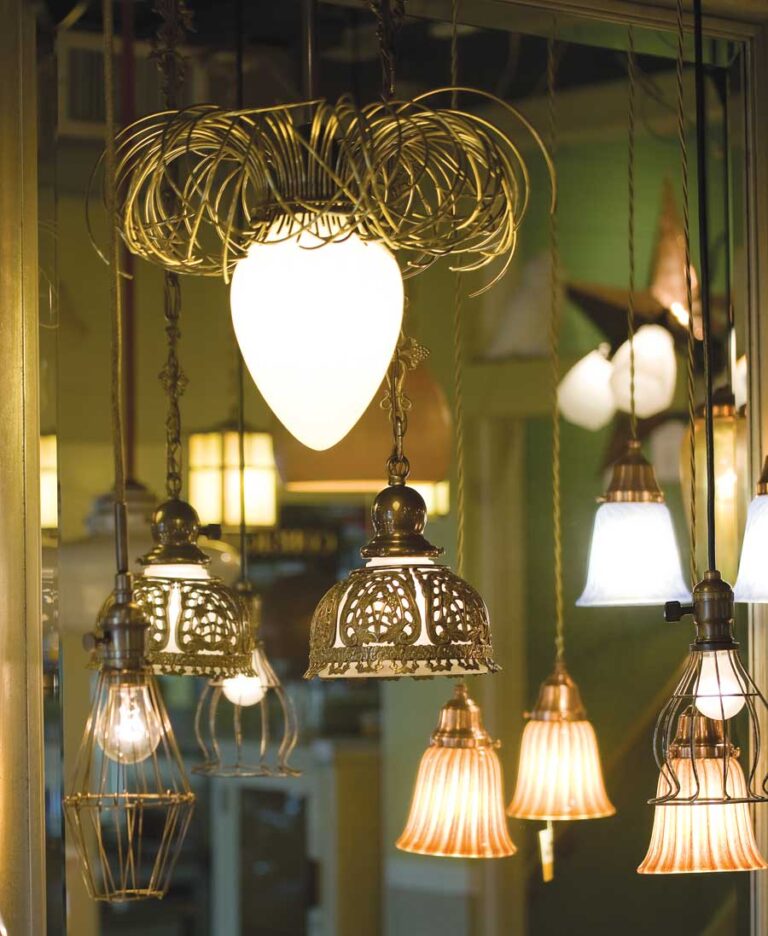
Creating balance is important in home design. It’s easy to fall in love with salvaged materials; it’s a lot harder to find the right balance of pieces and materials in a room. To avoid creating a mishmash of salvaged items that fight for the spotlight in your home, take some time to decide which pieces should take center stage and which are better as accent details. Proportion is one of the most important components of balance. A gigantic island created from a salvaged store counter can make an amazing statement in a kitchen, but adding two large vintage chandeliers above it would make the space feel too crowded. (Plus, it’s best to have three lights over an island, not two.) At the other extreme, pendant lights made from old canning jars might be perfect in a small bungalow kitchen, but they would look puny over a large island. Another tip: If you have large, exposed wooden beams in the living-room ceiling, be careful not to fill the room with a lot of heavy, oversized pieces of salvaged wood. Unless you’re designing a mountainside log cabin, too many heavy wood pieces can feel oppressive.
Putting It All Together

Putting your whole design together before you begin installation ensures a good outcome, allowing you to see if the pieces you’ve chosen will work together structurally, functionally and aesthetically. If the material is easily transportable, such as a tile, take it with you when you’re searching for the other components of the room. Bring pictures of the space you are designing and the room measurements on your salvage hunts. And, of course, don’t forget your tape measure — there’s nothing more frustrating than realizing that the perfect sideboard you bought for the bathroom won’t actually fit in it!
As in any kind of design, there will be times when you just don’t get it right. When working with salvaged material, especially one-of-a-kind pieces, the process and results will be new to everyone, including the architect and builder. But when you walk into a space and it wows you, it’s because the architect, designer or homeowner took a chance. A beautifully designed room isn’t the only reward in working with salvaged material–the initial inspiration, the hunt, the selection and the anticipation you feel as you watch the room come together are all a part of the fun. And, of course, knowing that your eco-friendly process is contributing to the greater good of the world makes it just that much better.
Salvaged Wood: Know What You Need

Size: Does the length and width match what you need? Many salvaged woods will need to lose a few inches at the ends, so bear that in mind when measuring.
Color: Sand a small piece to reveal the underlying color of the wood.
Structural Integrity: Look for splits, warping and rot. Old worm holes or nail holes can give wood character without affecting it structurally, unless there is serious insect infestation.
Type: Is it a softwood or a hardwood? Softwoods tend to scratch and dent more easily but can have a beautiful patina when finished.
Safety: Some of the paint you find on older wood may be lead-based, so it’s important to take precautions when cutting and sealing it. If you are unsure whether the paint is lead-based, err on the side of caution and follow the new EPA laws instituted in April 2010 regarding lead-paint abatement.
Heart of Glass

Old windows aren’t as energy-efficient as modern glass panes, making them better for use as interior windows or dividers. Separating rooms without walls with salvaged-glass pieces is an exceptional way to allow natural light into the spaces while giving the illusion of a wall. Be creative–hang a variety of old windows together with chains, get a custom piece made from recycled tiles, or place a stained-glass piece in your bathroom wall or as a transom above your dining room door.
Get a Handle
The average three-bedroom home has 75 to 150 drawer pulls, doorknobs, hinges, towel racks and fixtures. Multiply that by the millions of households in the United States alone, and you have a lot of fixtures to consider. Whatever the style–modern, simple, Victorian, cottage–salvaged or 100 percent recycled hardware is available to fit your design needs. If you are using older doors, try glass or bronze knobs. Simple chrome pulls from a more recent era are better for a modern design. Going for a totally eclectic look? Find a different piece of hardware for every door, cabinet and closet!
Seeking Salvage: Resources
Books
“Housing Reclaimed” by Jessica Kellner
“Junk Beautiful” by Sue Whitney and Ki Nassauer
“Patina Style” by Brooke and Steve Giannetti
“Recycled Home” by Mark and Sally Bailey
“Salvage Secrets” by Joanne Palmisano
“The Salvage Sisters’ Guide to Finding Style in the Street and Inspiration in the Attic” by Kathleen Hackett and Mary Ann Young
“The Salvage Studio” by Amy Duncan, Beth Evans-Ramos and Lisa Hilderbrand
“Salvage Style” by Joe Rhatigan with Dana Irwin
Organizations
Building Materials Reuse Association
searchable directory of salvage stores
Habitat for Humanity ReStores
nationwide chain of used building material stores
Excerpted from “Salvage Secrets: Transforming Reclaimed Materials Into Design Concepts” by Joanne Palmisano with permission by W. W. Norton & Company.





