

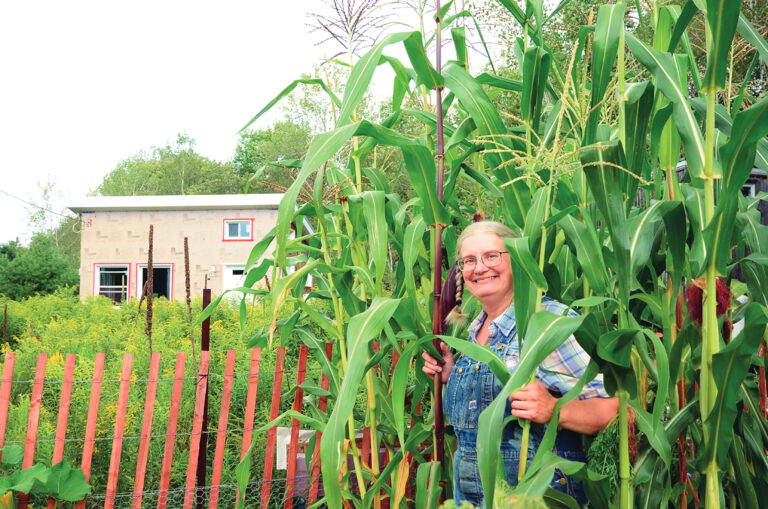
Remaining on-grid made sense for this solo homesteader, but learn how to build an off-grid cabin on a budget to keep those features in a small cabin.
In terms of home energy systems, “off-grid” and “on-grid” are often presented as polar opposites with no overlap. However, I believe the small cabin I built five years ago offers a middle ground between the two. Although it’s grid-tied for electricity, my 18-by-24-foot, slab-on-grade cabin features several systems that can operate without electricity.
A few experiences influenced my thinking about remaining utility-connected, at least for energy. My self-sufficiency strengths are in gardening and herbalism, not electrical. And I’d had my fill of small-engine repair. During the five years I spent shopping for land, I lived off-grid in a tiny house on wheels powered by a proportionally tiny solar array and no running water. Harsh Canadian winters tested my limits, particularly when my generator leaked oil or a charge controller failed. When an ice storm in January 1998 left many in my region without power for weeks, I knew I wanted a future cabin that would use minimal energy and maximize my ability to manage any future grid interruptions. Finally, I figured remaining grid-tied might offer advantages as I age.
Today, the design decisions I made early on keep my monthly electricity bills averaging less than $40 in summer and $75 in winter. I’m comfortable all year long for an annual electricity cost of about $700. Now, after five years of occupancy, I’ve weathered several storms and have lessons to share about the systems I chose.
Going (Passive) Solar
Originally, I’d intended to power the cabin with solar. One factor that tipped the balance toward grid-supplied electricity was interconnection access. An existing utility-supplied electricity pole stood near my property. I was able to connect the cabin to the grid through this pole for $700, plus a $300 installation fee. The estimate I received to go off-grid, on the other hand, was $12,500 (a cost I imagine would be higher today).
Even with grid-supplied electricity, I wanted my cabin to take advantage of a simple passive-solar layout that would capture heat from the sun during the day and radiate that heat at night. I planned the front wall of the cabin to face south and included two 4-by-5-foot windows. To further maximize solar gain, I added a sliding glass door at the south corner of the cabin’s west wall. My province’s building code requires insulation rated to R-10. I doubled the insulation under the cabin’s concrete slab (which sunlight hits) to achieve an R-20 value, reinforcing the slab’s heat-storage capabilities. These features didn’t add a lot of expense. The extra insulation under the slab cost $700, and buying larger windows amounted to a few hundred dollars more at the time.
Keeping Warm
In winter, I keep the cabin between 60 and 70 degrees F. I reach first for my “off-grid sweaters,” indoor hats, wooly socks, and warm duvet to stay cozy before turning up the heat. On sunny days, when I see plumes of smoke coming from my neighbors’ chimneys, I don’t need any heat other than the sun. During fall and spring, the passive solar gains enough heat during the day that I may only need a heat “boost” from a small electric space heater to get the temperature up to 70 degrees before bedtime. I shut it off and need no additional heating overnight. The home is still 60 degrees or higher when I wake up.
But passive solar alone isn’t enough to heat the cabin during deep winter in my climate zone. This part of the country has about 4,500 heating-degree days per year, meaning that, over the course of a year, I need to heat the cabin a sum total of 4,500 degrees to maintain a comfortable 65 degrees. I’m in Zone 4b, and minimum temperatures can reach minus 25 degrees, sometimes for weeks at a time during winter. At these temperatures, underground well lines can freeze, but so can indoor pipes! So, the building code requires homes around here to have two sources of heat. I chose to pair my small woodstove with a wall-mounted, propane-fueled furnace.
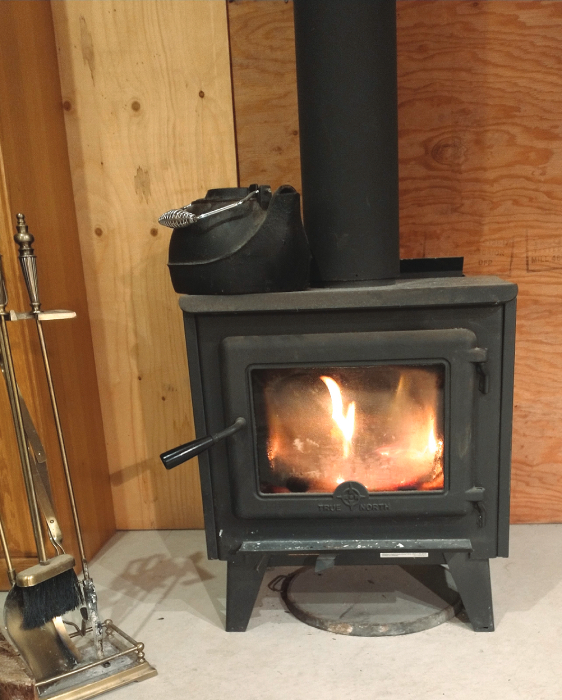
My woodstove is only 2 feet high and 21 inches wide. While it takes only 11-inch logs, this little stove can send out a cozy 15,000 Btu of heat. It produces so much heat that I only use it when overnight temperatures will drop below 23 degrees (and keep in mind the firebox of this stove is only 0.8 cubic feet). Even then, all I need to do is build up a nice evening fire and let it die down while I sleep. I won’t need to get up in the night to load the stove unless temperatures are minus 4 degrees or below. I love that it has a cooking surface too.
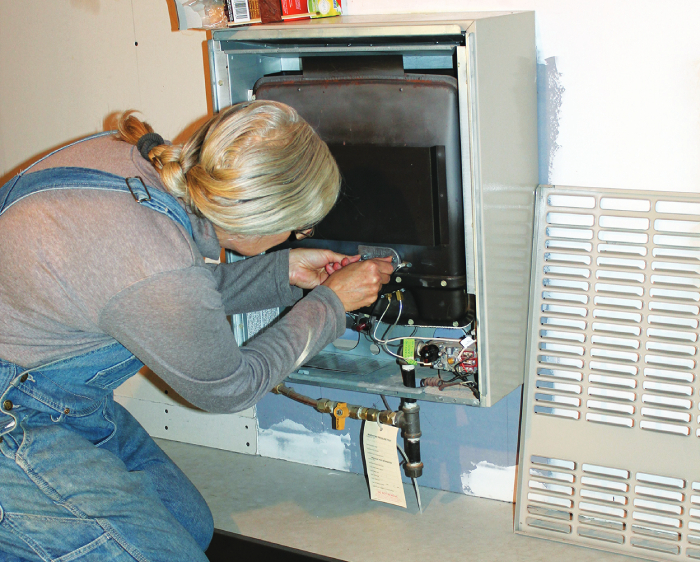
Having the woodstove allows me to set the propane furnace’s thermostat to 60 degrees and use it only as backup heating, conserving fuel. The furnace was an affordable option, relative to other choices, and it’s rated to also produce 15,000 Btu of heat. The unit measures only 20 by 24 inches, requires no electricity to operate, and the wall thermostat that controls it runs on two AA batteries.
Working this way, I can take care of most of my heating needs with only 1.5 face cords of 11-inch logs, which costs me less than $100 per winter.
Water Works
Given the importance of water for survival, this was a resource I prioritized for off-grid access. I achieved the goal by installing a hand pump on my well casing. To ensure access to water during our cold winters, I drilled a weep hole below the frost line, which prevents freezing by allowing the water to drain back down when I’m not using it. I’ve used the pump with no problems at temperatures below minus 20 degrees.
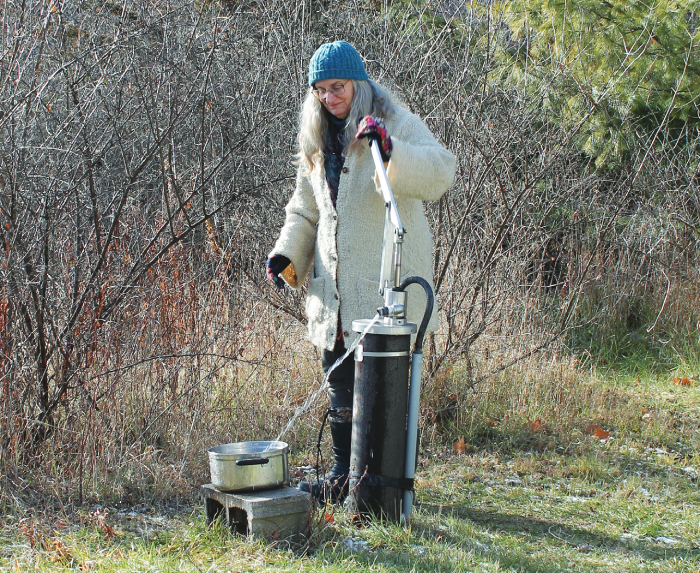
I also wanted access to safe drinking water without electricity. I run hand-pumped water through a specialized water pitcher that has two filters: a carbon one and a 0.2-micron membrane. These filters remove bacteria, parasites, heavy metals, and chemicals, including PFAS and pesticides.
Likewise, I wanted a septic system that could function during grid interruption. A gravity-fed septic system fit the bill. If I can put water in my toilet tank, even manually, I can flush into my septic system. This is peace of mind for me. If you want a pump-free septic system, as I did, then you’ll need to ensure the land you build on can accommodate one. Factors that support a gravity-fed system include a good soil-percolation rate, adequate soil depth, and a gentle downhill slope toward the septic bed. It pays to bring a septic installer on-site in the early stages to assess the potential of your location.
In the Kitchen
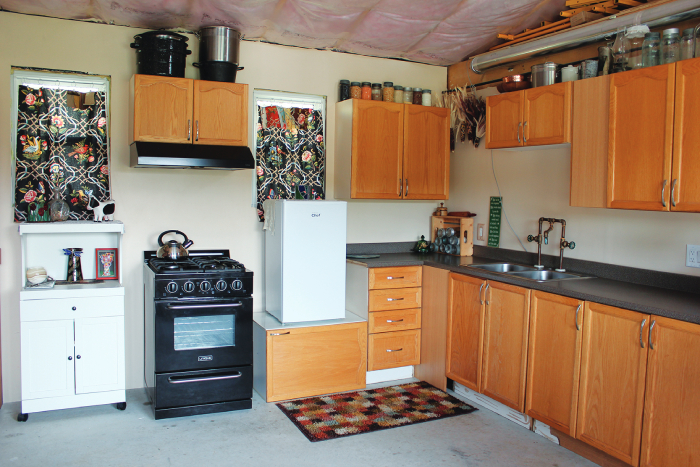
I like being able to cook on a propane range, electricity-free. Both the igniters for the burners and the oven pilot run on a D battery. Should I face a grid interruption, I can heat water and meals on either my propane range or woodstove. For bathing and doing dishes, I enjoy on-demand hot water using an ENERGY STAR-rated water heater that runs on propane and electricity. My total propane usage for a year of cooking, heating water, and running the furnace has never been more than 300 liters, costing about $250.
Off-Grid Wishlist
- Refrigeration. If the grid goes down in summer, I only have a generator for backup. I own a 3-cubic-foot fridge that could run off-grid by plugging directly into a DC power source. In the future, I may look into a small solar-powered system to provide the 38 amp-hours per day it requires. Alternatively, I could design a system that taps my ice-cold well water for refrigeration.
- Summer cooling. Our last summer was a record-breaker. At times, the indoor cabin temperature exceeded 85 degrees. I made some exterior shades for the windows out of double-reflective foil insulation. This kept the interior below 80 degrees even when temperatures outside reached 100 degrees. For a longer-term solution, I’m waiting for the two shade trees I planted to grow.
- Vaulted ceiling. The cabin has a high ceiling, 13 feet at the front to 9 feet at the back. While I love the spacious feeling it creates, heat rises. I’m working to install a ceiling fan to move hot air around, which I’m certain will improve my heating efficiency.
By mixing and matching on-grid and off-grid features, you can open new possibilities for building resilience into your home. My careful selection of off-grid home systems for my on-grid cabin has made a world of difference for my energy security and peace of mind. I love that my lifestyle is an ongoing journey, giving me opportunities to learn and grow at a pace that’s right for me.
Colette Kenny has a passion for sharing her knowledge about sustainable housing and self-sufficiency. She lives on a half-acre homestead, where she makes herbal medicines from the plants on her land, talks to the trees, and eats nourishing food.
Originally published in the June/July 2026 issue of MOTHER EARTH NEWS and regularly vetted for accuracy.





