Learn how to shop smart for food by following our 17 tips to spend less, eat healthier, and live lighter on the earth.
Everywhere, it seems, we’re blitzed with articles on the rising cost of food and the hardship implied for the average family. Actually, the hardship isn’t implied – it’s real, it’s depressing, and I’d argue it’s fixable.
Recently, I read a statistic that floored me: According to the U.S. Department of Agriculture’s “Thrifty Plan,” the average family of four spends more than $1,000 per month on food. A thousand dollars! Who has that much money to spend on food?
Most of us have fixed expenses every month, including car payments, student loans, and mortgage or rent. It’s hard or impossible to economize in these areas. But if you’re struggling financially, you need to take a hard look at your variable expenses – of which food is a significant part – and see where you can trim your expenditures.
Reducing your grocery costs will also help reduce the environmental impact of overpackaged and overprocessed foods. Many of these tips will also help you reduce waste and benefit your health. It’s a win-win situation.
So, how do we do it? Well, here are 17 ways our family keeps our food bill down.
1 Eat Lower on the Food Chain
Rediscover the joys of rice and beans. I know we all like the taste of oversalted and fatty foods, but don’t turn up your nose at healthy, inexpensive legumes and grains. You can buy a 1-pound bag of lentils or rice for a couple of dollars each. It’s even cheaper if you buy in bulk. Combined with spices, these foods will make an excellent, balanced, nutritious meal for next to nothing. Add a bit of meat and veggies to a stir-fry and you’ll have a delicious and filling dinner. Check out cookbooks at the library to learn how to liven up rice and beans, and eat like kings.
2 Plan and Make Future Meals
Plan your meals at least a week in advance. This is probably the single most underused trick for eating cheaply. So many people think, “Hmm – what will we have for dinner?” while driving home from work, and they stop at the grocery store to purchase high-cost prepackaged foods. Then they wonder why their grocery bill is $1,000 a month.
Instead, sit down with your family and plan out the week’s meals. For example, Monday you’ll have soup and garlic bread, Tuesday you’ll have a pot roast, Wednesday is a casserole, Thursday is spaghetti night – you choose. This way, you can purchase all of your ingredients once a week when you’re not hungry, stressed, or tired.
I recommend the excellent book Once a Month Cooking. Authors Mary Beth Lagerborg and Mimi Wilson demonstrate how a day of massive cooking can produce a month’s worth of homemade dinners, which can then be frozen. The book illustrates how to purchase and organize the necessary ingredients and efficiently cook and assemble the meals.
Of course, you don’t have to cook a month’s worth of food. You can scale back and simply double the quantities of whatever dishes you make during the course of a week, giving you a few extra dinners in the freezer for nights when you’re too tired or busy to cook.

3 Cook from Scratch
Scratch cooking has earned a bad reputation for being time-consuming and complicated. If you’re a busy working parent, then you may wonder how on earth anyone can make a meal from scratch. With planning, scratch cooking can be easy and, more importantly, cheap.
Cooking from scratch is easier if you do two things: First, find some recipes that are fairly simple and that your family enjoys. Yes, they exist. Your job is to find them.
Second, keep standard ingredients on hand. A scratch meal isn’t made any simpler if you have to make a hasty dash to the grocery store for some forgotten item. This can’t be emphasized enough. Learn about creating a well-stocked pantry of basic ingredients, and you’ll find that scratch cooking is simple.
4 Don’t Be Wasteful
Don’t waste food. Bring leftovers to work or school for lunch (microwaves are everywhere). Put leftovers in the freezer in a big bowl until you have enough for soup or “leftover pie” (my theory is that everything tastes better in a pie crust). Remember, if your kids turn up their noses at leftovers, it might be because you’re the one modeling it.
Sometimes when our refrigerator is overflowing with leftovers, I take everything out, put it on the table, and everyone has what they like best. My kids loved leftovers night.
5 Embrace Homemade Convenience
Make your own “convenience foods.” The freezer can be your best friend in this case. Double up your batches next time you’re making something freezable, such as lasagna or quiche. Homemade spaghetti sauce is startlingly easy and freezes beautifully. When I find mozzarella cheese on sale, I make a bunch of pizzas and pop them in the freezer. Whatever your family enjoys eating, see if you can find a fast, freezable, and homemade version for nights when you don’t want to cook.
6 Make Bread
Bread machines have become almost cliché in terms of unused and therefore unnecessary kitchen appliances (hence the multitude of machines available in thrift stores). But if you actually use a bread machine, you can save an extraordinary amount of money over the years. And, no, you don’t need to buy those hideously overpriced little boxes of premixed “bread machine” ingredients; regular flour will do.
It takes five minutes (or less) to throw the ingredients into a bread machine. Many machines have a time delay feature, so you can put the ingredients in before bed and wake up to fresh bread in the morning. Slice the bread yourself, and voilà: sandwiches, toast, whatever.

Check out your local thrift store for an inexpensive bread machine, particularly one that’s been only lightly used. Even purchased new, a bread machine is worth its weight in gold.
Yeast breads or sourdough breads made without a bread machine can also be learned quickly. If you make 10 loaves of any style of bread, you’ll have it pretty much down.
7 Cook It Slowly
Get a slow cooker (again, try your local thrift store). Seldom will you find a kitchen appliance that offers greater benefits to busy working people. Throw a roast or the ingredients for soup in it, turn it on low, and go to work. When you come home (to a house filled with rich, delicious smells), all you’ll have to worry about will be the “extras” for the meal – vegetables, rice, bread, or whatever else will round out the dinner.
8 Bulk Up
Buy your staples in bulk. If you make your own bread (or other baked goods), you’ll quickly discover why it’s cheaper to buy flour in the largest possible quantities. I purchase flour in 50-pound sacks from a restaurant-supply store. The same goes for rice, lentils, cornmeal, sugar, oatmeal, and other staples my family uses in large quantities. Even spices bought at the bulk bin are much cheaper than buying spices in individual bottles, with the added advantage that you can buy only what you need (lessening the chances of a seldom-used spice languishing on a shelf for the next five years).
Obviously not everyone has the room to store huge amounts of bulk foods, but even unusual places – such as under beds, in closets, or in a basement – can be used to store dry bulk food. Take into consideration heat, pests, and moisture when storing food. I use repurposed bakery buckets for bulk-food storage; these are food-grade and inexpensive, usually only a dollar or two.
9 Get a Knife
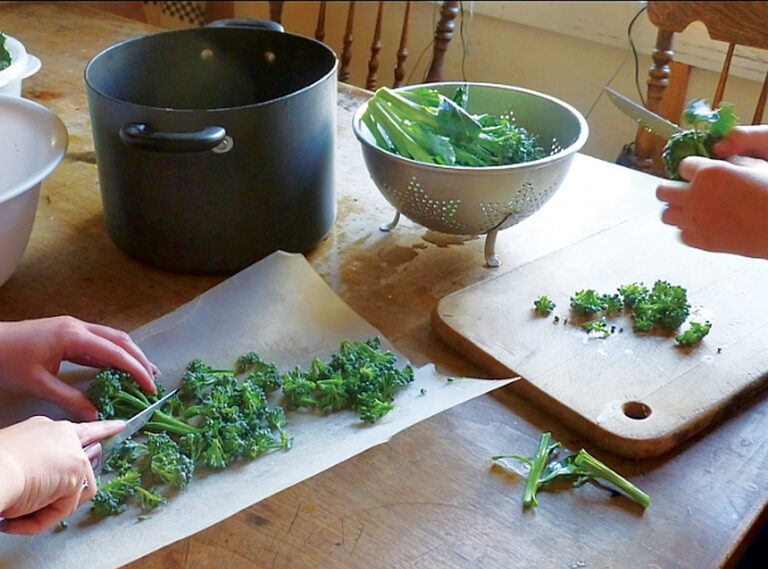
It staggers the mind how much money we’ll spend merely to save ourselves a little slicing and dicing. Pre-sliced lunch meats, pre-grated cheese, packaged melon balls, pre-shredded lettuce – the list goes on. Get some knives, a cheese grater, and some kitchen scissors. Learn to slice, dice, and cut your own foods, and watch your food bill get cut down as well.
Whether vegetables, meats, fruit, cheese, or anything else that can be cut, sliced, diced, or grated, the whole version is significantly cheaper than the prepared version. Multiply these savings week after week for your family members and watch how that $1,000 a month melts down.

10 Drink Water
Learn to drink water. And I don’t mean bottled water, either. How much of your monthly food budget is wasted on sodas, sugary juice mixes, or other non-nutritious fluids? Even if your tap water is undrinkable (and some is), a 5-gallon jug of water from the grocery store is far cheaper than the equivalent volume of soda, juice, or bottled water. A good water filter is an initial investment that will save money over time.
Purchase reusable water bottles for all family members (there are hundreds available in thrift stores), put their names on them, and keep them filled in the refrigerator. Glass canning jars work too. Then, don’t buy juices, sodas, or other expensive fluids. Your kids may object at first, but when they get thirsty enough, they’ll drink water. It will take some training, but you’ll save loads of money. Of course, I assume you’re being a good role model by drinking water yourself.
Fruit juices and milk can be an important part of a well-balanced diet, but nothing says your kids have to guzzle expensive bottled juices (make it from concentrate) or have chocolate milk six times a day (try plain milk at breakfast and dinnertime).
11 Find Cheap Sources
Let’s say you stop for gas on the way home from work. In the “quickie-mart” attached to the gas station, you notice milk for $2 a gallon, instead of the $4 gallon at the grocery store. What a deal! This is a “loss leader,” since the store hopes you’ll buy other more expensive items to compensate for losing a bit of money on the milk.
Make it a habit to buy milk here (since you’re passing it almost every day anyway) and nowhere else. You’ve just cut your milk bill in half.
It does no good to buy loss-leader items if you have to visit 16 different grocery stores and burn up gas. Nor does it do any good to buy loss leaders if you’re suckered into buying high-priced items you may not need.
But judiciously purchasing select loss leaders – particularly if they’re available on your regular driving or shopping route – is a fine way to cut your food bill.
12 Compare Unit Prices
On the shelf tag for most grocery items is a small number that indicates the unit price, whether it’s dollars per pound or cents per ounce. This is a handy tool for determining which of two comparable items are cheaper per unit.
If House Brand cereal costs 40 cents per ounce and Name Brand cereal costs 60 cents per ounce, it’s clearly a better deal to purchase House Brand cereal – assuming the taste is comparable (and it often is).
These little unit price numbers are one of the handiest ways to determine the true cost of an item in order to compare it to a similar item.

13 Use Cash
In this age of plastic, it’s a rare person who uses cash to pay for anything. Yet paying cash for your groceries has many advantages, especially if you’re on a budget.
It’s hard to overspend with cash. Either you have the money for it or you don’t. If your funds are limited, you simply drop the less-necessary items off your grocery list rather than build up debt on your credit card. With a credit card – or even a debit card – it’s too easy to shut your eyes to the total bill as you tap your card.
Cash makes you acutely aware of how much you pay. You can resist impulse purchases more easily. It helps to keep a calculator with you to tally your groceries as you go, so you’re not unpleasantly surprised at the cash register. And, of course, you’ll never go into debt if you pay with cash. ‘Nuff said.
14 Use a Price Book
A suggestion I got from the incomparable The Complete Tightwad Gazette by Amy Dacyczyn is to keep a price book. I started this when our first child was an infant. In my case, it was a cheap little notebook I kept in my purse that had a page for every item I regularly bought at the grocery store – milk, fruit, vegetables, cheese, etc. On each page I’d note the price of those items at a variety of different stores. I did this for a month or two and then could see my regular spending pattern at a glance. That way, if a store had a so-called sale price on such-and-such an item, I knew in a moment whether it really was cheaper than normal.
15 Nix the Junk Food
Recently, I got in line at the grocery store behind some distant acquaintances. It was interesting to study the contents of their cart. They had lots of soda, chips, and packaged foods, such as corn dogs and mini tacos. In fact, they had so much of this kind of food that I asked if they were hosting a party – and the answer was no. This was part of their usual dietary repertoire.
A surprising percentage of a typical food budget goes toward junk food and prepackaged foods. If you find yourself in the aisle with non-nutritious and expensive sweets or salty snacks, walk out.
It’s no accident grocery stores arrange their priciest and least nutritious items at eye level in the store’s central aisles, while the least expensive and most nutritious options are usually located around the store’s perimeter. Staples, such as fruits, vegetables, eggs, meat, and dairy, are usually located in perimeter locations, while prepackaged and snack foods are centrally located.
Try to restrict your center-of-the-store visits to rice and beans, flour or other baking needs, and spices. Keep bagged snacks out of your cart entirely, and learn to make your own cookies or crackers instead.

16 Buy in Season
Americans have become spoiled. We expect fresh strawberries in January and lettuce year-round. If we continue to expect our local grocery stores to keep up with our expensive and out-of-season tastes, don’t be surprised when your grocery bill reflects those expenses.
If you’re trying to cut your food budget, it’s time to adjust your yearly dietary habits to reflect in-season fruits and vegetables. Half the fun is looking forward to favorite foods when they’re available in your garden, locally, or regionally. It may be worthwhile to frequent your local farmers market, where locally grown fruits and veggies are fresher and sometimes less expensive than at your nearby grocery store. Bulk produce buys can reduce costs, and some farms sell second-quality fruits or vegetables at reduced cost.
17 Learn to Preserve
There are many ways to preserve food. Methods can be as simple as freezing or as sophisticated as freeze-drying, and can include dehydrating, salting, root cellaring, fermenting, and canning (water bath, steam, and pressure canning).
Some food-preservation methods can be costlier than others. Home freeze dryers can cost thousands. Pressure canners can cost hundreds. A root cellar can be pricey, so not everyone can afford some or all of these options.

To find the most economical equipment for food preservation, search thrift stores, garage sales, and online marketplaces for necessary items. It’s possible to pick up second-hand dehydrators, canning jars, pots and other equipment for water bath canning, and even freezers.
Once you have all the equipment you need, research how to use it safely and then take advantage of garden surpluses and bargains.
Less Is More
Keep in mind that the trade-off for saving money is a bit more work. In this economy, it’s important for everyone to understand thrift and how to accomplish it.
By following these simple tips, you’ll get more bang for your buck at the grocery store. The tips can help you eat healthier meals, and many of these strategies have the added benefit of being environmentally friendly because they produce less packaging and less waste.
Save the Earth, save your health, save your budget.
Patrice Lewis is a homesteader, homeschooler, author, and speaker. An advocate of simple living and self-sufficiency, she’s practiced and written about self-reliance and preparedness for 30 years.
Originally published in the October/November 2026 issue of MOTHER EARTH NEWS and regularly vetted for accuracy.