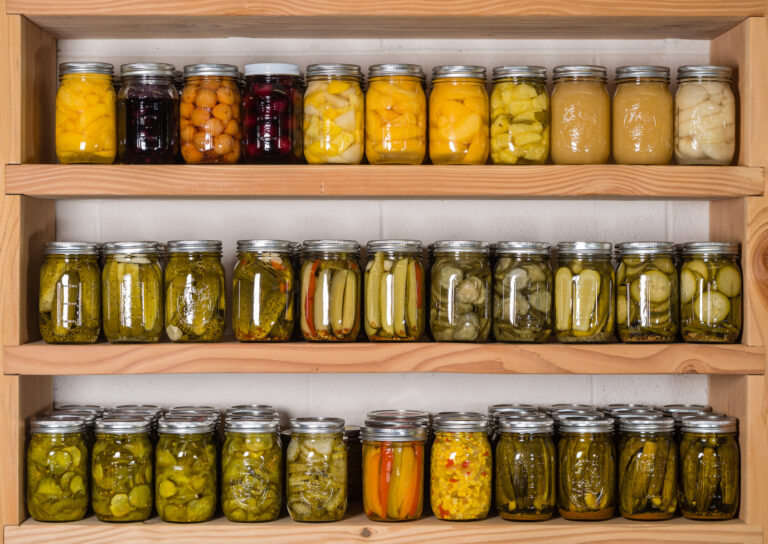
The process of canning food at home is experiencing a modern revival. Canning produces high-quality food that saves money, builds self-reliance, and creates lifelong memories.
It’s Saturday morning and you’ve just popped out your back door, your bare feet making an impression in warm dirt. You inhale the familiar scent of tomato foliage as you reach for the fattest, reddest tomato on your vines. It’s so ripe, it almost falls into your hand. This tomato was intended for the omelet pan that waits inside, but you have to have it here, now. You clutch it like a baseball and bite into it like an apple.
You can’t buy a tomato like this in any store. With a taste this rich and multidimensional, it can only be homegrown. Don’t you wish you could bottle up that taste and enjoy it all year long? There is in fact a way to capture that kind of flavor and pride: You can, if you can.
Even if you don’t have your own garden, you’ll enjoy safer, better-tasting food if you buy in bulk from a local producer and can it yourself. You can can almost anything — mint jelly, potato soup, barbecue sauce. With the proper equipment, the sky’s the limit. Laying by some or all of the food your household will require over the course of four seasons does require foresight and skill, but putting food by is also an art; a comfort that helps us feel secure.
Extending the shelf life of our foods dates back to early Mediterranean civilizations who dried figs in the sun and the ancient Egyptians who doused fresh herbs with olive oil. Home canning came along in France in the early 19th century, when Nicolas Appert invented a way to safely store food by vacuum-sealing it in jars. Whether to dry, freeze, ferment, or can is a fundamental food preservation question, and canning is often the best answer.
More and more people are deciding to learn how to can food at home. The University of Missouri Extension, for example, has doubled its available food preservation classes. Fran Blank, a food preservation instructor with more than 40 years of experience, says she has been amazed in recent years by how popular her classes have become. Last year, Ball Canning reported a doubling in sales of the Ball Blue Book Guide to Preserving.
We asked our more than 85,000 Facebook fans what they thought of home canning and were overwhelmed by the hundreds of responses. They told us they enjoy the rows of colorful jars that sit on the pantry shelves like treasures. Canning food provides a deeper wealth than dollars and cents — and that’s only one among many reasons people have taken up the art.

Canning Food at Home for Flavor and Better Nutrition
We also polled our readers, and they reported that they can to enjoy flavors and textures that are just better, more alive and real. The absence of additives has something to do with the difference, as does the selection of top-quality ingredients. In her Big Book of Preserving the Harvest, Carol W. Costenbader dedicates an entire chapter to choosing ingredients and the idea that “no recipe, however elaborate, can make up for ingredients that are inferior in taste or freshness.”
Home canning offers the ability to use fresh, great-tasting and hard-to-find ingredients, such as heirloom tomatoes or delicate peaches picked at the peak of ripeness. These simply can’t be used for commercial products because produce fully ripened on the vine or tree simply can’t stand up to long-distance shipping.
Respected biochemist Donald R. Davis reports that industrial farming techniques and selective breeding for increased yields are causing declines in the nutrient content of commercial produce. When you grow your own produce, you have the option to choose non-hybrid varieties and use organic growing methods, which are likely to provide more nutritious produce than industrial varieties and methods (for more, read Industrial Farming is Giving us Less Nutritious Food). You’ll also maintain control of the ingredients list, which is important to many readers who said they want affordable, chemical-free food.
Home Canning for Connection
Coming together to can is the basis of powerful memories for many readers. The part of our brain that helps us decode smells and tastes is embedded in the same part in which emotional memories are stored. We capture the bright colors and flavors of summertime in our jars, but we capture important memories in those moments, too. Reader Jean Moss’ earliest memory is of kneeling on a highchair at the outdoor sink with her mother, washing ripe peaches for canning.
Community canning efforts come in many forms that can all make the work a pleasure instead of a chore. Why not make an afternoon of home canning into an event with friends? Toni Boot has set up a food preservation co-op in British Columbia that provides space and instruction for canning events. She thinks the co-op business model has great potential for “sharing knowledge within the community and encouraging folks to support local growers.” You can find a list of community canneries at Pick Your Own.
If you can’t get together to can, you can do as Bob Washo, a farmer in upstate New York, does. He co-organizes a canning swap where community members trade their jars so that everyone ends up with a diversified pantry.
Home Canning for Savings
Most readers agree they save money by canning food. How much they save depends on how much food they grow: Reported savings ranged from $75 a month to a whopping $400 a month. Growing a garden slashed Vickie Barbour’s grocery budget in half. Canning reduced it by half again, “especially because it’s changed the way we think about food. We no longer buy groceries based on what we want to eat. We buy groceries based on what we have.” If you can’t grow all of your food, you can save the most by buying seasonal ingredients in bulk.
You can save more money by buying used canning equipment, as reader Amber Savela Jaggers did when she found 10 dozen canning jars for $20 via Craigslist.
Many people also save time. The upfront work of canning food is easily paid back with easy-to-prepare meals. According to Wendi Clark, a great meal of home-canned foods can come together quickly. “With a growing and busy family, my pantry provides our ‘fast food,'” she says.
Plenty of people find canning so valuable that they’d do it even if it didn’t save them a penny. “The money is not the point with me,” says Nancy Brewer. “Having control over the content is more important.”
Home Canning for Security and Self-Reliance
The primary reason many readers can is because they regard it as an unparalleled self-sufficiency skill. Linda K. Hodgen, a graduate of the Master Food Preserver program at the Washington State University Cooperative Extension, thinks food preservation is more than a hobby. “It is a fundamental life skill that should be taught to every boy and girl in America.”
Gardening and canning make reader Lana Lambert feel “directly connected and responsible for my food chain.” For Shannon Caudell Owens, canning is all about self-reliance. “It’s about being proud of bringing to the dinner table green beans that we grew and put up.”
Plus, the more foods you store without electricity, such as home-canned goods, the more secure your food supply will be — especially if you have limited freezer space or experience a prolonged power outage.

A Final Warning
Many readers discussed the slippery slope they found themselves on after beginning to can. “After I canned my first batch of stewed tomatoes, I started to can meats, then dried beans and soups,” says Janet Malone. “The canning bug had bit me good.”
Reading this magazine just might hook you, too. Cori MacNaughton, a 30-year canner, and Sylvie Rowand, a 20-year canner, both blame their habit on reading too many issues of MOTHER EARTH NEWS!
We’ve compiled everything you need to start canning, including a list of recommended how-to and recipe books, places to find your supplies, and a list of our favorite canning products from Etsy. Find it all in our Home Canning Guide.
Home Canning Science and Safety
The Science. The more you can learn about food science, the more confident you’ll be in the kitchen. In the simplest method of home canning — the water bath method — you fill jars with acidic food, cover them with lids and boil them in a pot of water for a specific amount of time to kill bacteria. You then remove the jars and wait for the satisfying “pop” of the lids sealing as they cool. Water bath canning can provide you with a number of delicious foods, including tomatoes, fruits, jams, jellies and pickles.
A more advanced method is pressure canning. It requires a little more skill and some specialized equipment, but it will unlock a wider world of food and flavor options. With a pressure canner, you can preserve virtually any food — meat, beans, vegetables, soups, and more. Read more online about how to safely pressure can in Canning Safety Tips.
About Safety. There’s no reason to be afraid of canning food because ensuring safety is entirely possible. The basic rules of canning are simple and practical. It’s important to follow those rules and to use tested recipes. Learn more in Are Old Canning Recipes Safe to Use?
Frequently Asked Questions
What is canning food preservation and how does it work?
Canning food preservation is a process that involves sealing food in airtight containers and applying heat to kill bacteria. This prevents spoilage and allows food to be stored safely for long periods. It is one of the most reliable methods of long-term food storage.
How does canning preserve food for long periods?
If you’re wondering how does canning preserve food, it works by eliminating microorganisms through heat and creating a vacuum seal. This combination stops bacteria from growing, which keeps the food safe and fresh for months or even years.
What are the best foods for home canning foods?
The best home canning foods include fruits, vegetables, jams, sauces, and pickles. These foods respond well to the canning method of food preservation and maintain their flavor and nutrients when properly processed.
Is learning how to do canning at home difficult?
Learning how to do canning at home is not difficult, but it does require following proper safety guidelines. Once you understand the basics of canning and food preservation, it becomes a simple and rewarding process.
Are old fashioned canning recipes still safe to use?
For canned foods to be safe, they must have the proper acidity in order to kill bacteria. Only approved, scientifically tested recipes should be used.
What equipment do I need for canning food at home?
To start canning food, you typically need jars, lids, a canner (water bath or pressure canner), and basic kitchen tools. These essentials help you properly execute the canning method of food preservation.
Why is canning and food preservation becoming popular again?
Canning and food preservation is gaining popularity because people want healthier food, reduced waste, and more control over their diet. It also supports sustainability and self-reliance.