
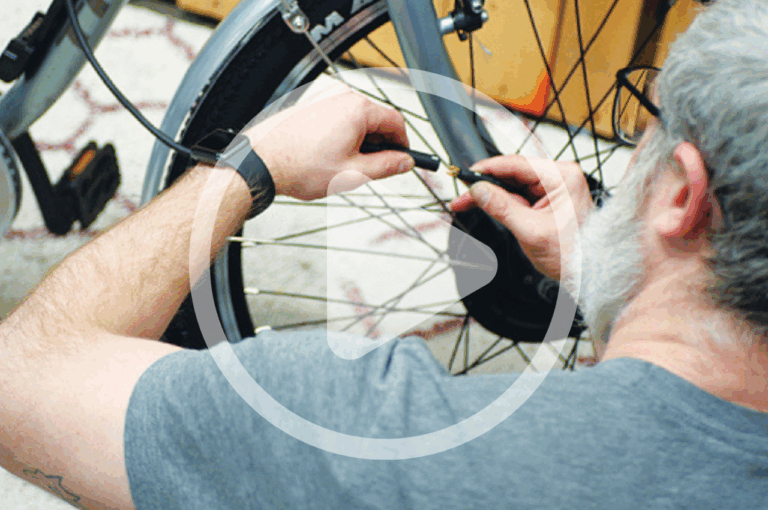
Andy Fry: The electric bike is like kind of more of an enabler in a positive way for bicycling and, and other transportation modes. I’ve had a lot of adventures on rail trails and other things around town or in the kind of northeast Kansas or Midwest area with family and friends. Not that you would stop riding in that context in terms of getting tired, but it kind of extends your opportunities, both on the daily basis, when I commute a lot to work. So the idea that you get out and the weather maybe is not great, but you realize you’re not gonna get super sweaty and so you’re more apt to ride more frequently. That kind of pushing your riding into a part of your life as a part as opposed to just a hobby has been nice with the electric bicycle and not feeling quite so stressed about it doesn’t make you feel like the outlier amongst people who may not be riding as much particularly in a more car-centric community.
[00:00:55] Josh Wilder: Welcome to the Mother Earth News and Friends podcast. At Mother Earth [00:01:00] News, for 50 years and counting, we’ve been dedicated to conserving the planet’s natural resources while helping you conserve your financial resources. In this podcast, we host conversations with experts in the fields of sustainability, homesteading, natural health, and more to share all about how you can live well wherever you are in a way that values both people and our Mother Earth
[00:01:22] Thank you for joining us today for this episode of Mother Earth News and Friends. I’m Josh Wilder, content director and sometimes host of the podcast. With me today, I have Andy Fry.
[00:01:32] How would you describe what you do?
[00:01:34] Andy Fry: I’m a volunteer with the Topeka Community Cycle Project.
[00:01:38] Josh Wilder: As well as many other things. We’re here today at the Topeka Community Cycle Project and what do we have behind us?
[00:01:49] Andy Fry: So what we have is a cargo bike. It’s made up of a more typical trek cruiser bike that’s been attached to an extra cycle free radical, and that allows the [00:02:00] bike to become a cargo bike.
[00:02:01] This free radical attachment isn’t produced anymore, but it was made for a couple of years to try to make cargo bikes a little more accessible to the general public. Rather than having to buy a whole bike, it was just a cargo bike.
[00:02:15] Josh Wilder: Now we have this bike with us because we’re gonna be talking about electric bicycles.
[00:02:20] Now, when you are considering getting an electric bicycle or sourcing one somewhere, what are some of the different factors that you want to consider?
[00:02:32] Andy Fry: You’d want to consider the type of riding you’re gonna do, maybe why you’re wanting an electric bike, particularly whether it’s your physical abilities perhaps, what you want to carry or the environment you’re riding in.
[00:02:45] So there’s various reasons. It could be multiple that you’d want an electric bike, and so. Say if you’re just going to get groceries, you may not need to get the fastest bike. Or if you’re going to just commute to work, you may not need the full [00:03:00] suspension electric mountain bike.
[00:03:01] So you, there’s, there’s still sub genres under electric bikes that you want to consider to try to get the one that’s appropriate for what you’re doing.
[00:03:09] Josh Wilder: Sure. And frankly, a lot of our audience are in rural areas and have farms and I know a lot of folks have electric bicycles on those types of properties so that they can go check the fence line perhaps, or go collect eggs from a chicken tractor out in the field.
[00:03:23] And some of these, like maybe wider tired cargo bikes would be capable of doing that. Is that right?
[00:03:29] Andy Fry: Yeah, I think you definitely don’t want the narrowest tires. And if you do maybe even have a front suspension, this particular bike is no suspension. But nonetheless the tires do provide some suspension depending on what air pressure you put it at.
[00:03:42] I think wider tires in general seem to be what’s preferred with electric bikes and kind of in various applications just based on the speeds they’re going. It provides a little more buffer between you and the road.
[00:03:55] Josh Wilder: Great. Now, you mentioned that this is a add-on to this bike and that [00:04:00] we’re purchasing this bike for Mother Earth News for this project used from the Topeka Community Cycle project. Can you talk a little bit about that and kind of its mission?
[00:04:09] Andy Fry: The Topeka Community Cycle Project is a nonprofit 501(c)(3) community bike shop, and we’ve existed since 2010. We offer a shop space where you can come work on your bike. If you already have a bike, you can volunteer a couple hours in our earn-a-bike program or you can come and volunteer and help others regardless of your intention to earn a bike.
[00:04:28] We do also offer other programs at times about how to learn to work on bikes as well as how to ride safely. And then we provide different rides throughout the community in the summer. We try to be a bike resource within the Topeka and Shawnee County area.
[00:04:42] Josh Wilder: Yeah, we’re here in Topeka, Kansas and you know, this is a great resource for the community.
[00:04:46] And to your knowledge, how common is something like this in urban areas?
[00:04:52] Andy Fry: Many, many urban areas have at least one of these shops. Some urban areas have multiple shops. There’s been multiple in Kansas City, [00:05:00] there’s been one in Lawrence, one in Wichita at different times.
[00:05:03] And Omaha, Lincoln, all these places even in the Midwest have them. And then the more dense the population, the more likely to find a shop like this.
[00:05:12] Josh Wilder: That’s great. So part of what we talked about when we discussed what sort of bike we were looking for for this project was, there’s a lot of bikes that are on the used market right now because of the boom of interest during the pandemic in 2020.
[00:05:28] Can you talk a little bit about that?
[00:05:31] Andy Fry: Yeah, I think maybe similar to the oil crisis in the ’70s and there was a bike boom, then there was a bike boom in the COVID years for a different reason in terms of people being at home and wanting to be outdoors and kind of spread their wings a little bit safely.
[00:05:43] And so a lot of folks purchased bikes. Probably a lot more folks than might have purchased bikes in a more typical timeframe. And so there’s been a lot of bikes available online. So that that would obviously open up another option. If you didn’t want to build a bike, you could potentially purchase a used electric bike [00:06:00] online.
[00:06:00] But yeah, there’s a lot of variety available currently that. I’ve not seen in other timeframes.
[00:06:07] Josh Wilder: So what we’re planning on doing with this bike is adding a battery and a system in order to electrify it and make the rider have less need to pedal as hard as they might if they’re going up a hill or for long distances.
[00:06:22] So what are our options with this bike?
[00:06:25] Andy Fry: So for a bike that’s existing you can put on a hub motor, which would go either there’s options in the front or the rear wheel. The hub, meaning the center of the wheel. And you would either buy, you can buy a pre-made wheel of that sort, or a lot of times you can buy the hub itself and you can have a bike shop, lace it, which means put the spokes on.
[00:06:47] Or if you’re so inclined, you could attempt to do that yourself. So those are, there’s wheel or hub motors. And then the other option is there’s, kind of add on mid drive, which means you add it here at the bottom [00:07:00] bracket by the pedals and the cranks. And what typically happens there is the motor itself hangs below it, and then through gearing powers in an assist to what the person is pedaling.
[00:07:12] And sometimes those also come with a thumb throttle up here. It can vary, but there’s a lot of, primarily Asian import of these sort of devices. I’m not sure if there’s American made ones, but that’s another option. And so there’s kind of differing trains of thought. The hub motors are a little more affordable usually, and a little easier to install.
[00:07:33] The bottom bracket ones are known to maybe have a little more longevity in their lifespan, but are a little more complex to install, but I think if you’re an average tinkerer or somebody who’s familiar with taking bikes apart, you could probably manage that. There’s a lot of instructions and, and videos and things online to assist you through those processes.
[00:07:56] Josh Wilder: Now, something we wanted to consider when we were doing this project is that, you [00:08:00] know, similar to when you’re building something like a mobile chicken tractor on a homestead, you want something that’s adaptable. So you might have have this bike for a long time and you might have different needs for it over time.
[00:08:13] You might be moving to a different area, maybe from urban to suburban to rural, or you might be in a situation where a new technology comes out. So you want to change the type of electrified system that you have on your bike. Now, how difficult would it be to do that sort of thing?
[00:08:33] With a bike that comes already with a motor as opposed to this sort of setup?
[00:08:38] Andy Fry: Yeah, so that, that’s a good point. That’s a plus for having a wheel based motor versus a hub based motor. Say something goes bad in the motor or something changes and through time you want to upgrade, you can just take the motor off and theoretically if you need to re-plumb the wires or replace it, that could be simpler. Having the motor in the bottom bracket in the mid drive could be more [00:09:00] challenging because a lot of the structural components that they put in to attach the motor might be proprietary or might be specific to that manufacturer. And so that could be something that would be more of a challenge to maintain through time.
[00:09:14] And yeah, I think you make a good point. The motor may go bad. The other things that may be of concern is through time, the battery system may age out. As probably a lot of folks on Mother Earth News know the batteries may not necessarily die, but they may degrade and get to a point where it doesn’t meet your needs anymore.
[00:09:30] And so you might need to upgrade. And there are some companies coming out with novel ways of trying to upgrade battery systems or kind of re recharge them with new cells and that sort of thing.
[00:09:45] Josh Wilder: So speaking directly to batteries, can you talk a little bit about the history of batteries and, and these sorts of systems and what’s kind of the default right now?
[00:09:58] Andy Fry: It’s my understanding that [00:10:00] most of them are lithium-based and they’re using I think in the past the 18650 cell that’s pretty common amongst different, handheld power tools and other things. Most of them that you’re gonna find in this market are prepackaged in a container and they’re not accessible, obviously.
[00:10:17] Tinkerers will do what they’re gonna do and investigate, but most of the time you’re not having to investigate that too much. A lot of them, size wise, I’ve seen the common sizes have been like 400 and 500 watt-hours. But there are larger ones and some electric bicycles that come with the electrical system OEM from the manufacturer will even have multiple batteries that can come up with multiple kind of slots to put in batteries is an option. I have not seen that as much in the aftermarket kits. But I think it’d be more likely that you might just buy a larger battery to begin with of the options that there might be available.
[00:10:59] Josh Wilder: If that’s [00:11:00] where we’re at now, what sort of electric bikes trends are you seeing going forward in the next five to ten years?
[00:11:09] Andy Fry: It seems that most major manufacturers of bikes are making some line of electric bikes as an option.
[00:11:16] And it’s more like a broader representation of manufacturers. It’s not just a niche like it was maybe a couple years ago. As far as the add-on systems, I think it’s becoming a little more mainstream. Where as before it was more of the tinkerer or the person who goes to the depths of the internet and ships something from overseas to it being more of a mainstream item where it’s almost plug and play with some systems. Particularly if you get a front wheel hub motor. There’s a couple different manufacturers I believe that you can basically unhook your front wheel, latch the front wheel. The battery can even hang up front or in a really simple attachment mechanism.
[00:11:58] You plug in maybe two or three wires [00:12:00] and you can have a connection. Some of those may have a thumb throttle or they may have different ways of sensing motion and that’s when it engages the motor. But they’ve gotten pretty approachable for the general consumer.
[00:12:11] Josh Wilder: What are some of the electric bikes that you’ve had and what sort of things, what did you use them for?
[00:12:18] Andy Fry: This kind of cargo bike is called a long tail. So I had, a more Bakfiet style cargo bike, meaning the platform, instead of being on the back has this cargo space out in front of the rider. And so that one I added a Bafang electric system, mid drive, like I was describing that would hook onto the bottom bracket. So I’ve had that and then I’ve had, several of the Tern models, electric cargo bike manufacturer.
[00:12:44] And so I’ve had the GSD and the HSD. They’re just different sizes of bikes. And then I’ve ridden some others that I didn’t necessarily own. I’ve ridden some of the Pedago brand, and that’s most of ’em. I’ve ridden the Trek varieties as [00:13:00] well in the past. And many of these manufacturers are using more standardized electrified systems.
[00:13:05] They’re not all procuring their own which is a good thing in terms of maintenance and long-term viability of the technology. And so the common ones that you’ll see on OEM bikes are Bosch based from Europe, and then others are Shimano, who’s a typical bicycle manufacturer. Then. There’s a few others that are becoming more and more prevalent, but the nice part about some of those first two I mentioned is that there’s training available to shops across the country.
[00:13:34] Unlike some of the things that may come in and get shipped in through the internet and never kind of go through a dealer system, the dealers are at least familiar with this and have standardized training so that they can feel comfortable and will touch it. There’s some systems still that exist that folks are not comfortable with.
[00:13:50] They don’t wanna cause an issue for the consumer and they don’t want the risk on their shop. And so they won’t work on it. And so that can kind of put some people in an odd space in [00:14:00] terms of having to maintain their own bike without a lot of manufacturer support
[00:14:06] Josh Wilder: Our crowd is very DIY to the point that, you know, a number of folks watching or listening to this can weld themselves. So talk a little bit about why you would steer them, perhaps towards the used market as opposed to fabricating something themselves.
[00:14:24] Andy Fry: I know that doing building frames and, and the like can be rewarding and fun.
[00:14:29] You can weld the heck outta something to where it’s very robust. I think the benefits you get from a prefabricated frame are just the idea that it’s been tested to certain levels. You’ll know what the rated weighting is, and you can assume that there’s a buffer beyond that.
[00:14:43] Particularly on a bike that you’re gonna be stressing because you’re intentionally carrying things other than yourself. The material along with that and kind of related matter they’re using are gonna be wider. I could build the equivalent of a motorcycle frame and try to ride it as a bicycle, [00:15:00] but that’s gonna be a lot of effort on my part.
[00:15:02] Whereas they’re gonna use materials like in this case, this front bicycle frame is a aluminum, and I think there’s portions of the free radical that may also be aluminum and a mixture of some steel in the greater frame. That’s probably gonna be lighter than the materials that I might have available to make something similar.
[00:15:19] And so it’s gonna be a better ride that you’re going to want to use in the longer term versus just a solution that you might get tired of. ’cause it’s so heavy.
[00:15:30] Josh Wilder: Finally, you know, just for a little bit of color, what what’s one of the funnest things you can remember doing on an electric bike?
[00:15:38] Andy Fry: I mean, I’ve had a lot of adventures on rail trails and other things around town or in the kind of northeast Kansas or Midwest area with family and friends. Not that you would stop riding in that context in terms of getting tired, but it kind of extends your opportunities, both on the daily basis, when I commute a lot to work. So the idea [00:16:00] that you get out and the weather maybe is not great, but you realize you’re not gonna get super sweaty and so you’re more apt to ride more frequently. That kind of pushing your riding into a part of your life as a part as opposed to just a hobby has been nice with the electric bicycle and not feeling quite so stressed about it doesn’t.
[00:16:19] Make you feel like the outlier amongst people who may not be riding as much particularly in a more car-centric community. The electric bike is like kind of more of an enabler in a positive way for bicycling and, and other transportation modes.
[00:16:34] Josh Wilder: I feel like if there’s anything that I could sign on for Mother Earth News to be, for anybody who’s enthusiastic about sustainability is I hope we’re an enabler.
[00:16:45] All right, well, great. Appreciate it and I can’t wait to get this on the road. Thanks.
[00:16:48] Thanks for joining us for this episode of Mother Earth News and Friends. To listen to more podcasts and get connected on our social media, visit [00:17:00] www.MotherEarthNews.com/podcast. You can also email us at podcast@ogdenpubs.com with any questions or suggestions. Our podcast production team includes Alyssa Warner and myself, Josh Wilder.
[00:17:12] Music for this episode is the song Hustle by Kevin McLeod, the Mother Earth News and Friends Podcast is a production of Ogden Publications.





