

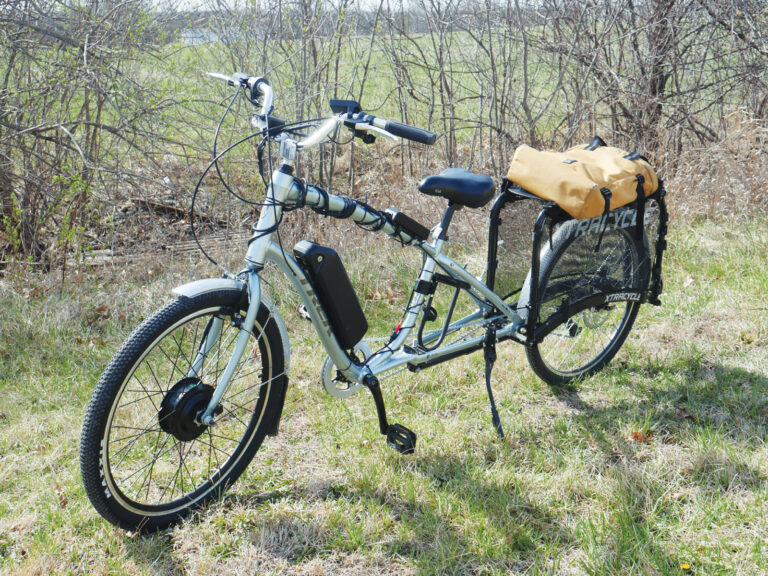
Make your e-bike dreams come true with an electric bike front wheel conversion kit that saves money and is easy to assemble.
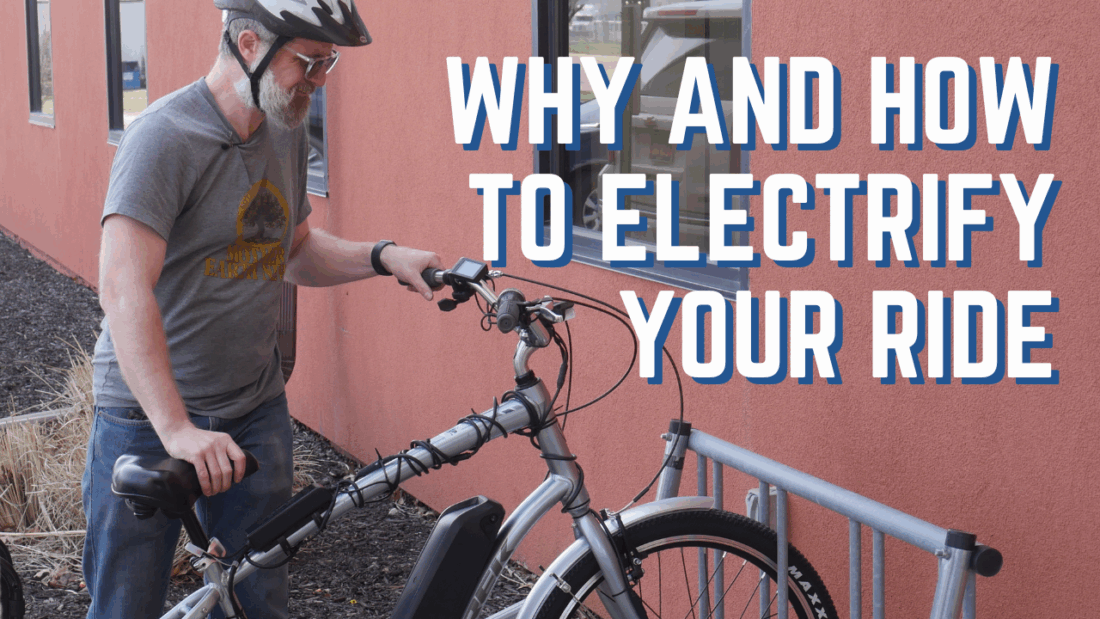
To say I was peer pressured into sourcing and building an electric bicycle may be a touch of hyperbole. Once you become friends with a handful of cycling evangelists, in addition to working for Mother Earth News, some things are simply fate.
When I learned to ride a bicycle as a child, I realized what freedom it was to have a new way to get around. I enjoyed riding up and down the dead-end road I lived on in Indiana as an adolescent. My first job at a restaurant came when I was only 15, so before I got a driver’s license, I took my bike. These were my first experiences of independence. Sure, I’ve been driving now for 25 years, but there are still perks to biking that automobiles don’t offer.
Lately, I mostly bike during my leisure time, riding for exercise or playing bike polo (it’s worth a Google). That wasn’t always the case, though, as bikes can be quite practical. On my first day working at the Mother Earth News office, I chose to ride a bicycle to work. I still remember the route I took and the big-box store I stopped at to change out of my biking clothes into office attire (usually a plaid shirt). I’ve gotten to know where I live better because of those early days riding from one side of town to the other. One of the top benefits of choosing to ride a bicycle is becoming more observant of your environment, wherever that may be.
Advantages of Upgrading to an Electric Bicycle
Bicycling today is as enjoyable as when I was first riding around. Longer rides, such as biking across your acreage or to your job, aren’t always easy. To remedy that and to improve the power of your ride, your best option is to source an electric bicycle, or e-bike. Not only does it make shorter rides more approachable, it also makes longer rides possible without resorting to a gas-powered conveyance. Commuting to work using an e-bike means less physical energy expended and a lower likelihood of needing to change into new clothes before starting work.
E-Bike History
E-bikes have a history in the United States that goes back to the 1890s, with patents that describe bicycles with a “6-pole brush-and-commutator direct current (DC) hub motor mounted in the rear wheel.” The mechanics of a bicycle being fairly straightforward, the greatest improvements have come through the locus of the power and how that power is applied to the bicycle. Modern e-bikes are largely powered by batteries, though some endeavoring tinkerers have fashioned solar e-bikes with panels affixed to the bike that charge the battery. The motors have two major classifications: pedal assist or on-demand power. The specific type of e-bike you’d prefer will depend on the reason you’re considering acquiring one.
Connect with Local Experts
If you’re interested in bikes in northeast Kansas, you likely know the name Andy Fry. Fry is one of the cycling evangelists I mentioned. He helped me find the right bike for what I do with Mother Earth News – primarily moving supplies for DIY projects, sometimes around an event space. He suggested that if a common errand might be visiting the farmers market, I may not need to get the fastest bike, but I’d want to consider the environment I’m riding in. Also, an electric mountain bike with a full suspension wouldn’t be necessary for simply commuting to work. However, if I planned to recommend an e-bike to a homesteader with acreage, a suspension and wide tires would make that ride more comfortable.
“Wider tires in general seem to be what’s preferred with electric bikes and in various applications, based on the speeds they’re going. It provides a little more buffer between you and the road,” says Andy.
Fry volunteers at the Topeka Community Cycle Project, a nonprofit community bike shop that’s existed since 2010. It offers a shop space where you can work on your bike, programs on how to fix your bike and how to ride safely, and even group rides throughout the community in summer. If you don’t already have a bike, you’re able to volunteer for a couple of hours in its earn-a-bike program, or you can volunteer to help others with their bikes. Ultimately, its mission is to be a bike resource within the Topeka and Shawnee County area. Finding a resource like the Topeka Community Cycle Project is key to navigating the latest options in electric bicycles that can be customized to your specific needs.
“Many urban areas have at least one of these shops. There’ve been multiple in Kansas City and there’s been one in Lawrence and one in Wichita at different times. Omaha, Lincoln, all these places, even in the Midwest, have them. And the more dense the population, the more likely [you are] to find a shop like this,” says Fry.
Which E-Bike Is Right for You?
As with anything, there are turnkey options available at your local bike shop or online that cost as low as $400 for an Actbest Core e-bike that has a battery range of roughly 50 miles, on up to $18,900 for an Optibike R22T Everest mountain e-bike with a purported range of 300 miles. However, a number of e-bikes have recently arrived on the used market. Similar to when there was a bike boom during the oil crisis in the ’70s, the latest boom has stemmed from the pandemic years, when folks were home and turned to biking to get around.
When I approach a purchase such as this, I focus on how adaptive the object is going to be to changes in my life. I try not to spend my money lightly, and I’d like to have an e-bike that lasts a long time. When considering longevity, I may have different needs for it over time. If I venture into a different area, maybe from urban to suburban to rural, or if new technology comes out, it would be ideal to change the type of electrified system that’s on the bike. Turnkey e-bikes have proprietary parts that can make them cumbersome to adapt or repair, especially if the manufacturer you purchased from ceases production. So, I decided my best option was to install an electric motor conversion kit on a bike.
You’ll also want to consider your motor. There are two main types to be aware of.
- Hub motor. This motor is in the center or hub of the front or the rear wheel. These come premade, or some distributors sell only the hub. Then, you can have it laced at a bike shop, which means putting on the spokes. You could also do that yourself, if you’d like.
- Mid-drive motor. This option is attached at the bottom bracket by the pedals and the cranks. The thrust in this case comes from pedal-assist, as the motor typically hangs below and works through gearing powers.
Both motor styles typically include a thumb throttle to control on-demand power in addition to or instead of pedal-assist power.
“There are differing trains of thought. The hub motors are a little more affordable usually, and a little easier to install. The bottom bracket ones are known to have a little more longevity in their lifespan but are a little more complex to install. But I think if you’re an average tinkerer or somebody who’s familiar with taking bikes apart, you could probably manage that. There are plenty of instructions and videos and things online to assist you through those processes,” says Fry.
Tools and Materials
- Metric Allen wrenches
- Flathead screwdriver
- Adjustable wrench
- Socket wrench set
- Crank remover tool
- Bottom bracket removal socket
- Round file
Complete Bafang Front Hub 26-Inch Ebike Motor Kit:
- Front-hub-motor 26-inch wheel
- Pedal-assist sensor
- Controller
- Thumb throttle
- Mechanical brake levers
- Controller cable
- Main wiring harness
- Clamps
- 48-volt 14-amp-hour Mini Shark e-bike battery (LG 3500 18650 cells)
- 48-volt 2-amp standard charger
- 500C mini color LCD display
- Zip ties
Install Your Electric Bike Front Wheel Conversion Kit
We ultimately decided on a front-wheel-hub motor kit, not only for its affordability, but for its repairability. At $712, it could be added to any bike with a 26-inch wheel, so you’d be able to keep the bike you have and that’s comfortable for you. In this case, we purchased a used bike from the Topeka Community Cycle Project that had been converted into a cargo bike.
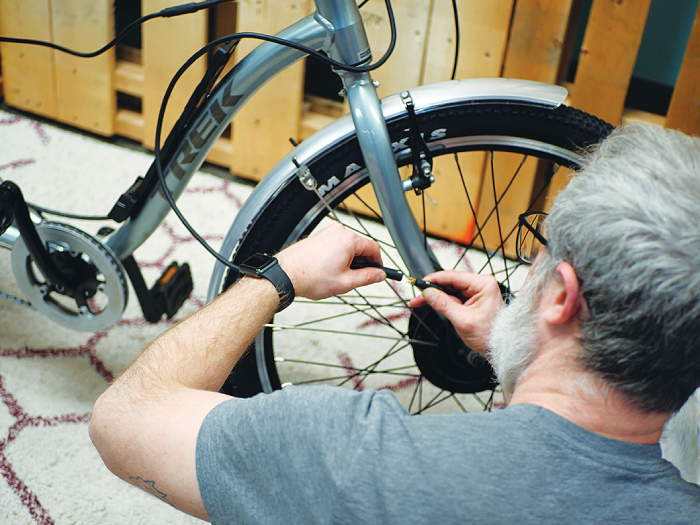
According to Fry, there are major benefits to using a conversion kit instead of a turnkey e-bike. “The motor may go bad. [Another] thing that may be of concern is that through time, the battery system may age out. As probably a lot of folks at Mother Earth News know, the batteries may not necessarily die, but they may degrade and get to a point where [the battery system] doesn’t meet your needs anymore and so you might need to upgrade. … There are some companies coming out with novel ways of trying to upgrade battery systems or recharge them with new cells.”
The Bafang front-hub motor came with a lithium-based 18650 cell, which is the same battery cell common among various power tools. This LG 3500 Mini Shark model is a 48-volt, 14-amp-hour battery with up to 678 watt-hours. There are larger batteries, and some e-bikes may have multiple batteries that can come with multiple slots to insert them.
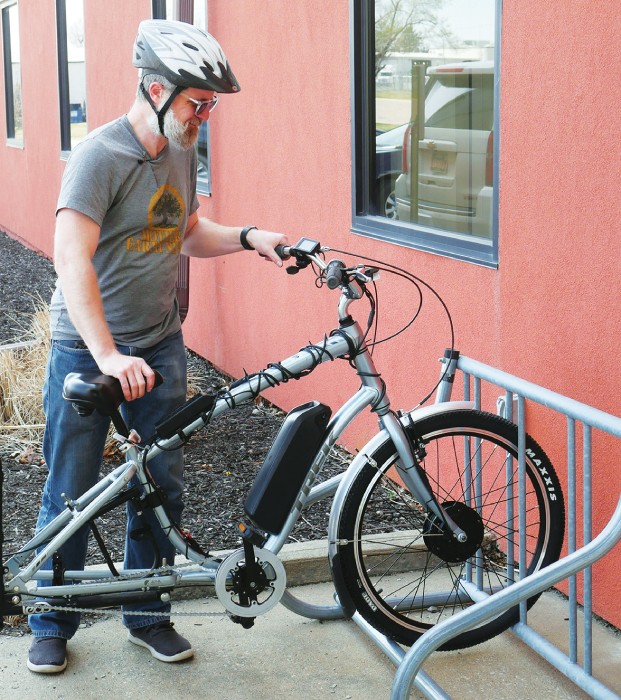
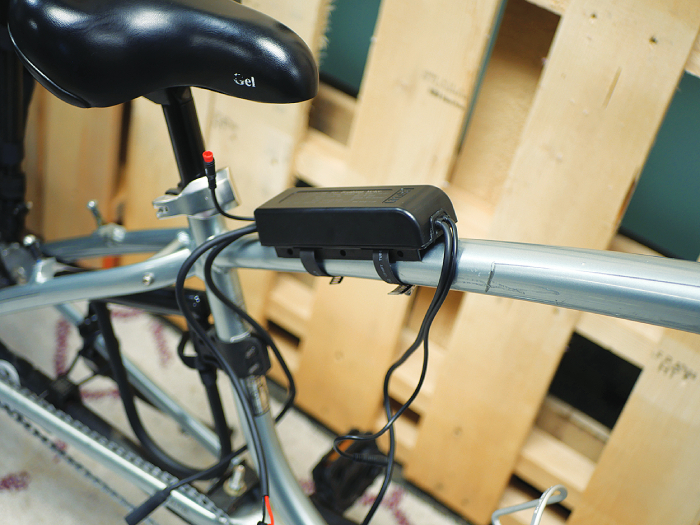
While Fry offered to assist in installing the kit, I chose to put it together myself. To assemble the kit, I had most of the tools I needed. I will say that removing a crank for the first time took some research. After removing the crank and installing the pedal-assist sensor, I replaced the crank and then affixed the controller, which communicates between the battery and the motor, onto the top tube of the frame using two hose clamps.
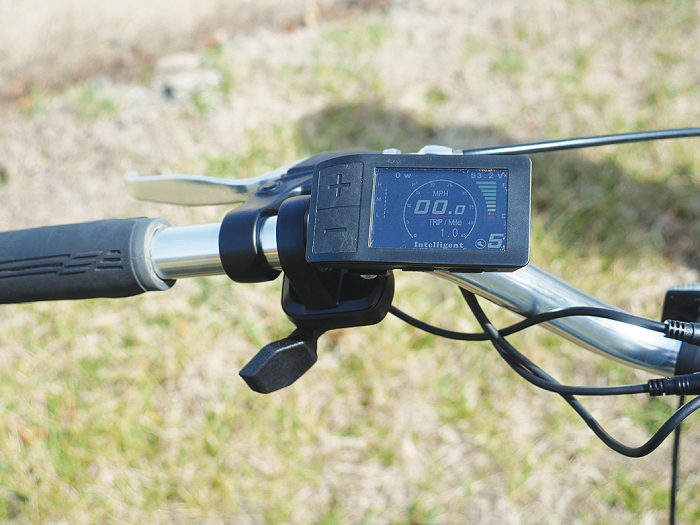
The handlebar fixtures were next, which meant removing the brake levers, gear shifter, and grip so I could move the brake cable to new brake levers; this communicated to the controller to shut off the motor upon braking. Be sure you’re able to adjust brake tension on your bike after moving the brake cable. I also added the thumb throttle and LCD display to the handlebars, which controls pedal-assist level and shows battery gauge – as well as odometer, average and max speeds, and trip time and length.
Near the end of the installation, I realized the bolts stemming from the hub motor were too wide for the fork of the bike where the wheel was to be installed. Luckily, I had come across a 30-minute installation of a Bafang hub motor at a show in 2018 by Justin Lemire-Elmore of Grin Technologies, where he explained that 30 to 40 percent of bikes have this issue and up to 2 millimeters may need to be filed. If you need to file like I did, be sure to check often whether you’ve filed enough, as over-filing could cause lost structural integrity in the fork.
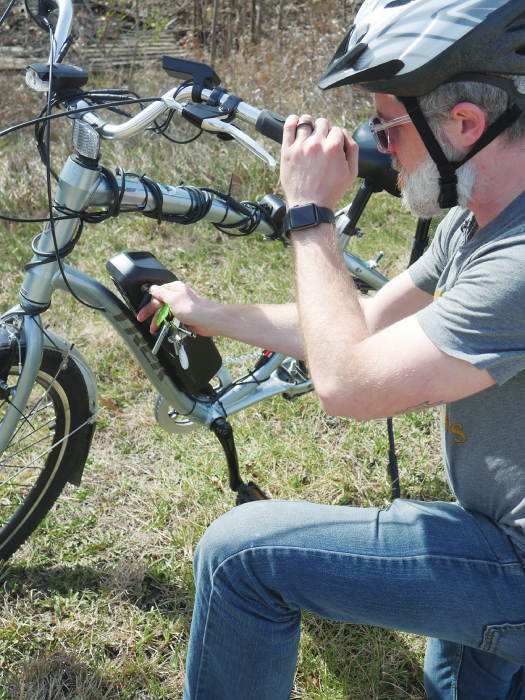
Finally, I affixed the battery to the down tube using the bolts that may be used for a bottle holder. The battery has an on-off switch as well as a lock and key to prevent the battery from being stolen while parked or detaching during the ride. Once all the cables to the components were connected and zip-tied down, the bike was ready to ride. And ride it did! It has incredible zip, and I could easily get across town in less than 30 minutes.
Your Future with E-bikes
With a newfound appreciation of what a walkable and bikeable city could be like, I asked Fry what the future of e-bikes might look like.
“As far as the add-on systems, I think it’s becoming a little more mainstream. Whereas before it was more of the tinkerer or the person who goes to the depths of the internet and ships something from overseas, [e-bikes are now] more of a mainstream item where it’s almost plug-and-play with some systems, particularly if you get a front wheel hub motor – you plug in maybe two or three wires and you have a connection. Some of those may have a thumb throttle or they may have different ways of sensing motion, and that’s when it engages the motor. But they’ve gotten pretty approachable for the general consumer.”
I’m glad I was convinced to pull off an e-bike conversion. Perhaps my experience will help you realize how the available e-bike options could fit into your life. I believe this can be a practical part of anyone’s lifestyle and, to those who worry about sharing the road, the more of us who ride, the safer it gets. I plan to be one of them, and I hope you’ll be one of them too.
Josh Wilder has worked with Mother Earth News in various capacities since 2017. In his current role, he’s responsible for overseeing the company’s content, from the magazine to podcasts and videos. He has spent his lifetime learning from some of the most talented creators, growers, and makers who thrive within DIY communities across the U.S. He endeavors to share those problem-solving skills with everyone interested in finding solutions. Ultimately, he hopes to spend his twilight years tending to a pumpkin patch.
Originally published in the June/July 2026 issue of MOTHER EARTH NEWS and regularly vetted for accuracy.






