
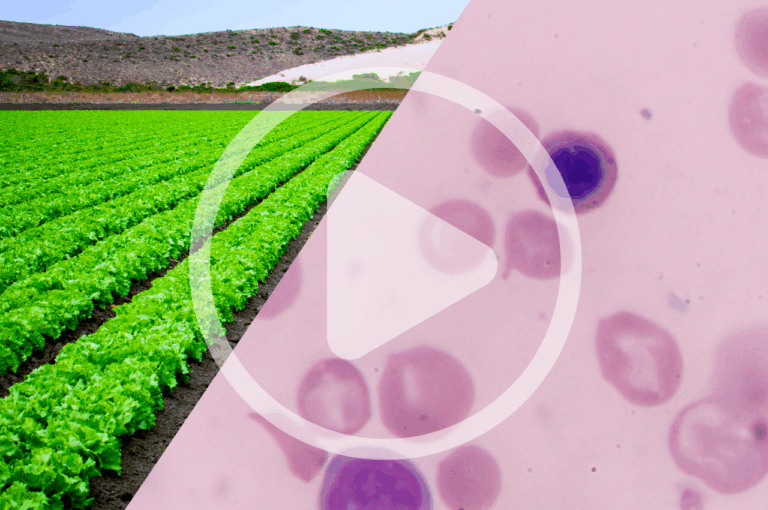
Sarah Mock: I’ve heard a lot of small farmers say that to some extent if you know that your produce came from a farmers’ market directly from a farm then you know where it came from, and we know that this current outbreak is affecting people in 35 states.
[00:00:11] This has to be from someone who’s doing like large scale distribution. So you’re probably less likely to get affected by this specific disease if you’re, dealing with someone locally. That doesn’t mean you’re not likely to get any disease at all, right? But just if you’re worried about this specific national issue buying your food locally is one way to maybe avoid that for now.
[00:00:31] Ana Skemp: I encouraged the folks at the coffee shop this morning to get a container garden and quick pop some soil and lettuce seed in, and pop it in the, in a bit of shade, because it’s still July, and they will have their own lettuce, baby lettuce, in two to three weeks.

[00:00:45] Josh Wilder: Welcome to the Mother Earth News and Friends podcast at Mother Earth News. For 50 years and counting, we’ve been dedicated to conserving the planet’s natural resources while helping you conserve your financial resources in this podcast. [00:01:00] We host conversations with experts in the fields of sustainability, homesteading, natural health, and more to share all about how you can live well wherever you are in a way that values both people and our Mother Earth.
[00:01:11] Hello, and welcome to Mother Earth News and Friends. I’m Josh Wilder. With me today I have Ana Skemp and Sarah Mock.
[00:01:18] The day after we recorded this episode, the FDA told Taylor Farms that iceberg lettuce produced in central Mexico had tested positive for cyclospora. That day, Taylor Farms recalled products in 27 states distributed primarily in the food service sector through restaurants such as Taco Bell and Jack in the Box. Two days later, the FDA shared that that test had ended up being a false positive, but still linked the outbreak to Taylor Farms based on an ongoing investigation. The CDC has, as of July 20th, linked 1,644 cases to this specific outbreak. It’s likely that this current outbreak [00:02:00] is the largest cyclospora outbreak in the US to date.
[00:02:03] One quick correction. Sarah states that 85% of carrots in the US are farmed by two companies. In fact, based on an article by Forbes, 60% of all carrots are farmed by two companies, Bolthouse and Grimmway. Now on with the episode.
[00:02:21] Ana and Sarah, if you’d like to go ahead and introduce yourselves.
[00:02:23] Ana Skemp: Hi, I’m Ana Skemp, lead editor with Mother Earth News magazine. I am a farmer, a homesteader, and I live in Wisconsin where we produce beef, sheep, a giant garden, and in the summer months we bring kids out to the farm to teach them how to grow food
[00:02:38] Sarah Mock: Awesome. And I’m Sarah Mock. I’m a freelance writer and researcher focused on the food and farm systems. Written a couple books, done research and work all across the country and all around the world just trying to answer some questions about ag policy, small farm economics the future of farming when it comes to climate change.
[00:02:56] Yeah, slowly working my way through all the jobs in agriculture.
[00:02:59] Josh Wilder: Why not? I asked Sarah to come on and talk with us today because I read her latest issue of her newsletter called “American Ag Is Less Regulated Than You Think.” Spinning off from the cyclospora outbreak that we’re having here in July of 2026, if you’re listening to this in the future.
[00:03:19] And this is an ongoing outbreak, so you know, we can cover a couple small things. I know Ana talked to a couple folks at coffee shop this morning about just what they’re concerned about. But really what I’m curious about and what you wrote about is like what can prevent this from happening potentially, and where are we at, and why, basically.
[00:03:39] Yeah. How did we get here? Ana if you wanna go ahead and set the stage for where we’re at right now.
2026 Cyclospora Outbreak
[00:03:44] Ana Skemp: You bet. So when I was at the coffee shop this morning, I asked everyone what their questions are, and I’ll just maybe go through a few of those, and you can give us a brief introduction of where we are right now, and then we can jump into a little bit more of how we got here.
[00:03:58] As Josh said, we’re dealing with an [00:04:00] increased level of cyclosporiasis cases this summer. People are wondering, so it’s not a bacteria, it’s not a virus, it’s a parasite. And if you could touch just a bit on how that’s different. People are very curious about where exactly it could be coming from, and I know there’s, possibly light, leafy greens, possibly lettuce, possibly raspberries, and hopefully more information on that will emerge within the next few days here.
[00:04:23] But like how does an outbreak like this start? Where does it, where does the fecal material originate specifically? And then just a lot of questions about what they should do next. Where can they find safe food? Do they need to stop feeding their kids fresh vegetables while we wait to hear more? And then just where to find safe sources of information.
[00:04:42] So if you could just give us a bit of an introduction on the what.
Usual Suspects of Foodborne Illness
[00:04:46] Sarah Mock: Totally. So I will lead off by saying I’m not an epidemiologist or like an expert in kind of public health in that way. But I can speak to the ag part of this and the regulatory system especially. To answer the question of where is it coming from, the answer right now is we [00:05:00] don’t know.
[00:05:00] There’s a couple reasons for that. One, FDA has a long traceback system, and I think rightfully is really careful about making sure that they know exactly where things are coming from in order to not cause a panic, not cause economic destruction to a bunch of industries or companies.
[00:05:14] I wouldn’t expect to know maybe anytime soon where this is coming from or where it originated. What we do know is that this kind of infection usually comes from fresh produce.
[00:05:26] It usually is a result of contamination in the field. A couple different ways that can happen, right? And again, we just really don’t know. We’ve heard about extreme cases in the past of, literally farm workers who didn’t have access to appropriate bathroom and hand-washing facilities coming into contact, or their fecal matter coming into contact directly with the plants.
[00:05:44] But it can also be, and is more commonly from water systems, the way the irrigation works where that water comes from, how it travels through the pipes, what is in the pipes, what is on the surface. Farming outside is a really tricky thing. You’re exposed to literally all of nature.
[00:05:58] And that is [00:06:00] why, just as much as I think it’s easy to look at the farm and be like, “Oh, that’s where disease comes from. That’s where we should be worried,” but also all fresh food travels through an elaborate and extensive supply chain to get to your grocery store.
[00:06:13] It goes into generally from the field, into a packing house, into storage facilities. From the field to a truck, to a storage facility, to another truck, to a third truck, to a distribution center before it makes its way to your grocery store where it, might not be sitting in the right temperatures.
[00:06:30] It might not be ripened correctly. Then also, of course, gets taken to your house, where maybe, you left it in the car for half an hour while you ran another errand, or you left it on the counter by accident for four hours while you were doing something else. So it’s not to say that the farm is the only place where there is risk for contamination or risk for a disease, or a bacteria, or a parasite to become more of a problem than it might have been originally.
[00:06:53] There’s lots of weaknesses in our food system. But yeah, we are most worried that, the contamination originated probably on a [00:07:00] farm, and then I think maybe to answer the last bit of that question, the only thing I’ve heard in the conversations I’ve had with experts this week is washing produce is really the only thing.
[00:07:09] Maybe cooking produce if you’re particularly worried. Spinach is something you can cook if you’re trying to keep eating leafy greens but you’re very worried about this kind of contamination. It’s salad season, so the idea of cooking your greens just seems so sad and disappointing.
Possible Sources of Safer Produce
[00:07:23] Yeah. I think the other thing is that I’ve heard a lot of small farmers say that to some extent if you know that your produce came from a farmers’ market directly from a farm then you know where it came from, and we know that this current outbreak is affecting people in 35 states.
[00:07:36] This has to be from someone who’s doing like large scale distribution. So you’re probably less likely to get affected by this specific disease if you’re, dealing with someone locally. That doesn’t mean you’re not likely to get any disease at all, right? But just if you’re worried about this specific national issue buying your food locally is one way to maybe avoid that for now.
[00:07:56] Ana Skemp: I encouraged the folks at the coffee shop this morning to get a [00:08:00] container garden and quick pop some soil and lettuce seed in, and pop it in the, in a bit of shade, because it’s still July, and they will have their own lettuce, baby lettuce, in two to three weeks. I want to circle back really quick, I was reading a bit about this particular illness this morning, and it does have a longer incubation period, so up to two weeks. And I was trying to remember everything I had eaten two weeks ago, and I mostly eat from my garden, but surely I’ve gone out to eat. I traveled through Michigan. I know I ate coleslaw in Michigan, which I’m regretting a bit.
[00:08:30] But it’s hard to track because of that long incubation period. So there’s a lot of like on the ground detective work, but it’s more challenging than if you were dealing like a, with a quicker illness. So I was seeing that, and then another thing is that and maybe you can speak a little bit to this.
[00:08:43] I was reading that illnesses caused by E. coli and salmonella, it’s really easy to track the DNA spread of those because they’re not changing or mutating or the genetics are stable during transmission, as opposed to this parasite that is reproducing sexually. This is from Michigan State University, and it sounds like it’s a little bit harder to track the DNA, which is complicating an already challenging situation. So that’s making it less ideal. Do you have anything to add about the particular challenges of this disease as opposed to some of the other foodborne illnesses we would be dealing with?
[00:09:18] Sarah Mock: I again, not a, not an epidemiologist Yeah … so I don’t know about the reproduction there. But I will also say, foodborne illness is already such a tricky thing to track, just because people get food poisoning a lot. 48 million Americans on average every year get food poisoning.
[00:09:32] And right, and that’s only… Which is one in six people, right? That’s every… think of your family, one of you got food poisoning last year. But that’s the thing is tracking food poisoning is very hard, ’cause a lot of times people get a 24-hour bug or like- … “oh, I must have just had something bad,” and you don’t report it.
[00:09:45] You don’t acknowledge it. You might take a survey, but if you don’t ever go to the hospital or the doctor to have that seen, that might not be counted. So I think to some extent- Yeah … really disappointingly, which is part of what my article was about, I think we’ve just accepted that a lot of foodborne illness is like, “Ah I [00:10:00] guess we’re all just gonna get sick sometimes.”
[00:10:01] And again, admittedly food is tricky. There’s a lot of different people doing a lot of different things with food, and it’s hard to do that perfect every time, and there’s no way we’re gonna eradicate all foodborne illness. But again one in six people every year is a crazy amount of sickness when it’s relatively preventable.
What Regulations Are in Place?
[00:10:18] Ana Skemp: So maybe we can talk a little bit about the regulation that does exist. So I raise beef for sale. I take my cows to slaughter both at a federally inspected meat processing plant, then we do some at a state-inspected meat processing plant.
[00:10:34] Small meat processing plants are not the norm, and most of beef production is done on giant plants. But I show up, there’s a licensed inspector right there. He looks at the meat, he looks at the facilities, and he’s there during the entire time of the slaughter and then the butcher. What does that look like?
[00:10:50] Is that same type of regulation happening on produce farms at large produce processing facilities?
[00:10:59] Sarah Mock: No [00:11:00] is the answer. So the meat in this country is regulated under a specific regulation that came out of Upton Sinclair’s The Jungle and the advocacy that came after that in the early part of the 20th century because people were so disgusted by what they learned about how meat was processed.
[00:11:16] And very specifically, slaughterhouses and egg processing facilities are regulated to that degree, where there is a USDA inspector on site, or supposed to be a USDA inspector on site, who meaningfully is empowered, supposedly according to the regulation, empowered to stop the line at any time and remove any meat or any animal from the system.
[00:11:35] And basically being able to say “Not this carcass, not this,” “You can’t slaughter this pig. You have to remove them because they’re not healthy.” In produce, there is none of that. There is no USDA inspector who is on-hand during large scale produce harvest or small scale produce harvest. There are best practices and there are regulations of things that have to happen, so some of them fall into kind of like the labor regulation of it, like requiring that there be porta [00:12:00] potties within a certain distance of where workers are working, hand washing stations, fresh water stations, which are really important for the health and safety of the workers, but also because if you don’t have a bathroom, then where are you going? You’re not gonna not go to the bathroom, and so that creates a food safety risk.
[00:12:16] Also, there are especially large scale producers who are selling to Kroger, to Walmart, to the kind of big places, big retail outlets for food, require GAP Good Agricultural Practices certification, which is a voluntary certification to the USDA.
[00:12:31] They might require like a HACCP plan, also some more, there are higher level food safety requirements that- talk about like how often workers need to wash their hands. What, like checking to make sure like your workers aren’t wearing jewelry, they’re not they don’t have artificial nails.
[00:12:47] They’re not doing, they don’t have things either on their body or like in the facility that could somehow end up like, in your head of lettuce or that could contaminate what you are harvesting. But yeah, in terms of is there [00:13:00] someone who like walks through a field of lettuce and like determines whether like this lettuce is healthy, it’s ready to be harvested, or on the other side, in the packing house, looking at fruits and vegetables and saying “Okay, this is operating correctly.”
[00:13:10] “We’re happy with all of the safety precautions being taken, and we have a high degree of confidence that this food is healthy.” That is all in a, on the honor system on the fruit and vegetable side of this. Essentially, you might get one annual audit maybe. But also the organizations who do that kind of oversight have also had their funding cut in the last two years.
[00:13:30] So there’s less audits like that happening.
[00:13:34] Ana Skemp: So what about food safety plans? There’s a lot of talk about, do, is there an official food safety plan that a producer has to have that would get shown and, you talk through it at your annual audit if you, assuming you had an annual audit. How standardized are those?
[00:13:53] Sarah Mock: I will say I’m not a food safety expert. Again I’m just a journalist, so grain of salt here from what I have seen and the research that [00:14:00] I’ve done. But yeah, I do think for people who are operating on a commercial scale, they are standard. I think how a lot of larger operations do that is they hire a food safety consultant who comes … and helps them set up a food safety plan, and then helps them execute it. And a lot of it is just like very straightforward if someone needs to wash their hands every time they come to this part of the line, how about we we put this part of the line nearest to the hand washing station?
[00:14:24] And let’s not have people cross over. If we’ve chopped something here, let’s not have the the unwashed produce delivered to the next station over. Let’s put those most dangerous things furthest away from each other.” That’s a lot of what a food safety plan is.
[00:14:37] It’s a lot of just practical thinking about how to eliminate exposure, eliminate prote- potential contamination. Let’s not store our hazardous cleaning chemicals above our chopping station. Let’s let’s make sure the bathroom is clean and far away from the most sensitive parts of where the food is prepared.
[00:14:56] So yes, they are in place. People have them. I think [00:15:00] to all my critiques of the regulatory system, I think a lot of people follow them and care a lot about food safety and are really thoughtful about it. The problem is And an outbreak like this shows that it only takes one person to not take food safety very seriously and to not be following their plan very carefully to make a lot of people sick. And honestly in a lot of cases when we look back in history at this kind of outbreak or similar kinds of outbreaks, a lot of people die. And yeah, that’s quite a risk to take on just I hope everyone’s doing the right thing.”
How Does Regulation Affect Small-scale Producers Versus Large-scale Producers?
[00:15:31] Ana Skemp: Could you maybe talk a bit about how regulation affects small-scale producers versus large-scale producers, and we don’t we are all suspecting it’s a larger outbreak because of the widespread nature.
[00:15:42] But historically, if these outbreaks have been linked to farms, to processing facilities, to large facilities versus small facilities, if you could just speak a bit about the scale.
[00:15:54] Sarah Mock: I will couch this by saying it’s a bit of a observation bias, right? Yeah. Large scale producers [00:16:00] make a lot more food and they distribute it a lot more widely. So if I’m a small farm and I produce, 30,000 pounds of food every year and I sell it locally in my market. If I have the worst outbreak imaginable, I can only affect that many people. If I’m like a huge producer making, where my farm produces three million pounds of food a year and I distribute nationwide or I export, suddenly I can affect like, 1% of the world’s population with a contamination. So I do think, and I think the bigger operations tend to take food safety more seriously and certainly spend more money on it. Whether it’s more money like relatively to the scale, I would have to look at some research on that. But so yeah, I do think most of our big national outbreaks have been linked to bigger operations, but that’s just that’s just because they’re big outbreaks.
[00:16:45] Like big farms make big flu, right? Big farms make big diseases. Not because they’re necessarily like more apt to not care about food safety, just because of like the scale of their distribution. So yeah, I mean I do think that the regulations and the scrutiny [00:17:00] on big farms is very different than the scrutiny on small farms in part because of that, because regulators have recognized that the risk any small farm has of killing 1,000 people across the country is relatively low compared to the risk that bigger farms have.
[00:17:14] And so there is more attention paid, I think in some cases to the bigger operations. But at the same time I would say the industry, the larger scale of the industry has a lot more political power to guide, I could say generously, or capture the regulatory system and basically determine the way that, tracebacks happen or when we determine like the source of an outbreak, like what happens to that producer. I think we, I, the industry has a lot of power to shape the way that is delivered. We’ve seen this in the past, right? The industry is often quick to say, essentially like we shouldn’t publicly talk about where this disease came from because if you say, it was from arugula, then everyone’s gonna stop eating [00:18:00] all arugula, and that’s not fair to everyone who didn’t, wasn’t part of this.
[00:18:04] And so like this, the CDC or the FDA should just be quiet about where it came from because otherwise it’s like an unfair punishment for more than just the individual farm that was involved. And I think there is a lot of like reasonable caution around just making sure that a whole industry isn’t affected or a whole category of produce, right?
[00:18:25] We talked a little off-air about are people gonna stop eating all fresh produce? That’s that’s the risk that the regulators have to keep in the balance of if you don’t say directly where it came from, then you’re causing potentially more general harm to everything that it could be.
[00:18:39] Whereas the more specific you lay the blame, the more intense consequence that individual, operation or industry is gonna face. So there’s tricky thorny questions in there for us to talk about as a country and our food regulatory system.
[00:18:54] But yeah, and what ends up happening is a lot of times by the time a traceback is complete and the time we actually by the [00:19:00] time we actually know what caused something, the threat is actually long over.
[00:19:04] And, that is not to be too cynical, but that’s beneficial to the industry.
How Can Antitrust Laws Improve the Food System?
[00:19:11] Ana Skemp: So let’s say tomorrow you take over fresh fruit and vegetable and herb safety in our country. What do you do?
[00:19:21] Sarah Mock: Oof. Well that is really tricky because I think there’s two things to keep in mind, which, the biggest thing is that right now the way our food system works is that we have gone all in on economies of scale, on the fact that if we grow a huge amount of stuff and process it at these huge centralized facilities, we can make things really cheap.
[00:19:42] And unfortunately right now, people need food to be cheap. People are not making enough money. People cannot afford food. People are putting groceries on buy now, pay later apps, and, like I don’t want anyone to starve. That would be my top priority, as the magic wand holder is let’s have no one starve.
[00:19:57] So I guess that would be a really [00:20:00] difficult thing because I think the most impactful kind of large scale change you could make is essentially like antitrust work, right? Like 85% of all carrots in the United States are grown by two companies. That’s not good for us. That’s not good for our country.
[00:20:14] That’s not good for the market for carrots. That’s not good for food safety, ’cause that means 85% of all carrots in this country come from two, essentially two facilities, and that’s that’s not just fresh carrots that you buy in the big bag. That’s also baby carrots. That’s also potentially frozen carrots.
[00:20:28] That’s canned carrots. Are people buying canned, a lot of canned carrots?
[00:20:32] Ana Skemp: Maybe. They’re out there. I don’t know if they still get purchased. Baby food carrots. Yeah there’s so many.
[00:20:37] Sarah Mock: Carrots that come in soup. Yeah. There’s a ton of… So all of that, or a dramatic proportion of that is coming from a single facility, which means if you had an outbreak in a single facility or on a single farm then you’d affect all of that.
[00:20:49] The best way to get around that is not to say “Let’s have sky-high regulations in that one facility.” It’s to say, how about instead of one facility, we have 100 facilities? How about we, instead of two farms, we have [00:21:00] 1,000 farms? And we distribute that better, and then when you have an outbreak in your 1 of 1,000 facilities, you can do potentially the right thing, which is what, in some other countries how the food system safety works, which is ah, you’ve had an outbreak and you’ve traced it back to a facility.
[00:21:15] Let’s close the facility and say “What happened here? Let’s figure it out. Let’s make sure it doesn’t happen again. Let’s take some steps to adjust to this system,” and then we can reopen it without, disrupting the whole food system and losing a single company or a single industry, half of their revenue for the, what- whatever that looks like.
[00:21:33] And this is dramatic. There’s no way you would ever close a facility for so long that you lose half of your revenue for the year, but yeah. That would be, it structurally, systemically reducing the size of our production and our processing and packaging facilities to be able to have a more resilient system that’s better distributed so that, when you have one parasitic outbreak on one farm, it doesn’t affect people in [00:22:00] 35 states.
[00:22:01] It, like I think that would be better. That would be my first step. Huge, very hard work to do but I think that would be better than trying to have a ton of new regulators.
[00:22:11] Yeah. I think the antitrust work would be the most important in my mind.
Prevention of Foodborne Illness Over Cure
[00:22:15] Ana Skemp: So we would need a farm bill that supports farmers to diversify then, and try to compete with these larger carrot-producing farms, corporations. What about of the, the possibility of monitoring sewage water has floated around a bit with this outbreak.
[00:22:35] Is that feasible? Is that realistic? Should we be doing it?
[00:22:40] Sarah Mock: I do not know enough about this probably to say, but the idea speaks to something that is true, I think, throughout the American food safety system, which I will say America does have, in some ways, like the world’s safest food supply.
[00:22:52] There’s a good number of stats to back that up, and that is one of our big brags, right? We have the cheapest and the safest, and that is [00:23:00] the main claims we can make about it. And safe- by safest I specifically mean disease, not health the health of it. But the problem is the US food system is generally, we do not do a proactive food safety regulation.
[00:23:14] We do not prevent diseases and contamination. We treat diseases and contamination. We rather than taking the time to ensure, super clean fields that prevent contamination, be really cognizant of food safety all the time, empowering food safety experts and professionals throughout the system, we just say “It’s fine.
[00:23:33] Right before our produce like goes into the boxes, we’ll spray it with an antibiotic.” And, or we say, we are like, “We’ll, bleach the meat,” or, “We’ll, do something right at the end to try and remove the bacteria or to limit the spread of the bacteria at that moment.”
[00:23:49] Basically so we can be lazy the whole process and then we’ll deal with it by just like applying some chemical right at the end. We do a lot of that. And you know what? It’s effective, [00:24:00] but we could just do it different and proactively. And I think like to me, monitoring sewage is like a similar thing.
[00:24:06] It could work and it could have good outcomes, and I, it doesn’t mean we shouldn’t do it. Nothing is a silver bullet and like when it comes to saving people’s lives, we should do all of it. But, or what if we just didn’t maybe use maybe we compost our human waste before we’re like applying it to, we could take other steps. There’s like other thoughtful, careful things we could do that don’t involve I don’t know, changing the, our whole like sewage, waste sewage system or, I don’t know. Again, not an expert on waste management either, so it’s tricky.
[00:24:39] Ana Skemp: So yeah, and there I’m just touching on monitoring communities to try to predict where it’s going next because of this longer two-week incubation period.
[00:24:46] Should we be monitoring water to see “Yep, here it is in this town, and now it’s in this town,” and that might help some of the monitoring efforts. So when I think about this, fed- federal regulations, state regulations, food safety, the whole [00:25:00] thing feels untouchable and a little bit scary to me, and I just wanna grow food in my own garden, and I don’t know how to change it, and I don’t know how to fix it.
[00:25:09] And I think a lot of our readers would feel the same way. They just they wanna reach out to local farms. They wanna do it in their own garden. But having access to that food is also a privilege. It’s expensive. It’s more expensive to source that food locally oftentimes, and that’s not fair. What… so let’s say I wanna reach out to my representative.
[00:25:31] The system isn’t working for our country. What even can I specifically ask for other than I want more carrot farmers? I want there to be 1,000 carrot producers in this country such that when there are outbreaks, we can trace it better. What specifically can we ask for?
[00:25:48] Sarah Mock: I think the easiest ask given where we are at this moment, not probably something we’re gonna see, is to just enforce the rules we already have. So there actually are a lot of [00:26:00] food safety rules. A lot of it, for better or worse, is voluntary.
[00:26:02] But there are things in place. Our meat is probably the most vulnerable part of our system. There’s a lot of things that, a lot of diseases, bacteria, funguses who can, that can live in meat. And because we cook meat at different temperatures, we don’t always cook it things to well done it can be one of the most dangerous kind of like food items that we buy and prepare at home.
[00:26:23] We have a lot of rules in place to regulate our meat system. We have allowed those rules to be eroded. We have allowed the industry to capture the way meat processing works. We’re allowing right now slaughter plants to set their own line speeds, which is if you’re watching 400 pig carcasses pass by you every hour, you’re not examining them carefully.
[00:26:42] It’s not possible. That’s four carcasses a second. Like- Yeah … wait, is that math right? It’s more than four carcasses a second.
[00:26:49] Ana Skemp: It’s too many to properly-
[00:26:50] Sarah Mock: It’s too many …
[00:26:50] Ana Skemp: see everything you need to be seeing …
[00:26:53] Sarah Mock: the front and the back. You can certainly only look at one side. So yeah.
[00:26:56] Let’s… So I… That’s actually a super easy one, [00:27:00] right? The federal government should better fund FSIS, the Food Safety Inspection Service, so that regulators have the power to do their work in slaughter plants.
[00:27:08] We should not be eroding our regulatory state. That’s at CDC, FDA, USDA. A- and really across the federal government, right? Because all of this comes down even to the way our banking system works, the way our financial system works, the fact that, we’ve, we have … We can bring antitrust lawsuits against companies.
[00:27:25] We can tell the two major carrot producers in the US “You have to split up.” The federal government can do that to companies, but we have been defunding and de-empowering our regulators for the better part of 50, 60 years. So you can ask your regulator “Hey we should be bringing antitrust lawsuit against maybe the top four seed companies that own 90% of the market, the top four meat processors who own 90% of the market.
[00:27:50] Like, how about we do some antitrust regulation?” So yeah, I think as simple as saying “We need more money for food safety inspections. That needs to be a priority. We [00:28:00] need antitrust regulation. We need to fund regulators at all of these agencies.”
[00:28:04] That’s the most straightforward way if you’re gonna have a conversation with your congressperson about, what can we do now.
[00:28:09] Also, states have some power to do food safety regulations. So you can also contact your state level officials and say “Listen, the federal government’s falling down on their job.
[00:28:17] Our state needs to step up.”
[00:28:19] Ana Skemp: So it’s interesting how when we’re in the middle of something like this, you assume that things are so safe until you realize that perhaps they’re not. So you assume your county health department is connected very deeply with your state health department, which is very deeply connected with the federal regulators, but that’s not necessarily the case, is it?
[00:28:39] Sarah Mock: No. Yeah, I would say again, not an expert on the way that the kind of health monitoring, human health monitoring system works, but my impression is that those three groups actually have pretty different jobs.
[00:28:51] Ana Skemp: Josh, what do you think?
[00:28:53] Josh Wilder: More of a cultural question about just the trust we put in farmers and the [00:29:00] agrarian ideal that we have for, our foods, like the farm, imagery on all the grocery store packaging and how would you start to change that picture of the reality versus the cultural understanding?
[00:29:19] Sarah Mock: Oof. Another very big question. Arguably the question I’ve been working on my whole career, and don’t know that I have a great answer to it. But I think a big part of it is just being honest, right?
[00:29:28] And having frank conversations and being willing to say… I cited a bunch of examples in my article, but we have a ton of evidence that not only are there not that many rules necessarily that that are being regularly enforced on farms, they’re being broken all the time.
[00:29:45] And to devastating effects, right? We know that there’s like a non-zero element of slavery in farm labor in the United States. People literally in shackles. Locked in shipping containers overnight. That [00:30:00] is a thing that is happening because there is basically no regulation in ag labor, and the little regulation there is under-enforced, unenforced.
[00:30:08] The regulators have no power, and they have no resources with which to do their job. That’s just like labor. There’s also we’ve been talking this whole episode about food safety. That is another place where there’s a combination of no regulations at all, voluntary regulations, unenforced regulations, and regulations that are like technically being enforced but like they’re so friendly to the industry that they have no real impact.
[00:30:30] I think that’s not crazy. A big part of the US economy, honestly more than people think, runs that way. But I don’t know. A lot of the rest of the economy isn’t selling things that you put in your mouth and swallow. I don’t know. Human health is really important, and food is a big part of that.
[00:30:47] And so I guess I think raising these stories and having these hard conversations in the moments when they happen, especially like right now and saying “Listen, we do trust farmers. We have the data on that.” Americans trust farmers more than l- [00:31:00] any other occupation in the US. But they, that doesn’t mean they shouldn’t earn our trust.
[00:31:07] If farms are doing a bad job or if we think that systemically, like something is failing in our food or farming system, we should call that out and have hard conversations and not just defer to farmers because they say, “I would never.” Which often is the end of the conversation. People talk to farmers and they say “I would never do anything to harm my customer.”
[00:31:26] And we’re like, “Okay. I guess that’s the end of the story.” I guess they would never, so we just take their word for it. And how do any of our other regulatory systems work? It’s not because we think that like people are necessarily twiddling their fingers and laughing maniacally and thinking of ways to harm others.
[00:31:41] It happens because of incompetence, because of accidents, because of corner cutting and cost saving and the point of regulations is to discourage those things. And so let’s discourage them, not just on the industries and businesses that we don’t trust, but also on everyone. [00:32:00] Because, farmers sometimes do it too.
[00:32:02] Food companies sometimes do it too. So let’s just let’s just have a level playing field, equal rules for everyone, where we say “Listen, great. You care about food safety. We also do. Let’s come in and audit you. Let’s come in and have an inspector show up regularly. Let’s take a look at what your food safety system looks like, and we’ll decide whether or not it is appropriate.”
[00:32:22] But the way our regulatory system works right now is we just take people’s word for it. And I think we should probably, trust but verify.
[00:32:33] Josh Wilder: Like you said, big question. I appreciate your standpoint. Yeah, and like we were talking about with outbreaks in general, like obviously there’s a big divide between large producers and the small scale producers. And it’s not easy to be a farmer.
[00:32:48] I think like you said when you know no one’s looking, it makes it harder to do the right thing.
[00:32:54] Sarah Mock: Especially when the right thing is very hard and expensive.
[00:32:58] Josh Wilder: Yeah.
[00:32:59] Sarah Mock: Which it is, [00:33:00] and we know that it is, right?
[00:33:00] We know that you can make a lot more money selling bacon and pork chops if the pigs are going by at 400 per minute instead of 200 per minute. We just know that’s true. So of course the industry wants that. But that doesn’t mean we should give it to them
[00:33:14] This was a kind of public conversation we had after 2008, but how would CEOs act if you could go to jail for a mistake you made? How would food companies act if you could go to jail for killing people with your food? I’m not saying that we should send people to jail, but like how would it change the way a company thinks about food safety if your, if a food safety outbreak was traced back your facility had to shut down for a year or, a month for every person who died. And like part of this comes back to antitrust.
[00:33:47] I think part of the problem is that like the economies of scale are, we’re operating on are too large, where… not to pick on carrots, I’ve picked on carrots too much, but if we traced a food illness outbreak back to carrots, like what if we just said [00:34:00] “No carrots for six months.”
[00:34:02] “No one’s gonna buy them. No one’s gonna sell them. We’re just gonna not do it while we figure out what went wrong with the carrots.” And like what if we did… I don’t know. I just would be excited to hear us have a different conversation that’s not just the conversation we’ve been having for the last 30 years, which is just like like the system is what it is.
[00:34:18] All we can do- Yeah … is try and make tiny changes with what we have, and otherwise just let it all keep going, business as usual.”
[00:34:25] Ana Skemp: Because it’s clearly not working.
[00:34:28] Sarah Mock: It’s clearly not working.
[00:34:33] Ana Skemp: I support this no carrots for six months because carrots are so good, and carrots are, carrots have done nothing wrong, let us be clear here.
[00:34:39] Josh Wilder: I don’t know if it’s on record, but I’ll put it here. I’m on record now as saying carrots are my favorite vegetable.
Public Awareness of Foodborne Illness Prevention
[00:34:44] Ana Skemp: Carrots are so good. But what if we couldn’t have carrots for six months? It would bring such greater public awareness to the fact that we do need to do something about these outbreaks to move to a healthier future. I like this. I like this [00:35:00] idea.
[00:35:01] Sarah Mock: There’s like a part of me that hesitates to say this, but I really think for some people, like again, like there are people even despite this whole conversation that we’ve just had, who would say America still has the healthiest food in the world.
[00:35:13] And I guess like for those people, the like 3,000 people who die of food poisoning every year are just like collateral damage. Just acceptable losses to have, I don’t know, food be as cheap as it is. I do not think it would be possible to eliminate foodborne illness deaths to zero, but I think we could get it down further than this, further than 48 million sickened every year.
[00:35:39] And I think there’s actually a lot of people who think “No, that seems reasonable to me. That’s like the right amount. I’m willing to accept that at that level because like I like the amount of profit we’re making, I like the scale of our facilities, I like how much land we own, and so I’m just willing to accept the status quo.”
[00:35:56] I don’t feel that way. I would like not feel [00:36:00] like I’m taking a huge risk every time I eat a salad. But there is like not zero people who think it’s reasonable.
[00:36:10] Josh Wilder: Yeah. I’m hoping by the time this episode comes out that the current outbreak is over and, they’re on their way to identifying its source and cleaning it up to the best of everyone’s ability.
[00:36:24] But I have never seen diarrhea, in so many headlines it’s not something that we talk about openly a lot. So it’s something.
[00:36:36] Ana Skemp: It’s not just diarrhea, Josh.
[00:36:37] It’s explosive, watery diarrhea.
[00:36:39] Josh Wilder: It can go on up to a month.
[00:36:41] Ana Skemp: Yeah. And if you’re immunosuppressed, it can come back. It’s not just 100% curable, which is also terrible.
[00:36:51] Sarah Mock: Yeah. And we know, right? That diarrhea is a major cause of death in the world. It causes severe dehydration. It can cause other micronutrient deficiencies when it goes [00:37:00] on for too long.
[00:37:01] Again, I feel like we’re so quick, it’s so easy to some extent to be like, “Everyone gets food poisoning sometimes.” Oh, whatever, you eat oysters at a gas station or you make some other weird choice in your life and you just accept that “I’ma be sick for a little bit.”
[00:37:15] But we don’t have to accept that. We could have safe food.
[00:37:19] Ana Skemp: It’s a weird reality, isn’t it? To think I’m sure all three of us, that is just part of our reality. We will eat something nasty in the next year, and we will probably get sick.
[00:37:30] Sarah Mock: Yeah, and it doesn’t even have to be oysters from a gas station.
[00:37:32] It could be just a regular salad.
[00:37:34] Ana Skemp: I think I just wanna eat salad from my garden. It’s what I’m gonna keep doing.
[00:37:40] Josh Wilder: Yeah, and most of the time the individual who comes down with that, their blame doesn’t go past the specific place they bought that food.
[00:37:49] Sarah Mock: Yeah. Or even, my partner’s a great example of this.
[00:37:52] He is always eternally “It was ever, whatever I ate last.” And it could be something you ate two days ago. It’s just easy to say “Oh, whatever I ate four hours ago [00:38:00] upset my stomach. Now I’m gonna be sick for a minute, so it’s fine.”
[00:38:02] Again, that’s why it makes foodborne illness so hard to track is because it’s underreported. People chalk it up to other things. We have so many regular chronic digestive issues in this country that probably sometimes people have food poisoning and don’t even know it.
[00:38:16] So yeah. That’s the scariest thing about our utter lack of regulatory enforcement is that it means we don’t even have that good of an idea of how severe the problem is.
[00:38:26] Josh Wilder: And like you mentioned, being more of a Band-Aid, cleanup treatment mindset than a prevention it’s not an easy thing to put a Band-Aid on.
[00:38:33] Sarah Mock: Yeah.
[00:38:34] Josh Wilder: In any case, I think you have some great ideas. The idea of, no more carrots if it’s an issue. There are ways, there are paths, but it needs some out of the box thinking.
[00:38:46] Sarah Mock: Related to that, we could also just say again, this is extreme and I’m not advocating for any particular like, company, but very famously, Jack in the Box sickened hundreds of people, but children died. Maybe there shouldn’t be a Jack in the Box anymore. [00:39:00] Maybe we should have just said “Listen, individually, like you are free, you are all free to start a different company if you want, but like this company, it’s gone.
[00:39:07] Like you killed kids.” That’s the end of Jack in the Box. But you know what? Jack in the Box is still very successful today, and it’s like a kind of a marketing miracle that like people just don’t remember that that happened, and that is a lot of companies.
[00:39:24] Ana Skemp: I don’t remember that. I wouldn’t eat at Jack in the Box, but I also don’t remember that happening. Was the source of that ever traced? Is it from the poor meat inspector that’s having to watch way too many cows go by per minute? Is it the processing, the slaughter, the handling, the cooking? There’s so many steps is the problem too where it could happen.
[00:39:47] Sarah Mock: Yeah, I think I would have to look back at the record. I haven’t looked into this one in a little while. But I think it was a supplier. But then also to some extent, even if you, your supply is contaminated, it, like you as the [00:40:00] like receiver are, hold some responsibility for that too. You’re meant to do some inspection, but also like the handling matters a lot, especially with things like bacteria. So I’d have to look into the, again, into what ex- exactly happened in that situation. But it was very specifically linked to Jack in the Box restaurants. So I would guess at some level it, it was a result of like standards, practices that they were doing internally there.
[00:40:23] Josh Wilder: I don’t think allowing this sort of, like you said, collateral damage is acceptable. Feeding people first and foremost, making sure they’re not hungry. Yes, we need to figure that out.
[00:40:35] Ana Skemp: Our food, our water, our healthcare, shelter basic human needs.
[00:40:42] Sarah Mock: Yeah. It’s easy for me at least to say “Oh yeah, if I get food poisoning, yeah, it’ll be uncomfortable for a few days and I’ll have a bad time, but I’ll be fine.” Lots of people, that’s not true. Little kids, our aging population, people who are immunocompromised. Could you just think for a minute about like you are doing [00:41:00] chemo, you are fighting for your life trying to beat cancer, and then you get got by like a freaking foodborne illness because you were trying to eat healthy? What are we doing to ourselves and each other? Come on, you guys. Yeah. It’s just, yeah, it’s wild.
[00:41:16] We’re in a wild moment in human history in terms of caretaking.
[00:41:22] Ana Skemp: We are.
[00:41:24] Josh Wilder: If anything, hopefully this can jog a little bit of change. That’s my morsel of silver lining that I’ll wrap this up on.
[00:41:34] Ana Skemp: I’m just gonna ask, where’s the optimism, Josh? Where’s the optimism? Things might get better. We need change.
[00:41:38] Josh Wilder: We’ve been working on this at Mother Earth News for 56 years now. Ideally it doesn’t take another 56 years,
[00:41:44] Sarah Mock: I always like the hopeful message of the thing is we’ve done this before, right? We got food safety regulations in the first place.
[00:41:51] They were stronger in the past than they are now arguably, but we could have them again. We just know what it takes, [00:42:00] right? Organizing, advocacy being resistant to I mentioned this in the article, but inevitably all companies, when you say, “We’re gonna regulate you. We’re gonna give you more rules.
[00:42:12] We’re gonna tell you how to run your business in these ways so that you don’t cause public harm,” they will say, “We can’t do that. It’s not possible.” They will say, “If we have to do that, you’ll put us out of business.” And then they’ll say inevitably, if they’re food companies, “If you make us do that, everyone will starve.
[00:42:28] There will be no food left, and we’ll…” A threat. It’s a racket, right? Would be a shame if something happened to your food system if you try and regulate us. And every time we’ve ever regulated or broken up a company or added new rules, they have made these same arguments. And it, when we originally put in food safety inspection rules at, like at the turn of the century after The Jungle was written, all the big meat packing companies made those same arguments.
[00:42:55] They said, “There won’t be any meat at all. It’ll be so expensive, no one will be able to afford it. It’ll be the [00:43:00] end of raising cattle in America.” That was part of their argument. “We’ll never recover if we’re not allowed to dump hazardous waste into our meat products.” And you know what?
[00:43:10] The meat sector was stronger after. Economically stronger. There was more trust. More people bought meat. People were more excited about the products. Workers were treated better and had a better time working at these plants. And like for 100 years, meat processing in the United States was like a boom industry because of the regulations.
[00:43:33] Companies don’t want to do it if they don’t have to, but often forcing them to do it anyways leads to better results, not just for everyone, but for them too. So I don’t know. It is just like inevitably we will hear tears and tantrums and threats when you go to industry and you tell them “There’s new rules and you’re gonna have to follow them,” or, “We’re gonna break you up and you’re gonna be smaller companies instead.”
[00:43:58] But it’s imperative on [00:44:00] us to just say, “We don’t believe you. We don’t care. We’re not gonna listen to your sad stories.” And yeah, and then it just takes it just takes hard work and good organizing and collaboration and yeah. The hopeful message is we’ve done it before, and we can do it again.
[00:44:14] Ana Skemp: We need to keep fighting to keep people safe.
[00:44:17] Sarah Mock: Totally.
[00:44:18] Josh Wilder: I approve this message. Thanks so much and Yeah, thank you for joining us.
[00:44:22] Sarah Mock: Yeah, thanks for having me.
[00:44:23] Josh Wilder: Yes, absolutely.
[00:44:23] Thanks for joining us for this episode of Mother Earth News and Friends. To listen to more podcasts and get connected on our social media, visit www.motherearthnews.com/podcast. You can also email us at podcast@ogdenpubs.com with any questions or suggestions. Our podcast production team includes Alyssa Warner and myself, Josh Wilder.
[00:44:47] Music for this episode is the Song Hustle by Kevin McLeod, the Mother Earth News and Friends Podcast is a production of Ogden Publications.





