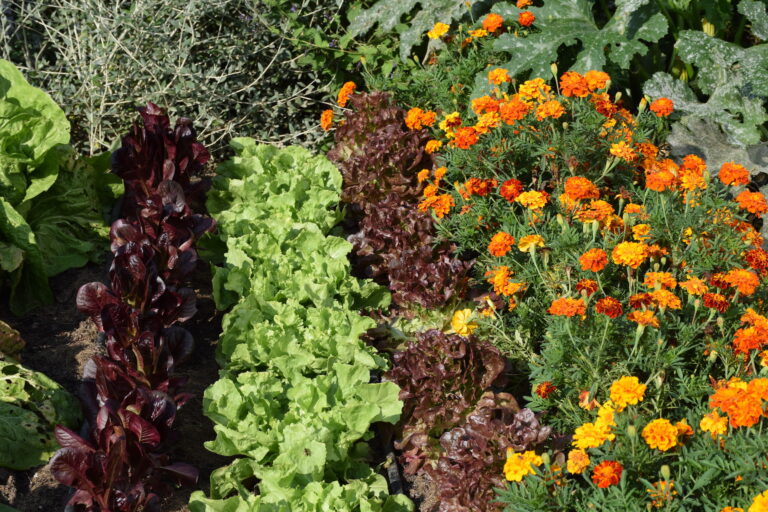
Learn a little of the science behind companion planting and find out why companion planting flowers with vegetables is beneficial for your garden and your plants.
Lure in Pest Predators. Monocultures of vegetables are easy prey for pests. By growing flowers such as cosmos nearby, pest predators such as hoverflies (syrphid flies) will be drawn into your garden.
Deter Pests. Growing flowers amongst vegetables creates a patchwork of textures, smells and colors that will confuse many insect pests — they are literally thrown off the scent!
Some flowers, such as marigolds, actively repel pests such as whitefly while attracting beneficial bugs. They’re ideal for growing alongside tomatoes that are prone to attacks.
Suppress Weeds. If beds will be empty for a spell between crops, sow a flowering cover crop to suppress weeds. Some, such as phacelia and buckwheat, also attract beneficial bugs and help improve soil structure. Low-growing, non-invasive flowers with dense foliage or broad leaves, such as marigolds, can also be used to help suppress weeds between rows of vegetables.
Annual and Biennial Flowers. Many annuals and biennials — which complete their lifecycle within one or two years, respectively — grow quickly and can be sown alongside vegetables or separately in their own bed, or can even be used to grow a stunning miniature wildflower meadow. Many, such as poppies, foxgloves and calendula, will propagate themselves by self-seeding from one year to the next.
Perennial Flowers. Perennial flowers grown near the vegetable garden will reliably attract beneficial bugs to help pollinate edibles and control pests.
Popular perennial flowers include astrantia, helenium, hollyhocks, monarda, and penstemons. Perennial herbs such as oregano and fennel also produce flowers that attract beneficials.
Plan Your Flowers. Our Garden Planner includes a selection of suitable flowers to grow alongside your vegetables. Clicking on the information button of a particular flower in the selection bar displays a panel providing full growing instructions and suggested companions. They can easily be added to your plan, and the accompanying plant list shows you when all the plants in your plan can be sown, harvested…or admired!
Learn more about companion planting in this video.
Get More Tips With These Great Gardening Resources
Our popular Vegetable Garden Planner can help you map out your garden design, space crops, know when to plant which crops in your exact location, and much more.
Need crop-specific growing information? Browse our Crops at a Glance Guide for advice on planting and caring for dozens of garden crops.
More Videos
Watch more videos on gardening techniques and other self-reliance, DIY topics on our Wiser Living Videos page.