

Building an Emergency Greenhouse
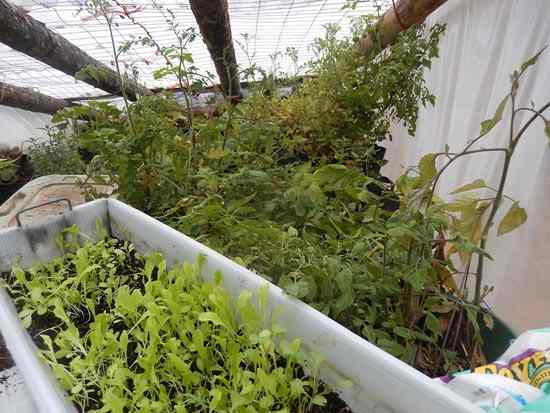
Living in a log cabin in Montana at an elevation of 5,825 feet means we usually have a short outdoor growing season. We’ll start some of our plants in indoor pots as early as March, and then move them outdoors when the weather warms up. But Montana weather can be unpredictable. When the temperature plummeted in early September last year, we needed a greenhouse fast.
I cut four 18-foot poles from trees on our property to create the roof supports for our emergency plant shelter. Then, I nailed a board to the outside wall of our cabin for the ends of the poles to rest on. After positioning the poles, I nailed them to the board and to the cabin. We covered the supports with salvaged welded-wire fencing. Then, we placed some clear, corrugated polycarbonate panels on top of the fencing. We covered everything with 4-millimeter clear plastic sheets. A few days later, while running monthly errands in town, we bought a 10-by-25-foot sheet of 6-millimeter clear plastic and put it over the 4-millimeter plastic.
The plants did great. The only thing we regret is not having much headroom inside our emergency greenhouse. Overall, we’re amazed that our simple structure protected our plants so well. The solar advantage is significant on sunny days, when the interior temperature can climb to more than 80 degrees Fahrenheit.
David Curran
Missoula, Montana
Turn T-Shirts into Rags
I don’t want the same rag that was used to wipe up unpleasant messes to also be used on my kitchen counters. And I don’t want to always be asked, “Which rag should I use?” So, I have a rag system. I cut all of my rags from worn-out T-shirts. For the kitchen, I cut either a white or navy T-shirt into squares, place one square on top of the other, and sew a zigzag stitch around the edges. I use these for dishcloths and for wiping counters. The double thickness makes them a nice weight and easy to identify. Next in my system are the cleaning rags in assorted other colors. I use these to scrub sinks, wipe up spills on the floor, clean windows, etc. I keep them on the shelf below the navy and white rags and wash them with the general laundry. After a rag has become very stained, I move it to a bin in the garage that holds rags destined for dirty jobs involving grease, shoe polish, wood stain, etc. I either rinse these rags outside with the hose or throw them away after I use them. This way, we use a minimum of paper products but also maintain the level of cleanliness I desire in our home.
As a bonus use for old T-shirts, I cut the body portion of the shirt into a continuous strip and stretch it out to make what I call “T-shirt yarn.” I use this yarn to tie up plants in the garden. No buying twine for me!
Karen Dawson
Kingsburg, California
How to Keep Moose (and Deer) out of Your Garden
I live in Palmer, Alaska, and have an acceptable garden, but this hasn’t always been the case. When we first started, after having gardened in urban Nome, I wasn’t concerned about garden predators. I quickly learned that a moose could wipe out our garden in one night. This was especially true if I was ready to harvest the next day. I tried several chemicals over the course of a few years, but nothing worked well at keeping moose out of the garden. I then tried a battery-powered electric fence. The moose just charged right through it. I varied wire spacing and tied ribbons to the wires, to no avail. I got to talking to one of the old-timers in the area, and he offered a solution to my problem. He told me to cut the ends out of some cans, and then attach those ends to my electric fence by bending them over the wires. Then — this is the important part — spread peanut butter on them. Apparently, what happens is that the moose either licks or smells the lids and gets a shock. I’ve not had a moose in our garden for the past 15 years. I put the peanut butter on the lids in early spring and once again in mid-summer.
Maynard Perkins
Palmer, Alaska
Seedling Support
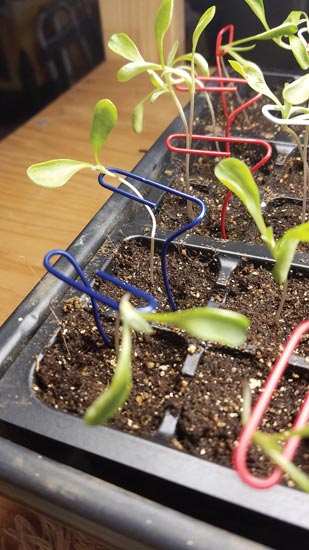
When sprouting seeds indoors, sometimes the seedlings can get leggy if they don’t receive enough light. Instead of letting them fall over into a tangled mess, you can use the paper-clip method. Unfold two of the three bends in a paper clip, and then insert the long end into a plant cell. The loop at the other end will act as a perfect support to thread the seedling into.
Jack Ripley
Estell Manor, New Jersey
Repurposed Seedling Trays
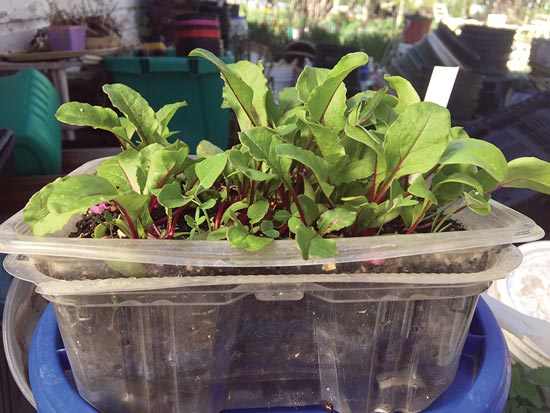
As an urban farmer who practices permaculture, I recycle, repurpose, and recondition as much as possible. The biointensive gardener John Jeavons taught me to start seeds in deep trays so the plants could develop strong root systems. The system I use requires three containers or trays of the same size. I like to repurpose the plastic containers that salad greens come in. Here’s how to do it: Poke holes for drainage in one container, and then put some pebbles or gravel in another so that when you stack them there’s adequate drainage. Place the container with drainage holes on top of the bed of pebbles in the other container and fill it with your favorite starting mix. Use the third container as a humidity dome until your babies are ready to face the world. Just remember to drain the bottom occasionally; otherwise, it’ll get too wet.
Colleen T. Bell
Fairfield, Iowa
Use Tennis Balls to Prevent Net Snags
You can use tennis balls to prevent netting from snagging on poles. Cut a slit in a tennis ball and slip it over the end of a pole that you’re using to support the netting. The tennis ball will prevent the netting from catching on the end of the pole and will make it easier to move the netting.
Kirk Miller
Richardson, Texas
Several Uses for Zucchini
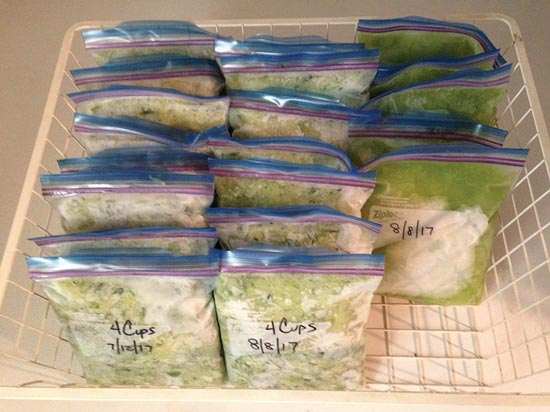
We have a large family with six children, which is why we have a large garden. We always have an abundance of zucchini, so I shred it, freeze it, and then sneak it into every meal that I possibly can. It cooks down, and no one is the wiser! I add shredded zucchini to ground beef, casseroles, meatloaf, cheesy potatoes, scrambled eggs, soups, brownies, cake — you name it! My husband took it a step further: Now, when we process zucchini, we strain the broth out and freeze the liquid to use in soups and stews, and no one has a clue! It’s a great way to use up the abundance of zucchini and secretly add nutritional value. Frugality, gardening, and hidden nutrition — just a few of my favorite things!
Kari Elmer
Geneseo, Illinois
Double-Duty Dehumidifiers
I have two dehumidifiers in my basement that serve two purposes. They dry the clothing hanging on my wooden clothes dryer, and they remove moisture from my basement. I pour the water from the dehumidifiers into jugs to save for watering my houseplants, vegetable garden seedlings, and outdoor hanging baskets.
Scott Hoffman
Vancouver, Washington
Marking Seeds to Save
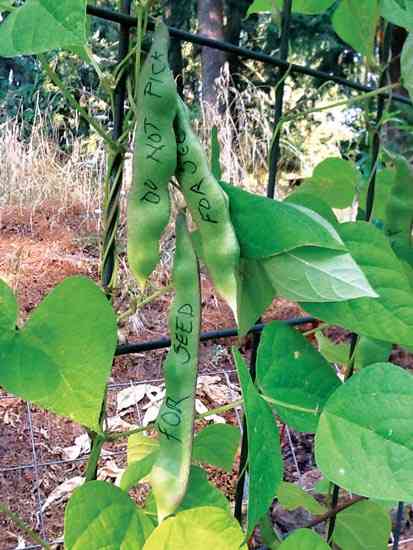
These ‘Ruby Crest’ broad beans came from a Portland woman who started her own seed company called New Dimension Seed to promote Asian vegetables. I mark the first set of the biggest and best beans with a Sharpie so my helpers don’t accidentally pick them before they’re mature.
Janice Becker
Wilsonville, Oregon
Large Cardboard Pieces for Weed Suppression
Regarding the Country Lore tip “No Need to Pull Weeds” in the October/November 2017 issue, we also use cardboard as a weed barrier in our vegetable garden, but we use grass clippings on top instead of straw. We’ve found that pet supply stores are a good source for free, large pieces of cardboard. Certain pet items, such as beds and crate pads, are sent to the store packed in very large boxes. Using larger pieces of cardboard means that there will be less gaps between them for weeds to grow through.
Helen Orem
Middle River, Maryland





