
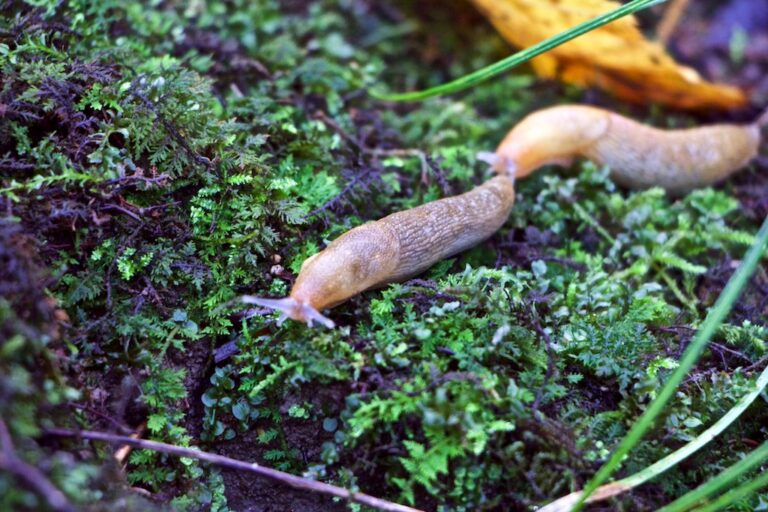
Control slugs in the garden using chemical, mechanical, and biological methods for slug control. The Minimalist Gardener: Low Impact, No Dig Growing, (Permanent Publications, 2017), by Patrick Whitefield, teaches new gardeners how to create a lasting garden. Whitefield shares with readers the right plants and flowers needed for a perennial garden. Find the plants that work best for you and your garden area. This excerpt is located in Chapter 9, “Slugs.”
When we moved into this hamlet, one of our new neighbours said, “The only way to grow any vegetables here is to have a large tub of slug pellets and use them constantly.” After our first year’s gardening I could see her point. Even for the wet west of Britain, the spot is unusually sluggy.
Our second season in the west was a notoriously bad slug year over most of the country, so you can imagine what it was like here. Our garden produced little food. Its main yield being knowledge about how to co-exist with slugs.
Of course, there are chemical, mechanical and biological methods of control, some of which we have tried in our garden. But we have also learned a good deal about how to avoid competing with slugs, by choosing the vegetables they least like to eat, and growing others in a way that avoids slug attack. So let’s look at the different forms of slug control available to the permaculturist.
Chemical Control for Slugs
The use of aluminium sulphate was occasionally accepted by the Soil Association, but they have now decided it isn’t sustainable in the full sense, because adding a poisonous heavy metal to the soil over hundreds of years, even in tiny quantities, will eventually lead to toxicity. Any truly sustainable practice must be safe to use indefinitely. Aluminium sulphate’s advantage is that it doesn’t kill anything other than slugs and snails. Its disadvantage is that it doesn’t actually kill them very effectively. It can have a marginal effect on a mild slug problem, but that’s about all.
The Soil Association has also allowed organic growers to use metaldehyde slug pellets in extreme cases, though only round the edges of fields, where slugs have the nearby cover of the hedgebottom. The problem with metaldehyde is that it’s poisonous to mammals and birds as well as mollusks, and they can die, either by eating the pellets or by eating slugs which have eaten them. They are poisonous to the carabid beetle as well which also preys on slugs.
As our neighbour suggested, in a home garden in a really bad slug year, pellets are only effective if used overall, and constantly throughout the season. A friend of mine grew good crop by totally surrounding his vegetable bed with a belt of pellets hidden under planks to keep them from the other creatures. You also need to dispose of dead slugs daily. But personally I haven’t the stomach for such intensive reliance on poisons.

Mechanical Control
The conventional organic answer to slugs is to grow vegetables in as large a block as possible, with no plants present other than the crop, no mulch, and the maximum of cultivation. This minimises the places where slugs can hide within striking distance of the crop plants, and the cultivation exposes the slugs’ eggs, which are laid in the soil, to birds and other predators. This is effective. Our local organic market garden, where most of the vegetables are grown in a single large field, has no slug problem. But it could hardly be further from the rich ecosystem of the ideal permaculture garden: lots of mulch and ground cover plants, minimal cultivations, and an intimate mixture of trees, shrubs, perennials and annuals. It’s also not really an option for the small home garden, where you are never far from a slug haven, even in the middle of the vegetable patch.
The most effective slug trap in terms of input of human effort per slugs killed is a plank, or any other flat object, laid on the soil. During the day the slugs hide under it to escape the comparatively dry daytime conditions, and you can scoop them up in large quantities. Of course, if you leave the planks down and then don’t come you’re just giving them an extra shelter right beside your vegetables. Picking slugs off the vegetables at dusk or during rain can help young plants survive a moderate slug population or mature plants a heavy population. But a single slug can kill a little cabbage plant – you only have to miss one.
Build Slug Barriers
Mulches of dry or prickly substances round the plants, such as wood ash, sawdust or dry oak leaves, are a waste of time. They only form an effective barrier to slugs when they are dry. As soon as it rains – which is when the slugs come out – they are useless.
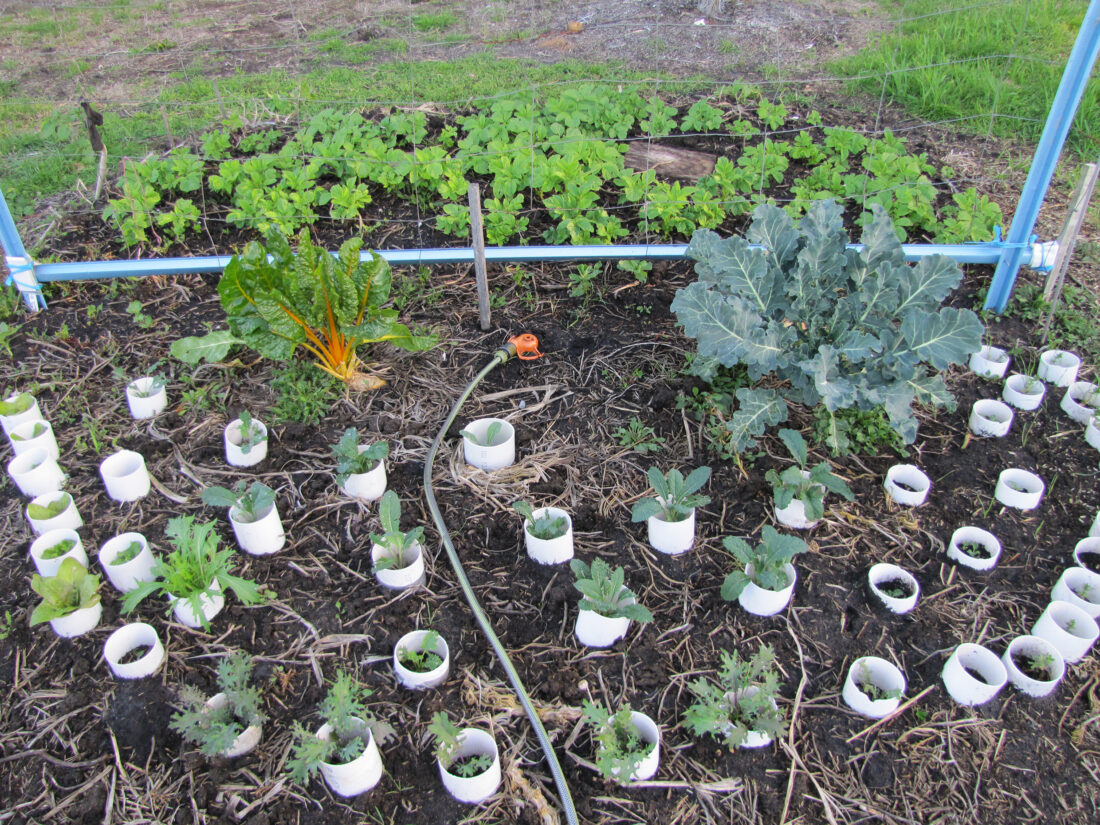
Plastic collars, made by cutting the ends off mineral water bottles, placing them round newly planted-out seedlings and pressing them well into the ground, make a more effective barrier. They improve the chance of the seedlings growing through their most vulnerable stage, and can make a big difference in a moderate slug infestation. But slugs do sometimes get inside them and, in a bad season, when the plants are growing slowly anyway due to cool, wet weather, losses can still be very high.
The best barrier method is a conservatory, greenhouse, polytunnel, cold frame or cloche. In these enclosed spaces it is possible to maintain a relatively dry micro-climate, and though slugs do get in, they will be few enough to control easily by hand-picking as soon as you see any damage.
Plants are at their most vulnerable when small. Sowing seeds of most vegetables directly in the ground is pointless if slugs are abundant, so plants must be raised under cover and planted out. A small cold frame, which can be made from windows rescued from skips, or bought for less than £20, is enough space to raise plants for a moderate sized vegetable plot. We have one raised up on an old table to make it more difficult for the slugs to find their way in.
Biological Methods for Slug Control
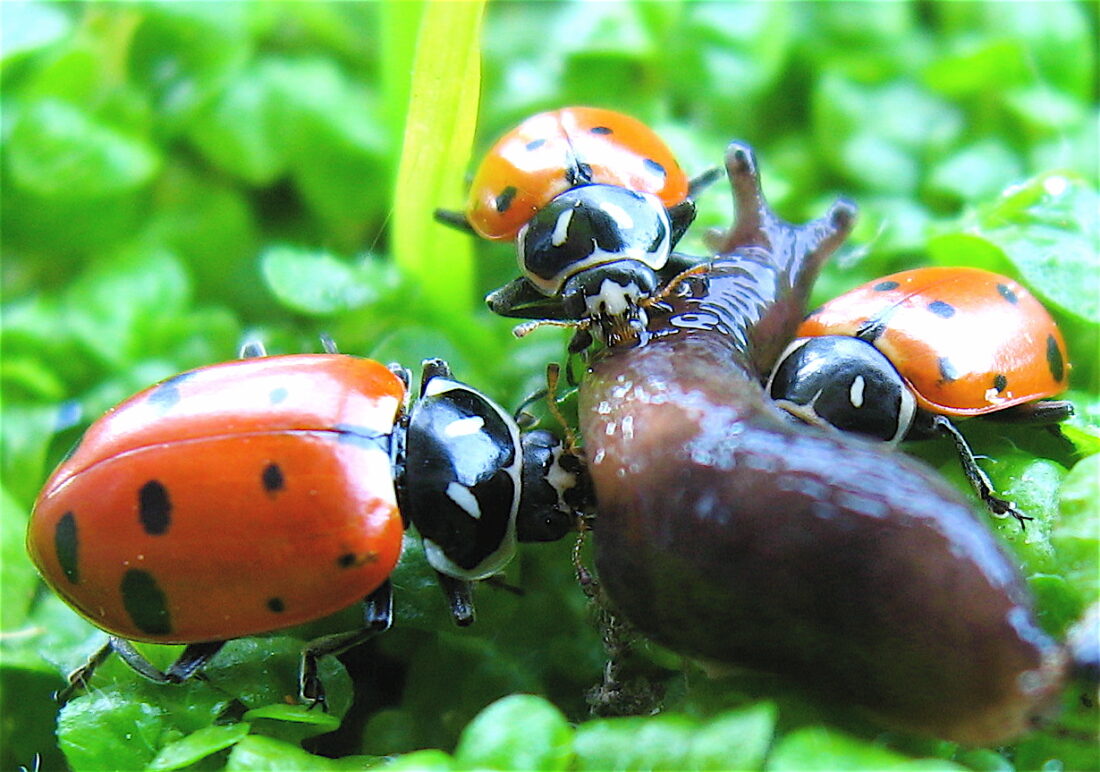
The ideal solution to an excess of slugs is to introduce a predator, such as ducks or frogs – both of which also eat snails. This avoids both the dangers of mucking about with poisons and the extra work involved in mechanical methods.
Ducks are very effective. They need to be managed carefully; only let them into the garden when there are slugs to be eaten and take them out when they have finished them and want to start on the vegetables. Some plants, like strawberries, will need to be netted to keep them off. It’s also important to choose the right breed: Khaki Campbells and Indian Runners are the best, because they are the most carnivorous breeds. You also need to have the necessary commitment to looking after animals, and enough space to keep them properly when they’re not on slug duty in the vegetable plot.
A high population of frogs will keep the slug population within bounds, though it takes a year or two for the frogs to get big enough to eat slugs. A pond is necessary for frogs to breed in. It can be tiny, say a metre across, and can be allowed to dry up in late summer after the tadpoles have become frogs. The adult frogs need dense, low vegetation to live in the rest of the year – in fact just the kind of thing slugs love to hide up in! You can wait for frogs to discover your pond and breed in it, or, to make sure, collect some frog spawn in early spring and put that in.
Rules for Slug-Resistant Planting
I have made and stocked a little frog pond, but the question remains what to grow in the year or two before the frogs are big enough. This year has taught me some answers. The overall principle is to avoid conflict with the slugs, and there are five main ways of doing this:
- Don’t grow the plants they most like to eat.
- Grow things that are at their young, vulnerable stage when the slugs are least active.
- Plant seedlings rather than sowing seed.
- Grow perennial vegetables, which are only in the vulnerable seedling stage once in their lifetime.
- Grow native plants, which have much more natural resistance than our regular garden plants, which are all either introductions or have been artificially bred for so long as to have lost their inborn resistance.

Reprinted with permission from The Minimalist Gardener: Low Impact, No Dig Growing by Patrick Whitefield and Published by Permanent Publications, 2017. This book is available in the MOTHER EARTH NEWS Store.





