Turkey Breeds
The prospective turkey raiser will have his choice of six
major breeds. They are the Bronze, White Holland, Bourbon
Red, Narragansett, Black and Slate. Choice will depend on
what varieties of poults are available, the size of the
finished carcass desired, and personal preference concerning
color. All breeds do well when produced on a small scale .
. . however, if the fancier wished to butcher birds at a
maximum of 25 pounds, he may select the Broad-Breasted
Bronze. If, on the other hand, he prefers a bird that will
dress out in the neighborhood of 20 pounds, he may select
any of the other four breeds. The Broad-Breasted Bronze is
an improved variety of the Bronze breed developed on the
Pacific Coast, its distinguishing feature being that it
produces more white meat per pound of dress weight than any
of the other breeds. In the past few years this has become
the most popular of all breeds and the beginner may very
well start with these magnificent birds for they are hardy,
do well on both range and in close confinement, and
certainly present a handsome carcass. If on the other hand,
unplucked pinfeathers that do not show are of importance
(as they are in the kitchen of Toowoomba) then the choice
may be the White Holland.
Starting With Turkeys
Although the rearing of turkeys is much different from the
rearing of chickens, the general principles of starting are
the same. As with chickens, there are three major
beginnings: [1] day-old poults, [2] “started” poults . . .
six to eight weeks or older and [3] home-grown poults. This
choice is up to the breeder, but unlike chickens, the
beginner will find it much more difficult and considerably
more expensive to produce home-grown poults than it was to
produce home-grown chicks. It goes without saying that
breeding turkeys will consume more feed than will the same
number of breeding chickens (a full-grown tom will consume
over 200 pounds of feed in a single year) and it is
therefore not practical to keep breeding stock unless a
minimum of 15 hens is maintained, or if the fancier is
interested in producing “show stock,” thus making the
economical production of poults a secondary matter.
Day-Old Poults
Assuming that the selection of breed has been determined,
and again assuming that the beginner has contacted a
reputable hatchery that produces a good strain of turkeys,
then we are ready to start with our flock. First off, it
might be wise to issue a word of warning as to how many
poults to order. If we are not interested in the commercial
side of turkey production (and we should not be unless we
have had considerable experience in their rearing) it is
not wise to purchase more than a dozen poults. A dozen
mature turkeys will produce over 250 pounds of turkey meat
which is considerably more than the average family can
consume during the year regardless of how much help they
receive from neighbors and relations. It must also be
remembered that a turkey will eat at least 100 pounds of
feed during his six months’ residence on the farm which if
multiplied by too large a factor soon becomes an expensive
outlay. It might also be wise to note that a mere dozen
poults do not require extensive housing and brooding
arrangements whereas many more than that number will
require considerable construction for their maintenance.
Great care should be exercised so that one will purchase
poults from a “pullorum free” flock, for this disease is
transmitted from turkey hens to poults and can only be
controlled at the source of supply. When the poults arrive
from the hatchery, they may be placed under turkey hens or better yet they may be placed in a
factory or homemade brooder and kept at a temperature of
from 95 to 110 degrees Fahrenheit for the first week or ten
days. This temperature is gradually lowered until the
poults are from 8 to 10 weeks of age when they require
little if any heat. Naturally, outside temperature and
humidity, general weather conditions, etc., will be a
deciding factor and the turkey raiser will do well to
control his heating arrangement by watching over the
comfort of his poults rather than any hard and fast
regulations concerning temperature.
Sand is considered the ideal litter for starting poults.
This litter should be changed at least once per week and no
substitute for sand should be used for at least the first
three week. After that, wood shavings, clean wheat straw,
peat moss or other litters may be substituted. Some turkey
producers insist that no litter should be used; instead
they maintain their poults on fine wire screen, contending
that young gobblers are kept cleaner on wire than on litter
and that if these wire screens are kept at least three
inches above the floor level, then cleaning is no problem.
Yet regardless of what method is used, the beginner will
experience considerable aggravation with the young birds
when he attempts to feed them for the first time. Young
poults will walk over feed dishes without seeing them and
many breeders experience difficulty in teaching the poults
to eat. Some recommend that all poults must have their
beaks dipped into feed several times during the first day;
others contend that feed should be kept on boards directly
under the brooder and that the birds will eventually learn
to eat. No matter which method is employed, it is
recommended that young poults be watched closely so that
the breeder knows that they have started to eat. After the
first day or two they may be fed in any convenient type of
chicken feeder and water is supplied in glass drinking
containers.
Turkeys usually stay in the brooder house (or in batteries
if they are used) for the duration of the brooding period.
Then, having reached six weeks, they are placed on the sun
porch. Some breeders contend that they should have access
to the porch before that time (and are therefore given
roosts to use before the age of six weeks has been reached)
. . . however, that is a question that must be settled by
local climatic conditions, time of year, etc. We here on
Toowoomba have always maintained our poults indoors for the
first six weeks with considerable success.
“Started” Poults
As in the case of chickens, turkey poults may be purchased
that have attained the age of from six to eight weeks.
Naturally, these poults are considerably more expensive
than the day-old poults and there is little to be gained by
their purchase except that the turkey producer is relieved
of the responsibility of maintaining a brooder, for he takes
delivery of the poults at an age when heat is no longer
necessary. Feeding of these “started” poults is of course
the same as that of day-old birds once the sixth to eighth
week has been passed.
Home-Grown Poults
We have previously stated that the beginner will find it
unwise to attempt to produce his own poults unless he has
had considerable experience with turkeys. Whereas the
purchase of young gobblers together with their fattening is
roughly a six-month program, the maintenance of a breeding
flock is a year-around proposition and is not practical for
the average beginner. Of course, if you are of an
inquisitive nature (as are the Widmers) you will want to
raise your own turkeys. There is no reason why you
shouldn’t and more power to you.
First, let us assume that the desired breed has been
selected and that we are prepared either to purchase
breeding stock, or as in the case of Toowoomba, the better
females from the originally purchased poults have been
saved. Then we are ready to get into business. If
home-grown turkey hens are kept, it would be advisable to
purchase a tom from an unrelated strain.
Obviously, the most satisfactory time to select breeding
birds is before Thanksgiving so that those good enough
either to save or purchase are obtainable before the
holiday axe falls. The breeders should have compact, meaty
bodies, with straight breasts and broad backs. They should
be vigorous and by all means they should have originated in
a purebred flock and one free from pullorum.
In mating it should be remembered that one mature male will
handle from 15 to 18 hens, and the best age for these
breeders is two years old even though yearlings may be used
in a limited capacity.
Ten days after mating it may be assumed that eggs are
fertile and these may be saved as “hatchers”. Each four
hens should be provided with a nest, and eggs should be
gathered at least twice daily . . . more often during warm
weather. The average hen will produce 35 eggs each season
before becoming broody, and if artificial lights are used
and if hens are “broken up” when they try to set, this
figure may easily be increased to 60 eggs.
Eggs should be stored at a temperature no higher than 60
degrees Fahrenheit and should not be held longer than ten
days between laying and setting. As to rations, laying
turkeys should be fed a combination of mash and scratch,
and of course salt and oystershell should be available at
all times. Excellent commercial turkey feed mixtures may be
purchased and for those producing a limited number of birds
annually this is the answer to the feed question. However,
for those who are interested in mixing their own feeds or
at least knowing what should be included in an ideal
mixture, we think it wise to include many mash mixtures
that have been found satisfactory. An excellent laying mash
and scratch is as follows:
MASH                                      PARTS BY WEIGHT
 Ground yellow corn or barley . . . . . . . . . . . 26.0
 Wheat middlings or ground wheat. . . . . . . . . . 20.0
 Wheat bran . . . . . . . . . . . . . . . . . . . . 12.0
 Alfalfa-leaf meal  . . . . . . . . . . . . . . . . 10.0
 Meat scrap (50% to 55% protein). . . . . . . . . .  8.0
 Dried milk . . . . . . . . . . . . . . . . . . . .  8.0
 Fish meal (60% to 70% protein) . . . . . . . . . .  8.0
 Ground oyster-shell or limestone . . . . . . . . .  7.0
 Salt . . . . . . . . . . . . . . . . . . . . . . .  1.0
                                                   -----
 Total                                             100.0

MASH                                      PARTS BY WEIGHT
 Yellow corn or grain sorghum . . . . . . . . . . . 40.0
 Heavy oats . . . . . . . . . . . . . . . . . . . . 37.5
 Wheat . . . . . . . . . . . . . . . . . . . . . . 20.0
 Cod-liver oil. . . . . . . . . . . . . . . . . . . 2.5
                                                   -----
 Total                                             100.0
During the laying season mash should be kept before the
hens at all times, the scratch being hand-fed twice daily
and given at the rate of about 1/4 pound per hen per day.
Turkey hens make good incubators and the average turkey hen
will cover from 15 to 18 eggs, the chicken hen (of the
medium-weight breeds) from 7 to 10 eggs. Either have proven
satisfactory, yet if eggs are to be artificially incubated
then it is advisable to take them to a commercial hatchery
and have the eggs custom incubated . . . usually at a very
small cost.
Turkey eggs incubate in 28 days and the method of handling
both hen and poults is much the same as described in the
MOTHER EARTH NEWS article “Raising Chickens At Home.” In the event that an artificial brooder is to be used then
we refer the reader back to the “Day-old Chick” section of
that article.
Raising Turkeys On Wire
As with chickens there are two major methods of raising
turkeys: [1] range production and [ 2] raising turkeys on
wire. Concerning chickens, we are willing to give the
beginner the choice of either method. However, in the case
of turkeys, we strongly advise all beginners to stay with
the wire or sun-porch method.
As in the case of chickens, it is probably true that
turkeys confined to wire enclosures consume more feed than
those who have unrestricted range, yet the advantages from
a sanitary standpoint of the sun porch should be the
deciding factor for the beginner, regardless of how much
range he may have available.
Turkeys require a minimum of five square feet of floor
space per bird when the sun-porch method is used. There is
no necessity for these sunning areas to be constructed on
an elaborate scale for many small-scale turkey producers
have had excellent luck with homemade and makeshift rigs.
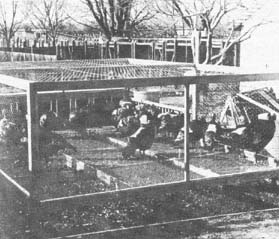
It is merely a chicken-wire cage large enough to allow the
five square feet of floor space required for each bird and
is usually constructed so that the birds have
headroom–3 feet 6 inches is sufficient–and
containing enough roosts so that all birds may perch
simultaneously. The floor may be constructed either of wire
or wooden slats and the entire contraption is built some
three feet above the ground so that droppings may be easily
raked out from under the porch and placed in the compost
pile. About 20% of the sun porch should be covered with
some sort of roofing material so that the birds will have
ample shade during hot summer days and also supply a cover
so that they may get out of driving rains. The sunning area
should be constructed so that all feed and watering troughs
may be reached from the outside, thus eliminating the
spread of contagious disease by the attendant walking from
one pen to the other.
Turkeys are placed on this sun porch as poults directly
from the brooder room and are kept there for their entire
stay on the farm. Of course porches of any size may be
constructed and more and more commercial producers are
going from the range to the sun-porch method of rearing
turkeys. Should the breeder raise more than 100 birds
annually, it is advisable to have more than one sunning
area (or at least to supply partitions in large sun
porches) so that not more than 100 birds are kept together.
This will eliminate danger from piling up and overcrowding.
In the range method, great care must be exercised so that
disease is not spread through soil contamination. Under no
circumstances should turkeys be permitted to run on ground
that has previously been occupied by chickens, and pastures
or ranges must be changed continually if the birds are to
remain healthy. These pastures should be changed at least
every ten days (if they are small) for once disease strikes
control is most difficult and sometimes utterly impossible.
Feeding Turkeys
Even though turkeys are very particular in their eating
habits, properly fed young birds make astounding gains. For
those interested in a very limited number of birds it would
not be practical to mix and grind starter mash for there
are any number of commercial products that have proven very
satisfactory. However, for those who like to mix their own
feeds, and for those who wish to compare the contents of
commercial mash against that of ideal composition, the
following mixtures may prove of interest.
                                          PARTS BY WEIGHT
 Ground yellow corn . . . . . . . . . . . . . . . . 17.0
 Whole oats . . . . . . . . . . . . . . . . . . . . 15.0
 Meat scrap (50% to 55% protein). . . . . . . . . . 12.0
 Wheat bran . . . . . . . . . . . . . . . . . . . . 12.0
 Wheat middlings or shorts. . . . . . . . . . . . . 12.0
 Dried milk . . . . . . . . . . . . . . . . . . . . 10.0
 Alfalfa-leaf meal  . . . . . . . . . . . . . . . . 10.0
 Fish meal (60% protein) . . . . . . . . . . . . . 10.0
 Cod-liver oil. . . . . . . . . . . . . . . . . . . 1.5
 Salt (fine, sifted). . . . . . . . . . . . . . . .  0.5
                                                   -----
 Total (crude protein 25%; crude fiber 6%)         100.0
In the event that liquid skim milk is available (and there
is no better feed for young turkeys) the following starting
mash may be used to advantage.
                                          PARTS BY WEIGHT
 Ground yellow corn . . . . . . . . . . . . . . . . 33.0
 Wheat middlings or shorts. . . . . . . . . . . . . 20.0
 Wheat bran . . . . . . . . . . . . . . . . . . . . 10.0
 Whole oats . . . . . . . . . . . . . . . . . . . . 10.0
 Meat scrap (50% to 55% protein). . . . . . . . . . 10.0
 Alfalfa-leaf meal  . . . . . . . . . . . . . . . . 10.0
 Fish meal (60% protein) . . . . . . . . . . . . . 5.0
 Cod-liver oil. . . . . . . . . . . . . . . . . . . 1.5
 Salt (fine, sifted). . . . . . . . . . . . . . . .  0.5
                                                   -----
 Total (crude protein 19%; crude fiber 6%)         100.0
In addition to either of these rations, fine gravel or
coarse sand should be supplied together with green feed if
such feed is available. Tender lettuce, Swiss chard, short
lawn clippings, or tender alfalfa are all excellent. Yet the
beginner must be warned not to feed tough greens for these
often cause impaction in young birds which sometimes proves
fatal.
By the time poults have reached six to eight weeks of age
and are confined to the sun porch, they may be switched to
a ration made up as follows:
                                          PARTS BY WEIGHT
 Ground yellow corn . . . . . . . . . . . . . . . . 20.0
 Wheat middlings (standard or brown). . . . . . . . 15.0
 Oats (finely ground) . . . . . . . . . . . . . . . 15.0
 Wheat bran . . . . . . . . . . . . . . . . . . . . 10.0
 Alfalfa-leaf meal  . . . . . . . . . . . . . . . . 10.0
 Yellow corn gluten meal. . . . . . . . . . . . . . 10.0
 Dried milk . . . . . . . . . . . . . . . . . . . . 10.0
 Meat scrap (50% to 55% protein). . . . . . . . . . 5.0
 Steamed bonemeal . . . . . . . . . . . . . . . . . 2.0
 Ground oyster-shell or limestone . . . . . . . . .  2.0
 Salt (fine, sifted). . . . . . . . . . . . . . . .  1.0
                                                   -----
 Total (crude protein 19%; crude fiber 6%)         100.0
Commercial feed manufacturers also make excellent mashes
that may be fed after poults have reached six to eight
weeks, yet regardless of whether mash is purchased or home
mixed, a grain ration is also fed at this point. Turkeys do
extremely well on corn, whole oats, barley or whole-wheat,
and this grain is fed in unlimited amounts . . . the young
gobblers are given access to all the grain they will
consume together with the recommended mash. As the turkeys
grow older, usually by the time they have reached 16 to 17
weeks, they will start increasing their consumption of
whole grains and will voluntarily cut down on the
percentage of mash consumed. This is natural and need not
concern the producer. This is especially true as cool
weather moves in and some breeders stop feeding mash
altogether at this juncture. Here on Toowoomba, however, we
have found that it pays to keep mash before the birds
regardless of how little they will eat for they receive
food values from mash that is not always present in whole
grains.
Sanitation and Disease Prevention
Turkeys are the most sensitive of all the members of the
home barnyard concerning sanitary conditions, and success
or failure with turkeys is often in direct relationship to
sanitary living and feeding arrangements. If
“pullorum-clean” poults have been purchased, there is
little danger from this disease. However, there are many
diseases that must be controlled if one is to be
successful. Coccidiosis has been a troublemaker for turkey
breeders for generations and is best combated by
maintaining strict sanitation in the brooder house. Litter
must be kept dry and changed at least once each week, and
feeders and water containers must be kept sterile.
Clabbered skim milk has been found to be an excellent
preventative for coccidiosis, yet if sour milk is fed,
feeders must be sterilized daily so that the leavings from
this milk will not remain in the troughs, thus spreading
disease.
Blackhead is perhaps the most dangerous of the long list of
turkey diseases. This sickness, which causes a black
appearance of the head as the name implies, is often
carried by chickens although they do not always show
symptoms of the disease. It is for this reason that many
contend that turkeys and chickens should never be produced
on the same farm . . . however, if care is taken there is
no logical reason why turkeys and chickens cannot be
produced on the same property. Of course, it goes without
saying that these two birds should never be permitted to
run together, that turkeys never be permitted to range on
land that has previously ranged chickens, and that the
turkey fancier never walk from his chicken pen into turkey
pens without first slipping on a pair of rubbers that are
kept for that purpose. This is the great advantage of the
sun-porch method of turkey raising, for if this porch is
constructed so that the birds may be fed from the outside,
then there is no necessity for the breeder to walk into the
turkey pen… thus eliminating all chance of blackhead
contamination.
The Finish Product
Turkeys are usually
fed so that that they will reach their maximum weight
during the Thanksgiving and Christmas season and the entire
flock (less those that we may wish to keep for breeding
stock) should be butchered at that time. Feed costs mount
steadily as the turkeys grow to maturity and there little
to be gained by keeping the birds after they have reached
their prime.
Turkeys freeze very well and may be stored from eight to
ten months at zero degrees Fahrenheit without losing any of
their original quality, especially if packed in cellophane
bags. Turkeys may be stuffed before freezing if this is
desired and are thus ready for the oven directly after
being taken from the deepfreeze and permitted to thaw.
Turkeys may also be smoked, canned, or used as broilers . .
. however, the use of broilers is not economical and few
turkeys are butchered at this early age.
Smoking of turkeys is not at all difficult and excellent
results have been obtained by many an amateur. A homemade
smoker may be constructed by anyone handy with tools. The
turkeys should be smoked whole for 20 to 24 hours after
having been soaked in a brine solution for a period of from
9 to 12 days. Oversmoking of turkeys must be avoided for
this darkens the skin too deeply. Also oversmoked turkey
tastes exactly as does ham and therefore the turkey loses
its distinctive flavor.