Reposted with permission from Harvest Public Media.
Feeding cattle on grass is supposed to help the animals thrive. But Missouri’s most popular grass for feeding cattle may be doing more harm than good.
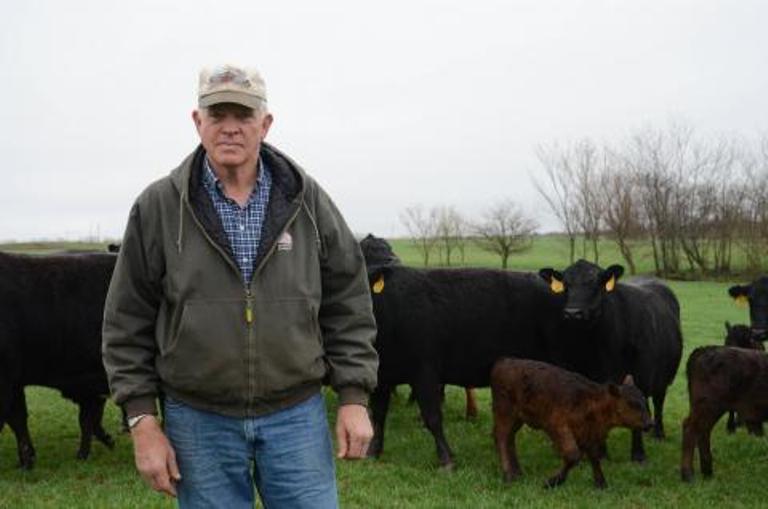
Cattleman Roger Zimmerschied spotted the problem a few years ago when he noticed that the cows on his ranch near Sweet Springs, Mo., were making an extreme mud hole out of a drainage area.
“They just stood there and they switched their tails; they threw mud up on their backs,” Zimmerschied says.
Standing in water and using mud to cool off are common signs of overheating, a symptom of the sickness that comes with grazing on Kentucky 31 tall fescue, commonly referred to as K-31. There are more serious and obvious side effects as well, especially during the winter. Some cattle lose their tails, hooves and ears because of restricted blood flow in cold temperatures.
“This grass is infected with a fungus,” says Craig Roberts, who has been studying the problem for 25 years. “It lives inside the plant, but it does release toxins that cause poor animal performance, a lot of health issues.”
Roberts, a forage specialist at the University of Missouri, is chair of the Alliance for Grassland Renewal. The group was formed last year to convince ranchers and dairy farmers to replace K-31 pastures with safer nontoxic varieties of grass such as MaxQ.
But this is a little more complicated than re-sodding a lawn. The drought-and-insect-resistant K-31 was planted in nearly every part of the state in the 1950s and 60s. And many cattlemen and dairy farmers have been unwilling to switch, Roberts says.
Still, that may be changing because there’s now more information and research about the effectiveness of alternative grasses.
Zimmerschied, for example, switched to MaxQ — and that solved the problem on his ranch. The cost was $4.50 a pound for the new seed and a year’s worth of extra field maintenance to make sure the K-31 didn’t come back.
MaxQ and other alternative grasses contain what Roberts calls “novel endophytes,” or new strains of the same fungus inside K-31. He says these novel endophytes are nontoxic to animals and have the same drought and insect resistance as K-31.
But will the cattle thrive on the alternative grasses?
At the University of Missouri’s Forage Systems Research Center, researcher David Davis is growing a small area of novel endophytes next to K-31 varieties. Cattle will eventually graze and their responses to the different varieties will be measured.
“Now we don’t know if we’ll see differences, but knowing cattle they’ll probably figure it out and they’re pretty selective in their grazing patterns once they know what’s in front of them,” Davis says. “Essentially here we have a cafeteria-style buffet, and they get to choose what they eat.”
By measuring what the cattle prefer, Davis says, the center can ensure some amount of quality control for the endophytes.
Zimmerschied says his cows have been doing much better since he made the switch. They don’t stand in water and pant. They gain more weight. And they produce more milk for calves. He thinks other ranchers will come on board soon.
“If they saw the results of how it works and the condition that the cows stay in — the calves certainly wean off as heavy or heavier than calves that were running on infected pastures,” he says.