Is grass-fed beef better? Eating grass-fed beef isn’t just some affectation. The meat is healthier, and the perennial pastures on which cows feed build better soil and have lower carbon emissions than conventional cropland.
I have been fascinated by the permanence and healing power of grassland for 15 years now. If we respect the great original wisdom of the prairies, I’m convinced we can heal the wounds inflicted on the American landscape by industrial agriculture.
But in America, the question is always does it scale up? This is the critical test of any potential solution to a major environmental problem. Is a given practice feasible, and are there mechanisms for spreading it to cover a whole landscape?
I first had a hint as to how this might work for America’s farms when a friend explained to me why he chose to raise bison for slaughter, marketing the meat with the guarantee the animals had eaten nothing but native grasses. He thought if he could make such a model pay on his own land, he could do more to save native landscapes than any amount of activism, litigation, or regulation. Profitable solutions self-replicate. Like viruses, they creep from one farm to the next, eventually exploding in exponential growth. They scale up.
Now there is big news on this front. A diverse collection of pioneers across the nation are raising not bison, but mostly grass-fed beef and dairy — an enterprise that can scale up quickly. They have a working model. It is not unrealistic to expect that we as a nation could convert millions of acres of ravaged industrial grain fields (plus millions of acres of land in federal conservation programs that cannot currently be used for grazing) to permanent pastures and see no decline in beef and dairy production in the bargain.

Doing so would have many benefits. It would give us a more humane livestock system, a healthier human diet, less deadly E. coli, elimination of feedlots, a bonanza of wildlife habitat nationwide, enormous savings in energy, virtual elimination of pesticides and chemical fertilizers on those lands, elimination of catastrophic flooding that periodically plagues the Mississippi Basin, and most intriguingly, a dramatic reduction in global warming gases.
The Grass-Fed Beef Boom
The best evidence of this potential meat production revolution is a label that began showing up on packages of grass-fed beef across the nation early in 2009. The American Grassfed Association, a network of almost 400 graziers, is behind this effort. The label certifies the beef came from cattle that ate only grass from pastures, not feedlots; received no hormones or antibiotics in their feed; and were humanely raised and handled. It signals the emergence of a marketing network that already has placed grass-fed products in virtually every region of the nation in co-ops, health food stores and, in the case of the Southeast, in Publix Super Markets, a chain of more than 900 stores. The grass-fed label is evidence that the idea has reached critical mass. It’s been a long time coming, but what is driving it is profit, plain and simple.
Todd Churchill runs Thousand Hills Cattle Co. in Cannon Falls, MN, which buys about 1,000 head a year from local producers, then processes and sells them to natural foods stores, restaurants, and three colleges in the Twin Cities area. He says demand for his product always exceeds supply, and he sees no leveling for its growth curve.
Churchill’s operation is, in fact, a sort of model, a regional company that buys animals from a handful of graziers and meets a local need. Carrie Balkcom, executive director of the Grassfed Association, says consumers can now find quality grass-fed beef just about anywhere in the United States. All of this has been fueled by demand. Consumers are willing to pay a premium for grass-fed beef and other meat simply because they know it’s healthier than its conventional grain-fed counterpart, and because they don’t like the filth, cruelty, and antibiotics inherent in the “concentrated animal feeding operations” that are now so prevalent.
Is Grass-Fed Beef better?
The health claim is not speculation. Grass-fed beef and dairy products are leaner, but more importantly, lower in omega-6 fats that are linked to heart disease. Grass-fed meat and dairy products also are higher in beneficial omega-3 fats and conjugated linoleic acids. Both reduce the risk of heart disease.
Besides, grass-fed beef tastes better. I know because I eat it. However, it only tastes better if it’s raised right. Churchill tells me that when he first considered going into the business, it was because he missed the taste of beef he remembered as a child. So as an experiment, he bought two quarters of grass-fed beef from local farmers. One was the best he had ever eaten; the other so rank he fed it to the dogs.
To be sure, there are variables affecting the quality of grass-fed beef — genetics, for instance. A major problem for today’s graziers is that the industrial beef system has monopolized the gene pool, and for more than 50 years has selected for cattle that are adept at standing in a feedlot and eating grain as efficiently as possible. It may sound odd to say so, but this has left us with cattle not very good at eating grass. That’s pretty much all cattle ate from domestication 8,000 years ago until mid-20th century. But Churchill says it’s virtually impossible to find Herefords, the classic beef animal, that finish well on grass. His operation has done best with Red Angus, and over the years he has been able to select for a set of traits that now yields animals that fatten well on grass. This selection for appropriate genetics is a key element in building the infrastructure of a scalable solution. We now have the correct foundation traits.
Better Grass and Rotational Grazing
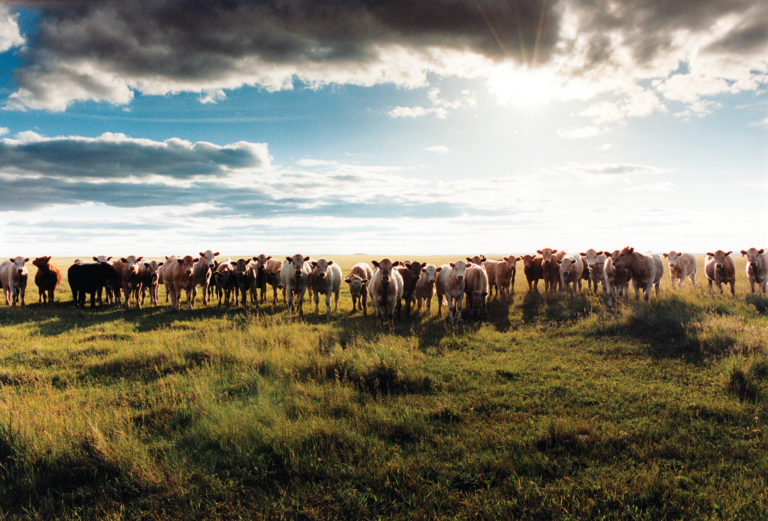
The most important factor in quality beef, however, is the quality of the grass itself. Specifically, the grass should have a high sugar content. That quality is not automatic. It is not as simple as pointing cows at pasture and waiting for results. In fact, a trained eye will notice a similar scene at virtually any modern grass-fed beef operation: a couple of strands of electric fencing running around a bunch of cattle grazing in a clump. In fact, you could argue that the current revolution in grass-fed beef would not be possible without poly-wire electric fencing, which is cheap and easy to move.

For thousands of years, the dominant big grazer of North America was the American bison. It is the rule of co-evolution that when species evolve together they come to thrive on each other’s presence, and this is true of bison and the grasses, forbs, and shrubs of the American landscape. But great herds of migrating bison grazed very differently than the way cattle graze on pasture today.
This has led graziers to develop a system that has many names but is often called “managed intensive rotational grazing.” Many people think of intensive grazing as negative, because we’re so accustomed to seeing the erosion that results from destructive overgrazing. But, intensive grazing is actually beneficial for grassland. It works this way: Graziers use the temporary electric fences to confine a herd of perhaps 50 calves or steers to an area the size of a small suburban front lawn for a short period, often as short as a half a day. Then the grazier arranges the easily movable fence to surround an adjacent small plot, on through a series of paddocks in a cycle of maybe 30 days, depending on conditions.
The result is the cattle graze all the plants down to a few inches, and then are moved to fresh grass. Each paddock is allowed to rest until the grass fully recovers. This roughly simulates the tactics of bison and in turn stimulates sweet, highly nutritious and palatable new growth, controls weeds, and promotes biodiversity. In short, intensive grazing forces cattle to graze grassland the way bison used to.
Go With Grass, Not Grain
Churchill’s producers are raising cattle this way on converted corn and soybean land in Minnesota, which is a bit like building a mosque at the Vatican. They take this plowed-up landscape and plant it to permanent pasture — permaculture modeled on the tallgrass prairie that was the native cover. Many of Churchill’s producers, in fact, don’t own tractors; they don’t need them. It takes a couple of years for the land to recover sufficiently to produce high-quality beef, but it does recover. And after that initial setup, his producers begin showing a profit; in fact, more profit than the corn and soybeans yielded before. Part of this is a result of lower or no costs for inputs such as fertilizer, fuel, pesticides, and machinery. This profit is one of the factors that will allow this system to scale up.

Churchill says that on properly recovered land, he can finish about two steers per acre. That is almost precisely the acreage it takes to grow the grain to finish those same steers in a feedlot. This whole system makes economic sense, acre by acre. More than half of our total grain crop goes to feed livestock, so it follows that we can convert half of the 150 million acres used to grow corn and soy to permanent pasture and lose not one ounce of meat production. At the same time, we can produce healthier meat and shift the massive federal subsidies for corn and soybean production to a better use.
Yet there are even more benefits to intensive grazing systems. Consider that the upper Midwest was flooded in the spring of 2008, an inundation that caused catastrophic dislocations, massive erosion of topsoil, and billions of dollars in damages. This is the landscape of corn and soy agriculture. Iowa, for instance, has been almost wholly converted to row-crop agriculture, maintaining only about 1 percent of its native habitat, which was largely prairie and oak savannah. A plowed field sheds rainwater almost as fast as a parking lot does; the soil can absorb, at most, about 1-1/2 inches of rain in an hour. A permanent pasture can suck up as many as 7 inches of rain in an hour. That’s the difference between floods and no floods.
Most astonishing of all is what happens after the land is restored to grassland. Grass, like most plants, reacts to changing conditions. It builds a root system to support its leaves and stems, but when a cow munches off the top of the plant, there’s not enough energy left to support all its roots. The plant reacts by sloughing roots, then builds back deeper roots as aboveground parts regrow.

Deep rooting is, in fact, an overlooked factor here. All of our row crops are shallow-rooted and so for generations they have worked a narrow layer of the soil. Constant harvesting of these crops has depleted this topsoil of essential elements such as magnesium and calcium. As a result, both are now lacking not only in our diets, but also in the diets of livestock. This is a human health issue, but veterinarians say it also creates a mineral imbalance in grain-fed livestock that lies at the root of many of their health problems. In contrast to shallow-rooted row crops, deep-rooted grasses dig down to fresh minerals. Those minerals then become available to everything up the food chain, supporting the overall health of the entire system.

The roots that are sloughed-off after every grazing rotation are equally important; they become decaying organic material that feeds microorganisms, restores subsoil health, creates water-absorbing voids, and ultimately steadily increases the organic matter — or carbon content of the soil. There are big implications here both for building fertile soil and fighting climate change.
Using Intensive Grazing to Store Carbon
When American settlers first busted Midwestern prairies, they worked highly fertile virgin soil that was about 10 percent organic matter. On average, 150 years of agriculture has cut that vital organic matter by more than half and released huge amounts of carbon dioxide, the leading driver of global warming, into the air. Permanent pastures managed correctly can tap solar energy to pump about 1 percent of organic matter back to the soil each year. If we convert from grain-fed to grass-fed meat, we can turn millions of acres of row crops into carbon sinks, and use permanent pasture to pull carbon dioxide from the atmosphere and slow global warming, as well as conserve water.

The carbon balance of any given enterprise is a complicated matter. We’ve understood some of this in looking at the carbon footprint of farming, but in fact, we have not made it complicated enough. There is a complex energy stream feeding industrial agriculture, both in fuels for transportation, tillage, storage, and processing, and also in the natural gas used to make chemical fertilizers. All this makes modern industrial agriculture energy intensive and therefore gives it a pretty big carbon footprint.

Yet focusing only on the energy flow of farming greatly understates the problem, because it doesn’t take into consideration the natural vs. unnatural cycling of organic matter. In corn and soy production, tilling adds oxygen. This in turn causes organic matter to decay, or oxidize, and be released to the atmosphere as carbon dioxide. Researchers have taken a closer look at this process and found that tillage not only releases carbon dioxide, but also methane and nitrous oxide (both greenhouse gases that contribute to global warming). True enough, a growing corn field sucks up a lot of carbon dioxide. But the field then releases it back almost immediately when the disced down stalks and leaves decay. Without exception, all of the tillage systems examined in one study published in Science were net contributors to global warming, and the worst offenders were the annual crops: corn, soybeans, and wheat, farmed with conventional methods. Meanwhile, fields of perennial crops in the same study pulled both methane and carbon dioxide from the atmosphere and stashed it safely in the soil. There is even some evidence that perennial grasslands are, under certain conditions, even better at sequestering carbon than forests.

A conventionally farmed corn or soybean field is a source of global warming gases, but a permanent pasture is a pump that pushes carbon back into the soil where it increases fertility. Even though we harvest meat from the pastures each year, still the soil grows richer and holds more carbon. We get all these benefits thanks to solar energy, plant photosynthesis, and natural cycles of grasslands and grazing animals.

So just how powerful could this tool be, were we to think as big as transforming American agriculture? Collecting data on the carbon storage potential of intensive grazing involves numerous variables, and overall estimates are not yet available. But using figures for annual and perennial crops reported in the recent Scientific American article “Future Farming: A Return to Roots?” we can get a rough idea of what effect the grass farming revolution could have on global warming. Production of high-input annual crops such as corn and soybeans release carbon at a rate of about 1,000 pounds per acre, while perennial grasslands can store carbon at roughly the same rates. This suggests that if we converted half the U.S. corn and soy acres to pasture, we might cut carbon emissions by roughly 144 trillion pounds — and that’s not even counting the reduced use of fossil fuels that would also result. That’s not a bad side benefit to a transformation that makes sense on so many other levels as well.
A conversion on an enormous scale is not out of the question. In fact, we have already done a massive land use change just in recent decades. After the great plow-ups of the 1970s and ’80s (conducted at the federal government’s urging) the country saw an enormous increase in soil erosion, so taxpayers began paying farmers to plant the most highly erodable acres back to grass. This Conservation Reserve Program (CRP) now costs us about $1.8 billion a year, and peaked at a total of about 36 million acres a couple of years ago. That’s exactly the sort of scale we need.
Intriguingly, though, the rules prohibit grazing on CRP lands under ordinary conditions. Imagine what could be accomplished with some creative changes in the rules to allow carefully managed grazing and connect CRP to the market driver of grass-fed beef and dairy!

All this raises the very point missed by industrial agriculture. Intensive rotational grazing offers a corrective to the narrowing diversity on the farm landscape. We are slowly learning that human enterprises work best when they mimic nature’s diversity. Early on, especially in organic farming and with the rise of vegetarianism, we began thinking we could approach that diversity by raising a variety of a dozen or so tilled crops (never mind that an acre of pure prairie contains hundreds of species of plants). But it seems obvious now that this line of thinking needed to step up a couple of levels on the taxonomic hierarchy. Why did we think we could in any meaningful way mimic nature’s biodiversity by excluding the animal kingdom?


Over the years, organic farmers have told me they relearned this important point: Many found out the hard way that they could not make their operations balance out — both biologically and economically (they’re the same in the end) — without bringing animals back into the equation. Handled right, animals control weeds and insects, cycle nutrients, and provide a use for waste and failed crops. Healthy ecosystems — wild and domestic — must include animals. Now there’s a chance we may realize how very important this idea is to the life of the planet.

The Multiple Benefits of Grass Farming
- More humane animal treatment
- More nutritious meat and dairy products
- Reduced flooding and soil erosion
- Increased groundwater recharge
- More sustainable manure management
- Less E. coli food poisoning
- More fertile soil and more nutritious forages
- More diverse and healthier ecosystems
- Reduced use of chemical fertilizers and pesticides to grow unsustainable corn and soy
Considering Cattle Burps
Any discussion of cattle and the environment will move quickly toward the unsavory subject of belching. Simply put, during digestion, a cow’s rumen breaks down lignins in feed, releasing methane, which happens to be 24 times more potent than carbon dioxide as a greenhouse gas. So would a grass-fed beef and dairy system mean more methane?
Not necessarily. First, I am not arguing for an increase in numbers of cattle, just moving the existing numbers from filthy feedlots to pastures. So the real question is, do cows produce more methane on grain or on grass?
There are studies to suggest grain produces less methane, but those studies, by and large, compare conventional pastures with feedlots. However, conventional pastures contain high-fiber, low-quality forage, which produces more methane. On the other hand, studies of rotational grazing have shown decreases of as much as 45 percent in methane production, when compared with conventional pastures. All studies seem to agree cows produce less methane when nutrition is best, and the very reason for rotational grazing is to improve forage quality.
Nor do those studies take into account such factors as methane produced by corn and soybean cultivation, which we know is significant, as well as releases from manure festering in feedlots, as opposed to manure cycling immediately into pasture soils.
To further complicate matters, singling out cattle blames them for their position in the grand cycle of nutrients. Remove them from the food chain, and other methane-producing organisms — termites, deer, elk, grasshoppers, not to mention an unimaginable array of microbes — would cheerfully assume the niche.
The world is a big place and cows are a small part of it. Stated another way, in 2004, ruminants — cattle, sheep and goats — accounted for only about 1.6 percent of the total greenhouse gas emissions in the United States. A massive expansion of rotational grazing is not likely to increase that number by much and could well reduce it. It certainly would reduce carbon dioxide to a much larger degree, and would lead to a net reduction of our greenhouse gas emissions. No doubt, at least some environmental good would come from reducing the world’s consumption of beef, but the trend is in the opposite direction. Humans and cattle have worked together for almost 8,000 years, and that is not likely to change soon. But there’s no reason we shouldn’t learn to raise cattle better.
Resources
Eat Wild
Learn more about the benefits of grass-fed meat and find local sources for grass-fed products.
Polyface Farms
Grassfarmer Joel Salatin’s website includes information about his farm and his books on pasture-based livestock.
The Stockman Grass Farmer
Subtitled “The Grazier’s Edge,” this publication is the go-to source for information on grassfarming.
ATTRA
The National Sustainable Agriculture Information Service provides detailed information on rotational grazing and sustainable pasture management.
Richard Manning is the author of eight books, including Rewilding the West and Against the Grain. He lives in Missoula, MT.
Originally published as “The Amazing Benefits of Grass-fed Meat” in the April/May 2009 issue of MOTHER EARTH NEWS.