Learn how to keep goats and sheep parasite-free by using the FAMACHA score card, pasture rotation for parasite control, and breeding for better resistance.
I’ve been hearing the term FAMACHA in relation to helping sheep and goats. What is it, and how can I use it?
FAMACHA is shorthand for the Faffa Malan Chart. It’s named after Faffa Malan, who developed the system in South Africa in the 1980s, when dewormers there weren’t working because of overuse.
The system is used to identify anemia caused by internal parasites in goats and sheep. It’s a good way to monitor your animals for barber pole worms, but it can also help alert you to coccidia and liver flukes, which, like barber pole worms, are bloodsuckers.
Barber pole worms are found on pastures, and small ruminants are infected when they ingest larvae from grass. Once swallowed, these parasites move into the digestive system, where they attach and suck blood. They grow into adult worms, then mate and lay eggs. The eggs are spread when infected animals expel them with feces.
Goats and sheep can also eat larvae in fall, and the larvae will become dormant in the animals’ abomasums. After months, often at kidding or lambing, large numbers of eggs are released, reinfecting the pasture.
Eggs can overwinter in the pasture, and once the climate is right, the eggs will hatch. Over a three-month period, they’ll go through two stages as non-infective larvae, and then become infective in the third stage. Once they’ve reached the final stage, they climb 1 to 2 inches up the forage in pasture, normally during morning dew, where grazing animals eat them, and the process starts all over again.
How Do I Use FAMACHA?
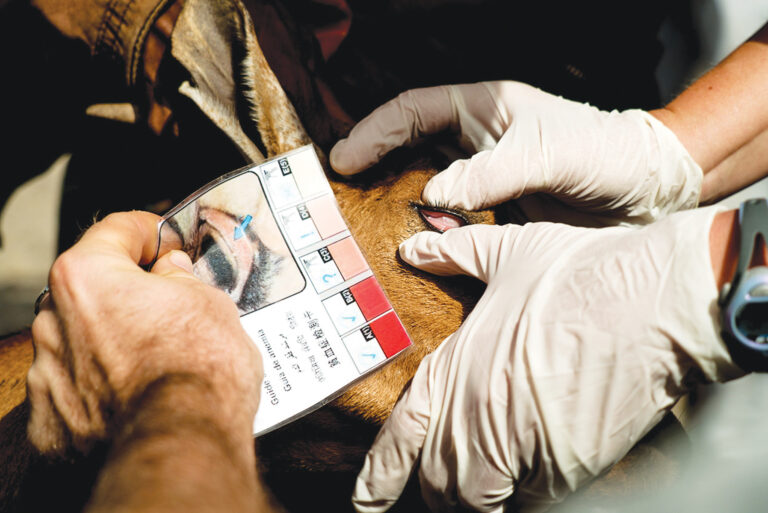
The first step in using FAMACHA is to take the training and purchase a copyrighted FAMACHA card. You can contact your local extension office or university agriculture program to schedule a training or take the online University of Rhode Island training.
Once you have the FAMACHA card, compare the conjunctiva inside the animal’s lower eyelid to the card (which indicates degree of anemia). Each color – which is related to the percentage of red blood cells in the sheep or goat – has a number from 1 to 5; ruminants that are scored 1 (very red) show no evidence of anemia, while those that are scored 5 (pale or almost white) are severely anemic. Simply eyeballing the eye membrane color without a card won’t give you accurate results. Score the animals outside, in natural light. Check both eyes. Record results and compare when you score again, so you can detect changes. (Store the card in a dark place to keep it from fading.)
Animals with a FAMACHA score of 1 to 2 shouldn’t be dewormed; those with a 3 may be treated, depending on whether they’re kids, pregnant or lactating does, or just in poor body condition; and any with a score of 4 or 5 need treatment. After you treat animals with high scores, check again a week later. During warmer seasons, check every two weeks; in winter (depending on your climate), you can check less frequently. FAMACHA doesn’t detect all types of internal parasites. Your small ruminants should also have fecal egg counts done every 6 to 12 weeks, depending on what you and your vet determine is necessary.
Parasites have developed resistance to dewormers because they’re used too frequently or inappropriately. Talk to your vet about which dewormers are appropriate. The current thinking on dewormer use is to treat only animals that need it, and to use at least two classes of dewormer when you do treat.
How to Keep Goats and Sheep Parasite Free
- Pasture rotation for parasite control. If you have enough land, one of the best ways to reduce your parasite burden is to rest pastures for at least 60 days after animals have been on them. Another method is to have animals other than sheep or goats, such as cattle or horses, graze the pasture either at the same time, or alternately, during times when sheep or goats are rotated off the pastures. Because they aren’t susceptible to the same parasites, the other animals aren’t harmed when they eat the larvae that infect goats and sheep.
- Limit access to pastures with known problems. Keep animals at risk, such as those in poor condition, kids and lambs, or lactating moms, off pastures known to be problematic. Also, keep the grass higher than 2 inches (pull animals off before it gets that low), and supply additional food sources. You can also make hay in your pastures, if possible, which aids in killing the larvae.
- Choose resistant breeds. Some breeds of ruminants are more resistant to internal parasites than others. In sheep, these are St. Croix, Barbados Blackbelly, and Louisiana and Florida Native. Some Katahdins are considered resistant and sheep in general are considered more resistant than goats. While no goat breeds are resistant, in meat goats, Spanish and Kiko are more tolerant than Boers.
- Strategically breed. Be aware of which of your animals have better resistance. Crossbreed these animals with other goats to hopefully expand those genetics in your herd. Don’t keep or later breed kids with persistent diarrhea or other indicators of a heavy worm burden.
Treatment Options
Talk with your veterinarian and make a plan for your animals. For my herd, we’ve treated animals that needed it with ivermectin and Valbazen. Current research supports using a combination of drugs to treat when needed. Give a full dose of each of 2 to 3 different drugs from different categories. Don’t mix the drugs; give one after the other. Restrict feed for 24 hours before you treat with a dewormer. Give all dewormers orally with a drenching syringe, over the tongue at the back of the mouth. If you’re treating a group, give each goat or sheep the amount needed for the member of the group with the heaviest parasite load.
You can also provide copper oxide wire particles (COWP). COWP can be effective against barber pole worms, although how they work isn’t known. The safest and most effective method to give them is to bolus capsules, rather than feeding with concentrates. The recommendation is that they be given every six weeks, as needed, but no more than four times in a season. Products for ruminants are sold as Ultra Cruz and Copasure Goat Bolus.
Make sure you know if your animals are getting copper from another source, such as loose minerals, to avoid overdosing. This is especially important with sheep because they’re more susceptible to copper toxicity. Work with your vet to determine how much and how often to treat. As with dewormers, only ruminants with low FAMACHA scores need to be treated.
According to one report, lambs treated with both COWP and albendazole (Valbazen) had greater reduction in eggs than those treated with only one method. The authors also reported that they had evidence that the same was true for levamisole and COWP.
Another option is to feed BioWorma or Livamol. These feed supplements contain a natural fungus (Duddingtonia flagrans) that targets gastrointestinal worms. The fungal spores are released in the manure, which then become active in the pasture and reduce the number of larvae.
Overall, the barber pole worm problem is expanding and is a dangerous enemy to goats and sheep. If not kept at bay, it can sicken and kill your ruminants quickly, even if you haven’t had a problem in the past. It’s essential that you collaborate with your veterinarian to make a plan for monitoring and treating if needed. Stick to a schedule and maintain accurate records. Again, animals with high parasite levels can die quickly. All preemptive measures are worth it.
Originally published in the August/September 2026 issue of MOTHER EARTH NEWS and regularly vetted for accuracy.