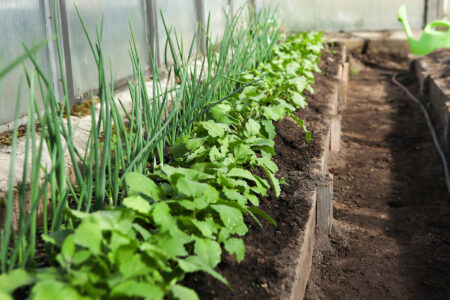
Learn about the crop-livestock integrated farming systems small farmers across the globe are developing in their agricultural operations.
Around the world, people are demonstrating how to manage animals in harmony with land and culture. Recognizing their innovations and adopting their practices are key steps toward lessening the problems of industrial animal agriculture. Whether you’re a small- or large-scale producer, you can be inspired by tested production practices that improve animal health while reducing waste, runoff, erosion, and emissions. These practices can also provide income and bolster your business efficiency.
These farmers don’t isolate animals from other farm enterprises, but rather integrate them into many land management activities. Even when corralled, animals aren’t detrimental to the land. This presents a starkly different mindset to Western animal agriculture, where animals are removed from the field, forest, and food source. Industrial practices concentrate animals into one place and truck in their food, which has to be highly formulated to suit the conditions created by their confinement. Under this scenario, any efficiency gained by concentrating production is counteracted by the human and fossil-fuel energy required to feed the animals and deal with the resulting waste, erosion, and runoff. But animals can augment and improve managed natural systems, and examples of this abound, if only we pay attention.
Dehesas in Spain
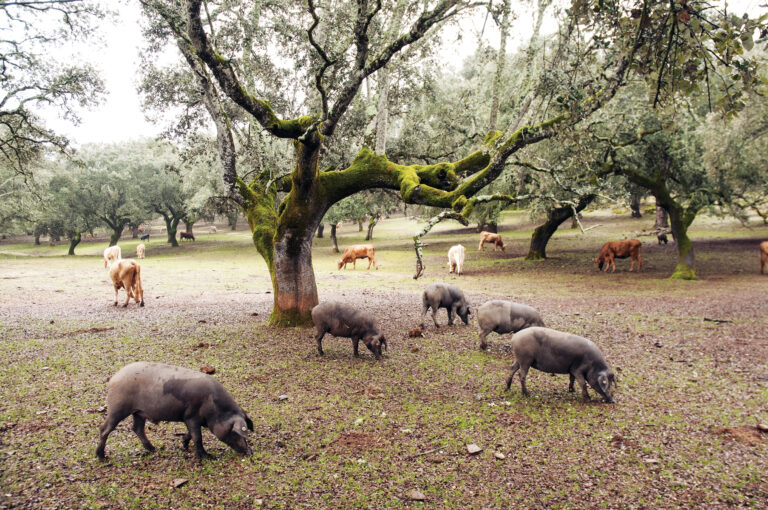
Silvopasture has been around since the Middle Ages in the example of the Spanish dehesa, a system of grazing animals in pastures with scattered oak trees. Dehesas mimic a Savanna landscape that provides multiple food and fiber needs. Farmers benefit not only from meat, milk, and other animal products, but also from selling cork from the oak trees; hunting rights; and mushrooms, herbs, and other plant-based products from the herbaceous understory. A modern example can be found in Sharing Our Roots, a poultry and perennial plant production system on a 100-acre farm in Minnesota. This organization is pasturing chickens with elderberry and hazelnut crops, sunflowers, corn, and other annuals. The system produces eggs, meat, medicine, and perennial nursery plants, while improving soil and providing a learning incubator for farmers of color.
Incorporating swales and fodder banks is another way to integrate animal production into the farm landscape. A swale is a basin or channel that increases water filtration on the land. The plant life around the swale and on its gently sloping sides is generally rich and diverse because of its water-holding capacity. Farmers can manage this plant community on a swale’s accompanying berm (the ridge directing water into the channel) to produce fruit trees, herbs, and medicine crops. Farmers often create fodder banks on berms to grow feed for their livestock. For example, alder trees can be grown on berms in a sheep pasture so their pruned leaves and branches can be thrown down to the livestock, or carried to sheltered sheep in harsh weather. Farmers raising animals in managed forests or silvopasture also produce “tree hay” — harvested and stored tree leaves that pack intense nutritional benefits. These same trees may also produce fruit or nuts, timber, shade for mushrooms and other understory crops, or sap products, such as maple syrup.
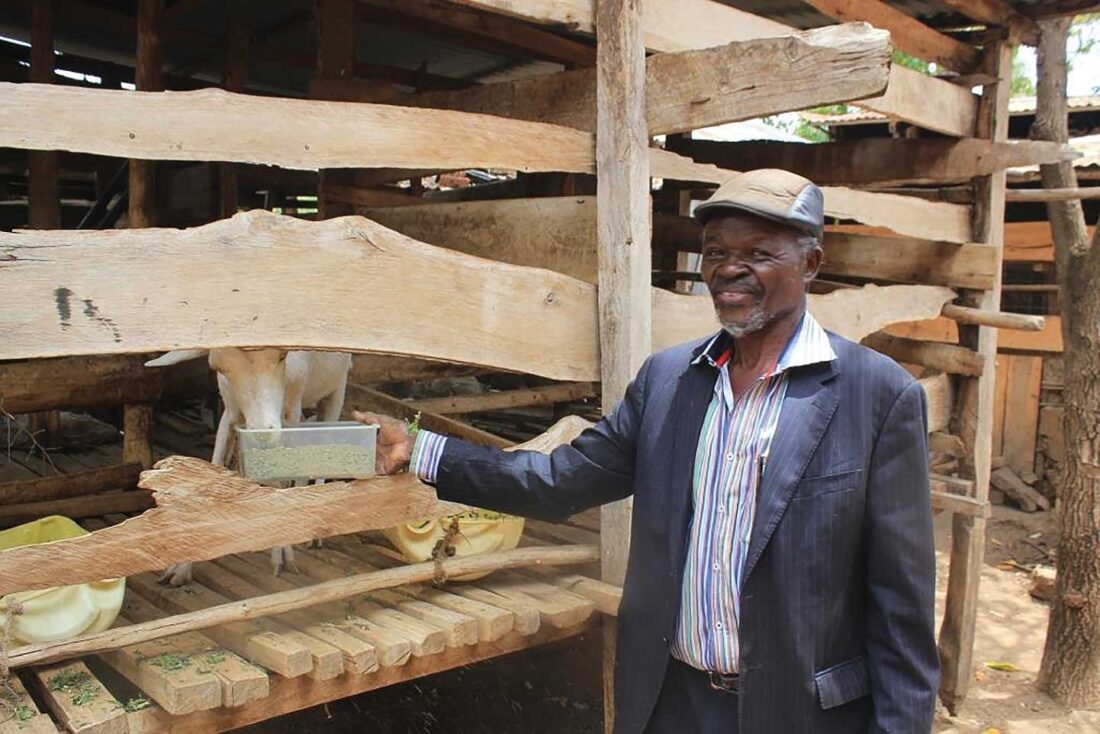
Goat Meal from Fodder in Kenya
Optimizing tree and leaf fodder is exemplified in the story of LOFODA-G-Meal (an acronym for “Locally Formulated Dairy Goat Meal”). Farmer and retired teacher Joe Ouko led the project to develop this meal through a social enterprise involving many community members in his area of southwestern Kenya. Ouko and his colleagues have improved on the “cut and carry” approach to feeding corralled dairy goats in a way that’s environmentally sustainable, culturally suitable, and optimal for animal nutrition and milk production.
“The innovation came about because of need: In my area, rainfall is very seldom,” Ouko says. When drought makes fodder from trees and plants scarce, the “old practice of cutting the branches down to almost nothing to get the natural fodder makes re-sprouting difficult.” Increased drought led to increased competition for fodder. Ouko says, “I noticed two things: To cut only the shoots of the trees during the rainy season made re-sprouting better, and also, the goats were going for the green, dry leaves.” He began to forage shoots and shade-dry them to produce fodder for storage.
As he found success stockpiling tree fodder from the rainy season to sustain dairy goats through the dry season, Ouko reached out to advance his project. With the help of Prolinnova (“PROmoting Local INNOVAtion”), an international network that supports farmer innovation, Ouko was able to collaborate with stakeholders to refine his idea, access support, and leverage funding. “Partners in Prolinnova-Kenya have invested a lot of time and energy in what we call farmer-led joint research,” says Chesha Wettasinha, a member of Prolinnova’s international support team.
One major advancement was procuring a chopper-grinder so Ouko could shred the dried fodder and increase its storage capacity. Ouko has continued to network via Prolinnova and its partners, and also with fellow farmers. Now, non-goat farmers are selling plants in their districts that can be used in the goat meal. LOFODA-G-Meal has evolved to become a formulated ration created from drying and grinding each natural fodder material separately, and then combining them to create the right energy, vitamin, protein, and mineral balance. “Milk from the goats has doubled because of this formula,” Ouko says.
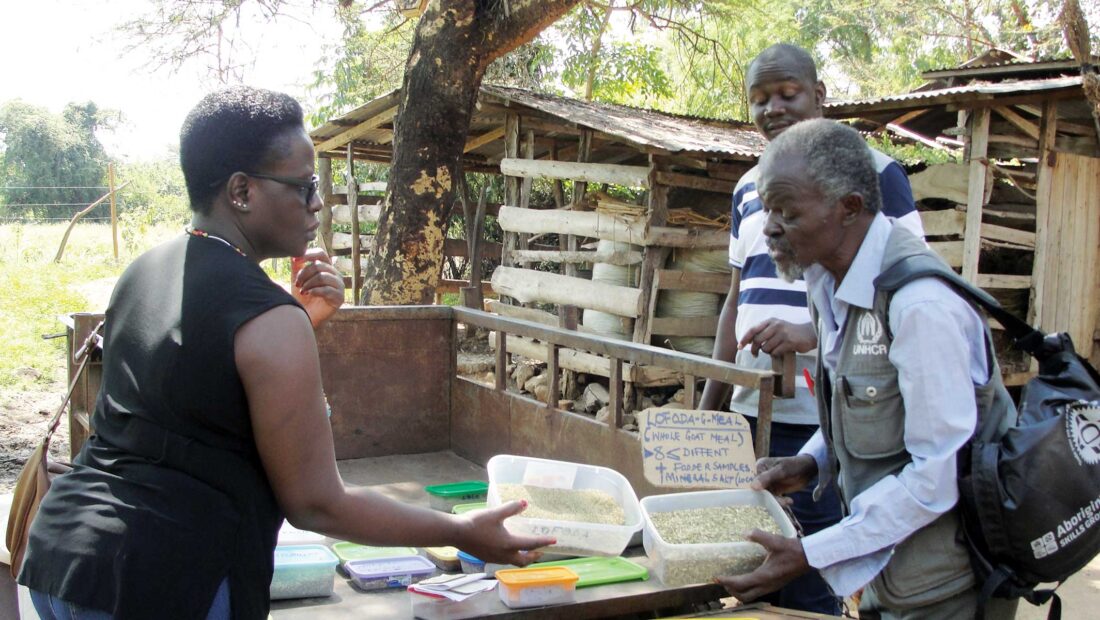
Ouko and the community continue to improve the product in ways that amplify mutual benefit. When fodder from neighboring areas still wasn’t enough to meet demand sustainably, he collaborated with the International Centre of Insect Physiology and Ecology, headquartered in Nairobi, and was connected with farmers who use high-energy crops to repel insects in their fields. These plants repel a particular worm that threatens their crops; when the plants reach maturity, the farmers can harvest and provide them to Ouko for inclusion in the goat meal. Additionally, women in Ouko’s area have been innovating with LOFODA-G-Meal to make products that enhance human nutrition.
“There’s no limit to sustainable production as long as financial resources are available to sustain the fodder production, alongside the available permanent water sources and labor aspects of the operations,” Ouko says. The project is an example of combining resources and needs to produce a holistic and environmentally conscious feed alternative. Wettasinha says, “LOFODA-G-Meal represents a social enterprise that involves many community members, especially women and youth.” The product sustains jobs, land, and families in this part of Kenya.
Living Deep Beds in Vietnam
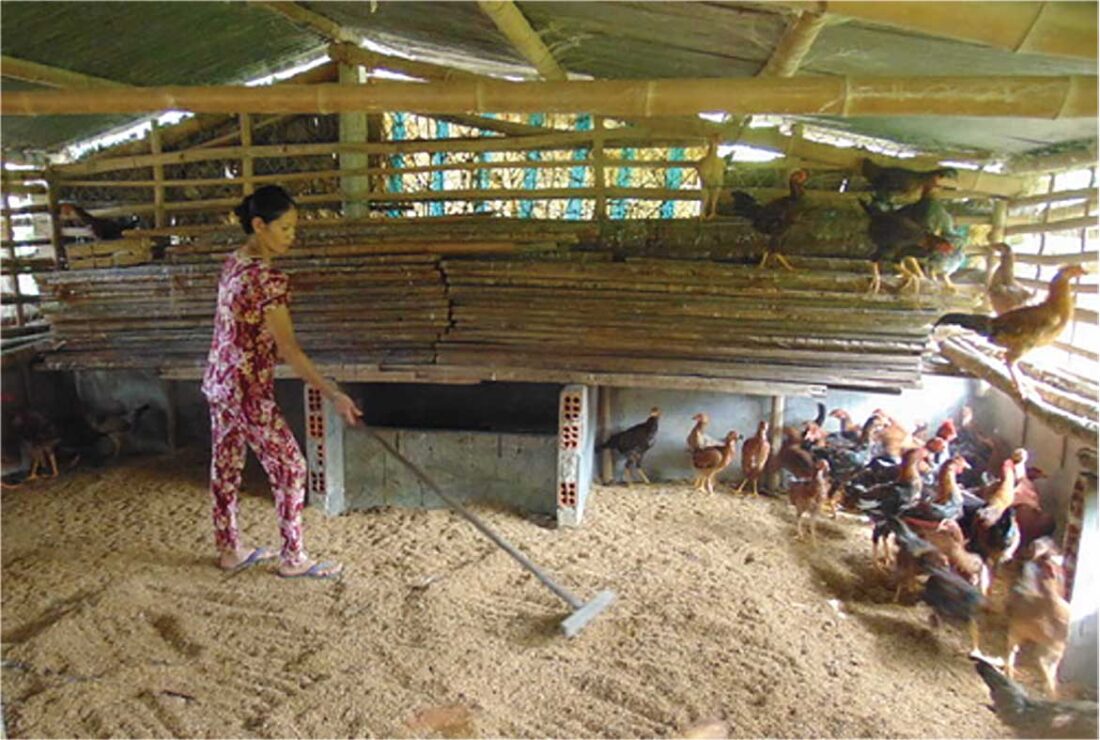
When animals must be confined, infrastructure can be designed to be healthier for animals and the environment than industrial agriculture’s concrete pens and waste lagoons. In rural northern Vietnam, farmers keep swine in a hog house because they don’t have the option of pasturing the animals extensively. However, instead of a concrete floor that can lead to muscle and bone complications in the animals, and that requires the collection of waste in lagoons that become management problems, farmers can use a living deep-bed system. The mulch floor inside the hog house is inoculated with beneficial microorganisms, and the manure is composted in place, thereby eliminating toxic odors and harmful runoff while also providing beneficial microbes for the animals’ digestive tracts.
Pham Nhu Trang grew up farming in rural Hanoi, and was deeply affected by animals lost to disease and environmental issues. She now studies and refines a living bed system for hog rearing that can be implemented by small farmers with limited financial resources. The basic setup is a deep layer of biomass that’s inoculated with beneficial microbes. As the animals produce dung, their bedding is turned consistently to create a perpetual compost of sorts, with a hot layer underneath and an ambient layer at the top. Trang has done extensive research on bedding materials, combining them in different quantities to test the results. “The original system calls for 70 centimeters of sawdust to create the living bed, but the cost of that in Hanoi is more expensive than a concrete floor,” she says. Trang has honed a specific bedding combination of rice hulls, biochar, dry soil, and dry leaves, and has been able to produce the beneficial microbes on molding rice, instead of having to purchase bedding inoculants.
Trang’s other innovations include designing living roofs and walls in hog houses using local flora and fauna to help with climate control. “These plants also have other functions, such as improving food sufficiency or repelling mosquitoes,” Trang says. She’s also experimenting with composting a portion of the living bedding for use on crops. Her hog houses don’t suffer from emissions, effluent, or odors; the surrounding environment is ecologically diverse and thriving; and the outputs are beneficial to other agriculture systems and to human nutrition. Trang emphasizes that the use of the living bed technique “requires a holistic solution, from design to the feed.” Her ingenious ideas show that placing animals in dynamic feedback with an environment’s plants, microbes, and humans can offer hope in the quest to sustainably feed people.
As farmers and homesteaders continue to champion ethical livestock production in the United States, we should look to Indigenous people and smallholders from around the world for clues on adjusting our mindsets and skillsets toward integrated animal agriculture. For more information, or to support Joe Ouko or Pham Nhu Trang, see Prolinnova and A Growing Culture; the latter nonprofit works globally to advance a culture of farmer autonomy and agricultural innovation.
Meredith Leigh is a farmer, butcher, cook, and author of The Ethical Meat Handbook. Her most recent book is Pure Charcuterie: The Craft & Poetry of Curing Meats at Home.