

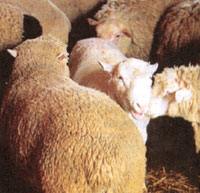
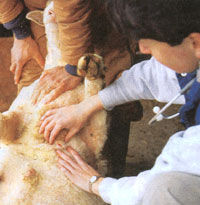
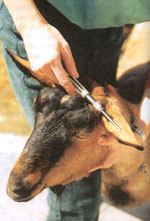
Andrea Looney, DVM, offers her farm animal health experience in caring for cows, calves, horses and sheep. (See the livestock photos in the image gallery.)
Farm Animal Health Topic
Many of our sheep develop abscesses after shearing. What’s the cause of this and how do we deal with the abscesses?
–Lisa Capriano
Burns, OR
Dear Lisa:
Virtually every sheep and goat producer faces the age-old problem of recurring abscesses in the flock. Most of these abscesses can be attributed to the bacteria Corynebacterium ovis and the disease called caseous lymphadenitis, or CLA. While many shepherds view the disease as a harmless problem, CLA can cost sheep and goat producers a lot of money in terms of decreased reproduction and production efficiency, as well as the cost of labor and drugs to treat affected animals.
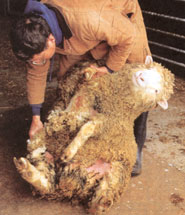
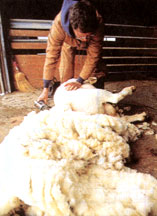
The disease seems to be more common in western and south-central United States, where sheep are more likely to graze year-round in an environment conducive to skin abrasions. Sheep can actually contract the bacteria through ingestion, inhalation, or penetration through intact skin. However, most do become infected via contact between infectious exudate and skin wounds. Contact with infected feeders, bedding, or equipment can spread the disease. Your sheep probably become infected at shearing time, when minor skin nicks and abrasions routinely occur. Once the clippers become infected, disinfection is difficult, and since the abscesses are not always so visible, spread from one clipped ewe to the next unclipped one is very likely.
So how do we treat these abscesses? For the simple once-a-year abscess, the treatment is easy. Isolate the animal first, as an abscess that is broken contaminates the environment with thousands of potential abscess-forming organisms. Trim the hair around the abscess and hot pack for three to four days. If the lump fails to come to a head and break, lance it (make an incision at the bottom) with a clean blade and continue to hot pack. Consult your veterinarian for appropriate antibiotics.
If the abscesses are a herd problem, draining many abscesses and administering systemic antibiotics may simply result in temporary improvement. The bacteria produces thick-walled abscesses and the capsule serves to keep the bacteria in and the antibiotics out, even if the abscesses are drained and flushed. Infections are likely to recur once treatment is discontinued. Long-term antibiotics may be economically impractical. Segregation of ewes with abscesses is of paramount importance until the abscess is opened and no longer draining.
In herd problems, it is extremely important to sanitize shears, combs, cards, and dipping vats, along with knives and emasculators. You can use quaternary ammonium compounds, chlorhexidine, hypochlorite solutions, iodines, and phenolic solutions on equipment once you remove organic material with hot water and a detergent. You should remove dirt from floors, walls, and walkways, and clean them with steam and detergent as well.
We have a small herd of Cashmere goats and one or two minor or rare breed goats. Is it best to get these animals synchronized for their heat cycles? Can wedo this ourselves?
–Jorge Gallegos
Shelby, MT
Dear Jorge:
Synchronization refers to having all the goats come into heat and be receptive to breeding at or about the same time. This is usually done via progesterone drug implants used in the breeding season. Synchronization makes it very easy for the farmer to breed a large number of goats, and improves the overall herd fertility rate, albeit via artificial methods. Only a few drugs are available and cleared for use in goats in the United States. Usually the drugs are implanted via a special injection needle either in the ear flap or in the skin under the tail. Given the availability of the drugs, the multitude of schedules used for implantation, and the equipment necessary, I would suggest having the herd synchronized by a veterinarian.
Using the regimen dictated by the implant, most does will usually come into estrus (heat) within 24 to 72 hours of implant removal if you implement synchronization in the breeding season. However, you may improve conception rates by detection of estrus. You can do this by using a teaser buck, a male goat that has been surgically altered to arouse and detect does in heat but is not able to impregnate them. Does in heat and ready to breed will stand firmly for a buck to mount. You can also detect estrus by watching for the following signs: restlessness, increased reddening of the vulva, vigorous tail wagging, frequent urination, and standing still to pressure over the tail head.
Decreasing light and temperature will usually bring does into heat. Other ways to synchronize without the use of progestogen compounds include introducing a buck or its smell to the herd at the beginning of the season. This usually brings the whole group into heat in an average of 7 to 10 days.
We have a pet rabbit that is now housed outside. Thumper gets fresh rabbit pellets daily and clean water as well as some alfalfa hay. Are there any vitamins we should give him as well?
–David Johnson
Quincy, MN
Dear David:
Fresh, high-quality rabbit pellets should be offered free choice to rabbits daily. Fresh is a key word here as many bags of rabbit pellets, especially those purchased in large quantities, lose their flavor and freshness over time. In addition, some vitamins are heat- and/or light-sensitive and will deteriorate in an open bag. Buying small quantities of food and storing it in the freezer will prolong the shelf life and prevent loss of nutrients.
You may also want to give him some fruits and vegetables, including lettuce, spinach, alfalfa sprouts, carrot tops, carrots, beet greens, and apples. These should not constitute more than 20 percent of the total diet and you should clean and dry them prior to feeding. Small amounts of grass or alfalfa hay or cubes will provide additional roughage or fiber, as well as prevent your rabbits from becoming bored. Adequate dietary fiber is necessary for normal gastrointestinal functioning, and most commercial pelleted diets do not provide enough fiber for the needs of middle-aged nonbreeding rabbits.
Grass hay is better than alfalfa hay as the latter may contribute too much protein or calcium to rabbits. You may also feed them little bits of rolled oats, crackers, or bread. Some rabbits enjoy tree branches or a boiled round steak bone to chew on.
Rabbits produce “night feces,” small, soft, green, mucus-covered feces. These need to be ingested directly from the anus during the night and early morning hours as rabbits derive important proteins, vitamins, and minerals from them. Thus, make sure your rabbit is not housed on chicken wire which may allow the feces to escape consumption as they are an extremely important part of the rabbit’s diet.
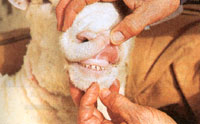
Feeding fresh pineapple juice or pineapple once or twice a week to a rabbit is a great idea as the enzyme, Papain, contained therein may help him digest hairballs. Some owners also supplement with small quantities of live-culture plain yogurt, which helps to maintain the normal bacterial flora in the digestive tract. Don’t forget to check your rabbit’s teeth on a regular basis to make sure they are not overgrown and causing difficult chewing.
Please help settle a dispute between my husband and me. He feels we’re depriving our animals of their God-given rights by taking away their reproductive capacity. I feel we would be irresponsible pet owners not to spay and neuter our dogs and cats. Where do you stand?
–Emma Greene
Moab, UT
Dear Emma:
Despite what many folks think, motherhood does not “round out” a pet’s personality. As a mother, your pet must divide attention between you and her new family. Often, a pet’s personality may change drastically during the course of “heat” or pregnancy. Parenthood for your pet really means parenthood for you as well. You must share the burden of caring for the newcomers, particularly if they become ill or have other problems that mom can’t cope with. More importantly, you must find a good home for each new kitten or pup. The number of dogs and cats born each year in the United States alone is staggering, and most animal shelters are overflowing with already unwanted dogs and cats.
Aside from the possibilities of unwanted pregnancy or litters, there are several aspects of dogs’ and cats’ natural reproductive processes and mating instincts that might interfere with the joys of owning a pet. For example, many of you may have already endured the nervous pacing and plaintive meowing of a female cat “in heat.” Or is your tomcat one of the many that has developed the annoying habit of spraying foul-smelling urine on furniture and draperies to “stake out his territory” during the breeding season? Your male pet’s desire for romance may call him away from his locality, possibly resulting in an accident or injury to him, other animals, or people in the process. Female animals in season are often injured in the breeding process or in attempts to ward off male animals. Owners who attempt to control their pets’ reproductive efforts often find their frustrated pets exhibiting signs of aggression towards them.
Fortunately many of these problems, along with the possibilities of unwanted puppies and kittens, can be eliminated by surgically removing certain reproductive organs through spaying and neutering. If your dog or cat is a female, the ovaries, fallopian tubes, and uterus are removed in a surgery known as an ovariohysterectomy, commonly called a “spay.” If your dog or cat is a male, the testicles are removed in a surgery properly termed orchiectomy, or simply “neutering.” The medical advantages of these procedures are many. The female has less chance of developing uterine infections or mammary cancer later in life, especially if spaying is done under two years of age. The male has less chance of developing prostate infections or inflammation.
Contrary to popular opinion, surgically altered animals do not tend to become less interested, less active pets. Removing the ovaries or testicles does affect metabolism; this may result in excess weight gain if the diet is not regulated properly after the surgery. The operations are not usually expensive, and several veterinarians are part of a network of practices that perform lower-cost surgeries in conjunction with animal shelter adoption programs. The cost of the procedure depends on the animal’s age, size, and general health; hence, the earlier it is performed, the better. Since the charge only occurs once in a pet’s lifetime, one can actually save money by having a pet sterilized when the cost of mammary tumor removal and unwanted litters is figured into the budget.
Consider having your pet spayed or neutered. As individuals concerned with the increasing numbers of abandoned puppies and kittens, we should do everything possible to reduce the population of unwanted pets and decrease the occurrence of the number one cause of death in companion animals–euthanasia. As a responsible pet owner, you can share these concerns by spaying and neutering, and ensure your pet’s long term health at the same time. Happy spring!
Dr. Looney would be glad to answer your questions regarding farm animal health. Send them to: “Country Vet,” c/o MOTHER EARTH NEWS, Arden NC. Send us a photo too!






