


Recently when I was at my dentist and while vulnerably perched in the operational chair, the hygienist pitched me the opportunity to purchase an electric toothbrush. Not just any high-performance aid to prophylaxis, mind you, but one that was also Bluetooth-connected to your smart phone to record your personal bests in competitive brushing.
A few notions crossed my mind, to wit: Why would anyone want such a thing? and How long will that baby last? and Can it be fixed? (Probably not.)
Questioning Hyper-Connected Smart Appliances
It truly is a wonder how we got here. Why would anyone think that putting sophisticated electronics and an Internet-connected computer into a damp and vibrating environment like a washing machine is a good idea? Or how about the non-repairable $1,000 cell phone in which the manufacturer intentionally downgrades its previous product’s capability to force owners to buy newer models?
And do we really need a refrigerator with a “smart device” implanted that will provide the user with remote alerts if the fridge door is open or the temperature drops or lets the user engage the “SuperCool” function from the grocery store to rapidly chill the freezer in preparation for storing frozen foods? Or how about contact services if any diagnostic codes pop up due to product failure or user error? How did we ever get by?
It wasn’t that long ago, at least geologically speaking, when American household appliances were considered the gold standard of both practical durability and reliability. Unlike the Rube Goldberg approach of many of today’s implements — where machines seem to be intentionally designed to perform a task in an indirect, complex and over-complicated fashion — older designs tended to be clean and simple in their approach.
The goal was to simply do one job really well.
There were good solid reasons for this. One was likely that the head of household duties, after years of drudgery and toil in the kitchen, was not about to put up with short-lived and slipshod construction. The other might be that the implement was an industrial rental.
Electronics Durability Exemplified
An example of the later is the venerable black ITT rotary dial wall phone that has hung on the kitchen wall here since at least 1974. It is still hard-wired to the independent Unity Telephone Company that still maintains the wires and switching equipment that understands the pulse of the dial.
These phones grace walls all over the rural five town empire that is now Unitel. And although the company gave up on charging rental on these phones decades ago, they still run like new. The reliability was a business decision: Service calls cost money. You can drive nails with the hand set and any bad component is easily replaced in a minute with a screw driver.
These humble pieces of telephony and the system are incredibly reliable and resilient. Indeed during the great ice storm of 1998, when most of Maine was without power for weeks, the land lines backed up by battery power kept humming along — even when the lines were laying on the ground encased in ice.
These units just do one thing: make and receive telephone calls. It won’t take photos or text, but if you want to contact someone without wondering how many bars you have or having to ask “can you hear me now?” there is much to say for this bulletproof technology.
Simplicity and Reliability Should be the Hallmarks of Good Design
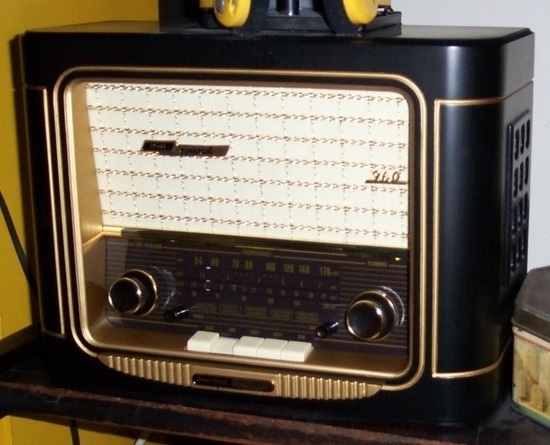
While we are on the matter of telecommunications, let us consider the original wireless accessory, the radio. There is something magical about a device that can capture voice and music signal out of the ether, broadcast either from across town or from halfway around the planet. And for free. An instrument so simple a Cub Scout can assemble a usable set out of spare parts in minutes, alligator clip a wire to say, the finger stop of the aforementioned telephone, put on a pair of earphones and voila! They are instantaneously receiving a broadcast.
A radio set built a century ago will still work today picking up the frequencies it was designed to receive. Unlike today’s baroque communication apparatus, radio is incredibly secure — no one can track your profile, steal your credit card number or know where you are. So secure and stealthy, in fact, spies still utilize the primitive “counting” codes that are sometimes heard on short wave. No avaricious tech giant can figure out a way to charge you to use your radio or disable it by changing a bit of code.

Right to Repair in the Kitchen
But, back to the humble kitchen appliance. Let us consider the robust and elegantly simple, circa-1940 “Juice King” industrial, heavy-duty manual citrus juicer.
Its Art Deco cast body is good looking and tougher than a boiled owl. To operate, place glass under spout. Lift lever to open top, insert orange, and push down on lever and presto: orange juice. Want more? Insert another orange and repeat process. When done, simply wash out the strainer, end of story. And it’s cordless.
But perhaps the best example of the fusion of handsome simplicity, reliability and repairability is the 1940 Toastmaster bread toaster.
My parents received this unit for a wedding present in 1940 and it has been generated perfectly toasted bread slices every day since then. The outer polished nickel shell sports an optimistic ambiance reminiscent of the Maine Central Flying Yankee streamliner locomotive. (Or maybe a vintage Airstream trailer.)
To operate the machine, simply insert bread slices (no bagels or croissants need apply). Push down the lever to charge the clockwork timer mechanism. To select either dark or light, turn the little indicator to (yes) dark or light. This changes the clockwork speed. When the timer reaches the end of its run it trips the ejection trigger and up pops the toast. To clean out crumbs, back out two little thumb screws and bottom plate comes off for speedy detritus removal.
If repair is needed (which is almost never), the outer shell is easily removed from the chassis for access to all the simple mechanisms. My father, who always believed that any good product would be rapidly replaced with one of lesser quality, purchased a junker model so he would have access to repair parts. It still resides in the loft above my shop, untouched.
So what does this odd assortment of products have in common? They are reliable, contain no exotic components, they do exactly what they were intended to do and no more. They use little or no electric power. And because they last so long, the embodied energy cost (i.e. the sum of all the energy, not to mention CO2 emissions, required to produce any goods or services) that was used to make them is considerably less than if the same product was purchased again and again. And, best of all, they are all easily repairable.

Importance of the Right to Repair Movement
And repairability is a big deal. We have all owned shoddy appliances that have given up the ghost right after the too short warranty runs out. Or one that probably could be brought back to life if the manufacturer hadn’t welded the machine together, or had refused to provide access to parts and/or repair instructions. The user has little choice to put the gadget into a recycling bin and buy another.
There may be some possibility of hope on the horizon, as in the European Union and at least 18 U.S. states have introduced “right to repair” legislation. European environmental ministers are hoping to force manufacturers to make appliances with greater longevity and that are easier to repair.
California has proposed their version of a “Right to Repair Act”, which would require electronics manufacturers to make repair information and parts available to product owners and to third-party repair shops and services. Needless to say, manufacturers are chary of these attempts citing safety, security concerns and even possibly discouraging innovation. There will likely be strong push back by lobbyists in legislatures worldwide to any laws that might impinge on corporate profit.
In the meantime, it will be up to the consumer to pose these questions to the manufacturer (and to themselves): 1. Is this device really necessary and worth the money? and 2. Is it at least as good as a 1940 toaster?
Photos by Greg Rossel
Greg Rossel builds, repairs, writes about, and teaches about boats in Maine. He also has produced a world music radio program on WERU-FM for 30 years.Connect with Greg Rossel Boat Company on Facebook, and read all of Greg’s MOTHER EARTH NEWS posts here.
All MOTHER EARTH NEWS community bloggers have agreed to follow our Blogging Guidelines, and they are responsible for the accuracy of their posts. To learn more about the author of this post, click on their byline link at the top of the page.






